• The first days of October, in most coffee-growing regions, did not show significant rainfall volumes.
• The Cerrado, South of Minas, and Rondônia producing regions are experiencing the most extended periods without significant rain.
• Significant moisture corridors are expected to form starting from 10/10.
Most of Brazil has been affected by drought in recent months. Below are the accumulated rainfall volumes observed over ten-day periods during 2024, up to October 4th, and an analysis of August, September, and early October in the main Arabica coffee-producing regions:
Bahia:
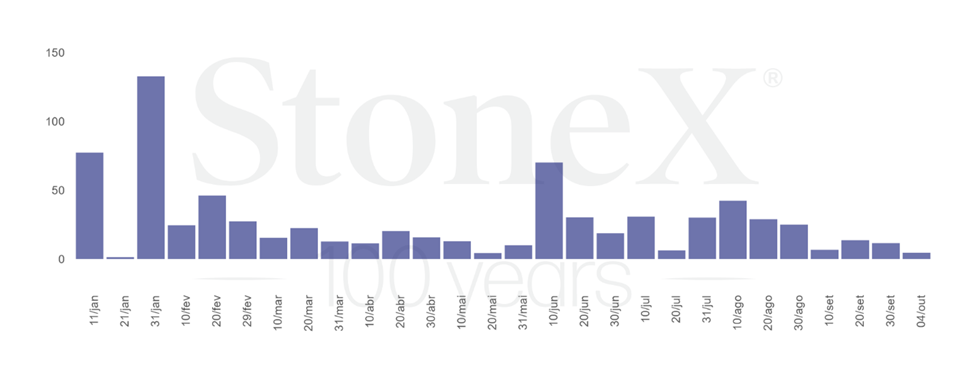
Rainfall was well distributed, with volumes exceeding 15 mm throughout August. In September, the volume was slightly lower, but moisture distribution remained steady, and the first week of October began with low moisture (5 mm/ten-day period).
Source: StoneX
Espírito Santo:
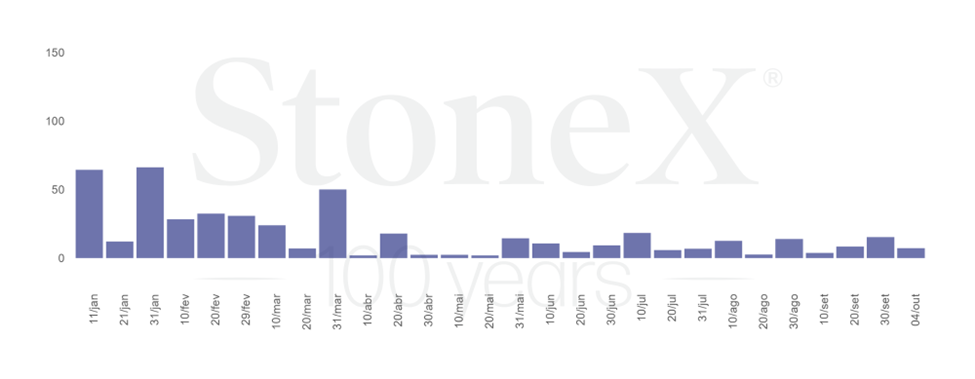
Rainfall was well distributed and exceeded 15 mm in all ten-day periods. The municipality of Brejetuba showed lower volumes compared to Irupi and Iúna.
Source: StoneX
Cerrado:
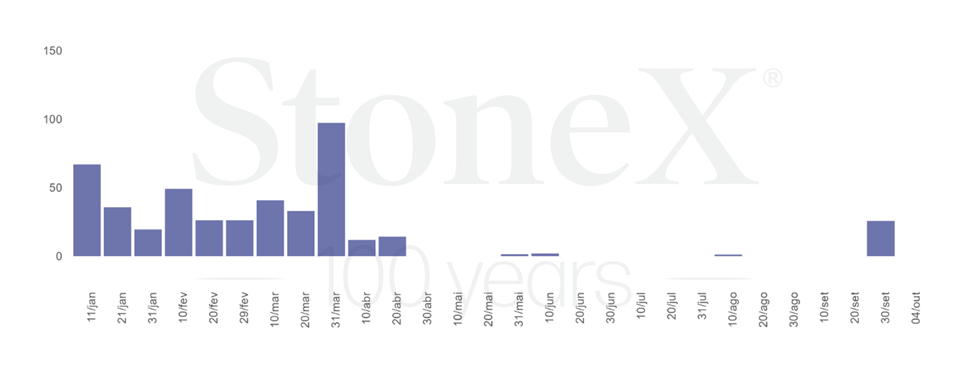
Rainfall volumes have been extremely low, with 18 consecutive ten-day periods registering less than 1 mm of accumulated rain per ten-day period in all municipalities in the region. In September, significant rainfall (volumes above 25 mm) occurred in the municipalities of Serra do Salitre, Rio Paranaíba, Patrocínio, and Carmo do Paranaíba. In other municipalities, such as Araguari, Campos Altos, and Monte Carmelo, volumes remain low, and the drought situation is concerning.
Source: StoneX
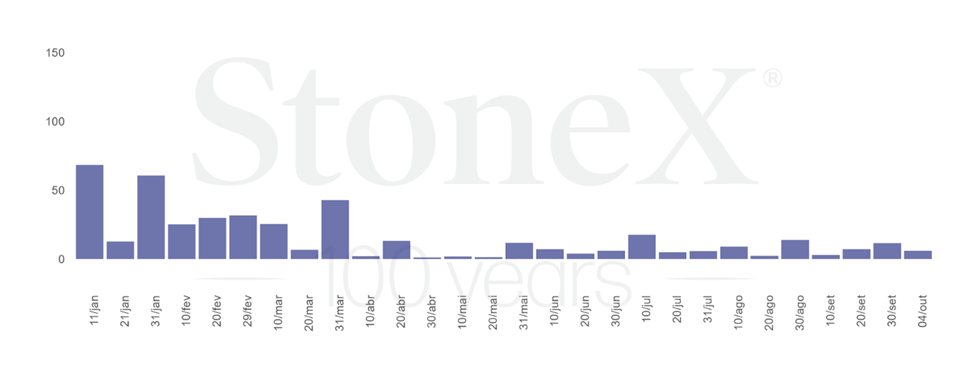
Matas de Minas:
The region recorded below-normal volumes during the winter of 2024; however, rains with volumes between 5 and 10 mm provided some moisture compared to other coffee-growing regions of Minas Gerais. The ten-day periods with significant volumes (above 15 mm) were:
• August 10th, in the municipalities of Divino, Espera Feliz, and Manhuaçu
• August 30th in all municipalities monitored by StoneX (Caratinga, Espera Feliz, Santa Margarida, Divino, Manhuaçu, Simonésia)
• September 30th, in the municipalities of Divino, Espera Feliz, and Manhuaçu
In early October, in the last ten-day period analyzed, the recorded volumes did not exceed 10 mm in all municipalities that make up this region.
Source: StoneX
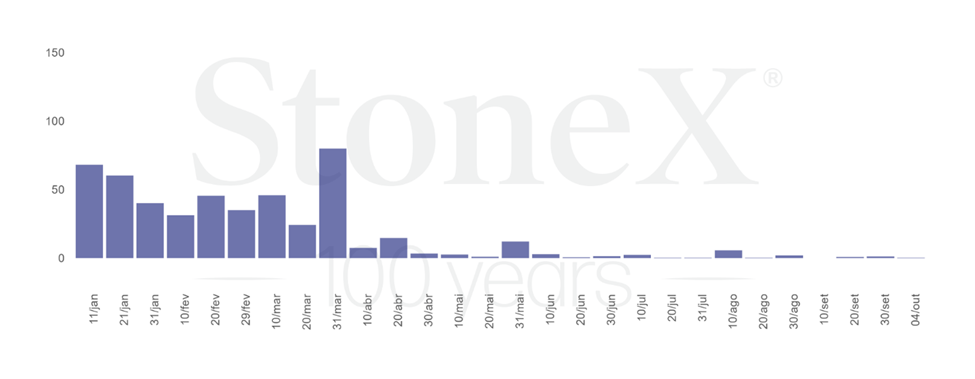
South of Minas:
In the 10-day period of August 10th, only the municipality of Boa Esperança recorded volumes above 15 mm. In other municipalities (Alfenas, Campos Gerais, Machado, Piumhi, Três Pontas, Ibiraci, Nova Resende, São Sebastião do Paraíso, and Varginha), the volumes were insignificant, and the drought persists
Source: StoneX
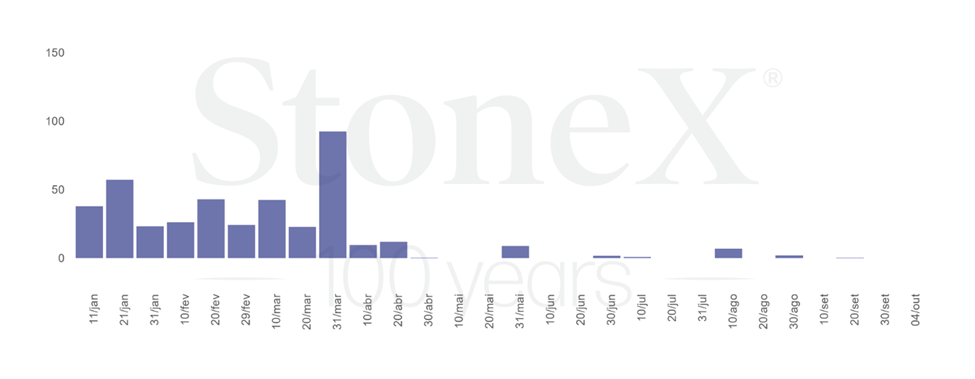
Mogiana:
On August 10th, there was rainfall above 15 mm in Espírito Santo do Pinhal. In other municipalities, such as Altinópolis and Caconde, the volumes were smaller, while in Franca and Pedregulho, the drought continues without significant rain.
Source: StoneX
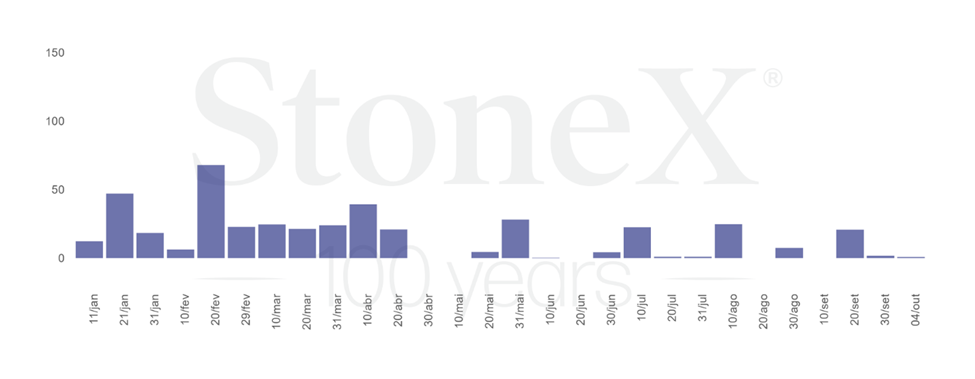
ROSP:
In the municipalities of Tejupá, rainfall was well distributed in August, during the ten-day periods of August 10th and 30th. In Gália, significant rain occurred only in the ten-day period of August 10th. The municipality of Garça did not record volumes above 10 mm in the last three ten-day periods.
Source: StoneX
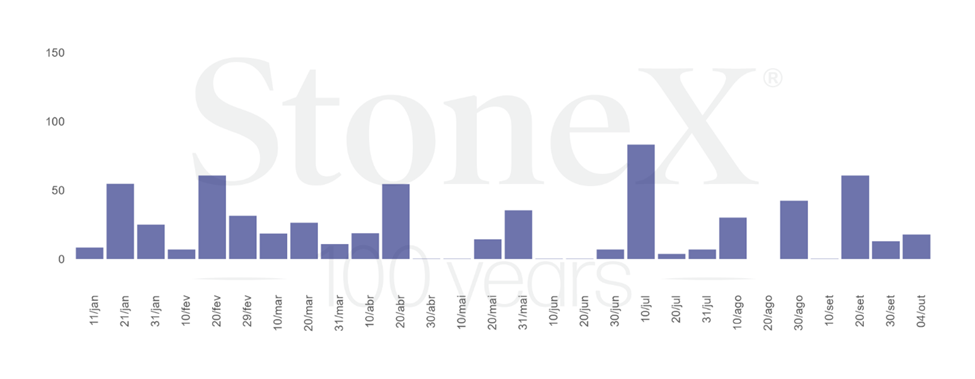
Paraná:
The municipalities of Carlópolis, Ibaiti, and Pinhalão recorded significant rainfall volumes over the last months of September.
Source: StoneX
For Robusta-producing regions:
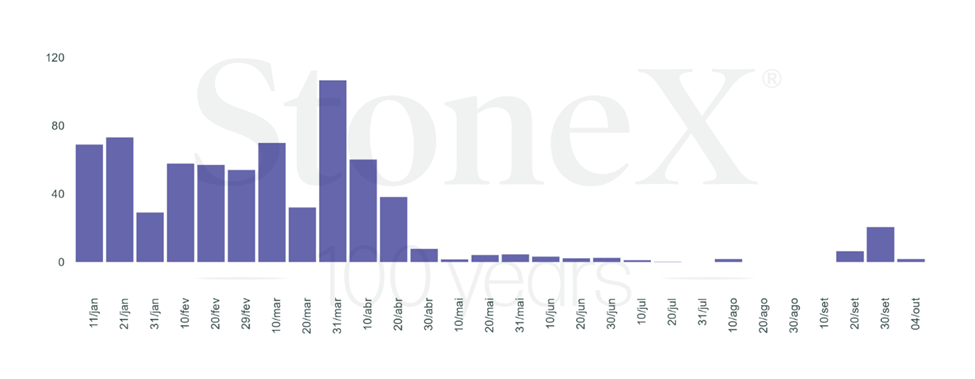
Rondônia
After the ten-day period of May 10th, there were 13 consecutive ten-day periods without significant rainfall in all monitored municipalities. Only in the last ten-day period of September there was significant rainfall, and the first week of October continued with a water deficit.
Source: StoneX
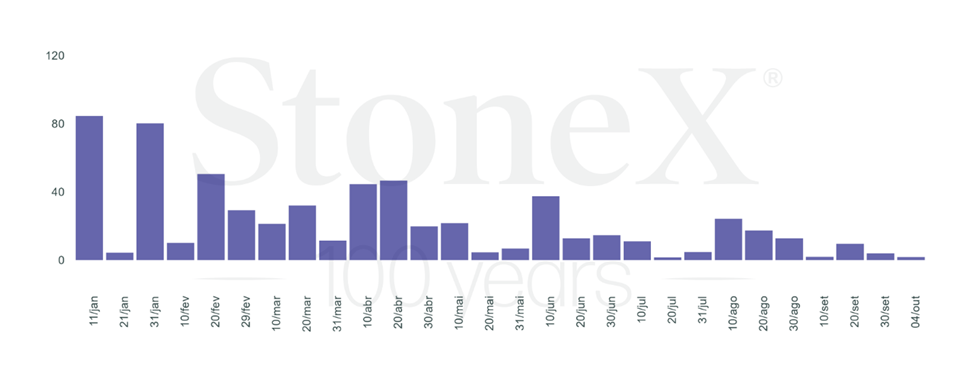
Southern Bahia
In August, the region recorded significant volumes in all ten-day periods. In September, only in the ten-day period of the 20th did the municipality of Teixeira de Freitas record volumes above 12.5 mm, while in other municipalities, such as Eunápolis and Itamaraju, the volumes were low. October started with volumes below 5 mm per ten-day period.
Source: StoneX
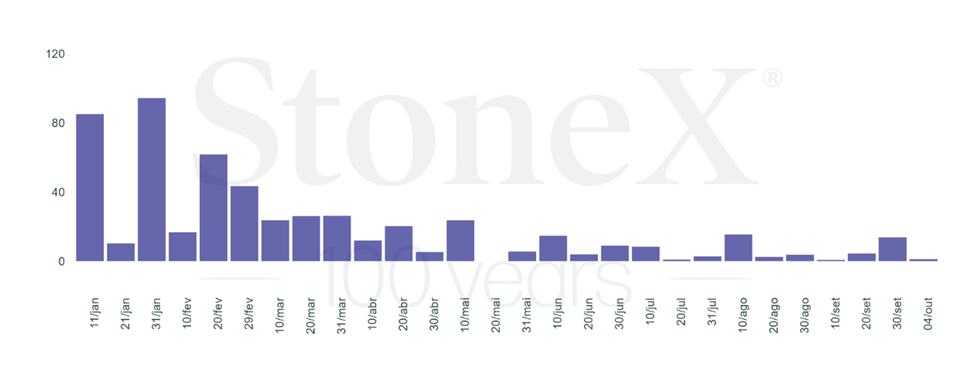
Northern Espírito Santo
In August and September ten-day periods, all monitored municipalities showed significant rainfall volumes. In the region as a whole, rainfall volumes ranged between 2 and 5 mm per ten-day period, ensuring adequate moisture for crop development.
Source: StoneX
The first days of October began without consolidated rains in most coffee-growing regions, according to INMET.
Accumulated rainfall in the last five days: Map of 10/08
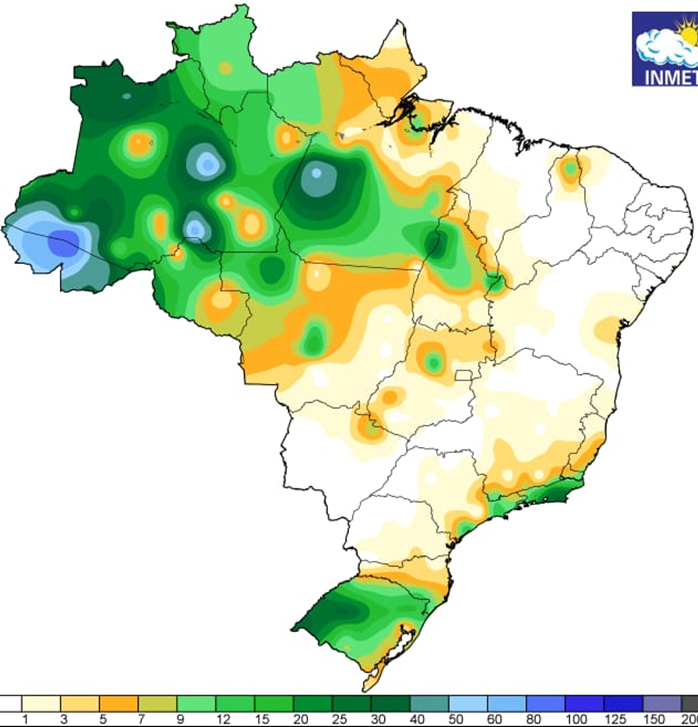
Source: Inmet
There are discrepancies between the American (GFS/CFS), European (ECMWF), and Brazilian (Cosmo) models regarding the volumes and distribution of rainfall in Brazil. The last two models indicate that one of the first moisture corridors, which normally form in the spring, originating from the Equator and meeting cold fronts from the south of the continent, will form with greater intensity and coverage from 10/10.
Accumulated rainfall forecast (mm) for October: A) 10/09 - 10/13, B) 10/14 – 10/18, C) 10/19 – 10/23. *Data from the GFSv2 model (right) and ECMWF (left), run on 10/09/2024
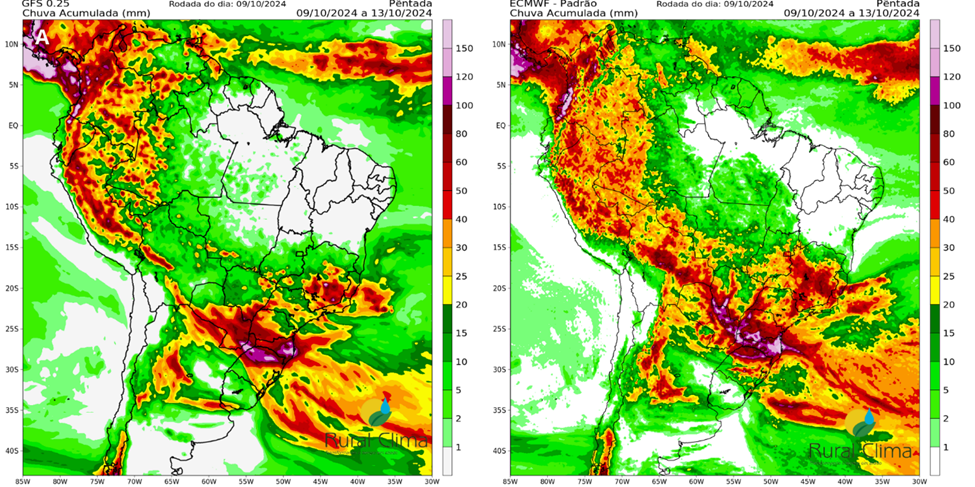
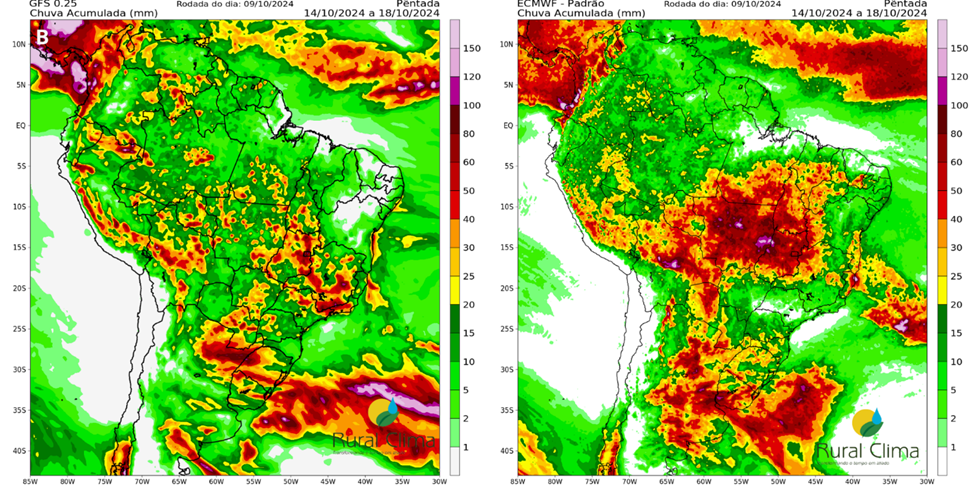
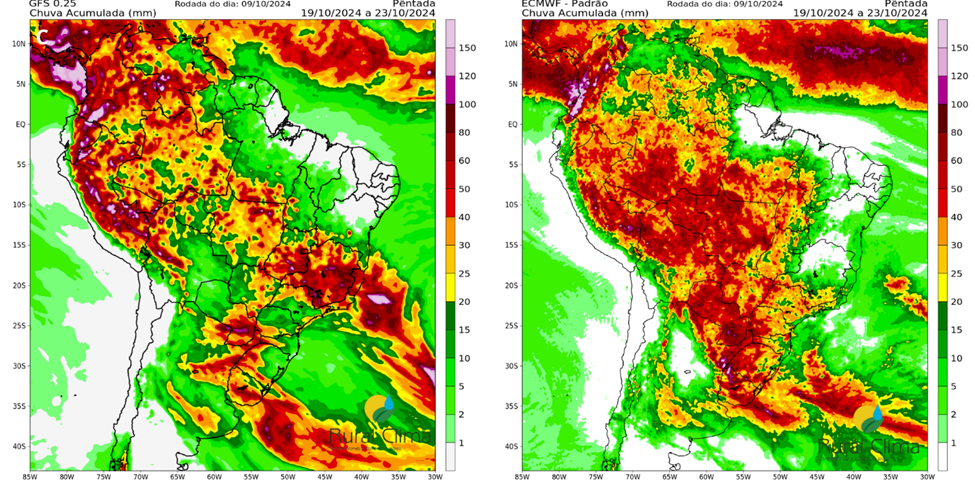
Source: Rural Clima
The accumulated volumes expected in the next 7 days (October 08–13) may vary between municipalities, depending on the region.
Arabica-producing regions:
• Espírito Santo: Between 28 mm and 22 mm are expected in the municipalities monitored by StoneX.
• Cerrado: Volumes may range from 38 mm in Paranaíba to 68 mm in Monte Carmelo.
• Matas de Minas: The lowest volumes may be recorded in Divino (22 mm) and the highest in Santa Margarida (60 mm).
• South of Minas: The municipality of Boa Esperança may record 52 mm, and Ibiraci could have volumes up to 104 mm.
• Mogiana: Altinópolis may accumulate 62 mm, and Pedregulho up to 103 mm.
• ROSP: Gália may record 31 mm, while Tejupá may have up to 56 mm.
• Paraná: Ibaiti may record 39 mm, and Pinhalão up to 47 mm.
Robusta-producing regions:
• Rondônia: Cacoal may show 8 mm, and Alta Floresta D’Oeste 39 mm.
• Southern Bahia: Eunápolis may have 17 mm, and Itamaraju 23 mm.
• Northern Espírito Santo: Pancas and Vila Valério may record 17 mm.
According to the soil moisture forecast provided by the GFSv2 (American) model, adequate levels for most producing areas in Brazil should reach above 30% starting from 10/21. Low moisture, below 30%, may affect the efficiency of agronomic practices such as planting, fertilization, and pesticide application. Soil is one of agribusiness’s main resources, and its protection from erosion and degradation is essential, especially after an intense drought. Therefore, it is recommended to monitor this variable locally to plan planting after this date and to maintain ground cover or adopt no-till farming to protect the soil from the impact of the first rains.
Accumulated rainfall forecast (mm) for the month of October: A) 10/09 - 10/13, B) 10/14 – 10/18, C) 10/19 – 10/23. *Data from the GFSv2 model (right) and ECMWF (left), run on 10/09/2024.
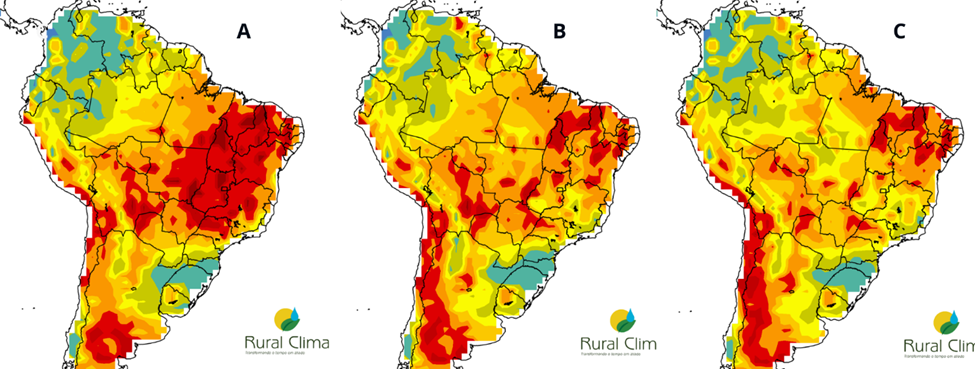
Source:Rural Clima
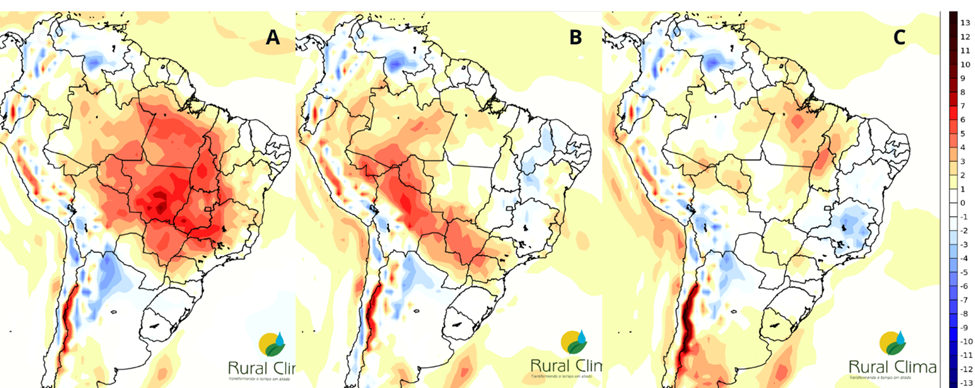
Temperatures will be above normal only during the week of 10/07 to 10/13. After that, the next two weeks will return to normal, and the month will end with temperature anomalies in southwestern Brazil.
Temperature anomaly forecast for the months of September and October, according to the week: A) 10/08 - 10/14, B) 09/22 – 09/28, C) 09/29 – 10/05. *Data from the CFSv2 model, run on 10/08/2024