Comments on the use of the Chinese yuan as an international payment currency
Since 2009, Chinese authorities have been pursuing a long-term strategy to internationalize their currency, the yuan (also called renminbi - RMB). They understand that reducing dependence on the dollar for foreign transactions is vital to establishing themselves as a global geopolitical and economic leader, as well as allowing greater autonomy and reducing possible volatility by not depending on foreign currencies. This strategy was reinforced by the context of increasing antagonism between Washington and Beijing on various topics, from relations with Taiwan to human rights to the use of microchip technologies. Additionally, in recent times, the United States, together with key allies of the Group of Seven (G7), imposed economic sanctions that removed access to financial institutions from Iran (2012), North Korea (2017), and Russia and Belarus (2022) to the international payment system SWIFT, as well as freezing international reserves of individuals and organizations from these nations. As a result, Chinese authorities have developed their international payment system, the Cross-Border Interbank Payment System (CIPS), which allows the settlement of economic transactions between countries through the yuan, as well as entering into agreements in their currency to mitigate the potential impacts of economic sanctions in the case of diplomatic friction with any G7 member.
China has been actively seeking these cooperation agreements with other countries, such as Russia, France, Saudi Arabia, Argentina, Chile, and Brazil. There are already more than 25 countries that are part of this arrangement for yuan payment settlement through CIPS. This does not mean, of course, that any agent doing business with Chinese companies is required to accept their currency as payment, nor any other currency. However, the agreement makes this possibility easier and less costly. In Brazil, in April of this year, it was reported that Vale and Suzano Papel e Celulose have already made exports to China with payment in Chinese currency.
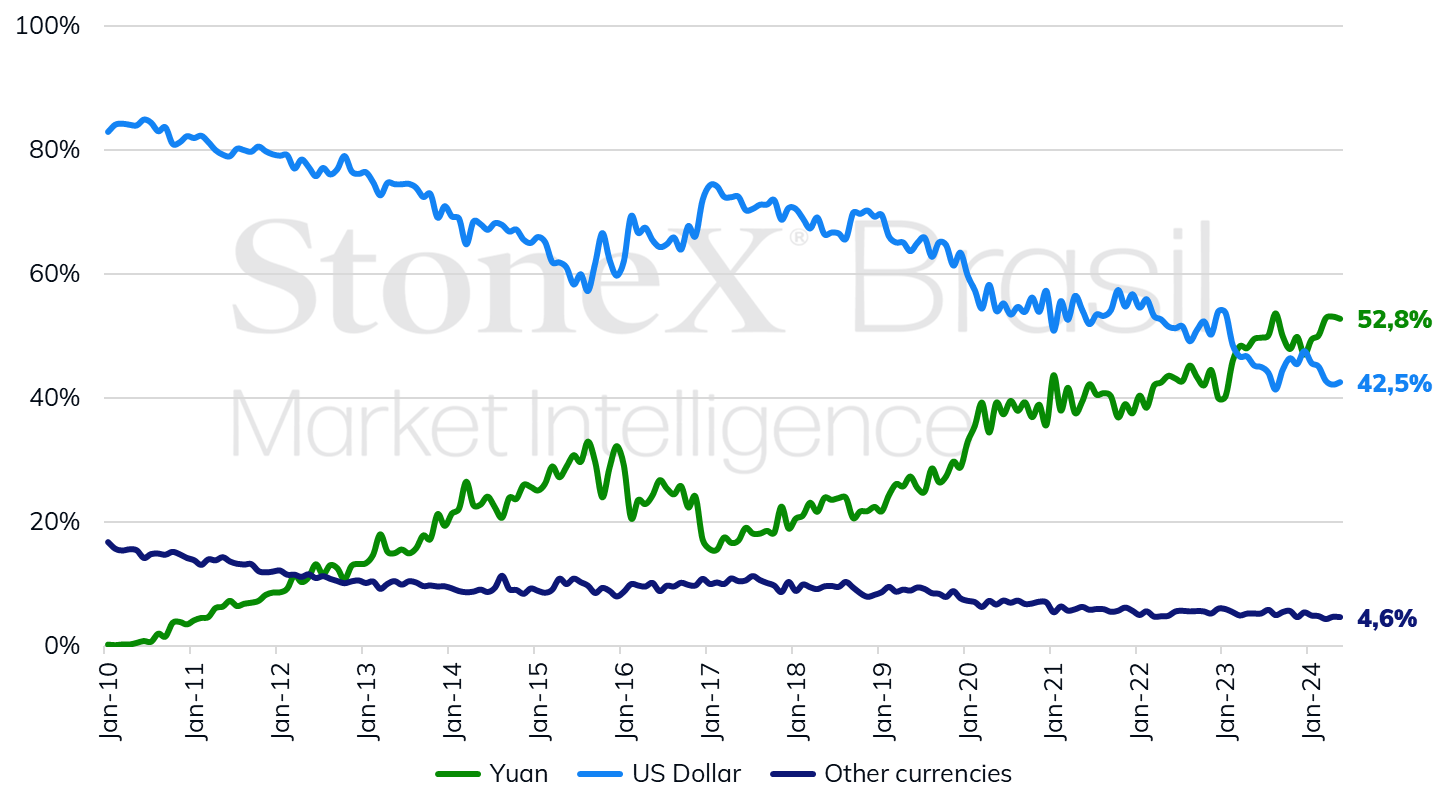
One of the main advantages offered by China is its volume of global trade. In 2023, the country was the largest exporter (US$ 3.380 trillion, or 18.5% of global exports) and the second largest importer (US$ 2.557 trillion, or 13.3% of global imports) in the world. In addition, by using its currency, China has more ease in offering credit lines to promote foreign trade and bilateral investments, deepening the use of the yuan in commercial and financial flows. The result of this strategy over the years is beginning to become evident, as the yuan has been the main currency for settling China's external transactions with other countries since March 2023.
Share os China's Cross-Border Payments and Receipts by Currency
Source: Bloomberg. Design: StoneX.
This result can also be verified in the growth of global use of the Chinese currency, although the American currency maintains a hegemonic position in the world financial system. In June 2024, the dollar was responsible for 47.1% of transactions in international payment systems, while the yuan was the fourth most used currency, responsible for 4.6% of these payments.
Share of the Chinese yuan (CNY) in international banking transactions (%)


Source: Society for Worldwide Interbank Financial Telecommunication (SWIFT). Design: StoneX.
Distribution of international banking transactions by currency in June 2024 (%)

Source: Society for Worldwide Interbank Financial Telecommunication (SWIFT). Design: StoneX.
The biggest obstacle to the strategy of internationalizing the yuan remains its reduced liquidity, as its use is still fundamentally limited to transactions between China and other countries. Additionally, the Chinese government implements capital controls and other measures to affect the external value of its currency according to its economic priorities, which brings some risks to nations that accumulate international reserves in yuan.
Distribution of global international reserves by currencies in December 2023 (%)

Source: International Monetary Fund (IMF). Design: StoneX.Note: information from 149 countries.
USD = US dollar; EUR = euro; JPY = Japanese yen; GBP = British pound; CAD = Canadian dollar; CNY = Chinese yuan; and AUD = Australian dollar.
In Brazil, according to data from the Central Bank, the use of Chinese currency in foreign exchange operations has been increasing, going from US$ 271 million in 2017, the tenth most used currency, to US$ 4.481 billion in 2023, the fifth most used currency. On the other hand, these values still represent a very small portion of foreign exchange contracts, increasing from 0.02% in 2017 to 0.26% in 2023.
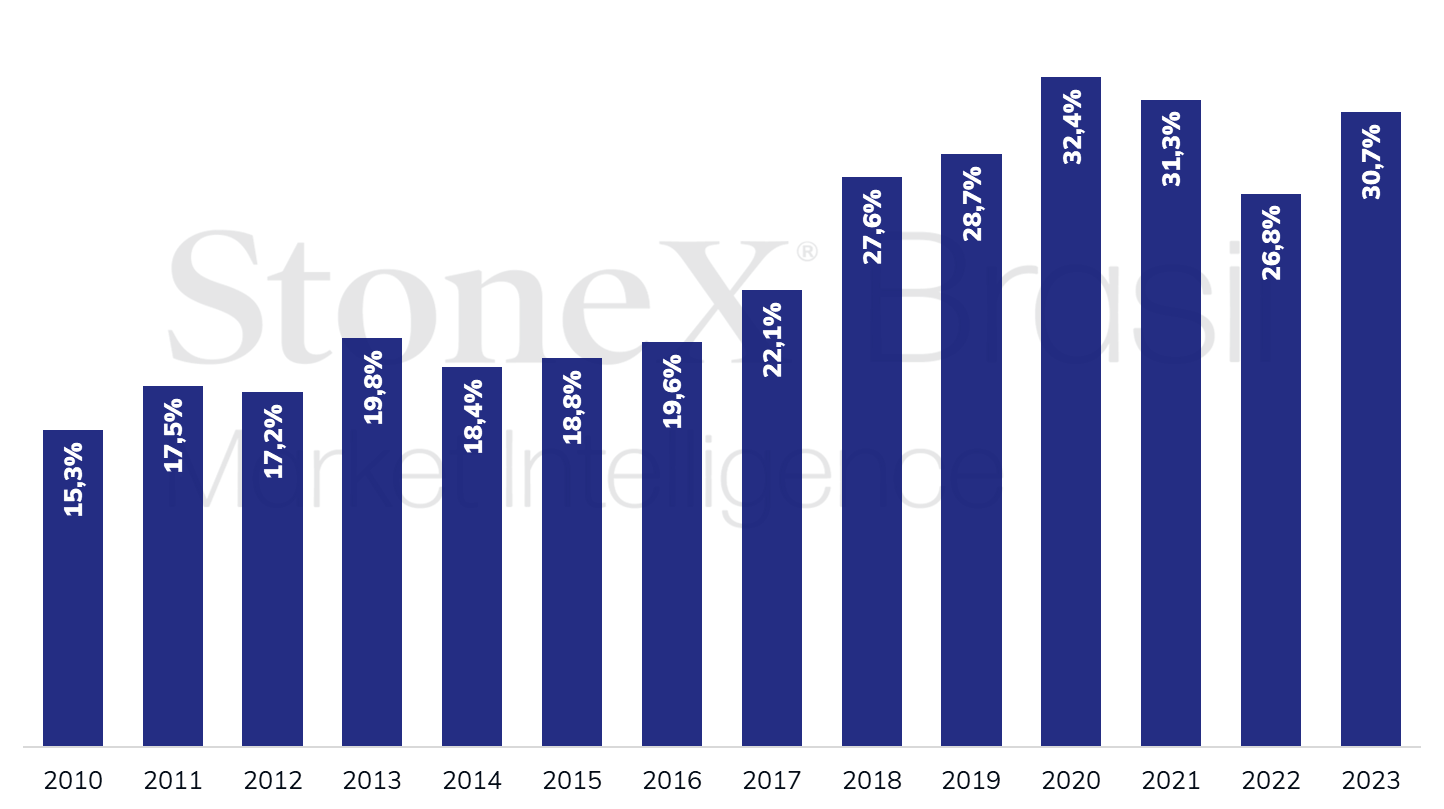
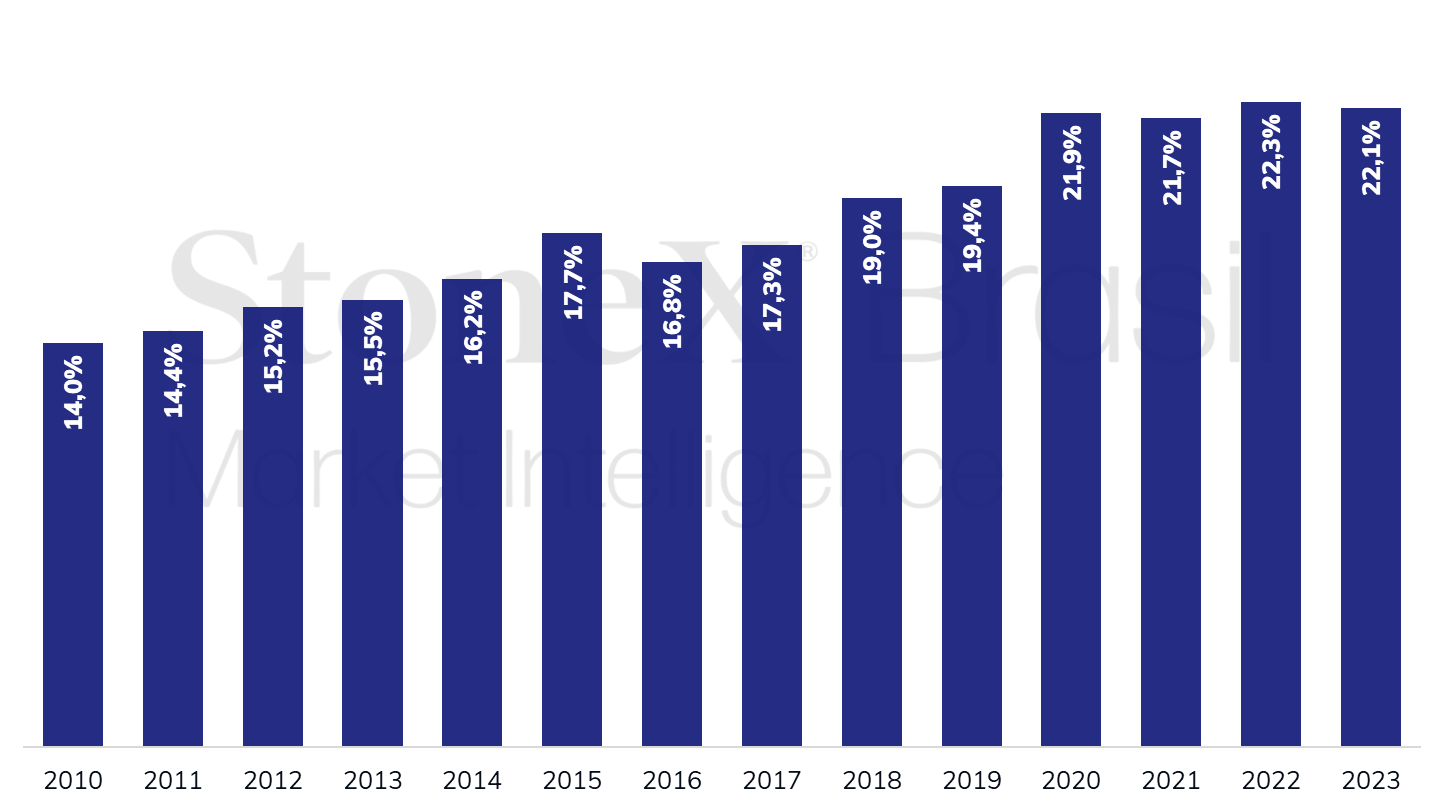
The growth in the use of the yuan in Brazil has been driven by foreign trade, as China was Brazil's largest trading partner in 2023, the destination of 30.7% of exports and the origin of 22.1% of national imports. This year, exports totaled US$ 104.3 billion and imports, US$ 53.2 billion, a surplus of US$ 51.1 billion. The main products exported to the Asian country were soybeans, crude oil, iron ore, beef, corn, cellulose, and sugar, while the main imported products were basic and processed industrial inputs, such as batteries and microprocessors (chips).
China's share of Brazilian exports
 Source: Comex Stat. Design: StoneX.
China's share of Brazilian imports
Source: Comex Stat. Design: StoneX.
Additionally, in a risk diversification policy by the Central Bank of Brazil, the yuan represents the third currency with the largest share in the international reserves of the monetary authority in 2023, with 4.8% of the total, behind the euro (5.2% share) and the dollar (80.0%).
 Source: Central Bank of Brazil. Design: StoneX. Any negative proportions reflect short positions in the currency.