Volatility Expectations Take an Unlikely Shift: From Crypto to Treasuries
S&P 500, Treasury Bond, Gold, and Bitcoin Market Volatility Key Talking Points:
- The Trump administration’s aggressive and unpredictable tariff announcements have increased volatility across major markets
- What could cause stock, bond, commodity, and crypto market volatility to increase or decrease from here?
- From a purely fundamental perspective, we may have already passed the peak in trade-driven uncertainty
“Survive until 2025” was a mantra for many investors and businesses following the global recession scare in 2023 and 2024’s pervasive geopolitical uncertainty, spanning everything from elections in the UK, European Union, and US to military conflicts in Ukraine and the Middle East.
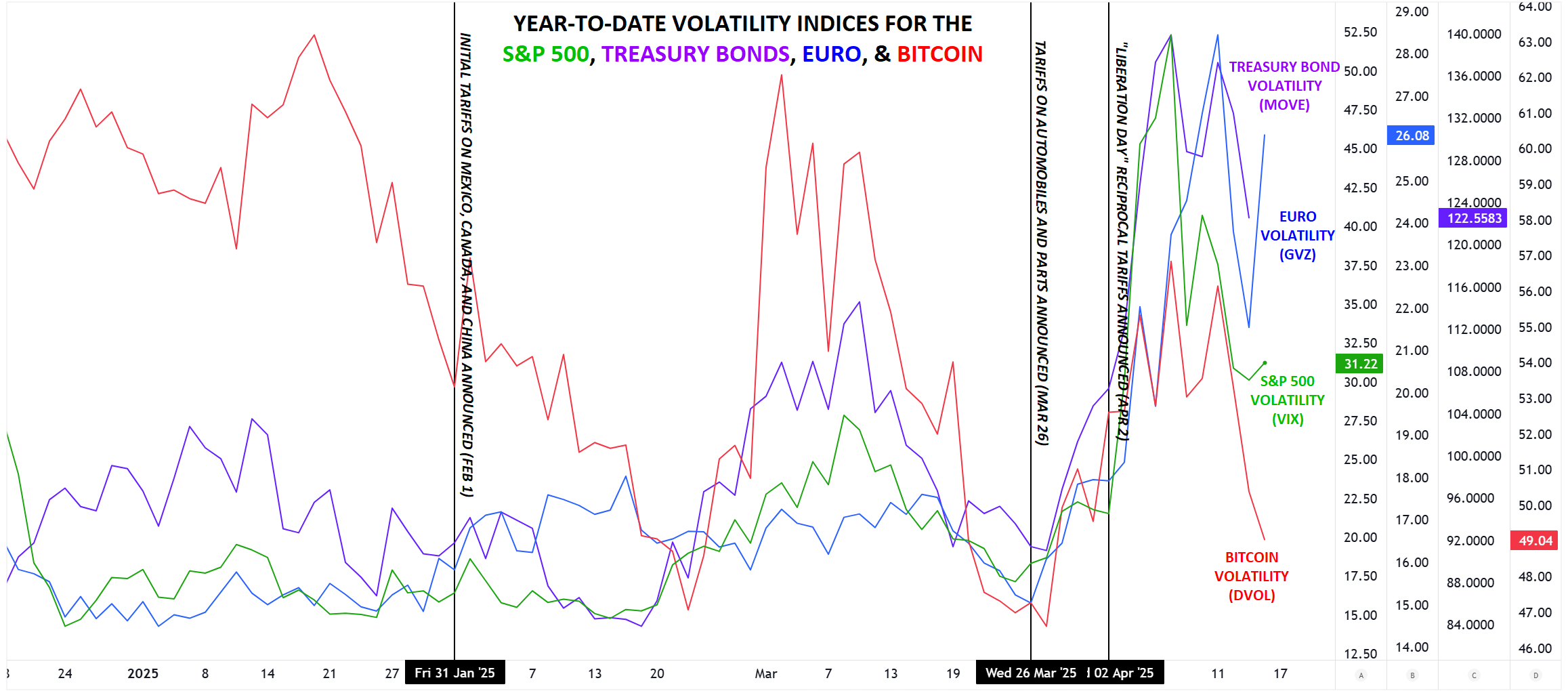
A bit over a quarter of the way through 2025 though, anyone looking for a decline in uncertainty should be on the lookout for a new mantra: “Exist and persist until 2026” perhaps? Below, we examine the timeline of US President Trump’s global trade war and its impact on volatility in major markets, highlighting relative changes in expected market moves in the stock, bond, currency, and crypto-asset markets:
Source: StoneX, TradingView
Below, we provide detailed volatility outlooks across major markets, beginning with equities.
Tariff Impact on Market Volatility
In the chart above, the black vertical lines represent major escalations in the Trump administration’s tariff policy. The first black line marks the unexpected February 1st announcement of tariffs on China, Mexico, and Canada ostensibly over those countries’ failure to reduce the flow of fentanyl into the US. Broadly speaking, we saw a short-lived uptick in volatility that quickly died down as the tariffs on Mexico and Canada were quickly delayed.
The second black line shows the surprise tariff decree on automobiles and auto parts on March 26th, which essentially marks the low for expected volatility in major markets as traders started to realize that the upcoming “reciprocal tariffs” could be far more substantial and longer lasting than anticipated. Even relative to those increased expectations, the figures for the “Liberation Tariffs” still surprised traders, and the lack of progress toward any meaningful trade deals since then has left market volatility at historically high levels, even despite (or perhaps, because of) the 90-day suspension of most of those tariffs.
As of writing, volatility in the stock, bond and commodity markets remains relatively elevated, suggesting that market moves may be larger than most were predicting at the start of the year, though implied volatility in Bitcoin has declined from the start of the year.
S&P 500 Volatility Outlook (VIX)
Starting with the stock market, the VIX, Wall Street’s “Fear Gauge” of implied volatility in the S&P 500 sits above 30, down nearly 50% from the peak seen a couple weeks prior. At this level, the VIX suggests that options traders expect daily moves of nearly 2% in the S&P 500 and weekly moves of about 4.3%.
Compared to the average VIX reading of 19.5 since inception in 1990, stock market volatility is elevated, but still well below the peaks seen in the depths of the Great Financial Crisis, COVID pandemic, and even the brief “Volmageddon” surge in August of last year. For reference, the current reading is in the 97th percentile of all daily VIX readings over the last year, indicating that expectations for future volatility remain highly elevated. The outlook for major multinational earnings remains highly uncertain, but US corporations have proven adept at protecting their profit margins and continuing to generate consistent shareholder returns over longer-term time horizons regardless of international trade policies.
Treasury Bond Market Volatility Outlook (MOVE)
Like the stock market, implied volatility in the Treasury bond market is much higher than it has been most of the decade, but still below the peaks seen in Great Financial Crisis and the (non-)“transitory” inflation scare of 2022, roughly matching the peak seen in during the COVID pandemic. At current levels above 110, the MOVE sits at the 86th percentile of all daily readings over the last year.
Moving forward, the key factors for bond traders to monitor will be the stability and independence of the Federal Reserve’s interest rate policies, along with the broader appetite for holding US Treasuries amidst fears of record high debt loads and the ever-elusive “bond vigilantes.”
Gold Market Volatility Outlook (GVZ)
After a prolonged period of mostly low volatility over the last few years, expected market moves in the commodity market broadly, and gold in particular, have spiked to historically elevated levels. Per the CBOE’s GVZ index, implied market moves are higher than they’ve been since COVID (and the Greek Sovereign Debt Crisis and Great Financial Crisis before that), and in the 99th percentile of all readings over the last year.
With fractures emerging in long-maintained geopolitical and trading relationships, volatility in the commodity market may remain elevated in the near term until the outlines of a new, sustainable equilibrium come into sight. In other words, gold traders may want to prepare for prolonged volatility more akin to what we saw in the early 2010s rather than the subdued post-COVID average.
Crypto Market Volatility Outlook (DVOL)
In contrast to the far more mature stock, bond, and commodity markets, traders in the relatively young crypto sector are accustomed to significant volatility. Indeed, volatility in the Bitcoin, the longest-standing cryptoasset, has generally declined since the blockchain’s “Genesis Block” in 2009. Looking at the above chart, the implied volatility in Deribit’s DVOL index is approaching 9-month lows. The index of implied volatility sits at just its 10th percentile of all daily readings over the last year.
Ultimately, growing acceptance of Bitcoin as an emerging asset class and a maturing set of increasingly institutional investors should continue to push Bitcoin’s volatility lower over time, regardless of US trade policy. A sustained global trade war might further encourage Bitcoin adoption as investors seek alternatives outside traditional finance, potentially leading to even lower volatility.
From a purely fundamental perspective, there is a case that we’ve already passed the peak in trade-driven uncertainty; after all, it’s difficult to surpass the ambiguity created by imposing – and then subsequently delaying – the most significant changes to global trade policy in at least a century. Progress toward trade deals, especially between the US and China, would likely reduce implied volatility. Even if tariffs remain historically high, traders would benefit from increased clarity, contrasting the unpredictable environment of recent months.
Follow the Global Macro Calendar
What are the major events and indicators on tap for the global economy that could charge volatility in markets and reshape deeper fundamental themes? Sign up for the updated Global Macro Calendar updated each week with a two week look ahead of the top events!
Sign Up
-- Written by Matt Weller, Global Head of Research
Check out Matt’s Daily Market Update videos on YouTube and be sure to follow Matt on Twitter: @MWellerFX