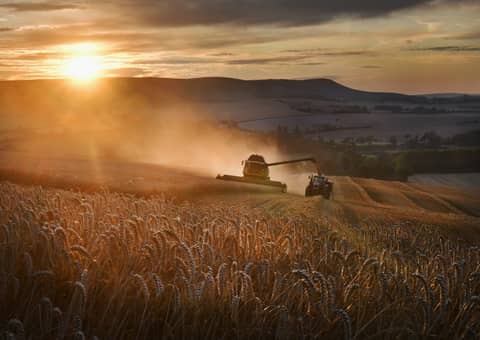
Roughly 80% of the farm bill relates to food stamps rather than farming, so the dispute holding up the bill says little about the farm provisions inside it. Democratic control of the House and Senate moves farm policy into committees with the power to reconsider how farm aid eligibility is defined, while farm measures on animal welfare, biofuels and environmental practices already carry support from both parties. For U.S. agriculture, which has absorbed trade disruption alongside high diesel and fertilizer costs, the targeting of assistance is one of the places where the change in control reaches farm businesses.
Ben Klieve, StoneX Financial Inc. Senior Research Analyst, covers agriculture and food sector equities, from animal protein and farm inputs to the wider food and agribusiness supply chain. That coverage gives insight into how farm policy, trade and input costs feed through to the businesses behind U.S. agriculture.
Key Themes from the Discussion
Food stamps make up roughly 80% of the farm bill, while its farm provisions draw support from both parties.
Democratic-led committees could move farm aid eligibility beyond acres toward agronomic practices and carbon efficiency.
Agriculture committee membership stays largely intact as Democratic majorities gain power over hearings and legislation.
Watch the Full Conversation
Farm Bill Provisions on Biofuels and Animal Welfare Draw Bipartisan Support
The farm provisions of the farm bill, including measures on animal welfare, environmentally friendly practices and biofuels, carry support from both Democrats and Republicans. Klieve points to "some legislation around, especially animal welfare and the ability of states to control specific guidance on animal welfare standards," adding that those measures and biofuels "all seem to have pretty bipartisan support." Notably, any compromise on the farm bill depends overwhelmingly on changes to the food stamp program rather than on farming and agriculture.
Farm Aid Eligibility Comes Under Democratic Committee Control
Farm aid eligibility rests with House and Senate agriculture committees that pass to Democratic leadership, opening the criteria behind assistance to review. According to Klieve, Democratic control could bring "a shift in that spend away from just a purely per acre basis to having more qualifying variables around agronomic practices, carbon efficiency, things of that nature." The farm sector has already received considerable federal assistance, including a proposed aid package to offset high diesel costs. As a result, the measure of eligibility, not only the size of support, becomes the variable farm businesses track under Democratic control.
Democratic Majorities Gain Legislative Power While Agriculture Committees Hold Steady
"Controlling both chambers of the Congress and doing so with the margins that they have will give them quite a bit of power that they certainly haven't had before," Klieve observes the incoming Democratic majorities. Those majorities can hold hearings and pass legislation more easily, whereas a veto-proof majority on any bill depends on remaining Republicans voting with Democrats against the Trump administration. Membership of the House and Senate agriculture committees stays largely intact, with Klieve noting that "it doesn't look like there's going to be sweeping changes that really derail the relationship between the farmer and the House and Senate committees." Consequently, farm policy under Democratic control is characterized by continuity in the committee rooms where farm aid and the farm bill take shape.
Farm Policy Direction Shows Up First in Farm Bill Priorities and Input Costs
The direction of farm policy under Democratic control shows up first in how far congressional leaders prioritize the farm bill, which Klieve calls "the second shoe to drop." The Iran war and its effect on fertilizer and diesel prices, alongside immigration policy and international trade, mark the pressure points where policy change reaches agribusiness most directly. The qualifying criteria attached to future farm aids show if assistance is moving away from a per-acre basis.
--- Written by Mohamed Faisal, Global Macro Content Specialist
--- Expert: Ben Klieve, StoneX Financial Inc. Senior Research Analyst
Grains & Oilseeds
StoneX TV content is created, produced, and distributed solely by StoneX Media Ltd (“StoneX TV”) and is provided for informational and educational purposes only. StoneX TV does not provide investment, financial, legal, or tax advice and does not make any recommendation or endorsement of any investment strategy, transaction, or financial instrument. Nothing in this content constitutes, or should be construed as, investment advice or a recommendation to buy, sell, or hold any financial instrument, including securities, futures, derivatives, digital assets, foreign exchange products, or CFDs. This content does not constitute an offer, invitation, or solicitation to engage in any investment activity. The information presented is general in nature and is not tailored to the financial situation, investment objectives, or risk tolerance of any specific person. You should not rely on this content as a substitute for independent professional advice. Investing and trading in financial instruments involves significant risk of loss and is not suitable for all investors. Past performance is not indicative of future results. Any views or opinions expressed are those of the presenter at the time of publication and are subject to change without notice. Such views may not necessarily reflect those of StoneX Media Ltd or its affiliates. StoneX Media Ltd and its affiliates, including StoneX Group Inc., may from time to time have positions in, or engage in transactions involving, the financial instruments referenced. This content may include general market commentary and opinion. It does not constitute independent investment research and has not been prepared in accordance with legal requirements designed to promote the independence of investment research. StoneX Media Ltd is not authorised or regulated to provide investment services and does not act in a fiduciary capacity. StoneX Media Ltd is incorporated in Ireland and operates in accordance with applicable Irish law. It is a wholly owned subsidiary of StoneX Group Inc. and is a separate legal entity from other subsidiaries within the StoneX Group, which may be regulated in various jurisdictions. StoneX Media Ltd does not act on behalf of, or provide services for, any regulated affiliate. This content is not directed at, and may not be distributed to, any person in any jurisdiction where such distribution would be contrary to local laws or regulations. Supporting documentation for any claims, comparisons, statistics, or technical data may be made available upon reasonable request, where applicable.
Discover more insights
Our subscribers have access to comprehensive market analysis from StoneX spanning commodities, equities, currencies and more.
Our market expertise, advanced platforms, global reach, culture of full transparency and commitment to our clients’ success all set us apart in the financial marketplace.
Reach
With access to 40+ derivatives exchanges, 180+ foreign exchange markets, nearly every global securities marketplace and numerous bi-lateral liquidity venues, StoneX’s digital network and deep relationships can take clients anywhere they want to go.
Transparency
As a publicly traded company meeting the highest standards of regulatory compliance in the markets we serve, our financials and record of accomplishment are matters of public record. StoneX’s commitment to “doing the right thing over the easy thing” sets us apart in the industry and helps us build respect, client trust and new partnerships.
Expertise
From our proprietary Market Intelligence platform, to “boots on the ground” expertise from award-winning traders and professionals, we connect our clients directly to actionable insights they can use to make more informed decisions and achieve their goals in the global markets.