Australia’s housing pipeline is showing signs of losing momentum, with private house approvals falling sharply in July and annual growth in commencements turning negative. The slowdown adds another layer to the growth and RBA outlook ahead of Wednesday’s Q2 GDP report.
Australian Housing Pipeline Weakens Ahead of Q2 GDP
Australia’s housing market is sending a mixed signal. Demand remains firm, yet the pipeline of new housing supply appears to be losing momentum.
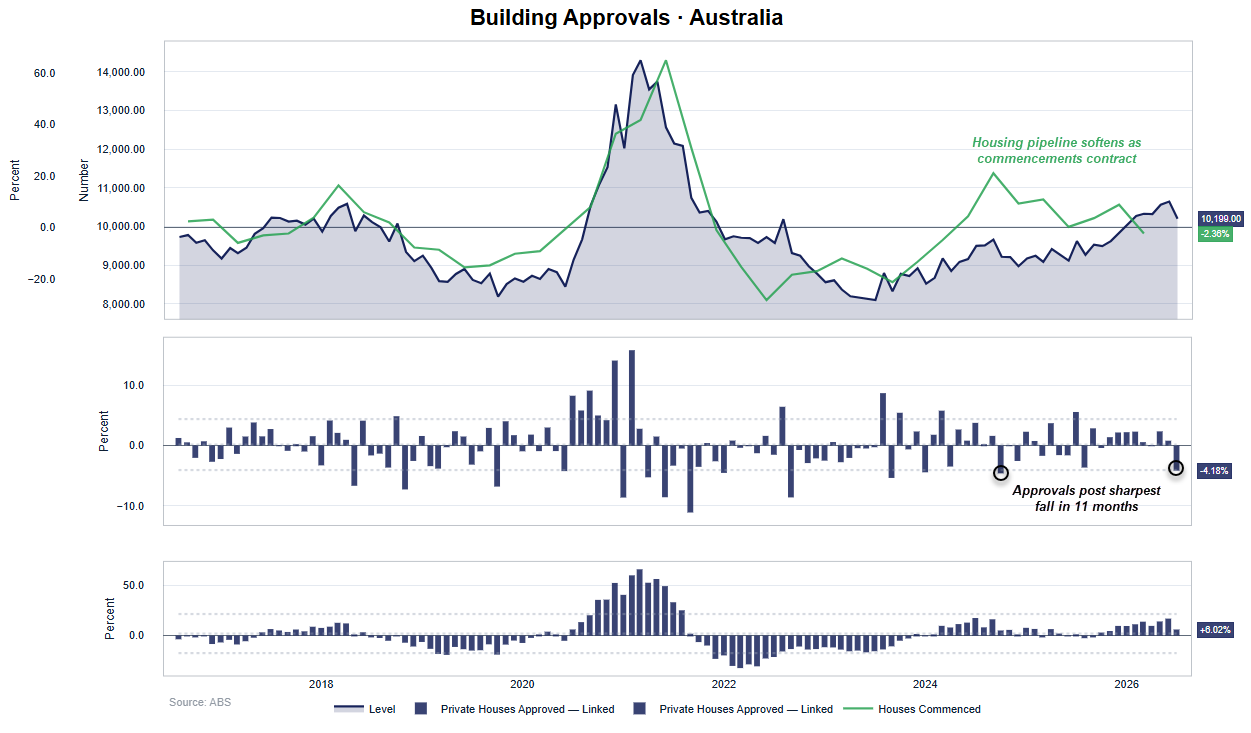
Private sector house approvals fell 4.2% in July, the largest monthly decline since October 2024. Annual growth also slowed sharply to 6.0% from 16.8% in June, which had marked a two-year high.
The timing is particularly interesting ahead of Wednesday’s Q2 GDP report. Private house approvals are not the only sign that Australia’s housing pipeline is losing momentum. Annual growth in house commencements has also turned negative, suggesting the slowdown is beginning to extend beyond approvals and into actual construction starts.
That does not necessarily imply weak construction activity in Q2, but it does point to a softer residential pipeline further ahead.
Weaker Approvals Leave a Mixed Inflation Signal
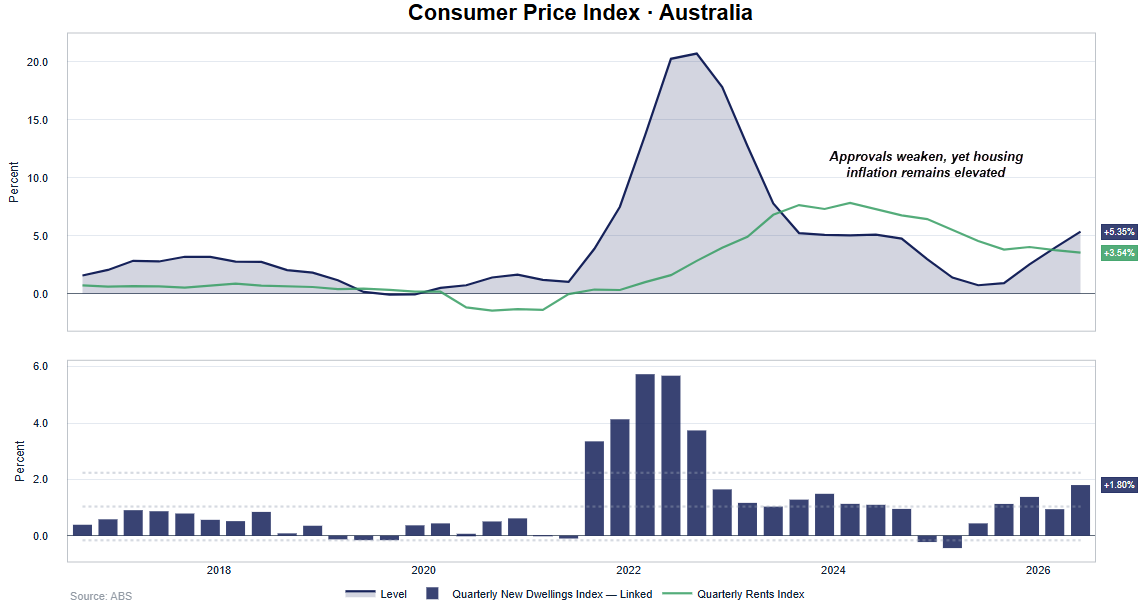
While weaker approvals point to softer residential construction activity ahead, the inflation implications depend heavily on why approvals are falling. The decline likely reflects some combination of weaker housing demand and persistent supply constraints, with higher interest rates weighing on borrowing and activity while elevated financing and construction costs continue to challenge new development.
That leaves a mixed inflation signal. Softer demand should eventually weigh on prices, rents and construction activity, but if supply weakens faster than underlying housing demand, fewer homes will be added to an already constrained market. That could keep upward pressure on rents and housing costs even as residential investment slows.
The policy backdrop may also be adding to those supply-side pressures. Property groups have criticised recent Federal Budget changes for potentially weighing on investment confidence and project viability, although it is too early to link July’s fall in approvals directly to those measures.
RBA Faces an Awkward Housing Trade-Off
For the RBA, weaker approvals are not an obviously dovish signal. They point to softer future construction activity, but if supply weakens faster than housing demand, rents and housing costs could remain elevated. Higher interest rates complicate that balance by cooling demand while also raising financing costs for developers and potentially weakening the supply response.
The combination of weaker approvals and negative annual growth in house commencements now makes the next few housing releases more important. If housing finance, rents and prices remain relatively resilient while the construction pipeline continues to weaken, it would strengthen the case that Australia is dealing with a supply constraint rather than a conventional housing downturn — an outcome that could keep housing inflation sticky and reinforce the case for the RBA to remain hawkish.
Private Housing in Context
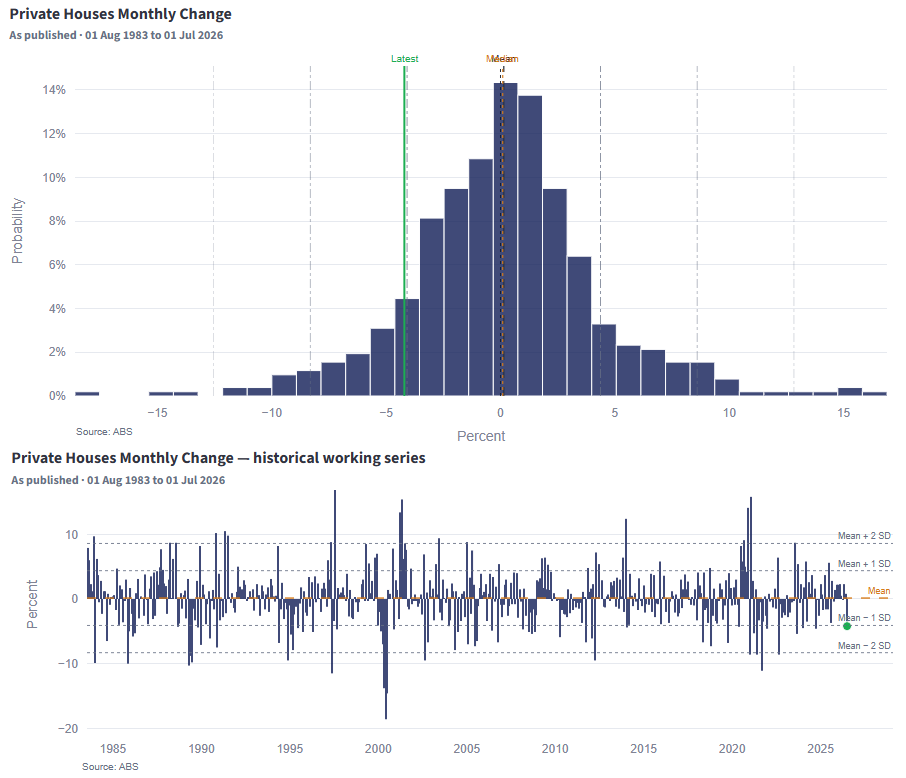
July’s 4.2% fall is notable as the weakest monthly result since October 2024, although it remains well within the historical distribution of private house approvals. That argues against reading too much into a single month. A sustained deterioration in approvals, particularly if accompanied by weaker commencements, would provide a stronger signal that Australia’s housing pipeline is losing momentum.
Currencies
StoneX TV content is created, produced, and distributed solely by StoneX Media Ltd (“StoneX TV”) and is provided for informational and educational purposes only. StoneX TV does not provide investment, financial, legal, or tax advice and does not make any recommendation or endorsement of any investment strategy, transaction, or financial instrument. Nothing in this content constitutes, or should be construed as, investment advice or a recommendation to buy, sell, or hold any financial instrument, including securities, futures, derivatives, digital assets, foreign exchange products, or CFDs. This content does not constitute an offer, invitation, or solicitation to engage in any investment activity. The information presented is general in nature and is not tailored to the financial situation, investment objectives, or risk tolerance of any specific person. You should not rely on this content as a substitute for independent professional advice. Investing and trading in financial instruments involves significant risk of loss and is not suitable for all investors. Past performance is not indicative of future results. Any views or opinions expressed are those of the presenter at the time of publication and are subject to change without notice. Such views may not necessarily reflect those of StoneX Media Ltd or its affiliates. StoneX Media Ltd and its affiliates, including StoneX Group Inc., may from time to time have positions in, or engage in transactions involving, the financial instruments referenced. This content may include general market commentary and opinion. It does not constitute independent investment research and has not been prepared in accordance with legal requirements designed to promote the independence of investment research. StoneX Media Ltd is not authorised or regulated to provide investment services and does not act in a fiduciary capacity. StoneX Media Ltd is incorporated in Ireland and operates in accordance with applicable Irish law. It is a wholly owned subsidiary of StoneX Group Inc. and is a separate legal entity from other subsidiaries within the StoneX Group, which may be regulated in various jurisdictions. StoneX Media Ltd does not act on behalf of, or provide services for, any regulated affiliate. This content is not directed at, and may not be distributed to, any person in any jurisdiction where such distribution would be contrary to local laws or regulations. Supporting documentation for any claims, comparisons, statistics, or technical data may be made available upon reasonable request, where applicable.
Discover more insights
Our subscribers have access to comprehensive market analysis from StoneX spanning commodities, equities, currencies and more.
Our market expertise, advanced platforms, global reach, culture of full transparency and commitment to our clients’ success all set us apart in the financial marketplace.
Reach
With access to 40+ derivatives exchanges, 180+ foreign exchange markets, nearly every global securities marketplace and numerous bi-lateral liquidity venues, StoneX’s digital network and deep relationships can take clients anywhere they want to go.
Transparency
As a publicly traded company meeting the highest standards of regulatory compliance in the markets we serve; our financials and record of accomplishment are matters of public record. StoneX’s commitment to “doing the right thing over the easy thing” sets us apart in the industry and helps us build respect, client trust and new partnerships.
Expertise
From our proprietary Market Intelligence platform, to “boots on the ground” expertise from award-winning traders and professionals, we connect our clients directly to actionable insights they can use to make more informed decisions and achieve their goals in the global markets.