• Coffee prices dropped sharply due to Brazil’s harvest progress
• Futures market pressured by technical factors and position adjustments
• Prices rebounded Monday amid forecasts of intense cold
• Dollar saw slight decline, influencing domestic market prices
• Brazil’s harvest reached 45.7% of the crop by June 23
• Weather models differ on cold intensity and coverage
• Conflict between Israel and Iran may impact the global macroeconomy
• Market monitors climate, geopolitics, and exports
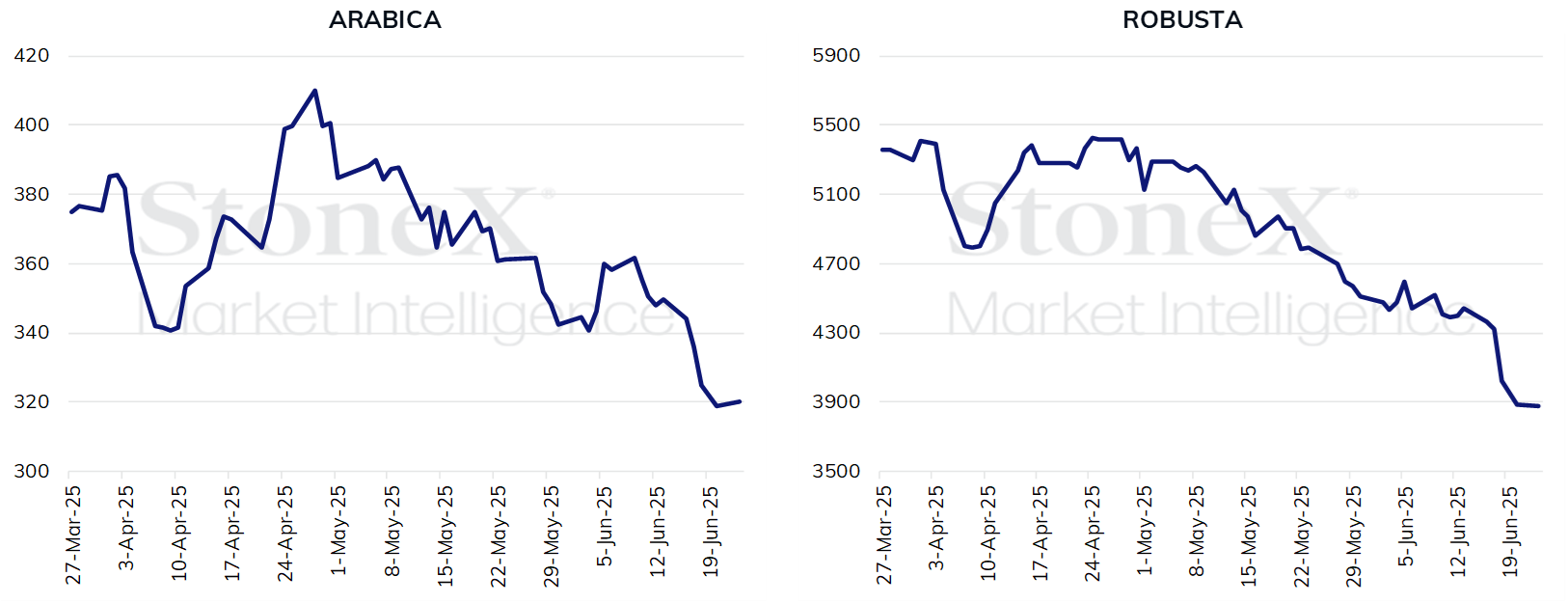
Coffee prices posted sharp declines last week for both arabica traded in New York and robusta in London. This movement mainly reflects the ongoing coffee harvest in Brazil, which has significantly increased physical market supply. Additionally, technical factors contributed to the downward pressure, including the approach of the first notice day for the July contract in New York, which occurred on Friday, June 20.
From a technical standpoint, prices were impacted by position adjustments ahead of the notice day. Market pressure intensified through Wednesday due to the June 19 holiday, which kept the exchange closed. Thus, June 18 was the last business day for position adjustments and risk management related to physical delivery.
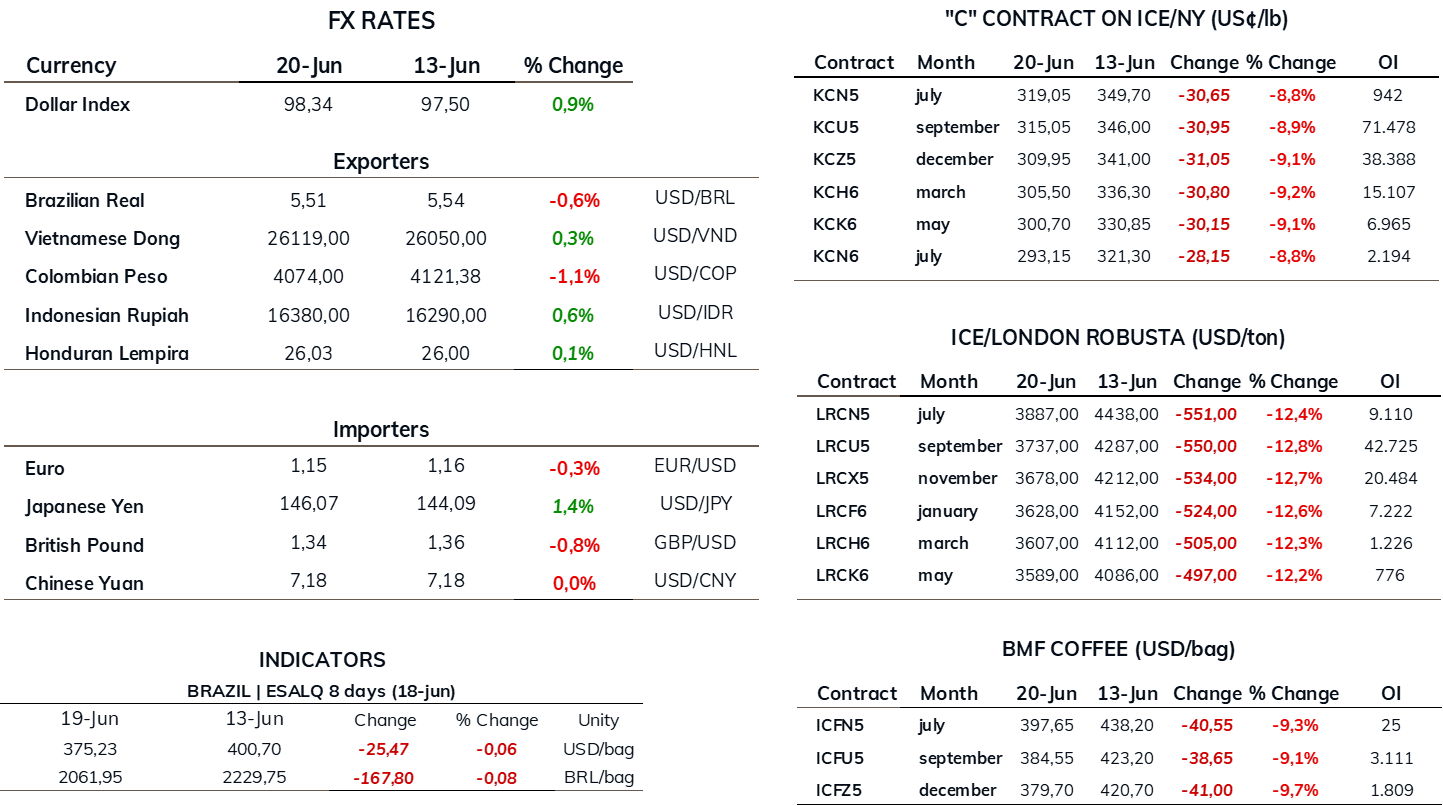
In New York, the most active contract, for September delivery, fell by 3,095 points (–8.9%), closing Friday at 315.05 US¢/lb. In London, the September robusta contract dropped even more—USD 550 per ton (–12.8%), closing at USD 3,737.00/ton.
During the same period, the US dollar depreciated 0.6% against the Brazilian real, ending the week at BRL 5.51. As of the drafting of this report on Monday, the market had begun to recover: in New York, prices were up by more than 1,000 points (+3.3%), and in London, by around USD 180 per ton (+4.8%). This rebound is tied to both technical correction after last week’s drop and weather forecasts in Brazil, indicating a sharp temperature drop and potential frost.
Arabica futures prices (US¢/lb) | Robusta futures prices (USD/ton)
In the domestic market, the trend was similar. According to the Cepea index, arabica prices fell 10.4%, closing the week slightly above BRL 1,969 per 60kg bag. Robusta dropped 9%, closing slightly above BRL 1,167 per bag.
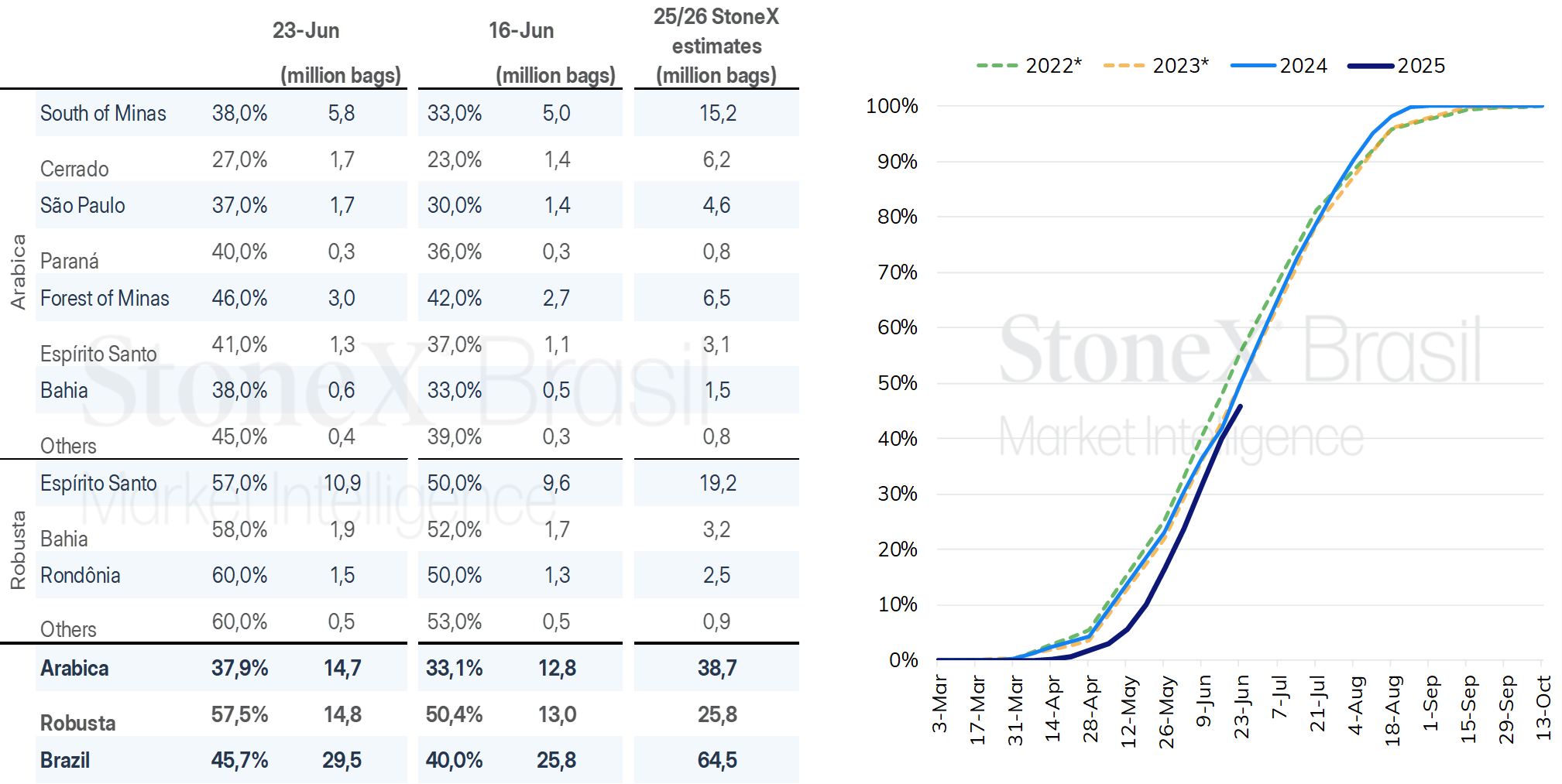
The harvest’s progress is the main factor behind price pressure due to increased supply. According to StoneX data, by June 23, 45.7% of Brazil’s crop had been harvested. Arabica harvesting reached 37.9%, while robusta, more advanced, stood at 57.5%. The most advanced regions include Rondônia (60%) and Bahia (58%). Among arabica regions, Matas de Minas leads with 46%, while the Cerrado lags with 27%.
Brazil Coffee Harvest Progress
Source: StoneX.
The market remains alert to weather conditions in Brazil. Forecast models point to a potential temperature drop in the coming days, raising concerns about frost. While there’s no consensus on the extent or severity, the European model (ECMWF) forecasts lows of 3°C in Alfenas (MG) on June 25, and around 4°C in Ibiraci, Machado, Nova Resende, Campos Gerais, and Varginha. In São Paulo’s Mogiana region, Caconde could see 3.8°C and 5–6°C in Altinópolis, Espírito Santo do Pinhal, and Franca. Tejupá (SP) may reach 2.3°C. In Paraná, towns like Ibaiti and Pinhalão could see negative temperatures.
The GFS model is more optimistic than the ECMWF, suggesting the polar mass will remain concentrated in southern Brazil rather than spreading northward. In northern São Paulo and southern Minas Gerais, GFS predicts lows above 3°C. Although humidity reduces frost risk in many areas, higher-altitude regions remain vulnerable, requiring close monitoring.
Another key factor is the impact of the Middle East conflict on the coffee market. In 2023 and 2024, the Israel–Hamas conflict affected prices, particularly after Houthi attacks on Red Sea shipping lanes increased freight costs—especially from Asia. This contributed to robusta price gains in London and boosted Brazilian exports.
Currently, the conflict involves Israel and Iran, following concerns over Iran’s nuclear ambitions. The U.S. has also entered the fray, bombing targets tied to uranium enrichment. Directly, Iran has little impact on Brazilian coffee exports, receiving only 2,435 bags in 2024 out of over 50 million exported.
However, macroeconomic impacts are possible. After U.S. attacks, Iran’s parliament approved closing the Strait of Hormuz, which handles 20% of global oil shipments. A blockade could raise oil prices and trigger global inflation. This may increase investor risk aversion, reducing appetite for commodities like coffee and pressuring prices. Nonetheless, no significant risk aversion has been observed so far, suggesting investors are not pricing in major conflict escalation. Currency volatility due to geopolitical uncertainty may also impact coffee markets.
The market will continue closely monitoring both harvest progress and weather conditions. Greater supply may keep pressure on prices, while forecasts of cold or frost could drive bullish reactions. The evolution of the Middle East conflict, especially the Strait of Hormuz situation, remains a key global risk. Additionally, June’s export data, expected in the coming weeks, may show recovery in volumes due to increased supply from the accelerating Brazilian harvest.
INDICATORS