- Prospects for Argentine production remain positive;
- US exports in 23/24 are below the 5-year average;
- USDA projects an increase in US ending stocks for 24/25.
- USDA reduced estimate for global production and ending stocks in 23/24;
- USDA projects a reduction in corn acreage in the US in 24/25;
- Funds are liquidating their short positions.
United States
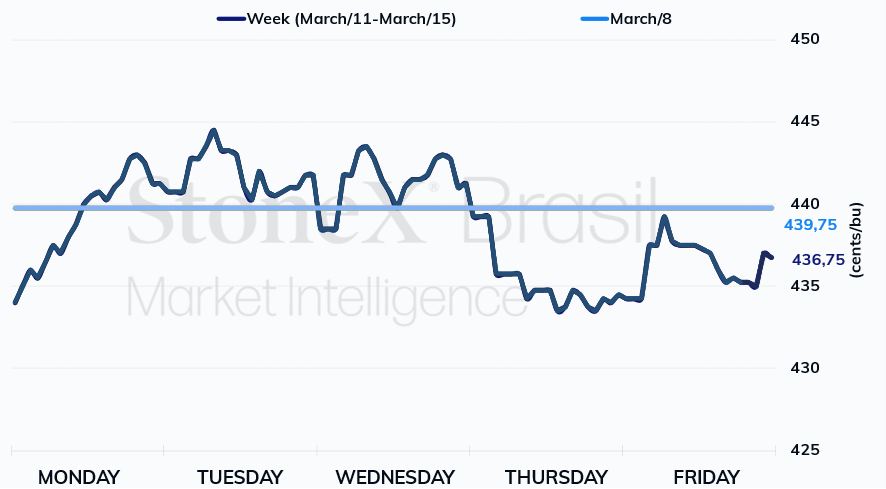
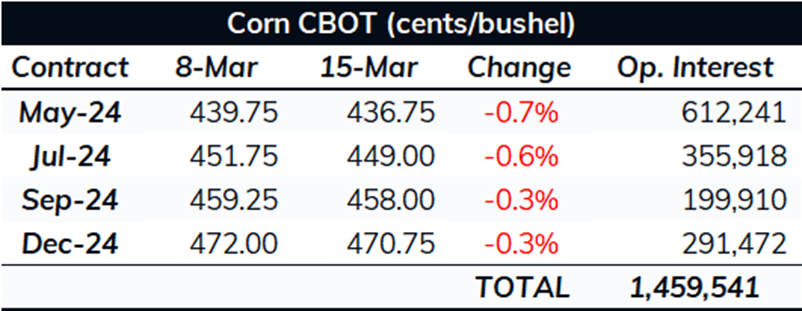
Stable prices on the Chicago exchange: Last week, some news caught the attention of the corn market. Conab updated its estimates for the Brazilian crop, the traditional export figures to the United States were released, and leafhopper problems were reported in Argentina. None of these events, however, produced significant changes in the agents' expectations. Consequently, the price of corn remained nearly unchanged on the Chicago exchange. At the end of Friday's session (15), May was quoted at 436.75 cents/bu, a weekly depreciation of 0. 68%.
Changes in the way funds trade have limited losses for corn in Chicago. In addition to supply and demand issues, changes in how funds operate have drawn attention to the corn market. Until mid-February, this type of investor was constantly increasing their short positions, sharply betting on the depreciation of corn. The CFTC report released on February 23 showed a balance of 341 thousand short positions, the highest value in the last five years. However, since then, the funds have started to move in the opposite direction. In the last CFTC report, released last Friday (15), the negative balance of funds decreased to 256 thousand contracts. In other words, the funds exited their short positions in 85 thousand contracts in three weeks. The factors behind this change are not fully clear. It can be related to profit taking, reduction of financial exposure or even a cautious stance in the face of signs of global inflation heating up. This means that the funds are less bearish, which influences prices on the Chicago Exchange.
Outlook for corn production in the United States: With the slight rebound in future corn prices on the Chicago exchange, the earnings prospects for North American producers have improved. Last Monday (18), StoneX brokers in the United States estimated a profit of US$ 13/hectare for corn production in the 24/25 crop, which is not much, but it is already a positive return, something that did not exist a month ago. For soybeans, the prospects are more interesting, with the estimated profit of US$ 43/hectare being able to foster the planting of this crop instead of planting corn. The USDA planting intentions report will be released on March 28, consolidating the initial outlook for the American 24/25 crop.
In the United States, export sales continue to disappoint: The United States export sales report showed a net sale of 1. 28 mmt in the week ending March 8, a volume 3% below the average recorded in the last three for the period. In the aggregate of the 23/24 crop year, sales reached 40. 5 million, compared to 44. 8 million on average over the last three years. In other words, American exports continue to disappoint in 23/24.
Intraday (15 min) May/24 contract - CBOT
Brazil
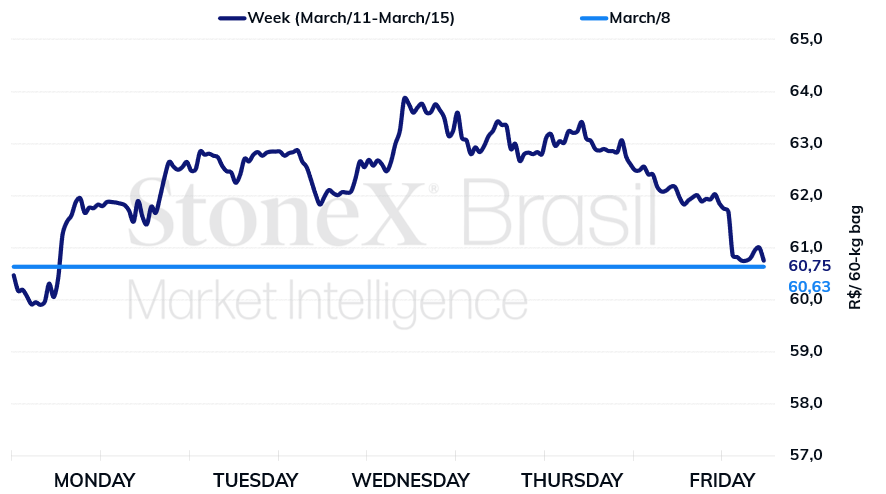
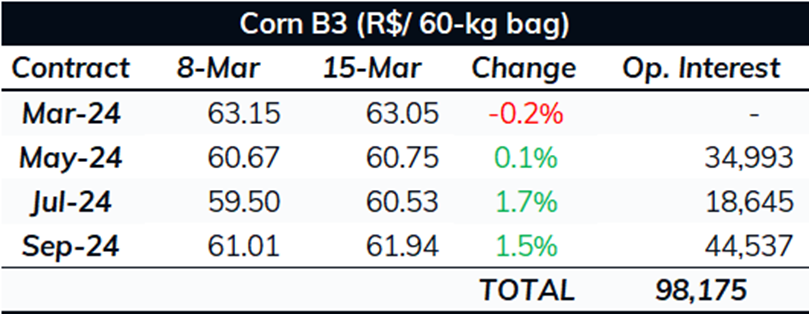
Stability for corn at B3: Like in Chicago, corn prices on the B3 remained near unchanged in the week ending March 15. The May contract traded at R$ 60. 75/bag, a weekly variation of 0. 1%. Among the factors that may be behind the agents' indecision, the uncertainties about the Brazilian supply stand out, as Conab, USDA's, and private institutions' estimates are significantly diverging. Another factor that may be behind the lack of direction of corn is the uncertainties about the North American crop. It will begin to be planted in April, and there is still no clarity about the size of the area that will be sown.
The CONAB estimate is diverging from that released by USDA and private Brazilian institutions: Last Tuesday, CONAB updated its estimate for the Brazilian corn crop 23/24, with 112.75 million tonnes representing a monthly reduction of almost 1 mmt. This disclosure was controversial because it further distanced CONAB's figure from that released by the USDA and Brazilian private institutions: the USDA estimates production at 124 million tonnes and StoneX at 124. 4 million tonnes, volumes 10% higher than CONAB's. With this divergence, the prospects for the Brazilian corn supply remain uncertain, making estimating future prices more difficult.
Progress of the summer corn harvest: As of last Friday (15), 52.4% of the summer corn crops had already been harvested in Brazil, a percentage in tandem with the average of the last five years. Looking at it regionally, we see that the harvest is almost finished in the Southern states, has progressed in about half of the crops in the Southeast, and is yet to begin in the North/Northeast.
Progress of the safrinha corn planting and heatwave - The planting of the safrinha corn 23/24 is practically finished. According to StoneX's estimate, 94.0% of the crops had already been planted by last Friday (15), a percentage in tandem with the average of recent years. Most of what has not yet been planted is in Minas Gerais, a state where fieldwork is behind schedule. With planting in its final stages, attention is now turning to the weather and its impacts on corn crops. Brazil is experiencing a heatwave that has significantly impacted the safrinha production area. However, most of the crops are still in the vegetative stages of development.
Intraday (15 min) May/24 contract - B3
Argentina
Issues with leafhoppers could result in cuts to Argentine production. In their weekly communications, both the Buenos Aires Grain Exchange (BCBA) and the Rosario Exchange (BCR) put quite a lot of emphasis on problems in the corn crop related to leafhoppers. From what was mentioned, the pest is very widespread in Santa Fé and Rosario, provinces that, together with Buenos Aires, make up the Argentine agricultural core. The exchanges have maintained their production estimates for 56.5 million tonnes for BCBA and 57 million for BCR. However, both have warned of possible cuts, which may occur in the coming weeks as the damages become clearer. The BCBA has already increased its estimate of crops in poor conditions from 13% on March 6 to 17% on March 13.
Rain affects the harvest: The heavy rains recorded over the past few days have hindered the harvest progress in Argentina. The Buenos Aires Grain Exchange indicates that only 3. 2% of the corn crops have been harvested, compared to 7. 0% on average in the last five years. The Rosario Exchange indicates similar figures: 3.0% in the current crop against 10% in the historical average. The conclusion is that the corn harvest is still just beginning, and there will be a long time interval before the final crop figure is consolidated.
Future and spot prices
Futures contracts traded on the CBOT (US¢/bu)

Future contracts traded on B3 (R$/bag)
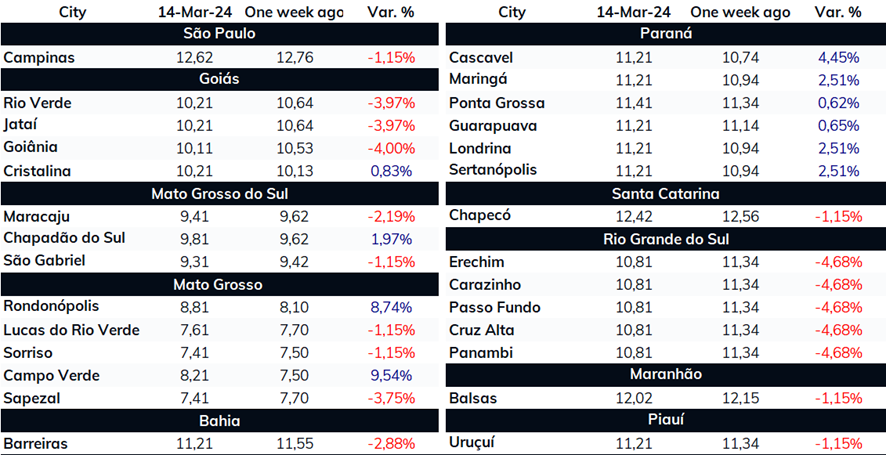
Spot prices in Brazil (USD/60kg-bag)