- Outlook of high stocks at the end of the crop year 23/24;
- Possibility of USDA having overestimated the reduction in corn planting area in the US;
- US exports in 23/24 are below the 5-year average.
- USDA projects a reduction in corn acreage in the US in 24/25;
- The spread of the leafhopper is impacting Argentina's productive potential;
- Dry weather in Brazil may impact the productivity of the 'safrinha.'
Overview
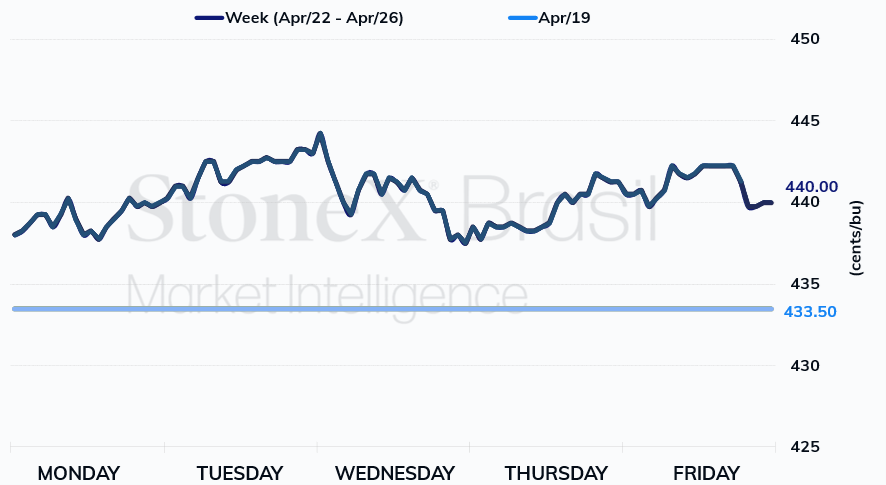
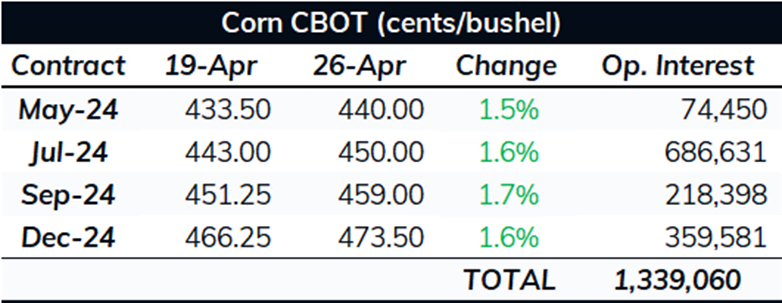
Last week, corn futures appreciated in Chicago. The May contract ended the period at 440 cents/bu, an appreciation of 1.5% compared to the previous week.
The gains throughout the week were not the result of a single major event but rather a series of small bullish factors. One was the significant appreciation of wheat futures, which supported the rest of the agricultural commodities. Earnings were tied to the dry weather in the United States Plains and southern Russia, two important regions for the global wheat supply.
Another factor that helped boost corn quotes was problems in the South American crop. In Argentina, the spread of the leafhopper began to receive more attention, with investors now paying attention to the possibility of significant impacts on the supply. In Brazil, we had a week with very little rain in the safrinha production areas, indicating that the country is entering the dry season.
Finally, geopolitical risks and strong export sales in the United States were also bullish factors that helped boost quotes.
Analyzing the corn market from a broader perspective, the supply and demand fundamentals are still mostly bearish. The United States will start the 24/25 cycle with very high stocks, estimates for the Brazilian and Argentine crops are still satisfactory, and the economic growth slowdown should limit demand.
However, enough concerns have made those betting sharply on the downside feel less comfortable. The highlights are the problems faced by South American farmers and the uncertainties about the crop in the United States, which has just started to be planted. In this scenario, corn has been trading sideways on the Chicago exchange since the beginning of March, with investors adopting a more cautious stance.
For the next few weeks, the focus will be on new crop estimates for Brazil, planting progress in the United States, and developing the leafhopper in Argentina. StoneX will release its new estimate for Brazil on May 2 and an article on the leafhopper in Argentina at the end of the week.
Intraday (15 min) May/24 contract - CBOT
United States
There are indications that the USDA underestimated the corn planting area in the United States - For the 24/25 cycle, the USDA's planting intention report indicated that corn will forfeit area in the United States to the benefit of soybean: in the last 12 months, corn has depreciated more than soybean, making the oilseed more attractive. There is a consensus around this analysis, but not around the intensity of this change in area. The USDA, for example, estimates the corn area at 36.44 million hectares in 24/25, a decrease of 1.84 million hectares, and the soybean area at 35.01 million hectares, an increase of 1.18 million hectares. However, some analysts, including the StoneX Market Intelligence team in the United States, disagree with this estimate. They believe that USDA overestimated the corn loss in the heart of the agricultural belt and estimated the corn planting area at 37.27 million hectares. If confirmed, this correction would be a bearish factor for corn.
Planting in the United States is progressing as usual - On April 21, the USDA estimated that corn planting in the United States had reached 12%. The percentage is in line with last year's figure and 2 percentage points above the average of the last five years. Today (29), the data referring to April 28 will be released.
The production of the corn-based ethanol sector decreased - On Tuesday (23), the EIA released data on corn-based ethanol production and stocks in the United States for the week ending April 19. The data fell short of expectations, with the 954 thousand barrels per day representing a decrease in production compared to the same period in 2023. With the production decline, stocks stood at 25.73 million barrels, a weekly decrease of 347 thousand barrels. From a broader perspective, however, it is worth noting that 2024 has been positive for corn-based ethanol production. Of the 16 releases already made in 2024, production exceeded that of 2023 in 13 of them.
Corn export sales in the United States were heated up for the week. On Thursday, the USDA released the export sales data for the week ending April 18. The report showed a positive balance of 1.299 million tonnes for corn, when the average of the last three years was only 526 tmt. Thus, the total export sales in the 23/24 year amounted to 45.92 million tonnes, a volume higher than that recorded in the same period in the 22/23 cycle but lower than in the 21/22 and 20/21 cycles.
Many funds have exited their short positions. Uncertainties about the United States crop, reduction of rains in Brazil, and leafhoppers in Argentina, in addition to more specific factors such as wheat appreciation, heated export sales weeks and geopolitical risks, have led many funds to exit their short positions in the corn market this past week, opting for a more cautious stance. The CFTC's COT report released on Friday (26) showed that the short balance of funds decreased by 41 thousand contracts.
US export sales (tmt)
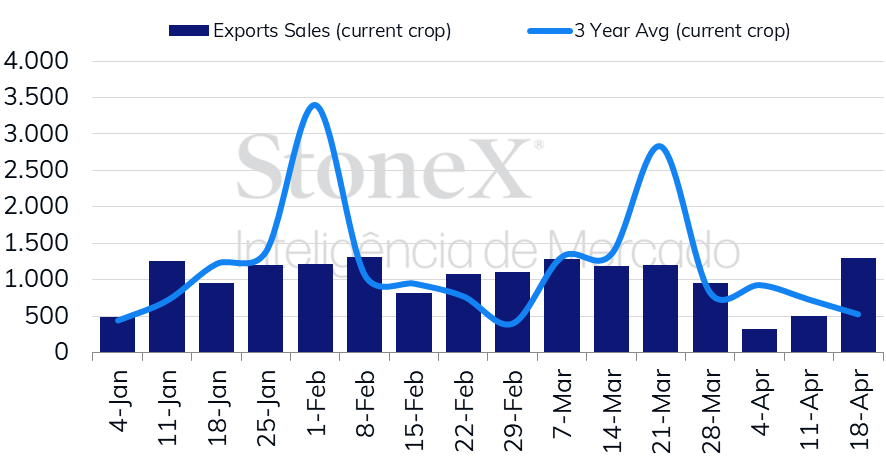
Source: USDA. Design: StoneX.
Brazil
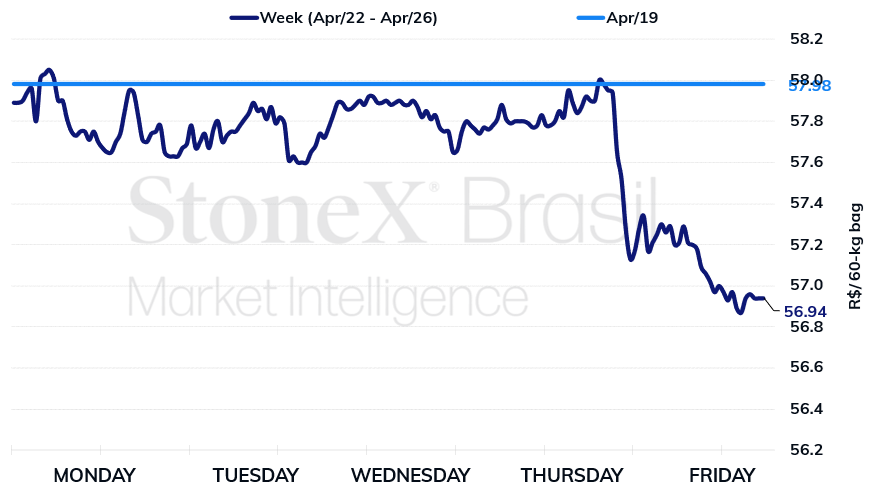
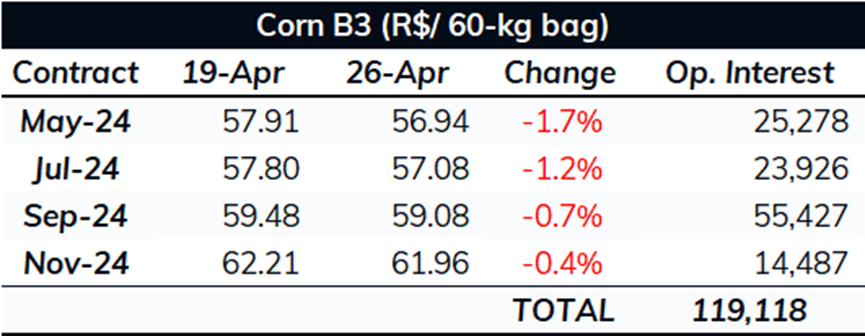
Corn depreciated on B3, following the movement of the USDBRL - As the USDBRL is crucial for the competitiveness of Brazilian exports, significant fluctuations in the exchange rate impact corn's pricing. Because of that, USDBRL and corn have been moving together on B3 in the last three weeks: between April 10 and 16, fiscal risks in Brazil, signs of higher interest rates in the United States for longer and escalation of geopolitical tensions made the USDBRL and, consequently, corn appreciate; already between April 17 and 26, signs of cooling economic activity in the United States and decreasing tensions in the Middle East made the USDBRL fall, pulling corn along. At the end of last week, the May/24 contract traded at R$ 56.94/bag, a weekly depreciation of 1.7%, while the USDBRL was priced at R$ 5.11, a weekly depreciation of 1.9%.
StoneX will update its crop estimate on May 2 - StoneX estimated the Brazilian second crop corn production at 96.3 million tonnes on the first day of April. This estimate's update will be released on May 2. Corrections in production are not ruled out, as Paraná and Mato Grosso do Sul suffered from drought in the first half of April, and Goiás had the same problem in the second half.
Weather models indicate very little rain in the next two weeks - In the last crop estimate made by StoneX, Mato Grosso, Paraná, Goiás, and Mato Grosso do Sul were responsible for 88% of the safrinha corn production in Brazil in 23/24. Last week, weather indicators showed rain only in Mato Grosso, with the accumulated rainfall in the other mentioned states remaining close to 0 millimeters. For the next two weeks, weather models show that the drought will also reach Mato Grosso. In this sense, the dry season has arrived in the main Brazilian regions that produce safrinha corn. StoneX will continue monitoring the impact of this on crop productivity.
Intraday (15 min) May/24 contract - B3
Argentina
Spread of leafhopper limits Argentina's crop potential - Last week, the Buenos Aires Cereals Exchange (BCBA) maintained its estimate for the Argentine corn crop at 49.5 million tonnes. However, the institution continued to issue warnings about the problems brought by the leafhopper, which has already affected the entire northern portion of the agricultural region in Argentina and has the potential to cause even more significant losses. It is worth mentioning that a month ago the BCBA estimated Argentina's crop at 56.5 million tonnes. For more details, read the article prepared by StoneX.
Corn harvest reaches 19.8% - Last week, the harvest in Argentina only advanced by 2.6 percentage points, reaching 19.8%. This percentage is above the one recorded last year but below the average of the last five years for the period. It is worth remembering that between 65% and 75% of corn is planted in Argentina late (between December and January), causing the harvest only to pick up pace from mid-May. In this sense, we still have many crops subject to illnesses caused by the leafhopper.
Strikes in Argentina may affect exports - The Union of Oil Workers and Employees (SOEA) of San Lorenzo, one of the largest agro-export ports in Argentina, announced an indefinite strike against the reforms of the government of Javier Milei. The Sindicato de Dragado y Balizamiento (Dragybal) and the state workers responsible for food sanitation quality (Senasa) announced similar strikes. All these factors should impact Argentine exports of soybean and grains complexes.
Future and spot prices
Futures contracts traded on the CBOT (US¢/bu)

Future contracts traded on B3 (BRL/bag)
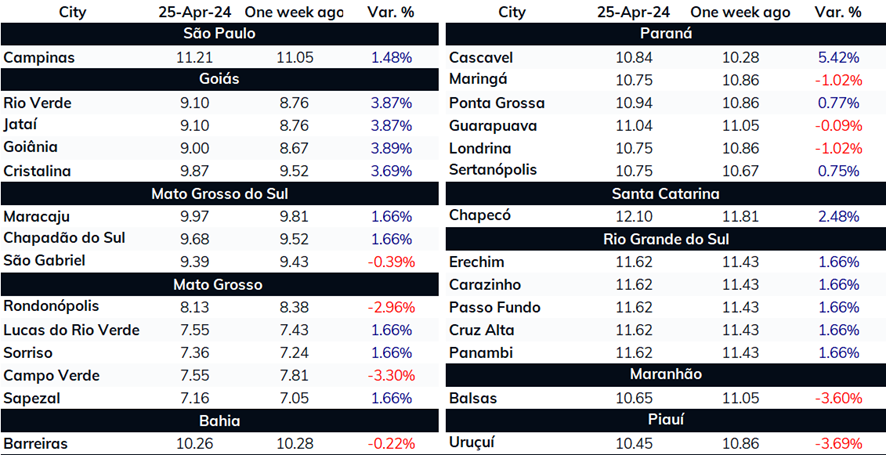
Spot Prices (USD/60kg-bag)