- Outlook of high stocks at the end of the crop year 23/24;
- Possibility of USDA having overestimated the reduction in corn planting area in the US;
- StoneX increased its estimate for the Brazilian crop 23/24.
- USDA projects a reduction in corn acreage in the US in 24/25;
- The spread of the leafhopper is impacting Argentina's productive potential;
- American inflation shows signs of resilience.
Overview
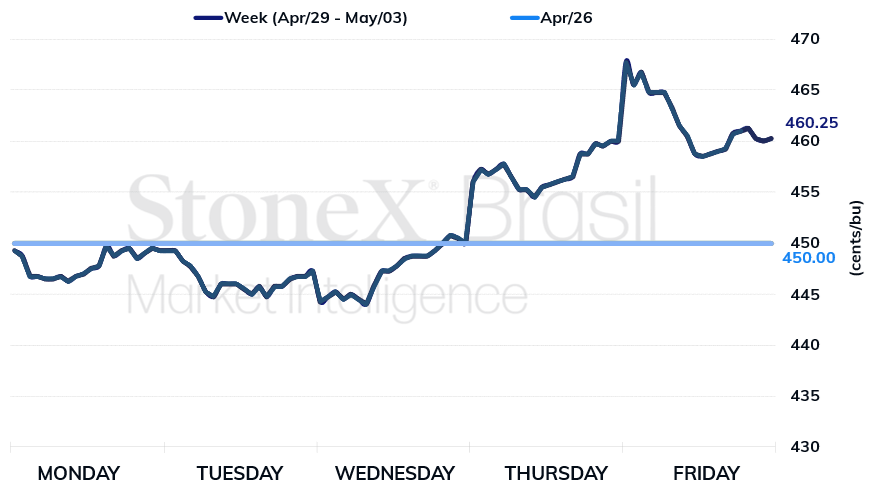
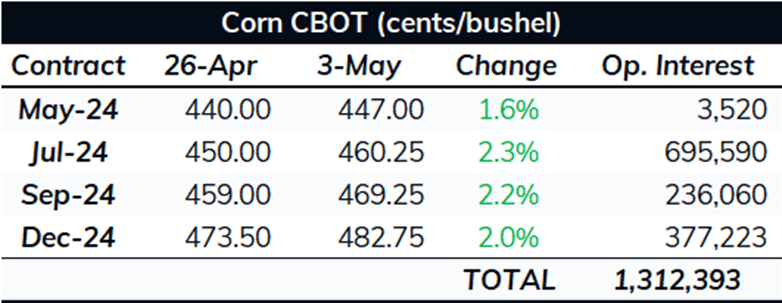
Last week (04/29 to 05/03), corn futures appreciated in Chicago. The July contract ended the quoted period at 460.25/bu, a weekly appreciation of 2.3%.
The earnings were driven by macroeconomic issues in the United States. First, on Wednesday (01/05), the Federal Reserve kept the interest rate of the US economy unchanged, with the institution's president, Jerome Powell, ruling out any possibility of new increases. Then, on Friday (05/03), the US government announced that 175 thousand jobs were created in April in the country, below analysts' expectations of 243 thousand.
Both disclosures were read as factors reinforcing the possibility of interest rate cuts in the United States in 2024. For the commodities market, interest rate cuts at a time when the US economy is still relatively strong brought the possibility of inflation returning, a bullish factor for corn.
Adding to this inflation issue, corn futures were also driven by the deepening supply problems in Argentina, a consequence of the spread of illnesses caused by the leafhopper. On Thursday (2), the Buenos Aires Grain Exchange estimated the country's crop at 46.5 million tonnes, an 18% reduction from the initial estimates.
Amid this scenario, the appreciation of corn was only not more significant because the grain supply in the spot market increased recently, as American and Brazilian farmers took advantage of the price appreciation to trade significant volumes.
From a broader perspective, last week's disclosures did not fundamentally alter the supply and demand outlook. In general, they continue to be surrounded by uncertainty, which has kept investors cautious and future prices relatively stable since mid-March.
Among the factors of uncertainty, the highlight is the United States' 24/25 crop, which still needs to go through the entire development period. Furthermore, there are uncertainties regarding the 23/24 crop in Brazil (since the figures from USDA and CONAB do not match) and in Argentina (affected by the leafhopper).
Accordingly, the USDA supply and demand report, which will be released next Friday (09/05), is characterized as the market's new focus. It will bring the first estimate for the American cycle 24/25 and updates for the crops 23/24 from Brazil and Argentina.
Intraday (15 min) July/24 contract - CBOT
United States
In recent days, corn planting in the United States has been hindered by the rains that fell over an important part of the agricultural belt, especially in the central and western areas. This phenomenon, however, was not read negatively by the market. In general, the agents understood that the rains were positive for the quality of the soils and did not increase the risk of corn being planted outside the ideal window. This is because a drier pattern is expected to return to affect the agricultural belt starting on May 10, opening up the possibility of planting progress still within the ideal period. In this sense, the weather has benefited the development of corn in the United States.
At the moment, the only point of attention is the possibility of the rains lasting longer than currently forecasted. For example, if it rains until after May 15, planting delay becomes more plausible. For now, however, the weather stations do not indicate this.
By April 28, 27% of the estimated corn area in the United States had already been planted. Today, the data referring to May 5 will be released.
In addition to the planting progress, last week there were also announcements related to demand. Regarding exports, the USDA report showed 758 tmt were sold, a volume 27% higher than the average for the last three years. In the aggregate of the 23/24 crop year, export sales are at 46.7 million tonnes.
Regarding ethanol sector consumption, the NASS monthly grinding report showed that 11.9 million tonnes of corn were used for fuel production in April, compared to 11.1 million in April 2023. The report confirms the EIA data consistently showing that ethanol plants are consuming high volumes of corn.
With exports and consumption in the ethanol sector rising, it is important to stay tuned to the USDA's supply and demand report, which will be released next Friday (10). If there are changes in the estimates for these indicators, there will necessarily be changes in the carryout 23/24 of the United States, a very closely watched indicator by the market.
Export sales from the United States (tmt)
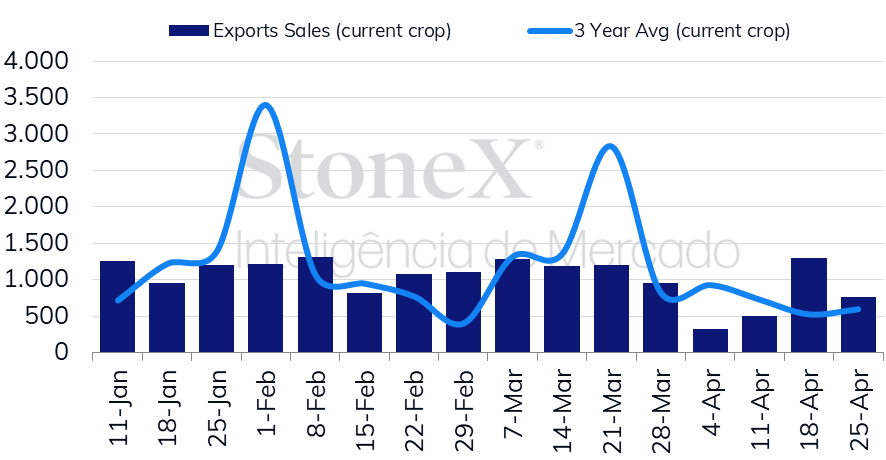
Source: USDA. Design: StoneX.
Brazil
On May 2, StoneX updated its estimate for the Brazilian 23/24 corn crop. Regarding the first corn crop, StoneX's production estimate increased from 25.9 to 26.1 million tonnes on a monthly basis, as a result of the rains that fell on states in the North/Northeast and resulted in positive adjustments in productivity.
Even so, it is worth noting that in the annual comparison, the summer crop did not achieve the same potential as last year due to a smaller area. The national acreage for the 23/24 cycle decreased by 13.5% compared to the 22/23 cycle.
For the second corn crop 23/24, StoneX raised its production estimate from 96.1 to 97.3 million tonnes, representing a monthly variation of 1.2%. Expected production was cut in São Paulo, Paraná, and Mato Grosso do Sul, with adjustments in the São Paulo area and a decrease in productivity in Paraná and Mato Grosso do Sul (due to the weather). Nonetheless, the expected growth in production in Mato Grosso and Goiás more than offset the losses in other states. The occurrence of rains in the largest corn producer in Brazil led the production of Mato Grosso to be estimated at almost 47 million tonnes, a figure still below last year's record but representing an increase of 2.7 million tonnes in the state estimate. In Goiás, the productivity review increased the expected production in the state from 12.2 to 12.7 million tonnes.
Making an overall assessment, the increase in monthly estimates is classified as a bearish factor for corn. To some extent, this rebound was not expected, mainly due to the problems faced by farmers in Mato Grosso do Sul and Paraná.
The focus now turns to the weather throughout May. Despite the critical period for the development of most crops being behind us, some regions of late planting are still subject to risks. It has rained in no producing state in the last seven days; for the next 14 days, the forecast is also for little or no rain. In this sense, new cuts in production estimates are still not ruled out.
About Rio Grande do Sul, the state does not produce second crop corn and the first crop corn harvest has been completed since early April. In this sense, the climate catastrophe that hit the state can only have affected the supply of corn in case silos and warehouses have been damaged. For now, it is still not possible to draw big conclusions.
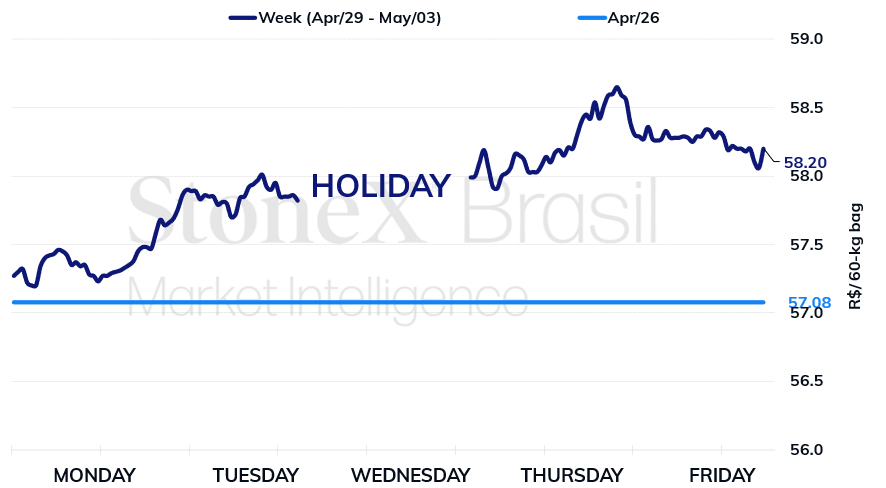
Intraday (15 min) July/24 contract - B3
Argentina
In its latest weekly report, the Buenos Aires Grain Exchange (BCBA) estimates that 22.1% of Argentine corn crops have been harvested. As approximately 70% of corn in Argentina is planted late (December-January), the harvest in the country usually only gains traction in June.
In this sense, the majority of the crops remain subject to the serious problems caused by the leafhopper. In particular, the northern portion of the Argentine agricultural belt is being severely impacted, with the BCBA classifying 17% of the acreage planted in this region as unharvestable. In areas that are still eligible for harvesting, an advancement of this activity is now expected, as the incidence of illnesses tends to accelerate the corn cycle.
Facing the problems recorded in northern Córdoba, northern Santa Fé, eastern Entre Ríos, and a large part of the provinces of the Northwest and Northeast, the BCBA now estimates the Argentine corn crop at 46.5 million tonnes, a decrease of 3 million tonnes compared to the previous estimate.
It's worth noting that until the beginning of March, BCBA's estimate was a production of 56.5 million tonnes. In other words, the crop failure is already at 17.7% and new cuts are not ruled out.
Future and spot prices
Futures contracts traded on the CBOT (US¢/bu)

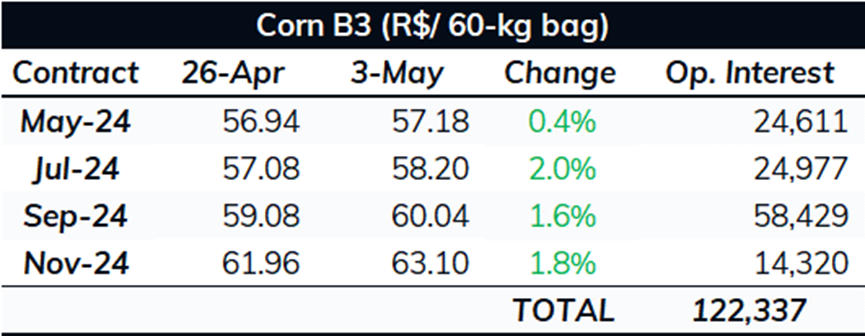
Future contracts traded on B3 (BRL/bag)
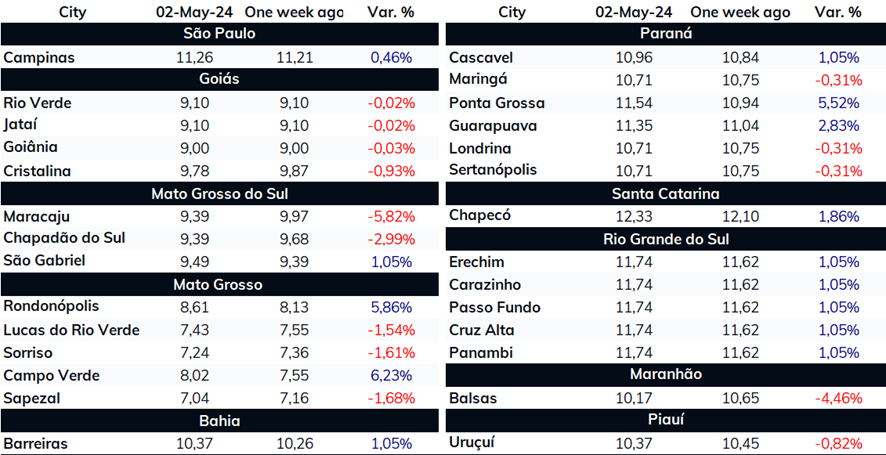
Spot prices in Brazil (USD/60kg bag)