- Bearish factors
- Outlook of high stocks at the end of the 23/24 and 24/25 crop years;
- Possibility of USDA having overestimated the reduction in corn planting area in the US.
- Bullish factors
- Drought in Paraná, Mato Grosso do Sul, and São Paulo;
- Spread of the leafhopper in Argentina;
- Planting delay in the United States;
- Funds exiting their short positions.
Overview
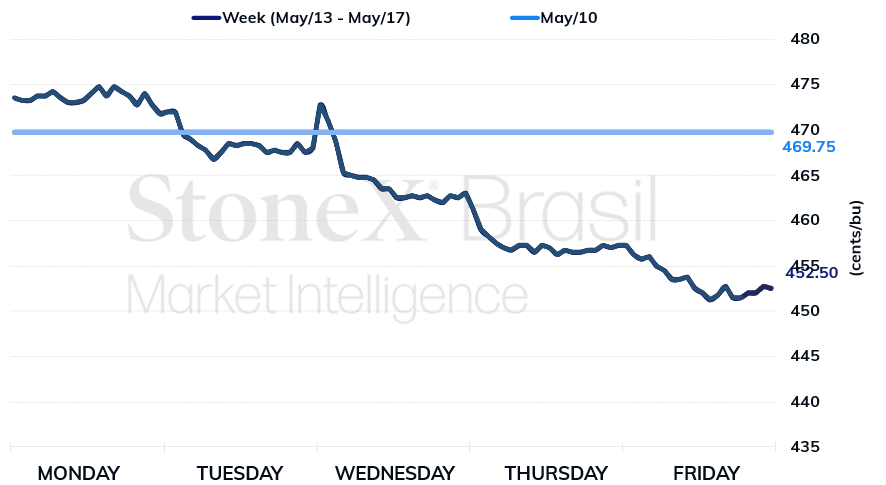
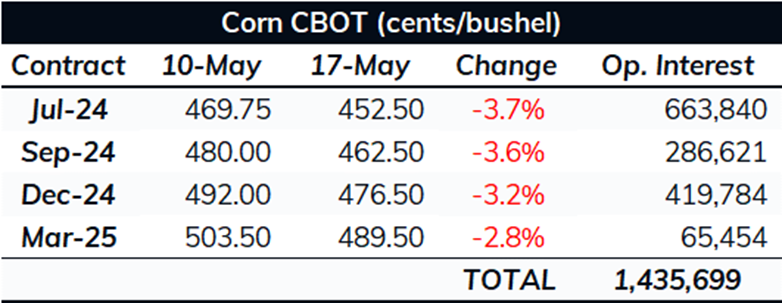
Last week (May 13 to 17), corn futures traded in Chicago acted lower, interrupting a sequence of three consecutive weeks of gains. The July contract ended the period quoted at 452.50 cents/bu, a weekly depreciation of 3.7%.
Three of the factors behind the losses stand out. First, the corn price was impacted by wheat devaluation on CBOT due to better supply prospects in the United States and Russia. Secondly, American corn exports were below the market's expectations, which raised concerns on the demand side. Finally, periods without rain in the agricultural belt of the United States were a phenomenon that brought the expectation of progress in planting.
In general, it is perceived that none of the factors behind the devaluations of last week represent significant changes in supply and demand fundamentals. In this sense, the variations in corn prices occurred mainly due to speculative issues with an emphasis on climatic issues.
In the short term, traders' most anticipated indicator is the planting progress in the United States, which will be released today (20). By May 12, 49% of the crops had been planted, a delay of 6 percentage points compared to the historical average. As mentioned, planting is expected to have advanced significantly, reducing the possibility of hectares being planted outside the ideal window. Today's disclosure will confirm or explain the frustration with that expectation.
In the medium term, American climate issues will become increasingly important. It is worth remembering that we are entering the period-denominated weather market, which peaks between June and July. As this is the time of year when the productivity of corn crops in the United States is defined, grain prices tend to be quite volatile on the Chicago exchange, reacting to changes in precipitation and temperature outlooks.
In addition to climate issues, inflation in the United States is another speculative factor that should impact corn quotes in Chicago. Last week, it was reported that the American consumer price index rose 3.4% in April annually, a lower value than the previous month but still keeping inflation in the United States from the 2% target. At the same time, the Fed rules out further interest rate hikes. For fund managers, persistent inflation and stagnant interest rates indicate the possibility of increased demand for commodities, which has led many of them to unwind their short positions in the corn market.
Intraday (15 min) July/24 contract - CBOT
United States
Currently, attention in the American corn market is focused on weather and planting progress. As these subjects have already been discussed in the first part of this report, here we will address issues that are less prominent but still important.
Starting with the export sales data, last week, the balance for corn was 742 tmt. As the market expectation was between 700 tmt and 1,050 tmt, the figure released was a bit disappointing. In the aggregate of the 2023/24 crop year, American exports are at 48.3 million tonnes. There are 17 weeks left to reach the USDA's estimate of 54.6 million.
Another important event last week was the Biden administration's announcement of a tariff package that will apply to import products from China. The measure should escalate the trade war between the two powers, potentially impacting Chinese purchases of American corn. In this sense, the dispute between the United States and China could increase Brazilian participation in Chinese corn imports.
US export sales (tmt)
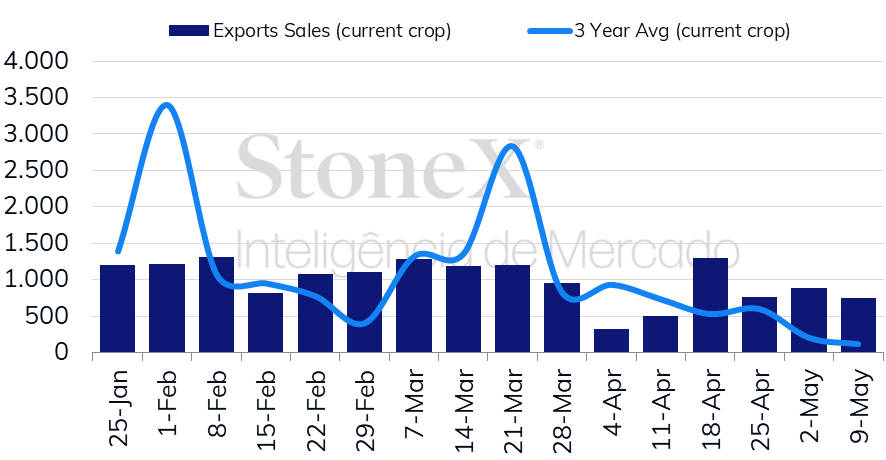
Source: USDA. Design: StoneX.
Brazil
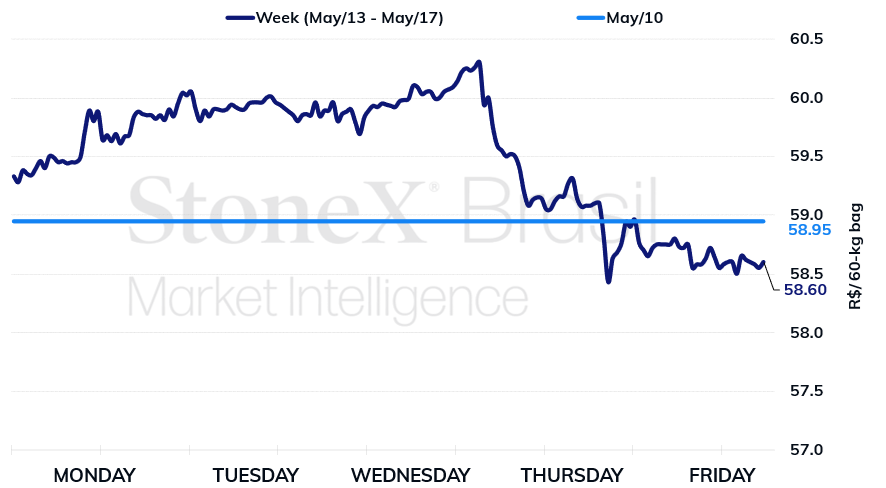
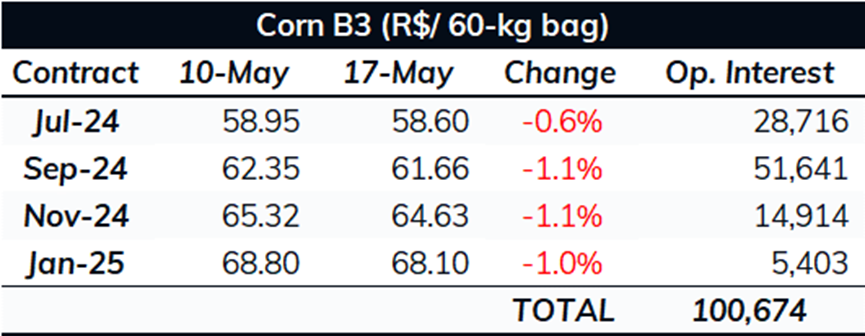
Last week, corn futures depreciated on B3, following the movement in Chicago. The July contract ended the period quoted at R$ 58.60/bag, a weekly depreciation of 0.6%. It is worth noting that Wednesday (15) was the last day of trading for the contract expiring in May.
Also, CONAB updated its estimate for the Brazilian corn crop last week. What drew the most attention was the maintenance of the disparity between this institution's number and that of the USDA, something that has been happening since the beginning of the 2023/24 crop year: while the USDA estimates the production of 122 million tonnes, Conab estimates the production of 111.6 million tonnes, a volume 8.5% lower.
The difference between the estimates mainly arises from disagreements regarding the production area. The American Department estimates a much larger corn planting area than CONAB. StoneX believes that the USDA's area figure is closer to reality.
Finally, it is worth highlighting the issues involving climate. In the last week, almost no rain fell in the Brazilian regions that produce second-crop corn, a trend that has happened since the beginning of May. This can result in productivity losses, especially in states that suffered drought throughout April, especially Paraná, São Paulo, and Mato Grosso do Sul. Last Friday (17), StoneX estimated that 0.4% of the inter-crop had been harvested.
Intraday (15 min) July/24 contract - B3
Argentina
Due to the spread of the leafhopper in the northern part of the country, the Buenos Aires Grain Exchange now classifies only 54% of Argentina's corn crops as normal, good, or excellent. The institution maintained its production estimate at 46.5 million tonnes.
Last year, the percentage of crops in normal, good or excellent conditions was close to 47%, resulting in a harvest of 34 million tonnes. This means the current estimate for crop conditions is only 15% higher than last year, while the production estimate is 37% higher. Therefore, new cuts in the estimates are possible.
Turning our attention back to the harvest, it continues at a lagging pace. By May 15, only 25.4% of the crops had been harvested, a delay of 8.3 percentage points compared to the average of the last 5 years.
Finally, it is worth noting that the Buenos Aires Grain Exchange warned of the risk of frosts.
Argentinian corn crops under normal, good or excellent conditions
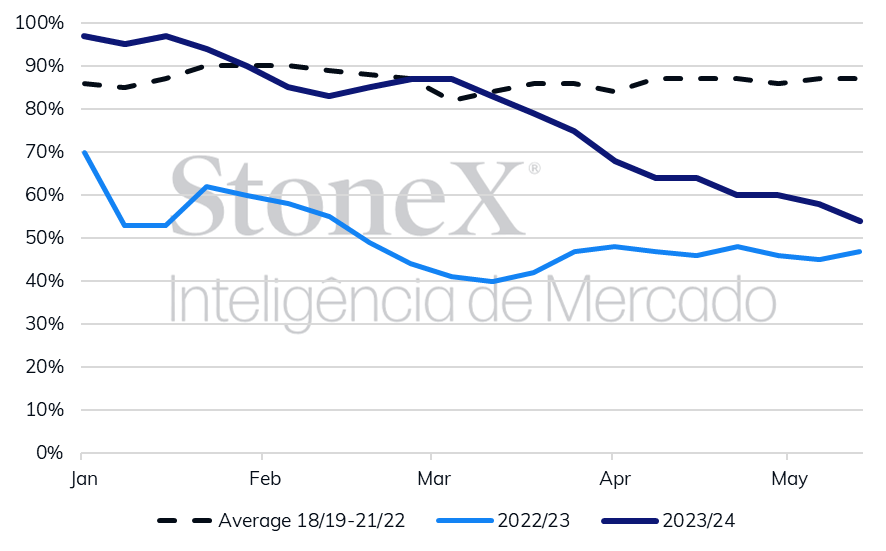
Source: Buenos Aires Grain Exchange. Design: StoneX.
Future and spot prices
Futures contracts traded on the CBOT (US¢/bu)

Future contracts traded on B3 (BRL/bag)
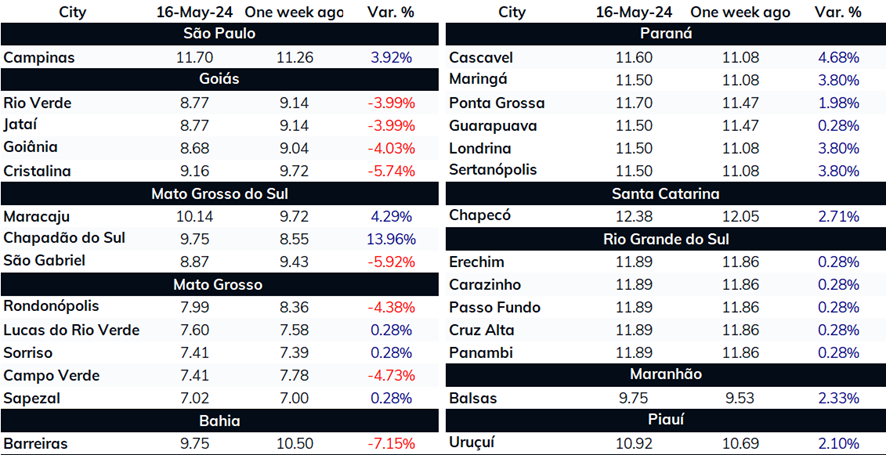
Spot prices in Brazil (USD/60kg bag)