- Bearish Factors
- Outlook of high stocks at the end of the 23/24 and 24/25 crop years;
- Possibility of USDA having overestimated the reduction in corn planting area in the US;
- Planting in the USA happening within the ideal window.
- Bullish factors
- Drought in Paraná, Mato Grosso do Sul, and São Paulo;
- Spread of the leafhopper in Argentina;
- Funds exiting their short positions;
- Appreciation of wheat due to weather problems in Russia and Ukraine.
Overview
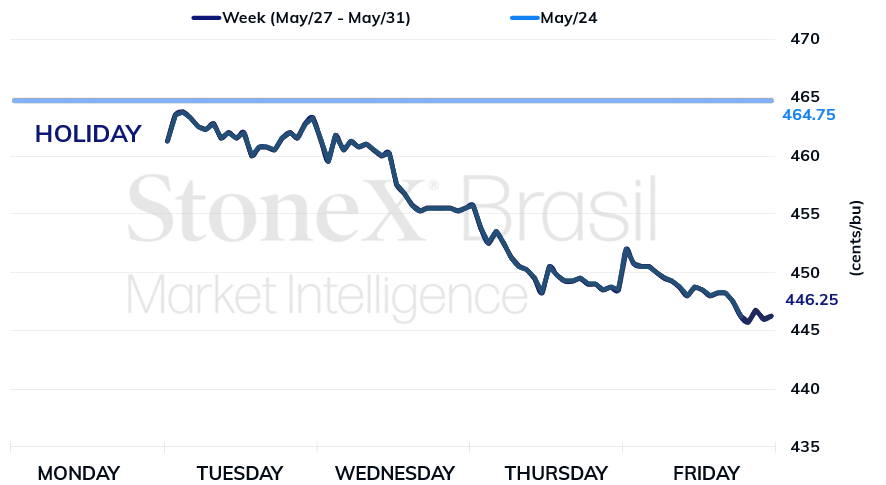
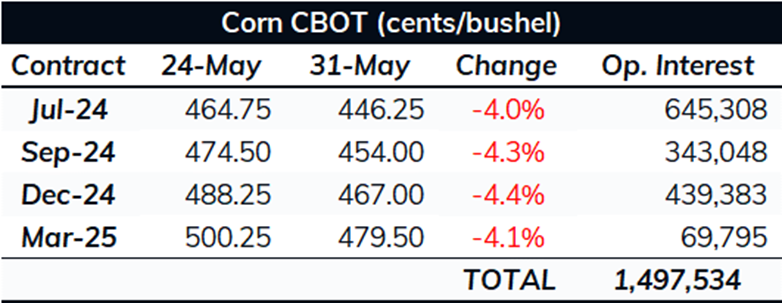
Last week (May 27 to 31), corn futures depreciated on the Chicago exchange, giving back some of the gains that had been happening since mid-February. At the end of the period, the July contract was quoted at 446.25 cents/bu, a weekly depreciation of 4.0%.
The main factor behind the losses was the significant advancement of corn planting in the United States, which went from 70% on May 19 to 83% on May 26. These figures indicated to the market that the probability of many hectares being planted outside the ideal season is low, which tends to be favorable for the good development of the crop.
Another factor that contributed to the devaluation of corn was the decline in the wheat price. This happened because some weather models indicated that it would rain in the producing regions of Russia and Ukraine that had been suffering from drought.
In the coming days and weeks, the maintenance or not of the downtrend will depend mainly on the data related to the conditions of the North American corn crops, which will replace planting data as the main price drivers. The expectation is that today (3) the USDA will release its first estimate related to this.
From a broader perspective, the scenario for corn remains uncertain. On one hand, the deflation of commodities, a phenomenon that marked the market throughout the years 2022 and 2023, is no longer dominant, a bullish factor for the corn price. The change is related to the intensification of geopolitical risks and the resilience of global demand, factors that inflated a series of commodities throughout 2024, with emphasis on oil and natural gas.
On the other hand, supply and demand data continue to show a comfortable balance for the corn market in the 23/24 and 24/25 cycles, a bearish factor for prices. However, it is clear that the confirmation or not of this estimate still depends on many factors, with the main one, at the moment, being the development of the United States crop.
Therefore, the agents operating in the corn market must pay attention mainly to the price of other commodities and the unfolding of the North American crop.
Two other important issues have emerged in the corn market over the past few days: StoneX's new crop estimate for Brazil and China's release of imports of Argentine corn. Both will be discussed in detail in the sessions below.
Intraday (15 min) July/24 contract - CBOT
United States
In the last week, supply fundamentals became more bearish in the United States due to the progress of planting. As this subject was extensively discussed in the first session of this report, we will not go into details here.
Regarding the demand fundamentals, they have become slightly more bullish. In exports, the FOB price of the United States has become very similar to that of Ukraine, Brazil, and Argentina, a rare situation in recent years that has increased the competitiveness of Americans in the international market. In this scenario, the USDA's estimate that the United States will export 54.6 million tonnes throughout the 23/24 cycle becomes more likely. With 15 weeks left until the end of the cycle, export sales have already reached 50.0 million tonnes.
Talking about the ethanol sector continues to demand corn volumes above the historical average. With summer approaching, the plants have already started producing more ethanol, anticipating the increase in demand from families, who usually travel more during this period. In the week ended on May 24, the United States produced 1,068 thousand barrels of ethanol per day, a weekly increase of 4.8% and 6.4% compared to the same period last year.
US export sales (tmt)
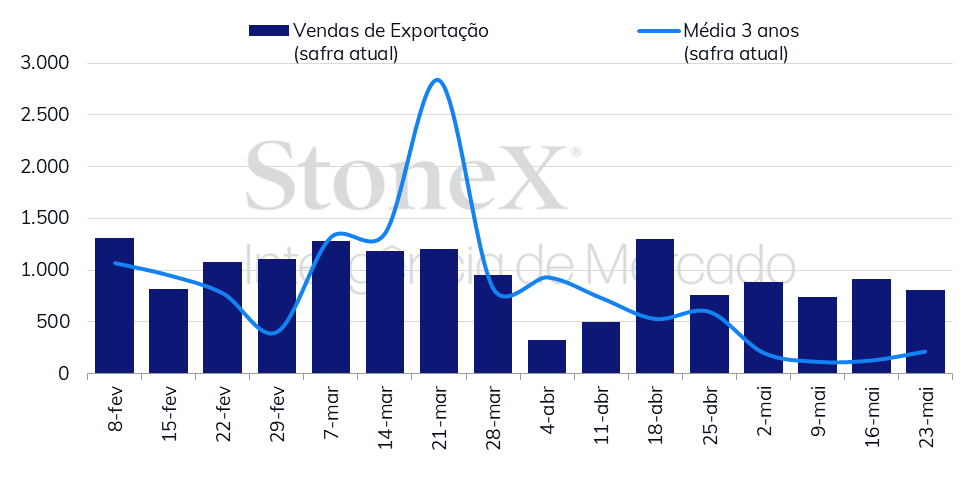
Source: USDA. Design: StoneX.
Brazil
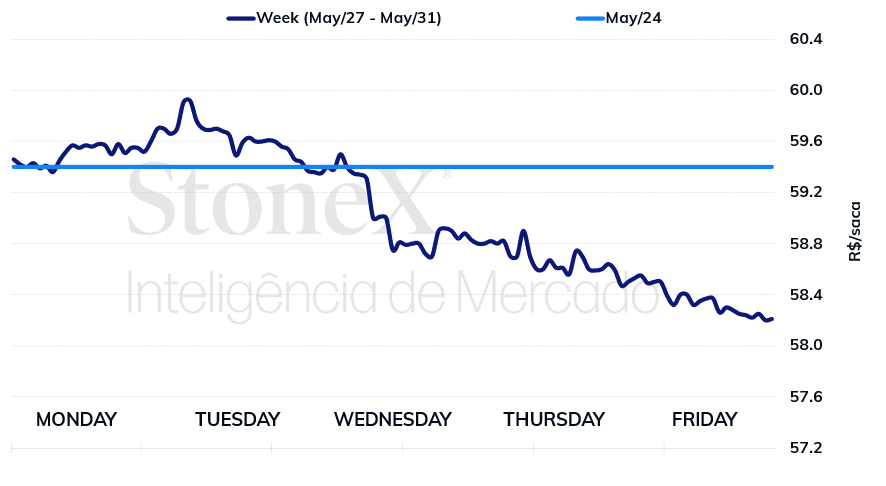
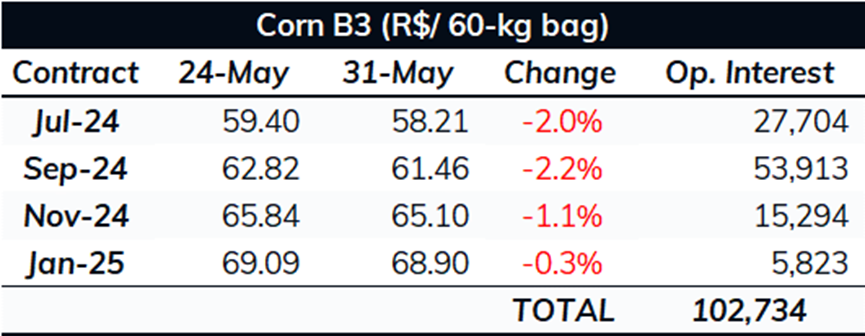
On the last Friday of May, the second corn crop reached 6.4%. The states where the activity is most advanced are Paraná and Mato Grosso, regions where the harvest reached 11% and 8.7%, respectively. Adding this increase in domestic supply with the devaluation of corn in the Chicago exchange, the result was losses for corn in B3 throughout last week (May 27 to 31). At the end of the period, the July contract was quoted at R$ 58.21/bag, a weekly depreciation of 2.0%.
In addition to harvest data, StoneX also updated its estimate for the Brazilian 23/24 corn crop. For summer corn, already 90% harvested, the figure of 26.1 million tonnes was maintained, a volume 8.9% lower than the previous cycle.
As for the second corn crop, significant reductions in productivity were made for Mato Grosso do Sul (-18.6%), São Paulo (-17.4%), Paraná (-9.2%), and, to a lesser extent, Goiás (-2.0%), as a consequence of the dry weather that prevailed in much of the country throughout May. The production of Mato Grosso, Pará, and Maranhão was adjusted upwards, but this was not enough to offset the losses of the other states. Now, StoneX estimates the production of 93.5 million tonnes of second-crop corn in the 23/24 season, a decrease of 3.9% compared to the May estimate and 13.7% compared to the 22/23 crop.
Intraday (15 min) July/24 contract - B3
Argentina
The Chinese government has approved the import of hybrid varieties of genetically modified corn available in Argentina. The expectation is that the first batches will start to be shipped in July.
This measure can bring important changes for Brazilian exporters. Historically, China heavily relied on the United States and Ukraine to meet its needs. However, in 2023, with the approval of Brazilian imports, Brazil quickly became the main trading partner of the Asian country, gaining significant market share. Now, with Argentina's crop becoming available, Brazilians may end up forfeiting space, as there is now another important player operating in the Chinese market.
Turning our attention to the Argentine crop 23/24, the harvest advanced 1.7 percentage points in the weekly comparison, reaching 30.1%. At the moment, productivity is at 134.2 bags/hectare (8.05 ton/ha), but the expectation is that this value will decrease as late-planting crops begin to be harvested.
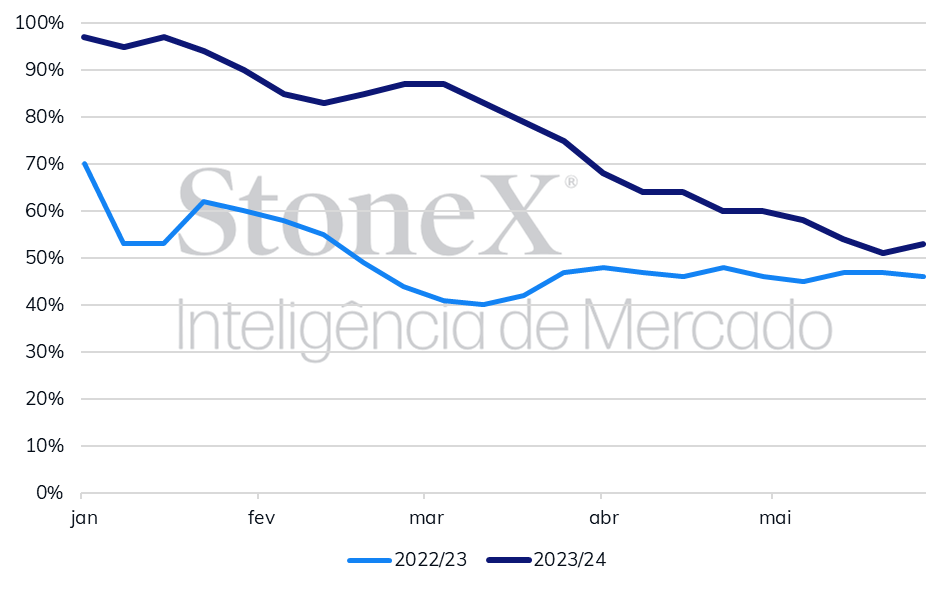
Regarding crop conditions, the Buenos Aires Grain Exchange (BCBA) estimated a slight improvement in the weekly comparison, with the average percentage rated as fair, good, or excellent rising from 51% to 53%. There are indications, therefore, that the leafhopper is no longer spreading rapidly. With that, the BCBA maintained its production estimate at 46.5 million hectares.
Argentinian corn crops under normal, good, or excellent conditions
Source: Buenos Aires Grain Exchange. Design: StoneX.
Future and spot prices
Futures contracts traded on the CBOT (US¢/bu)

Future contracts traded on B3 (BRL/bag)
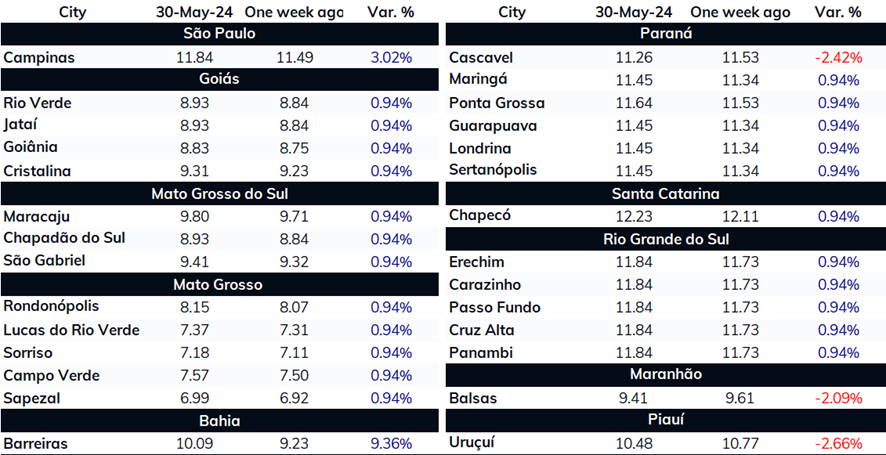
Spot prices in Brazil (USD/60kg bag)