- Bearish Factors
- Expectation of high stocks at the end of the 23/24 and 24/25 crop years;
- Possibility of USDA having overestimated the reduction in corn planting area in the US;
- Safrinha harvest progress;
- Planting in the USA happening within the ideal window;
- Good condition of US crops.
- Bullish factors
- Drought in Paraná, Mato Grosso do Sul, and São Paulo;
- Spread of the leafhopper in Argentina;
- Dry and hot weather in parts of China;
- Delay in the marketing pace in Brazil and the United States.
Overview
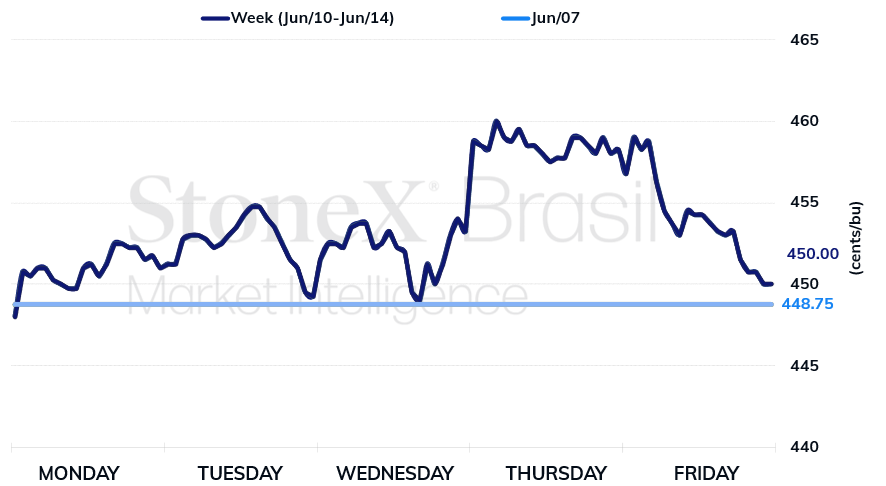
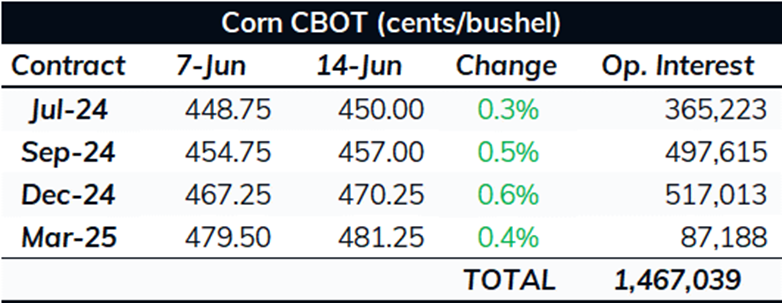
Last week (June 10 to 14), corn futures traded in Chicago did not vary uniformly, alternating days of gains and losses. At the end of the period, the July contract traded at 450 cents/bu, a weekly variation of just 0.3%.
This is because the last few days have marked the official start of the so-called weather market: on Wednesday and Thursday, some of the weather models indicated hot and dry weather in the United States throughout the end of June, increasing prices. Then, on Friday, forecasts began to show a higher volume of rain, leading to falls. This dynamic of price variations due to changes in weather outlooks will continue to be present in the corn market at least until the end of July. At the time this report is written, the forecast for the next few days in the agricultural belt of the United States is for good rainfall volumes and maximum temperatures not exceeding 30º C.
Another issue that has impacted the quotes is the marketing pace in Brazil and the United States. In both countries, producers are not satisfied with the current price level, playing hardball when it comes to making their stocks available. This phenomenon has a bullish impact on quotes, as it produces small rallies in the spot market when tradings and cooperatives are forced to increase supply prices to increase marketing. It is worth remembering that only 30.7% of the Brazilian second corn crop was marketed at the beginning of June, the slowest pace since the 16/17 cycle. StoneX will release an update of this estimate in the coming weeks.
Finally, it is worth noting that several institutions updated their supply and demand estimates in the last week, although the figures did not bring any major news. For the United States, the USDA maintained its outlook unchanged for the 23/24 and 24/25 crops. With that, the estimate still shows supply surpassing demand throughout the next crop year, which shows that the market fundamentals are bearish in the absence of weather problems. For Brazil, the USDA kept the production for 23/24 at 122 million tonnes, while CONAB increased its estimate to 114.2 million tonnes, narrowing the gap between the figures of the institutions. The only surprise came from Argentina. It was expected that USDA would cut its production estimate due to the impacts caused by the leafhopper, but the figure of 53 million tonnes was maintained. It is worth mentioning that the Buenos Aires Exchange estimates the Argentine crop at 46.5 million tonnes and the Rosario Exchange at 47.5 million.
In addition to these three major subjects, some other factors are influencing the corn quotes in Chicago and will be discussed in more detail in the sections below. On the downside, the progress of the safrinha crop harvest in Brazil and positive conditions for the United States crop stand out. During the high season, the highlight is the drought in parts of the corn belt in China and good export volumes in the United States.
Thinking in the short/medium term, the direction of prices is projected to be determined by the unfolding of the North American crop, despite the issues that have been raised here. In this sense, the market already has a date marked on the calendar: June 28, the day when USDA will release the final planting area figures in the United States for the 24/25 cycle, a key factor in determining the size of the crop.
Intraday (15 min) July/24 contract - CBOT
United States
Na 2ª feira da semana passada (10), o USDA atualizou sua estimativa de plantio e de condição das lavouras nos Estados Unidos. Para o milho, os dados mostraram que a semeadura está praticamente finalizada, tendo alcançado 96%. Sobre as condições, o Departamento norte-americano indicou que 74% das lavouras estão boas/excelentes, recuo semanal de 1 ponto percentual, mas que ainda mantém a qualidade da safra atual bem acima do registrado no mesmo período do ano passado (61%) e acima da média dos últimos cinco anos para o período (67%). Hoje (17), às 17h, o USDA divulgará nova atualização desses números.
Sobre o relatório de oferta e demanda do USDA, não houve alterações nos dados referentes aos Estados Unidos. Com isso, os números para a safra 24/25 seguem mostrando oferta superando demanda: enquanto estoques iniciais (53,4 milhões de toneladas) e produção (377,5 milhões) somam 430,9 milhões de toneladas, consumo doméstico (320,2 milhões) e exportações (55,9 milhões) somam “apenas” 376,1 milhões de toneladas. Nesse sentido, caso a safra siga se desenvolvendo sem grandes problemas, os Estados Unidos deverão encerrar o ciclo 24/25 com um enorme estoque de passagem, fator baixista para as cotações. Entretanto, é claro que ainda há muito chão a ser percorrido.
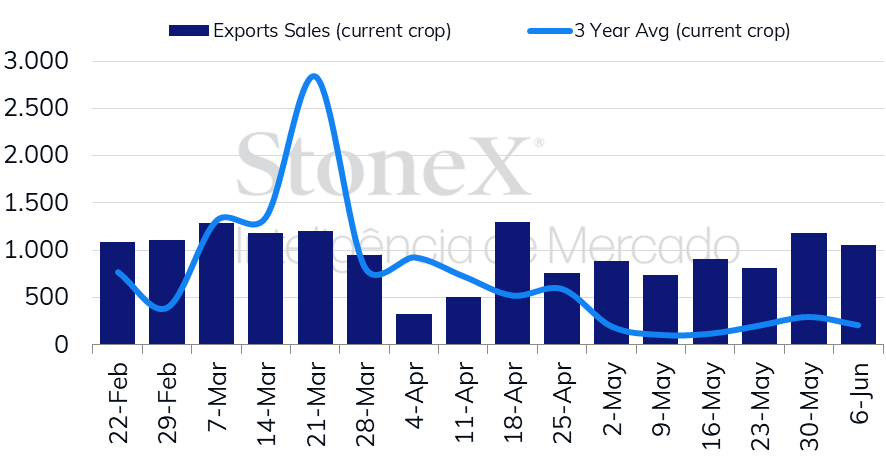
Voltando as atenções para a demanda, na quinta-feira foram divulgados os dados de vendas de exportação de milho para a semana encerrada dia 7 de junho. Eles mostraram a venda líquida de 1,06 milhão de toneladas de milho, volume muito acima da média dos últimos três anos para o período, que é de apenas 214 mil. Com isso, as vendas de exportação dos Estados Unidos no ciclo 23/24 alcançaram 52,3 milhões de toneladas, volume muito próximo da estimativa do USDA de 54,6 milhões. Nesse ritmo, as exportações provavelmente ultrapassarão a estimativa do USDA.
US export sales (tmt)
Source: USDA. Design: StoneX.
Brazil
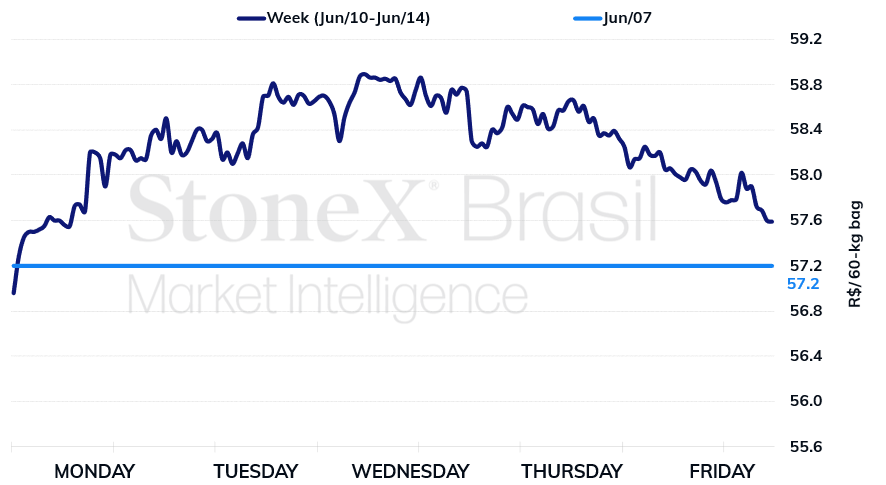
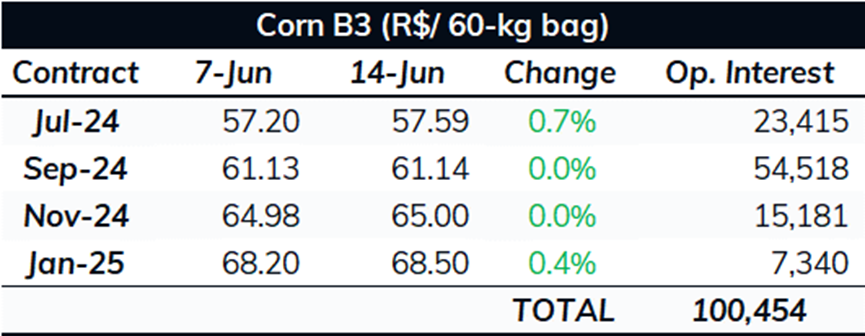
Just like on the CBOT, corn futures traded on B3 did not show a clear direction throughout the last week (June 10 to 14). After gains on Monday, stability in the following three days of the week, and a drop on Friday, the weekly balance was of small gains for the July contract. At the end of the period, it was quoted at BRL 57.59/bag, a weekly variation of 0.7%.
In addition to the exchange prices, corn basis at the port of Santos was also a highly discussed topic in Brazil over the past week. As the marketing of the crop is slow, often tradings are being forced to increase their supplies, positively impacting basis. This phenomenon occurred at the beginning of last week, but lost strength in the last few days, keeping the basis practically unchanged in the weekly comparison: for shipment in August, last Friday's basis (14) was +60 cents/bu, compared to +65 cents/bu a week before that.
Regarding the "safrinha" (second crop), StoneX estimates that 16.8% of the crops had been harvested on June 14, compared to 7.6% on the same date last year. Bringing regional data, the harvest was at 22.3% in Mato Grosso, 20.0% in Paraná, 10.8% in Mato Grosso do Sul, 9.5% in São Paulo, and 4.5% in Goiás. In Minas, the harvest had not yet begun.
Finally, crop estimate data. The USDA did not bring changes to its figures for the Brazilian crop 23/24, keeping production at 122 million tonnes. CONAB, on the other hand, increased its production estimate, which went from 111.6 million tonnes to 114.1 million. The increase was attributed to improvements in productivity in Mato Grosso, Pará, Tocantins, and parts of Goiás, which offset the drought faced by Mato Grosso do Sul, Paraná, and São Paulo. Now, the difference between the USDA and CONAB has dropped to 7.8 million. Last year, the two agencies had a difference of 5.2 million tonnes in their final count and, in the previous year, there was a difference of 2.7 million. The history shows that CONAB is more likely to increase its final estimate than USDA will decrease theirs.
Intraday (15 min) July/24 contract - B3
Argentina
In early March, before the spread of the leafhopper, the USDA, the Buenos Aires Grain Exchange (BCBA), and the Rosario Chamber of Commerce (BCR) had very similar estimates for the 23/24 corn crop in Argentina: 56 million, 56.5 million, and 57 million tonnes, respectively.
As the leafhopper started to spread throughout the northern region of the country, the two Argentine exchanges began to significantly cut their estimates. In early May, BCBA estimated the crop at 46.5 million tonnes, a decrease of 18%, and BCR estimated it at 47.5 million tonnes, a decrease of 17%.
Last week, both institutions updated their estimates of the harvest but maintained the figures from early May, an indication that the problems caused by the leafhopper have already been largely accounted for. Still, it is worth noting that BCR did not rule out further cuts.
The USDA also updated its estimate last week but kept the figure at 53 million tonnes, a decrease of "only" 5% compared to the March number. The stability in Argentine production surprised the market, which expected more significant cuts that would bring the USDA estimate closer to the levels of the Argentine exchanges.
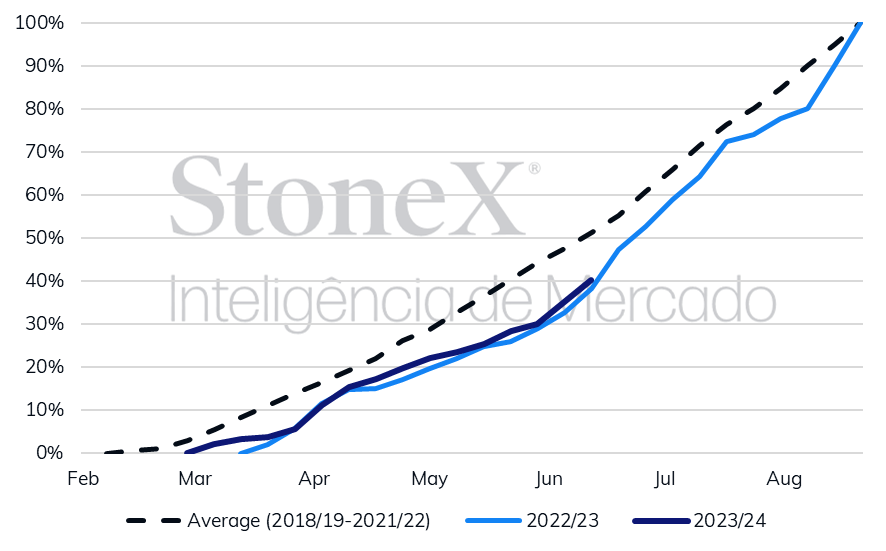
In addition to the crop estimate, last week we had the traditional update of the harvest figures from BCBA. According to the institution, 40.3% of the country's corn crops have been harvested, a weekly increase of almost 5 percentage points. The harvest accelerated in the last two weeks, as late corn, dominant in the Argentine market, finally reached the ripening period.
The productivity of harvested hectares is at 7.53 tons/ha(125.5 bags/ha), but the expectation is that this will decrease as the harvest progresses since the corn most affected by the leafhopper was the late-planted one. At the moment, the BCBA estimates the final productivity of the Argentine crop at approximately 6.26 tons/ha (104 bags/ha)
Corn harvest in Argentina
Source: Buenos Aires Grains Exchange. Design: StoneX.
China
The Chinese government estimates that China will produce 297 million tonnes of corn in the 24/25 crop year, while the United States government estimates production of 292 million tonnes. These figures place the Chinese as the second-largest corn producers in the world, behind only the US.
In this sense, a heatwave that has affected part of the Chinese agricultural belt has worried the corn market, as this could mean a crop failure and, consequently, a significant increase in imports. It is worth remembering that China has a calendar similar to that of the United States in the corn market, which means that the planting of the crop is about to end, with the crops entering the development period.
Despite the situation being concerning, some considerations need to be made. First of all, the area affected by drought, called the North China Plain, is not the one that produces the most corn in the country, representing something close to 20% of the acreage. Secondly, analysts from StoneX based in Shanghai point out that the North China Plain has an extensive irrigation system, which should mitigate the impacts of drought. Finally, and perhaps most importantly, is the fact that last year China also faced drought during May and June, but this ended up having little impact on the final productivity of the crops.
In conclusion, the situation in China is concerning and should be closely monitored, but there is still not enough evidence to speak of crop failure.
Future and spot prices
Futures contracts traded on the CBOT (US¢/bu)

Future contracts traded on B3 (BRL/bag)
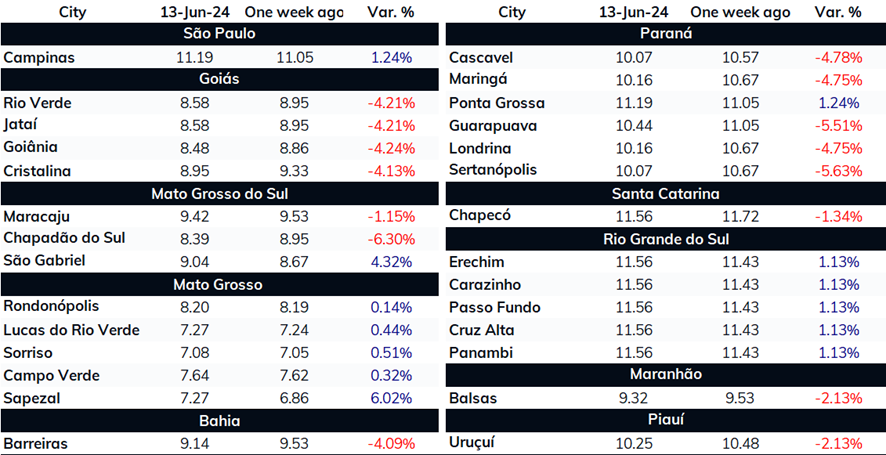
Spot prices in Brazil (USD/60kg bag)