- Bearish Factors
- Expectation of high stocks at the end of the 23/24 and 24/25 crop years;
- Possibility of USDA having overestimated the reduction in corn planting area in the US;
- Safrinha harvest progress;
Good condition of American crops.
- Bullish factors
- Drought in Paraná, Mato Grosso do Sul, and São Paulo;
- Spread of the leafhopper in Argentina;
- Dry and hot weather in parts of China;
- Delay in the marketing pace in Brazil and the United States.
Overview
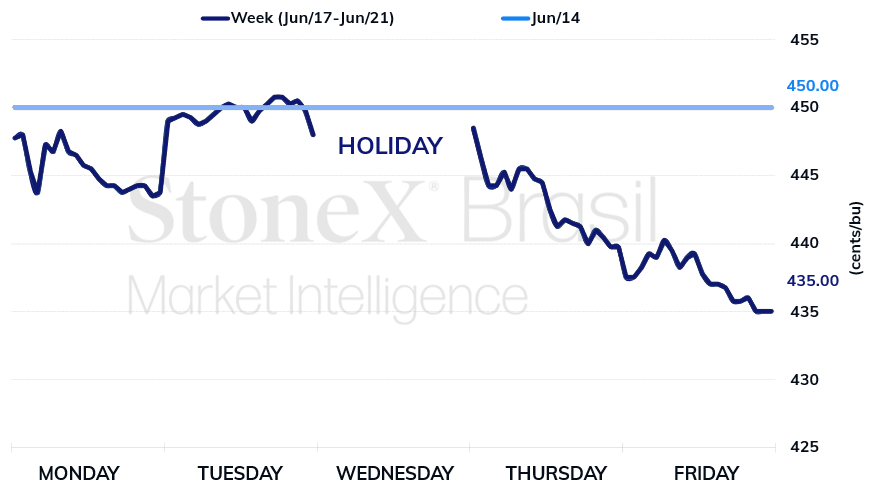
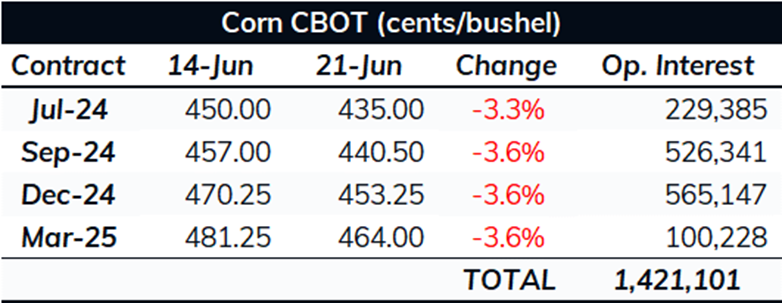
In June, there is a bearish sentiment dominating corn trading on the Chicago exchange. Last week (06/17-06/21), the futures contract with expiration in July traded at 435 cents/bu, which is a weekly depreciation of 3.3%.
This is due to the positive forecasts for the 24/25 North American crop. In the USDA's weekly report for June 16, 72% of corn crops were classified as good/excellent, a 2-percentage point drop compared to the previous week, but still the highest value in the last five years for the period.
Weather models indicate that for the next two weeks, the agricultural belt of the United States will continue to receive good volumes of rain, a sign that the crops will continue to develop without major problems.
In addition to the weather in the United States, the appreciation of the USD was another topic that stood out in the corn market last week. This phenomenon negatively influences the corn price because it makes exports from Brazil, Argentina, and Ukraine more competitive, which ends up exerting bearish pressure on the price of American exports.
Furthermore, it was a week with little news in the corn market, mainly because CBOT did not open on Wednesday due to a holiday in the United States. For the current week, expectations are very high, as on Friday (28) the USDA will release the final acreage figures in the United States, a highly anticipated report by the market.
In the planting intentions report released on March 28, the USDA indicated that American farmers would plant 36.44 million hectares of corn and 35.01 million hectares of soybeans. If the acreage report shows values very different from this, we may have significant changes in the quotes of grains and oilseeds. Before the March report, many analysts, including StoneX's chief economist Arlan Suderman, estimated a larger corn area than what was disclosed.
Intraday (15 min) July/24 contract - CBOT
United States
Last Monday, the USDA did not release data for corn planting in the United States, indicating that the grain planting is almost complete. On that date, it was reported that 72% of the crops were in good/excellent condition, a percentage significantly higher than the previous year (55%) and the average of the last five years (64%). This suggests that the American crop is off to a strong start this harvesting season.
However, there are some concerns. The 72% represented a weekly decrease of 2 percentage points, as some important states experienced quality losses. In Illinois, for example, crops in good/excellent conditions decreased from 74% to 65% due to heat and lack of rain. Additionally, the drought and heat affected Ohio (-7 p.p.), while excess rainfall resulted in quality losses in South Dakota (-5 p.p.), Nebraska (-3 p.p.), and Minnesota (-3 p.p.).
For the update of the conditions that will be released today (24), it is possible that the heavy rains in Iowa and other regions may have resulted in new quality losses. There is also concern about drought and high temperatures in the eastern agricultural belt. Despite this, USDA data does not show significant drops in crop quality.
On the demand side, corn export sales for the week ending on June 14th totaled 511 thousand tonnes, significantly higher than the average of the last three years for the same period, which was 144 thousand tonnes. Even so, the disclosure was a bit disappointing as the market was expecting something between 700,000 and 1.2 million tonnes. However, with more than ten weeks remaining in the crop year, the USDA will likely need to revise its estimate for exports upwards, which is a bullish factor for quotes.
In the week ending on June 14, the ethanol sector consumed 1,057 thousand barrels per day, a volume very similar to the previous year's consumption of 1,052 thousand barrels per day. This figure is 4.6% higher than the average consumption over the last five years. The data indicates that the ethanol sector continues to consume high volumes of corn.
US export sales (thousand tonnes)
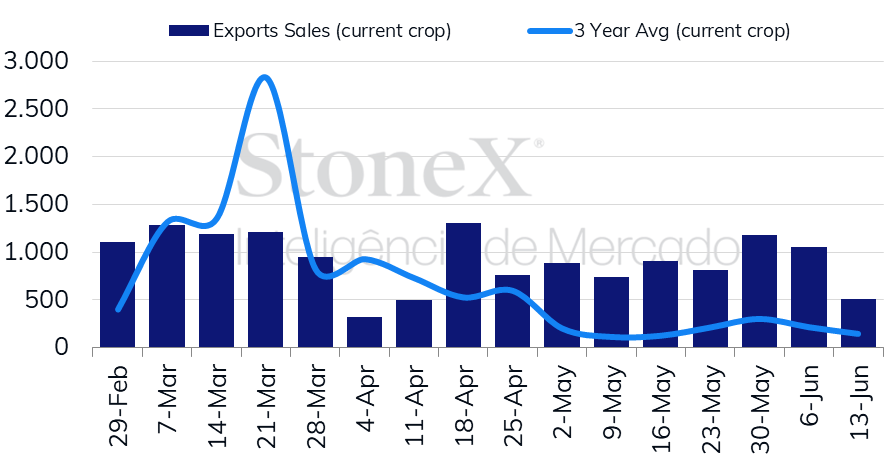
Source: USDA. Design: StoneX.
Brazil
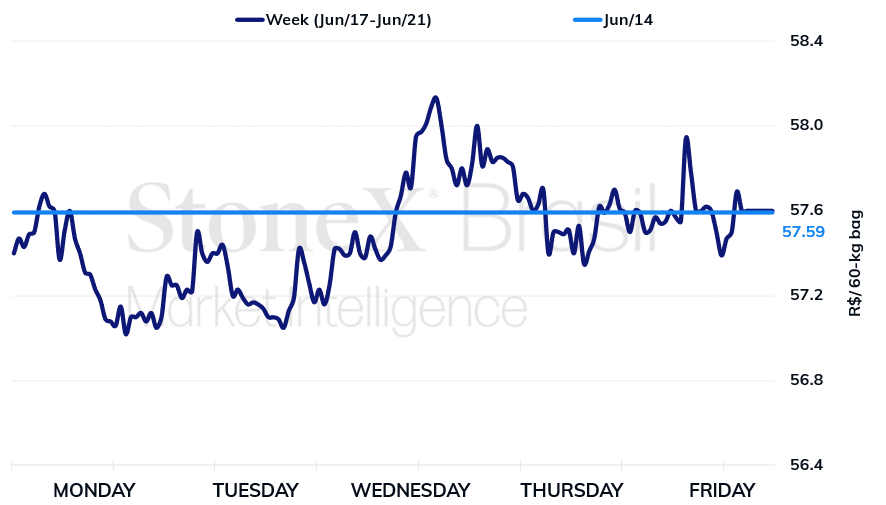
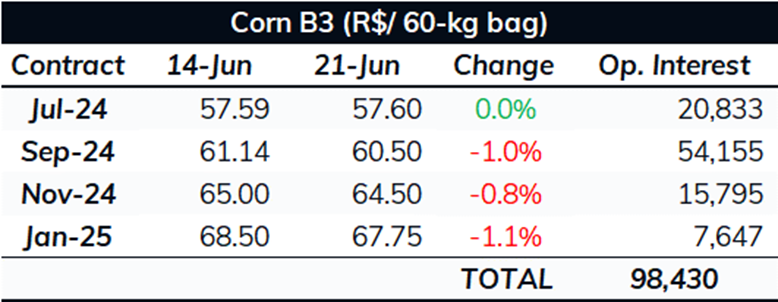
The corn futures market on B3 experienced volatility last week (06/17-06/21). Prices saw significant losses on Monday and Thursday but posted important gains on Wednesday. Throughout the week, the July contract was quoted at R$ 57.60/bag, the same as the previous week's closing price.
Besides the price of corn, market participants also closely monitored the dollar. Last week, the dollar surpassed the range of R$ 5.40 for the first time since January 2023, influenced by both external factors (maintenance of interest rates in the United States) and internal factors (fiscal uncertainties). For the FX Weekly Overview, click here.
On the supply side, Brazil saw significant progress in the harvest and commercialization of corn. According to StoneX's survey, 28.6% of the second crop had been harvested by last Friday (21), the highest percentage in the last three years for the period. However, only 32.7% of the second crop was marketed on June 20, the lowest percentage in the last six years for that period. The harvest progress is contributing to lower prices, while the delay in commercialization is providing some support.
In terms of demand, corn exports are picking up pace due to the progress in the harvest. Brazil exported 392 thousand tonnes of corn in the first two weeks of June, compared to 421 thousand tonnes in the entire month of May. However, exports are 14.4% lower than in the same period last year.
Intraday (15 min) July/24 contract - B3
Argentina
On the last Wednesday (19), the harvest in Argentina reached 49.3%, a significant weekly advance of 9 percentage points. If the weather allows, the harvest is projected to be completed by mid-August.
As expected, the yield in regions in the northern part of the country is low due to the impacts caused by the leafhopper, which contrasts with the good yields in the southern part. In the province of Córdoba, for example, the trend yield in the central-northern portion is only 4.34 ton/ha (72.3 sc/ha), while in the south it is 8.17 ton/ha (136.2 bags/ha).
As poor yields in the north were already expected, the Buenos Aires Grain Exchange maintained its production estimate at 46.5 million tonnes.
Corn harvest in Argentina
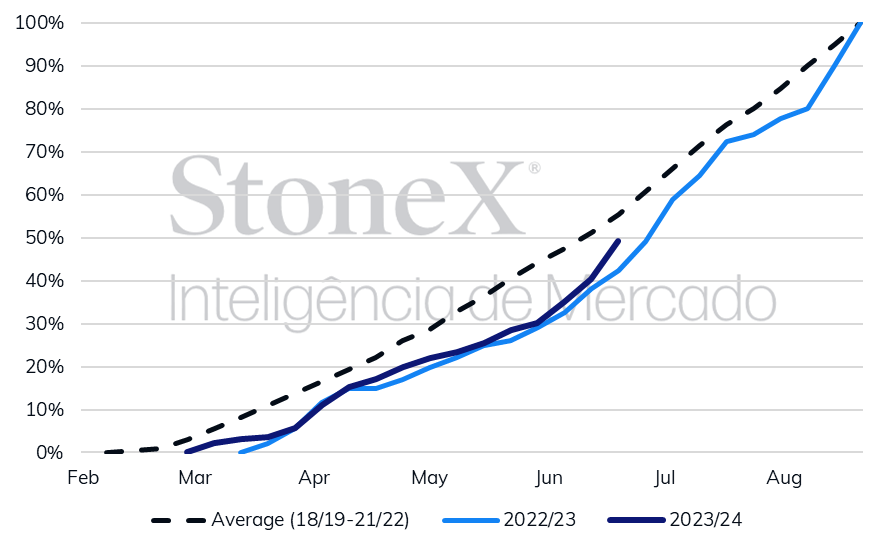
Source: Buenos Aires Grains Exchange. Design: StoneX.
Future and spot prices
Futures contracts traded on the CBOT (US¢/bu)

Future contracts traded on B3 (BRL/bag)
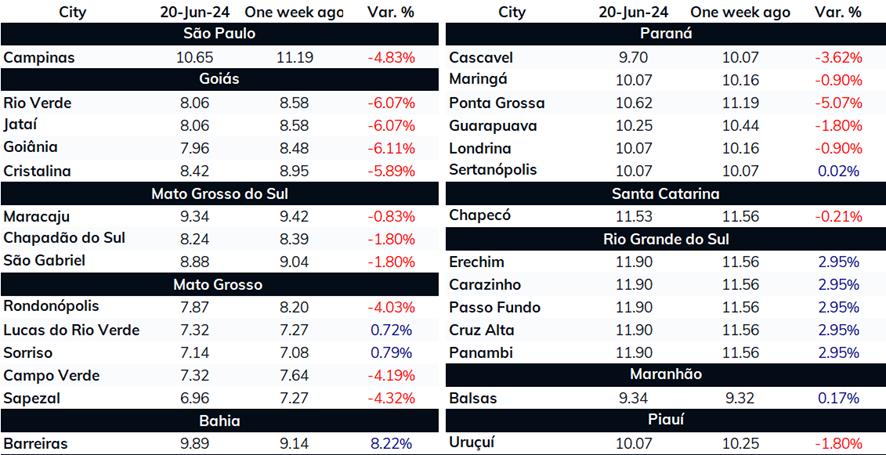
Spot prices in Brazil (USD/60kg bag)