- Bearish Factors
- Expectation of high stocks at the end of the 23/24 and 24/25 crop years;
- Acreage in the United States above expectations;
- American stocks above expectations;
- Safrinha harvest progress;
- Good condition of US crops.
- Bullish factors
- StoneX estimates that the Brazilian second crop 23/24 will be 14.5% lower than 22/23;
- Spread of the leafhopper in Argentina;
- Delay in the marketing pace in Brazil and the United States.
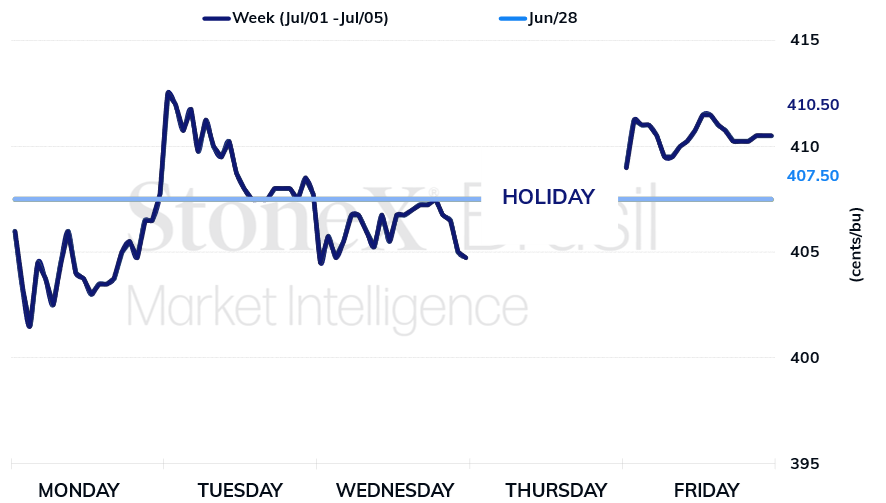
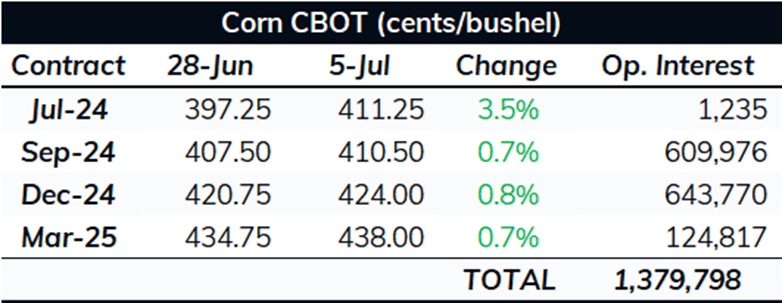
Last week (July 1 to 5), the corn futures contracts traded on the CBOT varied little. At the end of the period, the September contract was quoted at 410.50 cents/bu, a weekly variation of only 0.7%.
The low volatility of the contracts was largely related to the Fourth Of July holiday, which caused the Chicago exchange to be closed on Thursday and limited liquidity on the other days of the week. In any case, bearish sentiments continue to dominate the corn market, a trend validated by the supply and demand fundamentals that will be discussed below.
Starting with the supply, the market's focus is now on the productivity of the North American crop, with hedgers and specs analyzing the condition of the fields and weather models to try to guess this figure.
Regarding crop conditions, USDA data shows that 67% of them were in good/excellent conditions on June 30, a weekly decrease of 2 percentage points due to excessive rains in parts of the agricultural belt, with Iowa and Minnesota standing out. However, this percentage is still 5 percentage points higher than the average of the last five years for the period and 16 percentage points above the same period last year factors that maintain the predominantly bearish bias in the corn market. The data will be updated today (8).
The data brought by weather models are a little more uncertain than those of crop conditions. On Wednesday of last week, the outlook was for favorable weather for the development of crops over the next two weeks, but Friday's updates began to show drier weather. The market is also keeping an eye on longer-term prospects, which point to a hot summer in the United States. Anyway, there are no major weather problems on the radar big enough to justify a reversal of the downtrend in the corn market.
Intraday (15 min) September/24 contract - CBOT
Source: CBOT. Design: StoneX.
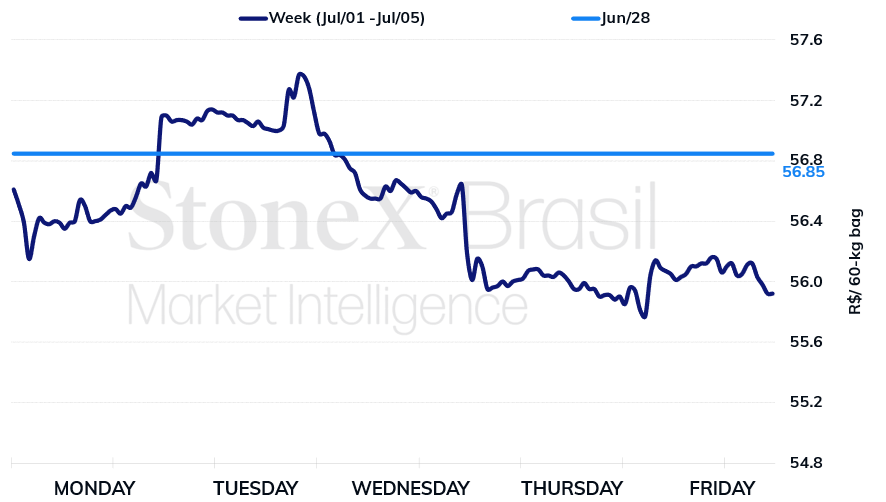
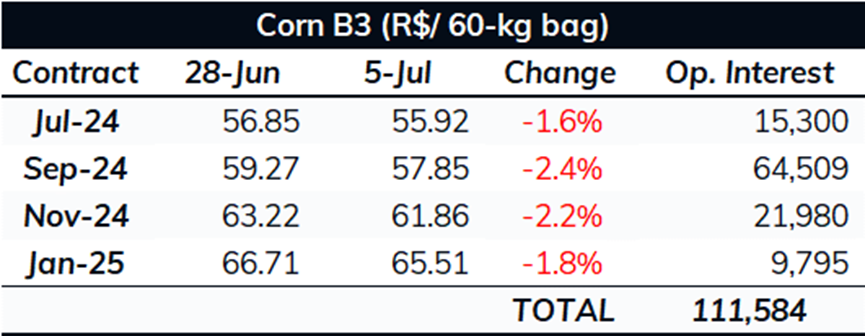
Turning our attention back to Brazil, here the second crop harvest reached 63.7% on July 5, the fastest pace since StoneX started tracking this indicator, back in the 18/19 crop season. This increase in domestic supply, along with the bearish pressure coming from Chicago and the dollar depreciation, is among the factors that explain the depreciation of corn futures contracts traded on B3. The July contract ended last Friday's trading session (5) at BRL 55.92/bag, a weekly depreciation of 1.6%.
If the harvest progress is a bearish factor for corn, the delay in sales is an important bullish factor that has helped limit corn losses in the Brazilian market. Regarding summer corn, a StoneX survey showed that 65.8% of the 23/24 crop had been marketed on July 5, the lowest percentage for the period since the 17/18 cycle. Regarding the "safrinha" corn, only 36.1% of the crop was sold, the lowest percentage since StoneX started tracking this indicator. Still on the marketing of the second crop, it advanced only 3.4 percentage points in the monthly comparison, a figure that shows that farmers are playing hardball when it comes to selling their stocks.
Due to this slow commercialization, corn premiums at the ports of Santos and Paranaguá are high, above the historical average for the period. On June 28, the premium for a load of corn with scheduled shipment for September was 66.5 cents/bu in Santos and 75 cents/bu in Paranaguá; now, these values are 80 cents/bu and 81 cents/bu, respectively.
Intraday (15 min) July/24 contract - B3
Source: B3. Design: StoneX.
In Argentina, the harvest continues to advance rapidly. Until July 3, 62.9% of the crops had been harvested, a weekly progress of 8 percentage points that puts the 23/24 cycle harvest above the average of the last 5 years for the period (60%). With the harvest coming to an end, no major variations in crop estimates are expected anymore. The Buenos Aires Grain Exchange maintained for the tenth consecutive week the estimate of 46.5 million tonnes, a volume that represents an increase of 12.5 million tonnes compared to the previous cycle, but a decrease compared to the period from the 18/19 to 21/22 cycle, when at least 52 million tonnes were always harvested.
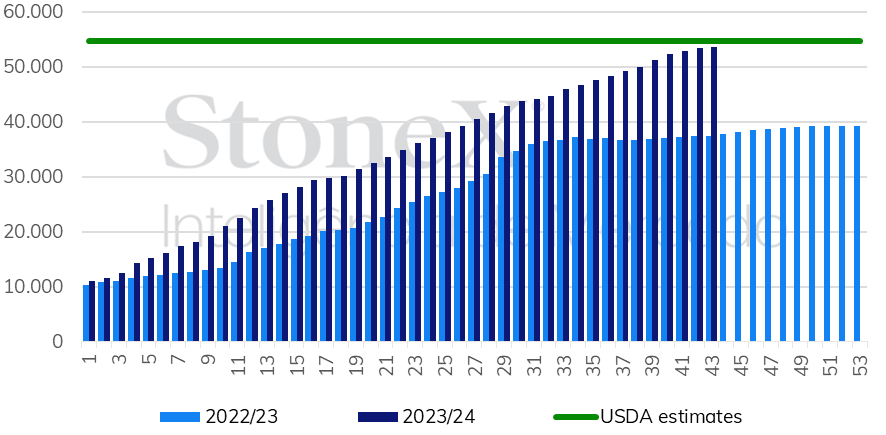
Turning our attention to demand, forecasts remain positive for Americans. Looking at the export sales, they reached 53.7 million tonnes in the 23/24 crop year, a volume very close to the 54.6 million tonnes estimated by the USDA. With nine weeks still remaining in the crop year, the USDA will likely revise its estimate upwards, repeating what was already done in the May report.
The high premiums at Brazilian ports have contributed to the good volume of exports in the USA, a factor that reduces the competitiveness of Brazilian exports. This factor, combined with the delay in sales, caused "only" 851 thousand tonnes of corn to be shipped from Brazilian ports in June, an 18% decrease compared to the previous year. Also contributing to this decrease is the fact that the volume harvested in the 22/23 crop was higher than that harvested in the current crop.
Looking ahead to the upcoming week, the market's focus is on the USDA supply and demand report, which will be updated on Friday (12). Among the most anticipated indicators, the highlight is productivity in the United States. Other relevant indicators that can also be adjusted are production in Brazil and Argentina, as well as export estimates from the United States.
US export sales (thousand tonnes)
Source: USDA. Design: StoneX.
Tables of future and spot prices
Futures contracts traded on the CBOT (US¢/bu)

Futures contracts traded on B3 (BRL/bag)
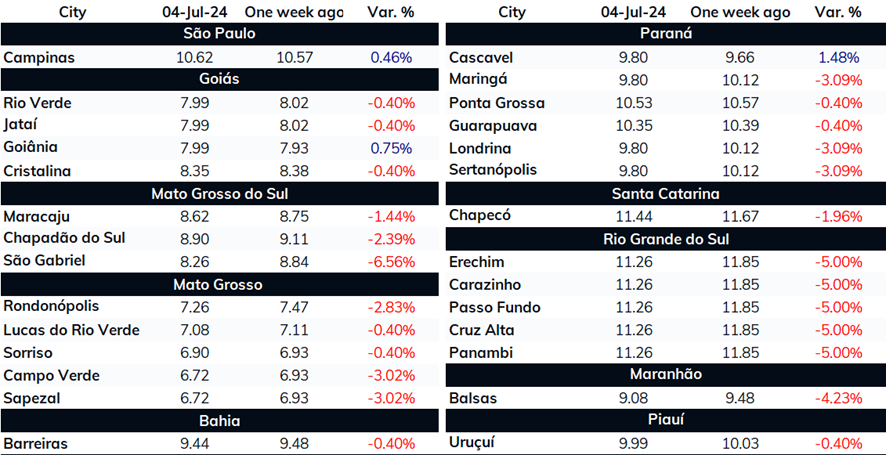
Spot prices in Brazil (USD/60kg bag)