- Bearish Factors
- Expectation of high stocks at the end of the 23/24 and 24/25 crop years;
- Acreage and stocks in the United States above expectations;
- Safrinha harvest progress in Brazil and the Argentine crop;
- Good condition of US crops.
- Fatores altistas
- StoneX estimates that the Brazilian second crop 23/24 will be 14.5% lower than 22/23;
- Delay in the marketing pace in Brazil and the United States.
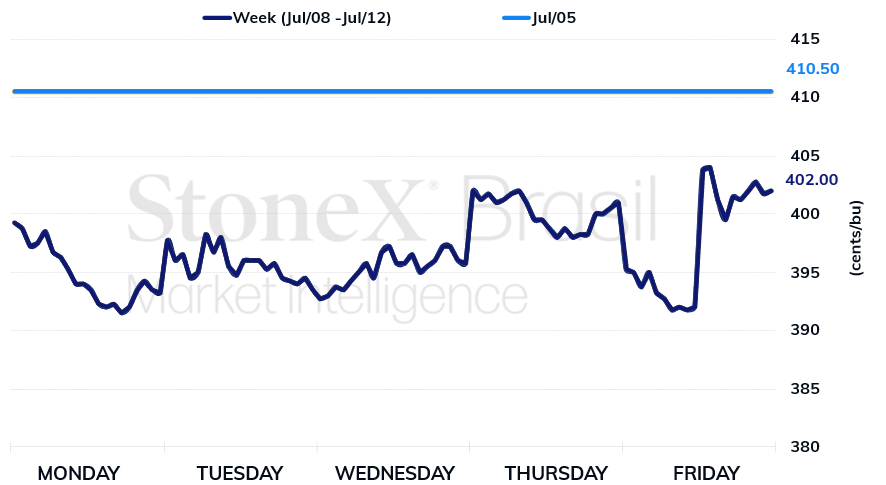
Last Monday (8), corn futures fell more than 3% on the CBOT, renewing the lows of the last 44 months (November 2020). The factor behind the losses was the update of the weather models, which showed beneficial weather for the development of American crops: for the eastern agricultural belt, which had been suffering from drought, the forecast was for significant rainfall; and for the western region, where some areas had been suffering from excess precipitation, the forecast was for a decrease in the volume of rain.
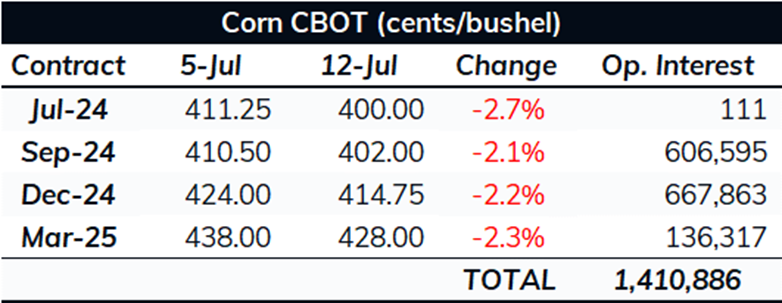
For the rest of the week, corn prices rose. The correction was influenced by the fact that the funds' position was the most long in history, which led them to act more cautiously. Even so, the gains were not enough to recover all the losses, leading the September corn futures contract to end the quoted period at 402 cents/bu, a weekly depreciation of 2.1%.
In summary, the good development of crops in the United States is bringing the prospect of robust supply in the main corn-producing country in the world, a factor that exerts bearish pressure on the price of this commodity. The latest USDA report showed 68% of American corn crops in good/excellent conditions, compared to 62% in the average of the last five years; and 24% of the crops in the tasseling stage, compared to 14% in the average of the last five years. These figures will be updated today (15).
In addition to the weather and its impacts on crop quality, the update of the USDA's supply and demand report gained great prominence in the corn market last week. For the United States, there were some surprises, but overall, the scenario of supply exceeding demand was maintained, a bearish factor for quotes.
For the 23/24 cycle, which will end in late August, the USDA increased the outlook for United States exports by nearly 2 million tonnes and also increased the feed use by almost 2 million tonnes. With that, the carryout stood at 47.68 million tonnes, a decrease of 7.2%, but still representing a significant volume.
For the 24/25 cycle, regarding the current season, the initial stock was narrowed by 7.2% but this was offset by the increase in acreage, a factor already mentioned in the report released on June 28. With that, the corn carryout in the United States for the 24/25 year stood at 53.27 million tonnes, a decrease of just 0.2% and maintaining the prospect of the highest carryout stock in the last five years.
Intraday (15 min) September/24 contract - CBOT
Source: CBOT. Design: StoneX.
For Brazil, the USDA report brought no changes, with the American Department still estimating Brazilian production for 23/24 at 121 million tonnes. Conab, on the other hand, increased its estimate, which went from 114.14 million tonnes to 115.86 million. From a predictability standpoint, the convergence of estimates from USDA and Conab is positive. Now, the difference between the figures of the institutions is 5.14 million tonnes, a significant volume, but it does not compare to the difference of 13 million tonnes that existed in April.
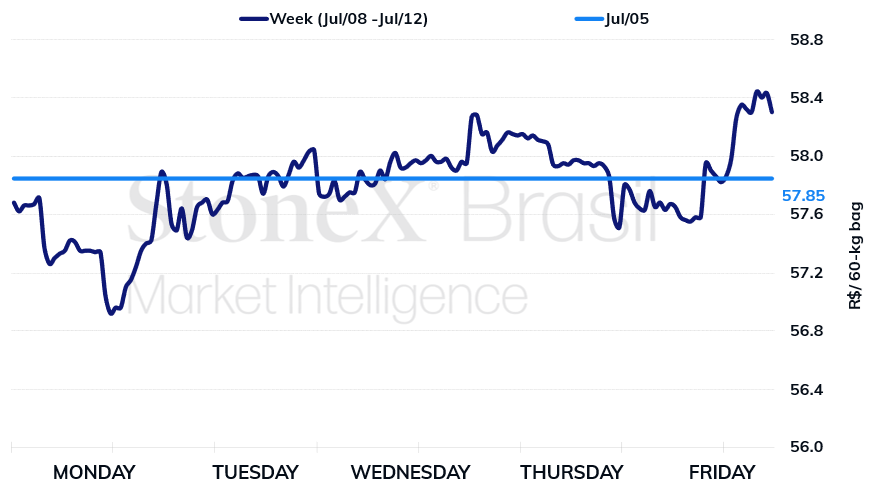
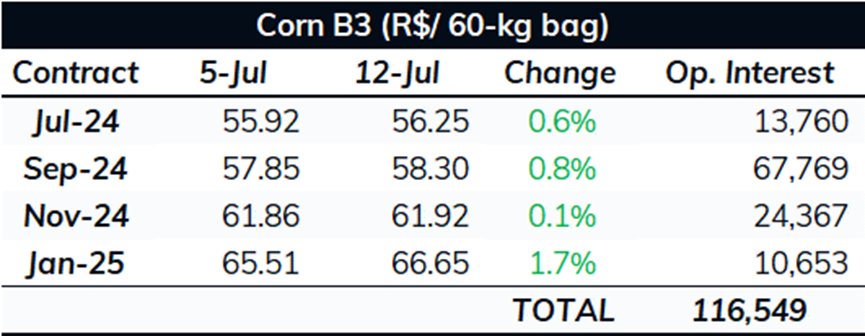
Still regarding Brazil, last Friday (12) StoneX updated its harvest estimate, which is now at 74.5%, the fastest pace since this indicator started being disclosed, still in the 18/19 cycle. Counterintuitively, however, the supply of corn is not abundant in the Brazilian market because the marketing of the crop is slow, with farmers playing hardball when it comes to selling due to unattractive prices. This situation has strengthened the corn basis at the port of Paranaguá and has caused this commodity to appreciate on B3. In the weekly comparison, the premium at the port went from 80 cents/bu to 85 cents/bu (August shipment) and the contract expiring in September went from BRL 57.85/bag to BRL 58.30/bag. Bevan Everett, a consultant from StoneX based in Des Moines, wrote that the "Brazilian producer is creating scarcity among plenty (holding firmly to grain as values fall).
For Brazilian exports, this "scarcity among plenty" has limited the volume of corn shipped. In the first week of July, there were 224 thousand tonnes, compared to 519 thousand in the same period last year. Also weighing on this retraction is the fact that the Brazilian last crop reached a record volume last year.
Intraday (15 min) July/24 contract - B3
Source: B3. Design: StoneX.
In the rest of the globe, some news stood out. Regarding Argentina, USDA cut its production estimate from 53 to 52 million tonnes, as a result of the impacts caused by the leafhopper. Even with the cut, the volume remains much higher than estimated by Argentine institutions: the Buenos Aires Grain Exchange (BCBA) estimates production at 46.5 million tonnes, and the Rosario Exchange at 47.5 million. Regarding the harvest, BCBA estimates it at 70.2%.
Regarding China, farming conditions have normalized because the rains returned in early July, providing the reprieve that Chinese corn needed after the hot and dry weather in June. The USDA estimates that the country will produce 292 million tonnes of corn in 24/25 (an annual increase of 1.1%) and will import 23 million tonnes (the same volume as in 23/24).
In Ukraine, the weather continues to be a concern, with drought and heat impacting crops. The USDA maintained its estimate for the country's exports in the 24/25 crop year at 24.5 million tonnes, but the continuation of weather problems could change that. The Ukrainian corn is entering the pollination phase, a crucial period for determining the size of yield.
To access the complete USDA’s WASDE report, click here.
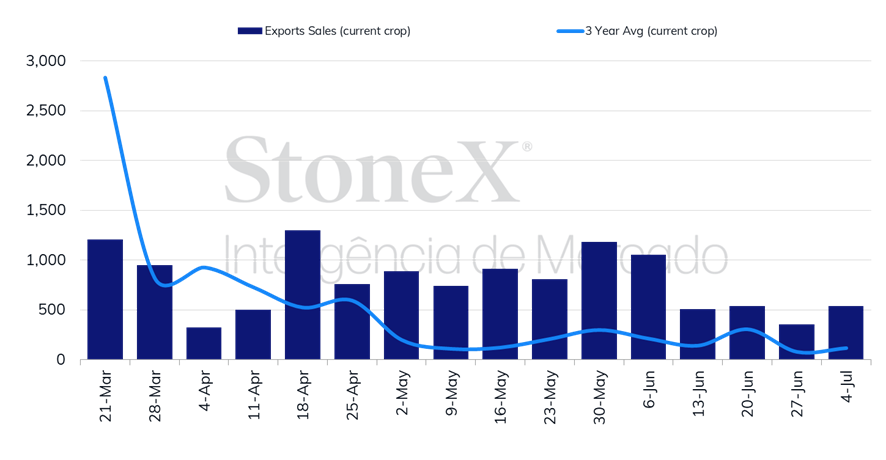
US export sales (tmt)
Source: USDA. Design: StoneX.
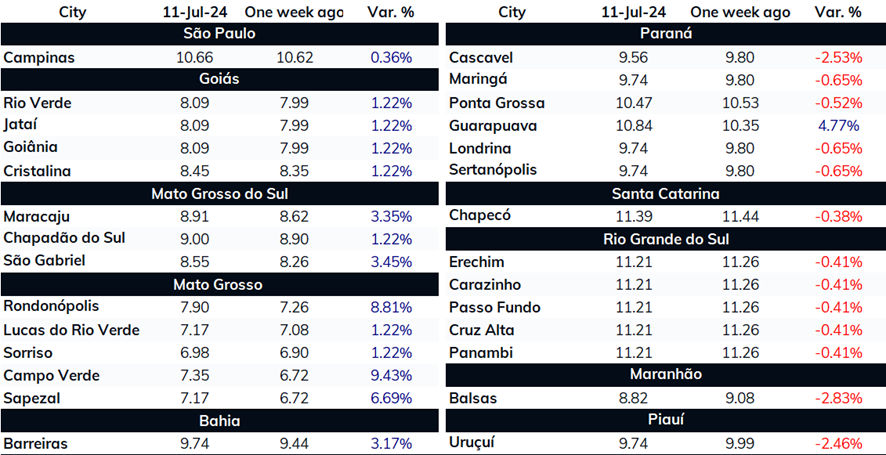
Tables of future and spot prices
Futures contracts traded on the CBOT (US¢/bu)

Futures contracts traded on B3 (BRL/bag)
Spot prices in Brazil (USD/60kg bag)