- Bearish Factors
- High stock outlook by the end of the 23/24 and 24/25 marketing years;
- Good/excellent crop conditions above the average;
- WASDE once again revises US productivity upwards.
- Bullish Factors
- Dry weather in Brazil;
- Prospect of a rate cut cycle beginning in the US in September;
- Short covering in recent weeks;
- Geopolitical risk in the Black Sea.
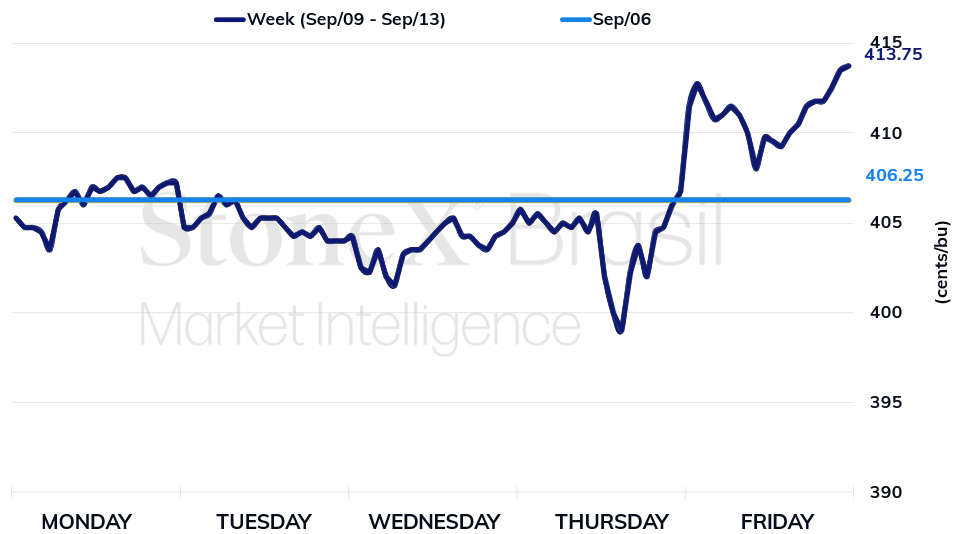
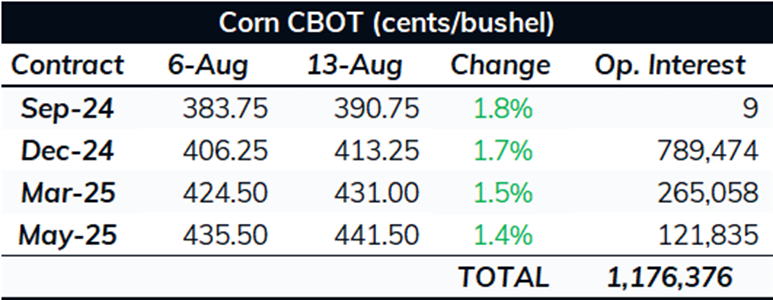
Weekly Summary | Corn futures had a positive week on the CBOT, with the December/24 contract closing the week at US¢413.25/bu (+1.7%). For most of the week, the market traded sideways, with few transactions beyond some position adjustments, as the market awaited the USDA’s Supply & Demand Report (WASDE) release on Thursday (12). After the report, which showed higher yields for US corn – adding about 1 million tonnes to the US 2024/25 supply – futures initially reacted negatively. However, a correction soon followed as domestic consumption and exports were revised upward, which pressured final stock forecasts for both the 2023/24 and 2024/25 seasons. On Friday, the market responded to news of a Russian attack on a grain vessel in the Black Sea, which likely led to short covering, pushing futures to a positive close.
WASDE | The September WASDE, released Thursday (12), revised US corn yield for the 2024/25 crop upwards. The figure now points to a productivity of 11.52 ton/ha, 0.03 higher than August’s estimate. While the reinforcement of record yield prospects temporarily pressured corn futures, revisions to US domestic consumption for the 2023/24 crop – influenced by a 380,000-ton increase in corn for ethanol production – and a rise in exports for the old crop (up more than 1 million tonnes compared to August’s figure) motivated gains for the contracts. As a result, US ending stocks for the 2024/25 crop are projected at 52.25 million tonnes, 410,000 tonnes less than the August estimate.
On a global scale, the South American corn crop underwent minor revisions, particularly in Brazilian demand adjustments. Domestic consumption in Brazil was revised upward by 1 million tonnes for both the 2023/24 and 2024/25 crops. However, a 2-million-tonne reduction in 2024/25 exports offset the effect of this domestic demand on final stock volumes. It is worth noting a discrepancy between USDA and StoneX numbers for Brazil. StoneX expects 2023/24 exports at 35 million tonnes (versus 48 million from USDA) and stocks at 19.44 million tonnes (versus USDA’s 4.84 million tonnes).
Additionally, the European Union is expected to harvest a smaller crop in 2024/25, leading to corn imports of 59 million tonnes (1 million more than estimated in August). Regarding imports, China is projected to receive 21 million tonnes of corn in 2024/25, 2 million tonnes less than the August report.
The report summary can be accessed by clicking here.
Black Sea | Tensions in the Black Sea region have increased in recent weeks. After a Ukrainian invasion of the territory, capturing parts of the Kursk region, drone attacks intensified on both sides of the borders, with Russia’s capital, Moscow, even targeted last week. However, the major news that moved commodity markets was a Russian attack on a grain vessel in the Black Sea region near Romania. This event has raised concerns about the global grain supply, as Ukraine is a key supplier to Europe and China. Although wheat is the most affected due to its predominance in the black soil region, corn prices also felt the impact. This is not only because of the substitutability between corn and wheat but also because most of Ukraine’s corn is harvested in the spring, with the crop now being harvested. Uncertainty about this corn harvest’s export potential has emerged as a bullish factor for international prices, driving funds to cover short positions and providing market support.
Intraday (15 min) December/24 contract - CBOT
Source: CBOT. Design: StoneX.
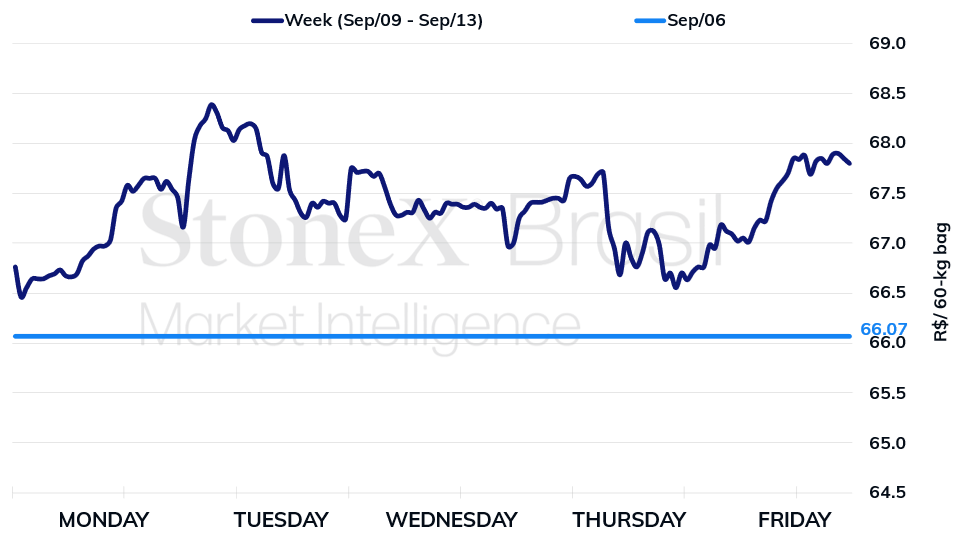
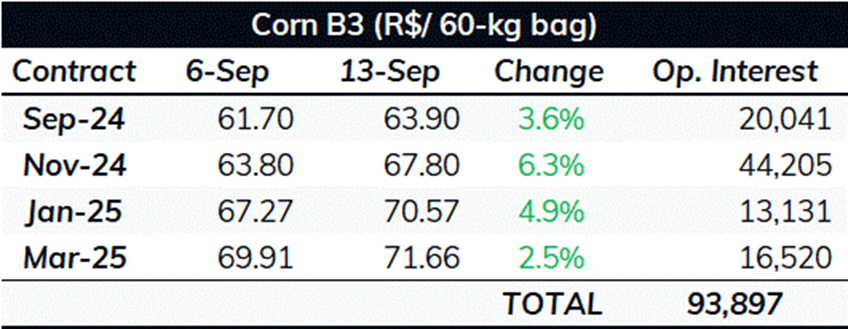
Weather and Prices - Brazil | Brazilian prices followed the upward movement in Chicago, though to a greater extent. The November/24 contract on B3 closed the week at R$67.80/bag (+6.3%). With the exchange rate relatively stable week-over-week, in addition to the global scenario, weather concerns in Brazil are also influencing the market, as dry conditions dominated the country in September. The dry weather has delayed the planting of the first corn and soybean crops, which have not yet begun in most parts of the country. As a result, there is an expectation that a delayed planting of the first crop could also delay the planting of the second crop, increasing the risk of yield impacts for the 2024/25 season. However, it is still too early to estimate substantial effects on Brazil’s corn supply, which will be closely monitored throughout the month. The necessary rains are expected between the end of September and early October. As such, the timing and intensity of these rains will be closely watched by the market.
Intraday (15 min) November/24 contract - B3
Source: B3. Design: StoneX.
Looking Ahead | This week, the grain market will be focused on three main factors. Firstly, it is a week of interest rate decisions in the US, and traders will be watching for the extent of the expected rate cut. Until last week, the consensus was for a 25-basis point cut in the US interest rate. However, expectations now point to a 50-basis point cut. It’s worth noting that the Federal Reserve’s monetary policy is closely tied to labor market conditions. A more aggressive rate cut would signal stronger demand and better future employment indicators. However, a 0.5% cut could suggest the Fed is concerned about a recession and current labor market deterioration, signaling recession risks.
Aside from macroeconomic factors, the market will be monitoring the development of geopolitical tensions in the Black Sea as spring crop harvesting continues in the region. Lastly, Brazilian weather will also be on the radar as the South American crop begins to take center stage as a price driver.
Future and spot prices
Futures contracts traded on CBOT (US¢/bu)

Futures contracts traded on B3 (R$/bag)
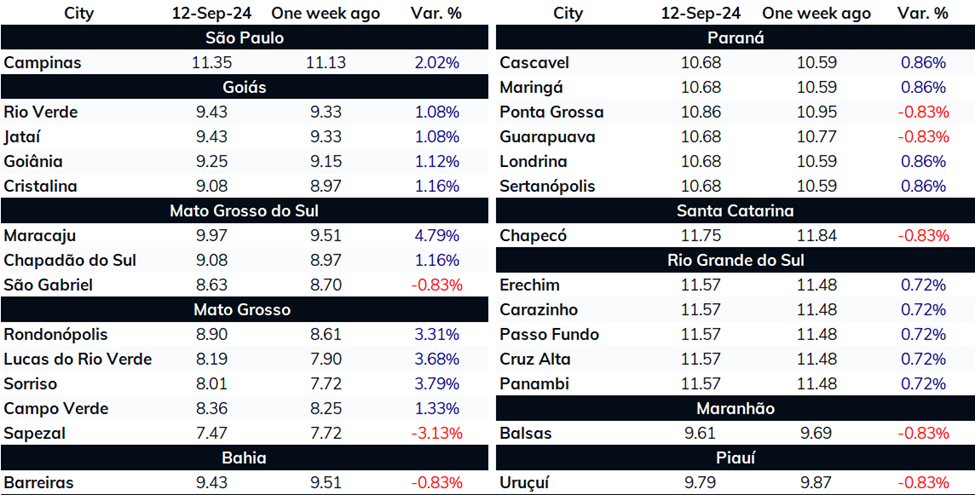
Spot prices in Brazil (USD/60kg bag)