- Bearish Factors
- Expectation of high stocks at the end of the 23/24 and 24/25 crop years;
- Accelerated harvest of the US crop;
- Appreciation of the dollar in a global risk aversion scenario.
- Bullish Factors
- Dry weather in Brazil is expected to delay the planting of the first crop soybeans, which may impact the planting of the second crop;
- Interest rate cut cycle in the US is expected to strengthen demand in the medium term;
- Downward revision of US ending stocks.
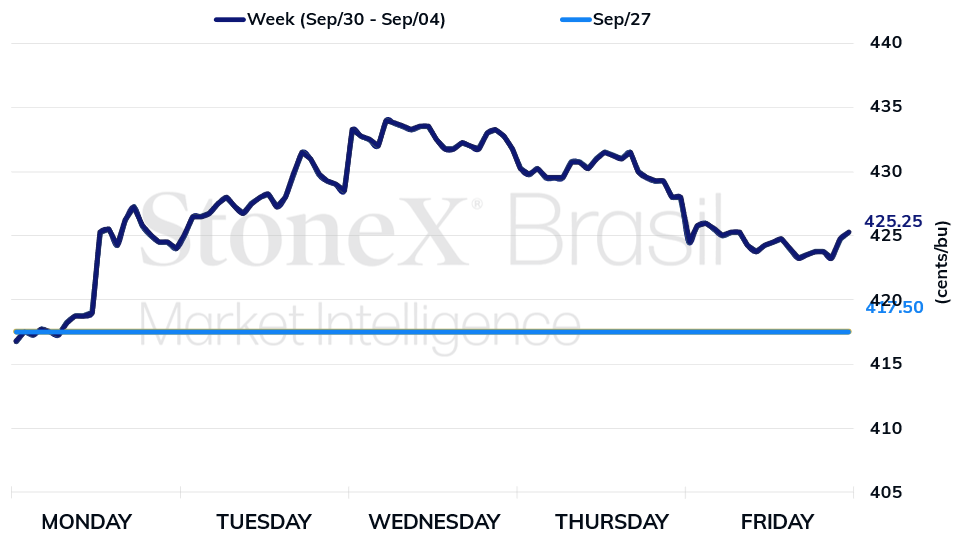
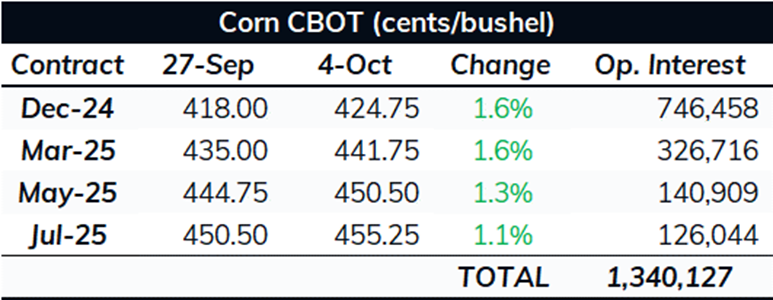
Weekly Summary | Corn futures advanced in Chicago this week. The December/24 contract closed the day trading at US¢424.75/bu (+1.6%). Behind the gains were better prospects for US ethanol production, which also contributed to a revision of the 2023/24 crop ending stocks by the USDA, helping to improve demand outlooks. Additionally, international wheat prices also rose, following concerns about Russian supply, which helped support corn. However, limiting the gains was the rapid progress of the US harvest and a stronger dollar amid a global risk aversion scenario.
Intraday (15 min) December/24 Contract - CBOT
Source: CBOT. Prepared by: StoneX.
US Stocks | USDA stock data published last Monday showed final 2023/24 crop stocks below both market estimates and the latest WASDE. The corn stock position on 01/09 was 44.72 million tonnes. The volume, about 2 million tonnes below the average market estimates, was enough to prompt a market position adjustment, resulting in gains for corn on Monday.
StoneX Estimates – US | StoneX positively revised its estimate for US corn productivity. The national average is now expected to reach 11.55 tonnes/hectare, higher than the current USDA estimate of 11.48 tonnes/hectare. With this, the US is expected to harvest 386.65 million tonnes of corn in this crop.
Ethanol – US | Ethanol production in the US remains strong, consistently above the 1 million barrels per day mark in recent weeks. Additionally, ethanol stocks have been declining for the third consecutive week. In fact, much of the reduction in US corn stocks discussed earlier was associated with an increase in domestic demand for ethanol production. Thus, ethanol demand in the US remains strong.
Middle East and Macro | Last week, the market cautiously watched an escalation of conflicts in the Middle East. Israel has been intensifying its operations on the northern border by launching attacks against Hezbollah. This agitated Iran, which, in retaliation for Israel's invasion of Lebanon, launched more than 200 missiles against Israel on Tuesday. The moment marked an intensification of conflicts in the region, an important oil producer, supporting energy prices. Throughout the week, the effects continued to reverberate, with increased apprehension after US President Joe Biden, when asked if he would support attacks on Iran's oil infrastructure, responded that he was "discussing that possibility." This further increased the risk of compromising Iran's supply, causing oil to end the week with a nearly 10% appreciation.
In any case, it is clear that the US desires are far from an escalation of international oil prices. The country is fighting to achieve a "soft landing" by solving the high inflation problem of recent years without compromising its job market. Still, inflationary pressures from energy costs may act in the opposite direction, depending on how they are reflected in inflation indicators in the coming months. This situation may lead the Fed to adopt a less expansionist position in future monetary policy meetings, which could result in a future deterioration of the job market. This entire situation is particularly undesirable in an election context, which could weaken the current Vice President, Kamala Harris's ticket.
Moreover, an escalation of the conflict is not in China's interest either. The Asian country, which is the main buyer of Iranian oil, is striving for economic growth close to its official estimates of 5%. Energy shortages in this context are equally undesirable for Beijing.
Wheat | International wheat prices have received some support over the past few days from an increase in FOB prices from the Black Sea, where intense drought is worsening prospects for planting the new wheat crop. As a result, concerns about export surpluses from Russia and Ukraine, important players in the international market, have once again caused market fears. Midway through last week, these fears intensified amid rumors that Russia might limit exports in the second half of the year if the country's supply remains under pressure. This whole context has been helping to support wheat prices, which also tends to have an effect on corn as they are two of the world's main food crops.
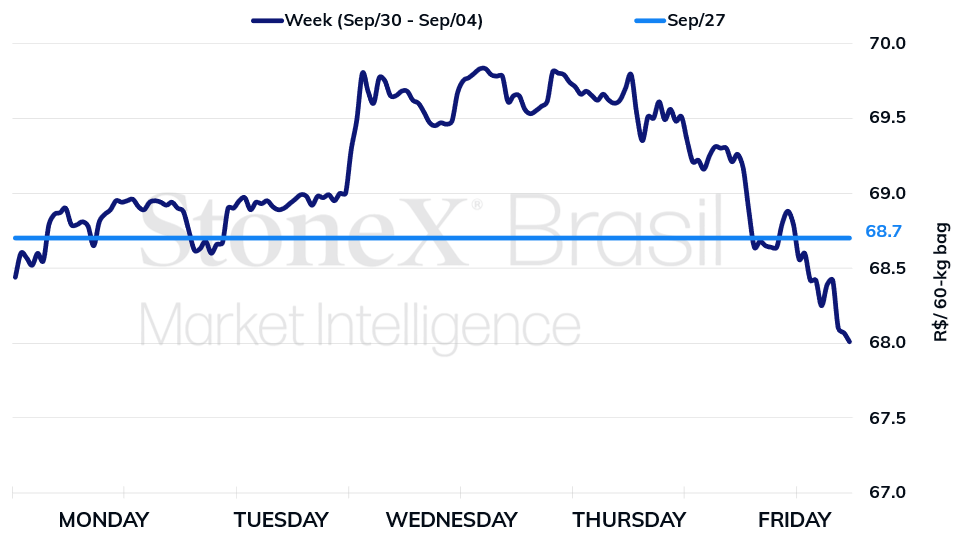
Intraday (15 min) November/24 Contract - B3
Source: B3. Prepared by: StoneX.
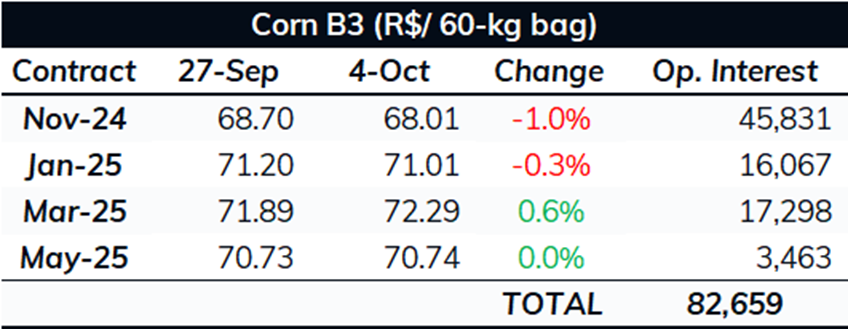
B3, Weather, and Exchange | Futures traded on B3 retreated slightly despite international gains. Profit-taking weighed on contracts at the end of the week after robust gains between Wednesday and Thursday. The November contract closed the period trading at R$68.01/sc (-1.0%).
The dollar had an appreciation week against the real, mainly favored by a risk aversion sentiment in the international market after the escalation of conflicts in the Middle East. The US currency was also strengthened by better-than-expected employment data in the US.
As for the weather, Brazil remains dry in the Midwest, but the effects on the corn crop are still questionable, with the planting of the first corn crop proceeding normally, as the weather in the South of the country remains more favorable. The StoneX crop monitoring report indicates that 32.4% of the area has already been planted.
StoneX Estimates – Brazil | In StoneX's most recent estimate, the numbers for the first corn crop suffered a slight reduction due to a smaller expected area in Bahia. Thus, the country is expected to harvest 24.87 million tonnes of corn in the first crop. Repeating the area of the previous season for the second crop and with productivity within the historical average, the aggregate crop numbers could reach 123 million tonnes. However, it is worth noting that StoneX has not yet estimated the 2024/25 second crop. With good rains in southern Brazil, corn planting is being less affected than soybeans, for example, which are already experiencing delayed planting in the Midwest.
This Week | The corn market started the week lower, following the US harvest and a stronger dollar in the interbank market. The market will continue to reflect the progress of planting pace after the US crop monitoring data, which will be published later today. Additionally, the situation of the Middle East conflict will be on investors' radar as Israel prepares a reaction to last week's Iranian attacks.
This week, on the 10th, StoneX will hold its 7th seminar on Challenges and Opportunities for Commodity Markets. You can register for the event for free by clicking here.
Tables of Future and Physical Prices
Futures Contracts Traded on CBOT (US¢/bu)

Futures Contracts Traded on B3 (R$/sc)
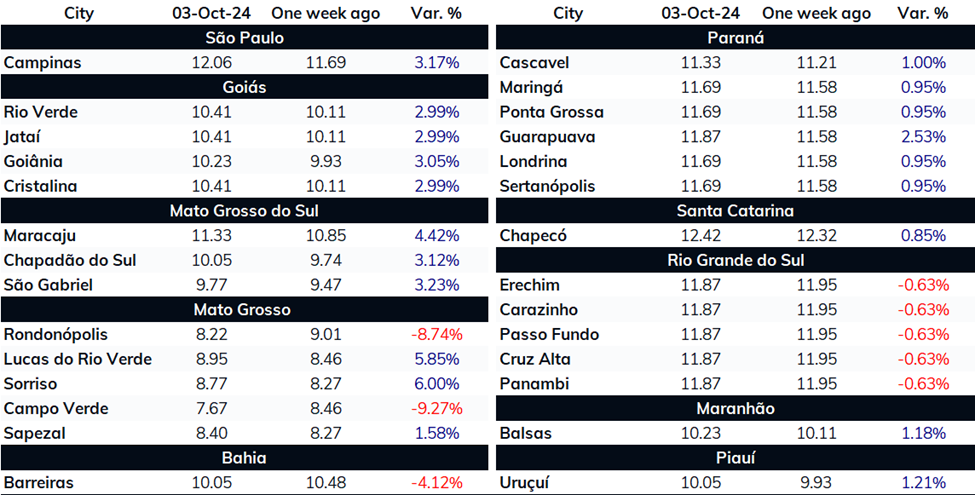
Spot Prices in Brazil (USD/ 60 kg bag)