- Bearish Factors
- High stock forecasts at the end of the 23/24 and 24/25 crop years;
- Accelerated US harvest;
- Appreciation of the dollar in a global risk-aversion scenario.
- Bullish Factors
- Dry weather in Brazil may delay the planting of the first soybean crop, which could impact safrinha corn planting;
- US interest rate cut cycle expected to strengthen medium-term demand;
- Downward revision in US carryout.
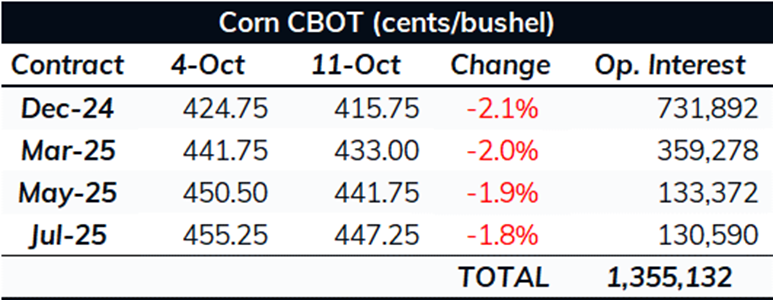
Weekly Summary | Corn faced depreciation this week, with the December/24 contract closing last Friday at US¢415.75/lb, down 2.1% for the week. The drier weather in the US, despite raising concerns about river levels, which are important for crop flow, continues to benefit fieldwork. Motivated by the WASDE report, published by the USDA on Friday, an increase in short positions helped push prices down.
Intraday (15 min) December/24 contract - CBOT
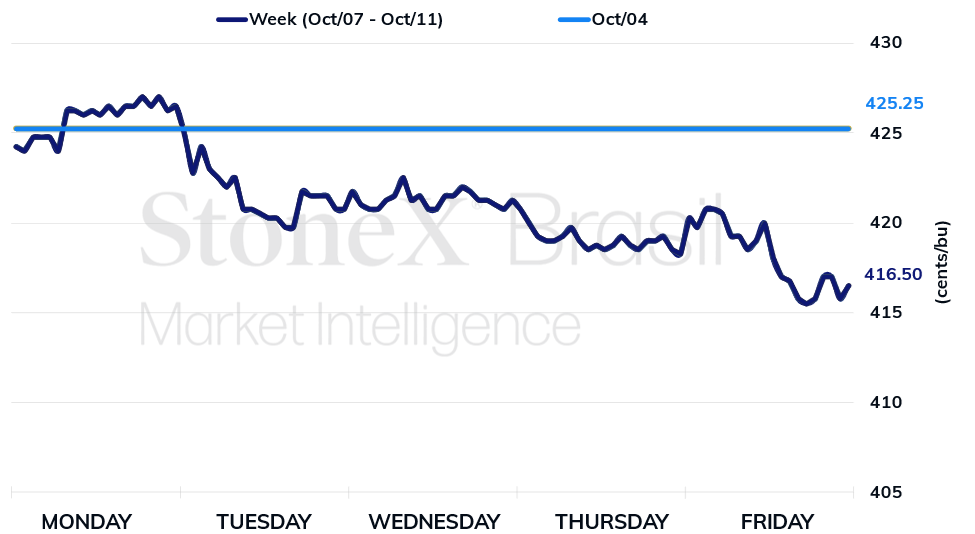
Source: CBOT. Design: StoneX.
WASDE | The USDA's Supply & Demand Report presented another upward revision for US productivity, which reached 11.54 tonnes/ha, close to StoneX’s latest estimate of 11.55 tonnes/ha. As a result, around 400 thousand tonnes were added to total US supply. Nevertheless, the overall global results were negative.
The USDA finally issued a downward revision for Brazil’s 23/24 corn exports, now forecasted at 46 million tonnes, 2 million less than estimated in the September report. A similar move was made for Argentina, which is expected to export 3 million tonnes less than reported in September for the 23/24 crop year. In Argentina, a revision of previous years’ balances added 1 million tonnes to the country’s stocks, allowing room for positive revisions in domestic consumption.
Lastly, another bearish factor for the corn market was the expectation that China would export 2 million tonnes less in the 24/25 crop year, justified by the recent pace of exports from the US and Brazil to the Asian country in recent months.
Macro | The macroeconomic scenario was heavily impacted last week by inflationary concerns in the US economy. A recent surge in oil prices helped increase expectations of rising production costs throughout the entire production chain in the US in the medium term. Additionally, the impacts of an unusually active hurricane season will require significant reconstruction efforts, which could fuel inflationary pressures, especially considering the more active fiscal policies of the US government aimed at restoring normalcy in the southern and southeastern regions of the country.
This movement, along with a September CPI that came in above expectations, helped increase the risk of US interest rates remaining high for longer. Fears intensified with the statement from Atlanta Fed President Raphael Bostic, who mentioned that he would be comfortable maintaining the current rate level at the next FOMC meeting before proceeding with rate cuts.
Nonetheless, several US financial institutions emphasized their belief that the US economy is heading toward a “soft landing.” Whether this is an optimistic or realistic perspective will be proven over the coming months.
Intraday (15 min) November/24 contract - B3
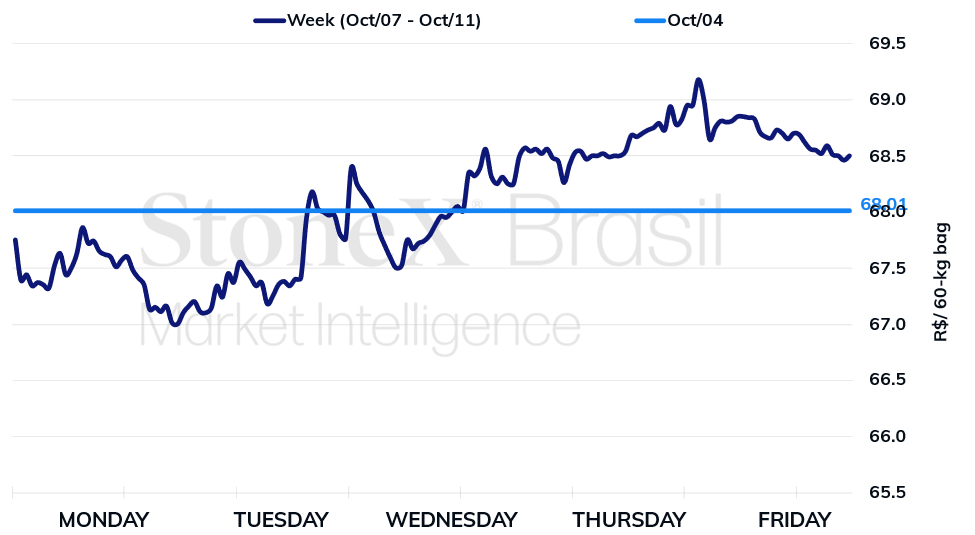
Source: B3. Design: StoneX.
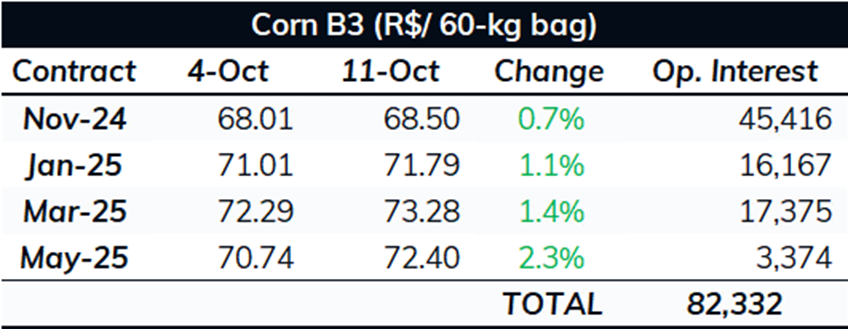
Brazil | Corn futures traded on B3 rose 0.7% for the November/24 contract. Despite declines in the international market, the domestic market was supported by the USDBRL. The Brazilian real depreciated almost 3% against the dollar. The week was marked by a risk-averse global context and concerns about Brazilian inflation on the domestic front. First-crop corn planting continues to progress, with 36.2% of the area already planted. Concerns about Brazil’s weather were mitigated by the arrival of rain in various parts of the Midwest, enabling the progress of the first soybean crop’s planting.
Future and Spot Prices
Futures contracts traded on CBOT (US¢/bu)

Futures contracts traded on B3 (R$/bag)
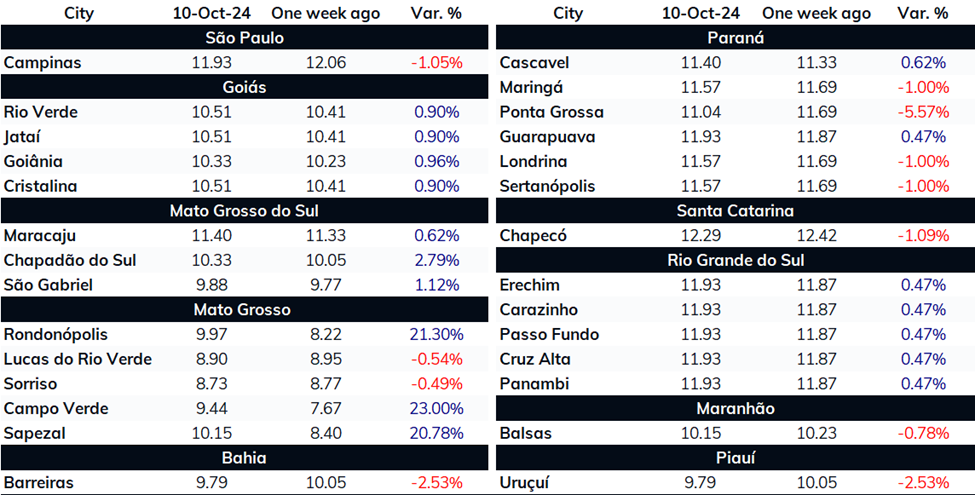
Spot prices in Brazil (USD/60 kg bag)