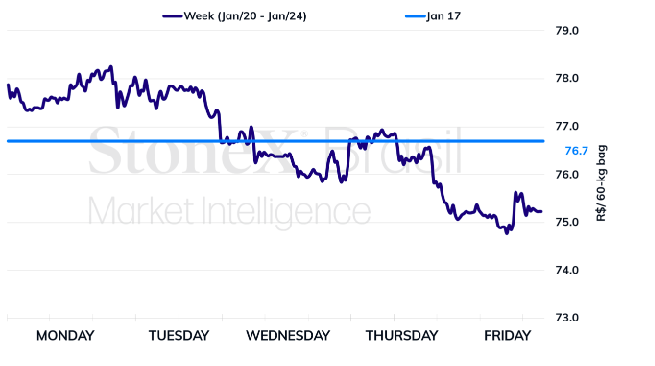
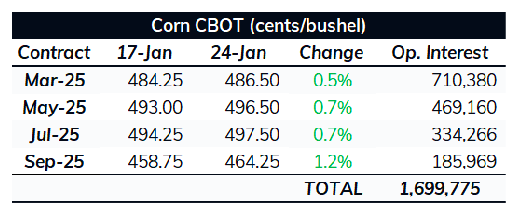
Weekly summary | Corn futures advanced in Chicago, with the March/25 contract ending the week trading at US¢486.50/bu (+0.5%). Commodities were helped by a weakening dollar. In addition, supply-side pressures, motivated mainly by adverse weather in Argentina, also continued to provide support. Even so, corn futures face strong resistance at the US¢500/bu level, which caused the market to give back part of its gains at the end of the week.
Intraday (15 min) March/25 contract - CBOT
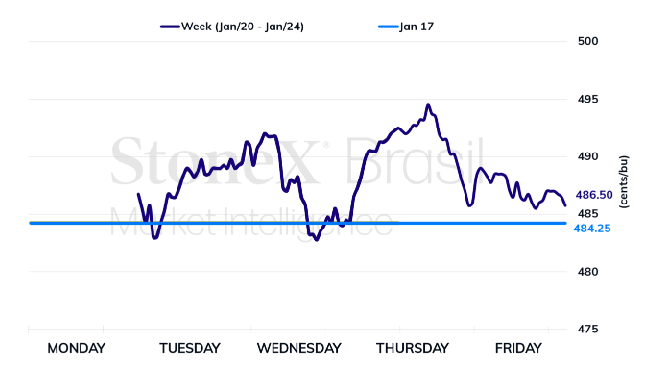
Source: CBOT. Design: StoneX.
Dollar and macroeconomics | The week was marked by a loss of global strength for the dollar. With Trump's arrival in the White House on the 20th, it was expected that the new US president would already put into practice the aggressive tariff policy proposed during the campaign, which included a 60% tax on Chinese products. However, what was observed from the first moments of the new administration was a much more cautious stance, focusing primarily on tariffs on neighboring countries such as Mexico and Canada.
This helped weaken the so-called “Trump-trade”. As a result, the dollar retreated against other currencies and the commodities market opened Tuesday trading predominantly in the blue, strengthened both by the weaker dollar - which tends to lower the price of US commodities - and by the prospect that international trade would not be so compromised under the new Trump administration.
Speaking of the dollar, this week will see a new monetary policy decision in the US. The almost unanimous view is that the FOMC will keep interest rates at the current level. The question now will be to understand how Jerome Powell, chairman of the Federal Reserve, will position himself on the future course of US interest rates, with emphasis on the inflation data that was released in January, as well as the prospects for inflation and growth under the new US government.
Foreign policy under Trump | As already mentioned, Trump focused his first actions in this new administration on pressuring neighboring countries, such as Mexico and Canada, which became the first targets of the tariffs that the president talked about during the campaign.
The focus of the new administration's foreign policy on the Americas is striking. In addition to tariffs against neighboring countries, Trump has also promised to retaliate against mass deportations that are due to take place in the US in the coming weeks. Over the last few days, the presidents of the US and Colombia have found themselves in a dispute after Gustavo Petro opposed receiving deportees from the US. Donald Trump retaliated by promising import tariffs against Colombian products.
After the heated debate, the situation seemed more peaceful on Monday morning, as the countries seemed to have reached an agreement. Even so, the reflection arising from this recent movement is that Trump in this mandate is seeking a foreign policy much that is more focused on the Americas, which is reinforced if we think that the president chose Marco Rubio - a congressman of Cuban origin who has guided his political life in the discussion of immigration and relations with Latin American countries - as Secretary of State, the most important position for foreign policy in the US government.
This could pose a threat to the US relationship with two important trading partners that buy US corn. Mexico and Colombia occupy two positions among the four largest importers of US corn. The fact that the two countries are in the crosshairs of the new administration's foreign policy should be important to monitor in the corn market over the coming months.