BEARISH FACTORS
- Fears about a possible new wave of coronavirus cases
- Expectation of less tight US and global stocks in 2021/22;
- Progress in US harvest.
BULLISH FACTORS
- Advancing vaccination roll out against Covid-19;
- Resumed activity in some of the terminals affected by Hurricane Ida in the US Gulf;
- Recent rise in crude oil prices.
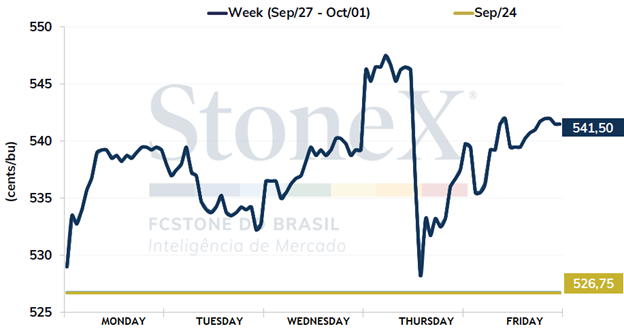
Corn futures started last week significantly higher in Chicago, driven by the rallies observed in the crude oil market. The contract maturing in December/21 closed Monday’s session with a 12.75 cent/bushel rise from previous week’s settlement price (09/24).
The USDA export inspection report indicated that in the week ended September 23, the US exported 517,000 tonnes of corn, compared to 830,000 in the same period last year. As a result, accumulated shipments reached 1.1 million tonnes, 1.7 million below last year.
On this day, the USDA released its US crop follow-up report. By September 26, 59% of the US crop was in good/excellent condition, unchanged from the previous week and in line with market expectations. In relation to field work, harvesting reached 18% in the country, a weekly advance of 8 points, above the five-year average for the period (15%), but below the 19% expected by the market.
Intraday (15 min) - December/21 (CBOT)
Source: CME. Design: StoneX.
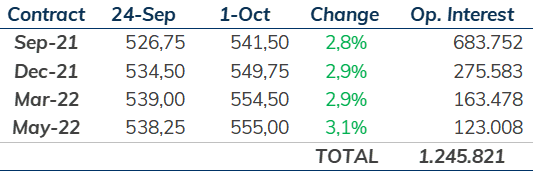
Corn Prices - CBOT (cents/bushel)
Source: CME. Design: StoneX.
On Tuesday, corn futures returned some of the previous session’s gains amid a technical sales move, with December/21 losing 7 cents/bushel in the daily comparison.
On Tuesday, corn rose again up in Chicago, with December/21 ending the session with 6.5 cents of gains in the intraday. Support on the day came from purchases made in anticipation of the quarterly stocks report, as agents expected a lower number for 2020/21 US corn crop ending stocks in relation to the September WASDE.
The Energy Information Administration (EIA) reported that US ethanol production dropped to 914,000 barrels per day in the week ended September 24, a weekly drop of 12,000. On the other hand, stocks rose by 109,000 barrels, to 20.22 million.
On Thursday, futures retreated again on the CBOT, with December/21 contracting by 2.25 cents/bushel in the day. The main reason for the decline was the quarterly stocks report for September 1, corresponding to the ending stocks of the 2020/21 crop, which stood at 31.4 million tonnes, a lower level than the average market expectations of 29.21 million, and close to the upper limit of estimates, which ranged from 25.35 to 31.80 million tonnes.
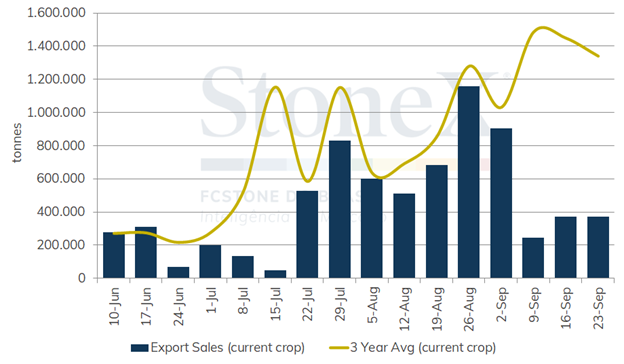
The USDA reported that net sales of 370,400 tonnes were registered for the 2021/22 crop in the week ended September 23, below market expectations, which ranged from 400,000 to 900,000 tonnes. In the same period last year, US net sales totaled 2.0 million tonnes. As such, commitments to all destinations rose to 25.3 million tonnes, compared with 24.6 million tonnes in the same period last year.
Weekly US export sales - 2021/22
Source: USDA. Design: StoneX.
On Friday, corn rose higher again in Chicago, supported by higher wheat prices in the US. December/21 gained 4.75 cents/bushel, closing the week quoted at 541.50 cents/bushel. With this, the contract in question accumulated a rise of 14.75 cents/bushel in relation to the end of the previous week, or 2.8%.
On the day, StoneX updated its crop estimate, slightly increasing production for the 2nd 2020/21 crop to 59.2 million tonnes, and reducing production for the 3rd to 1.67 million. With this, total production remained virtually unchanged at 86.63 million tonnes. For the 1st 2021/22 crop, StoneX increased production to 30.05 million tonnes, reflecting the increase estimated Rio Grande do Sul planted area. Compared to the September report, the estimated area in the state increased by 4.2%, from 801,000 to 834,000 hectares.
According to StoneX’s follow-up, first-corn planting in Brazil reached 35.7% up to October 1, compared to 25.2% last year. For the time being, field work has been almost entirely restricted to the southern region. Planting reached 98% in Rio Grande do Sul and 96% in Paraná. At the same time last year, sowing in these states had reached 64% and 46%, respectively. Despite the promising start, moisture needs to be sustained to guarantee a good crop, and the weather at the end of the year needs to be monitored, since less moisture in the coming months could impair corn development.
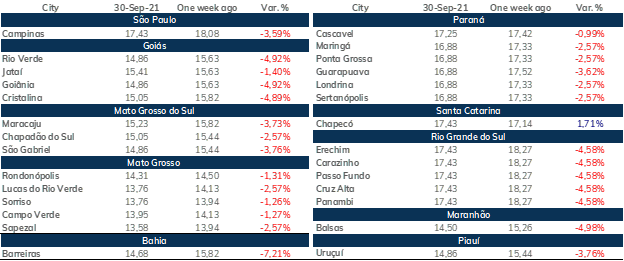
SPOT PRICES (USD/60kg-bag)
Source: StoneX, Agrolink and IMEA. Design: StoneX.
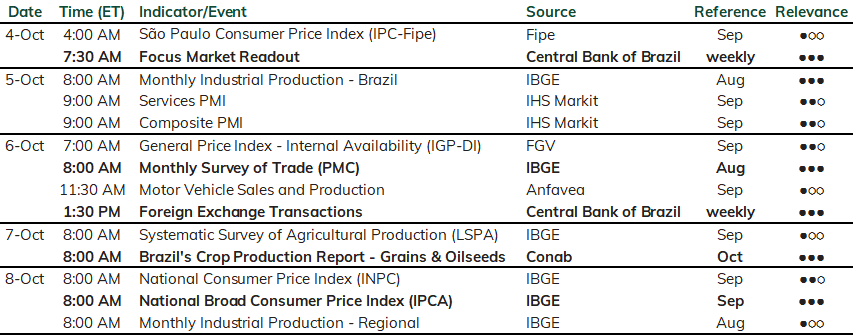
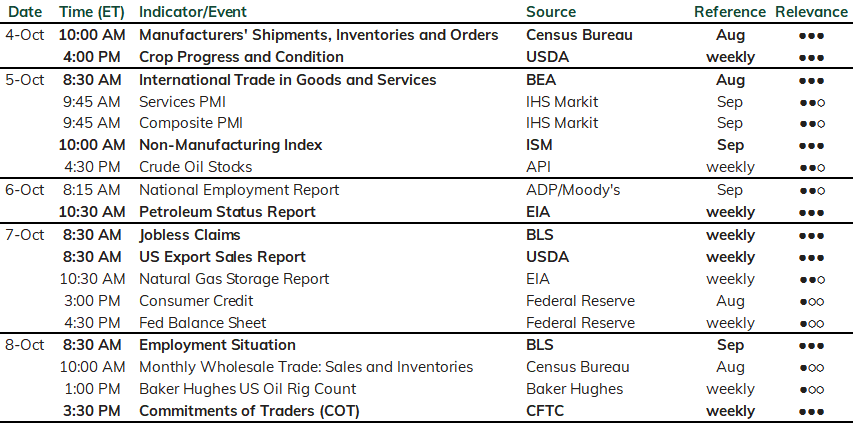
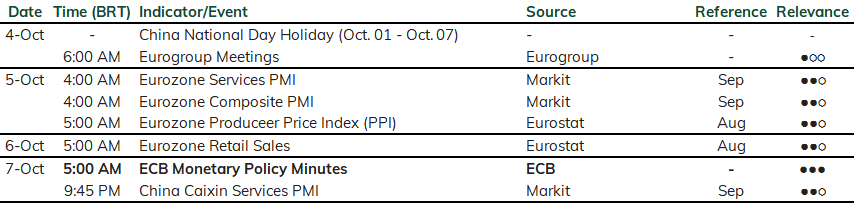
ECONOMIC CALENDAR
BRAZIL