BEARISH DRIVERS
- Fear about a global recession;
- More favorable weather forecast for grain development in the US Midwest;
- Agreement involving the creation of a Ukrainian export corridor through the Black Sea.
Bullish DRIVERS
- Restriction on grain supply due to conflict in the Black Sea;
- New Russian attacks in Ukraine.
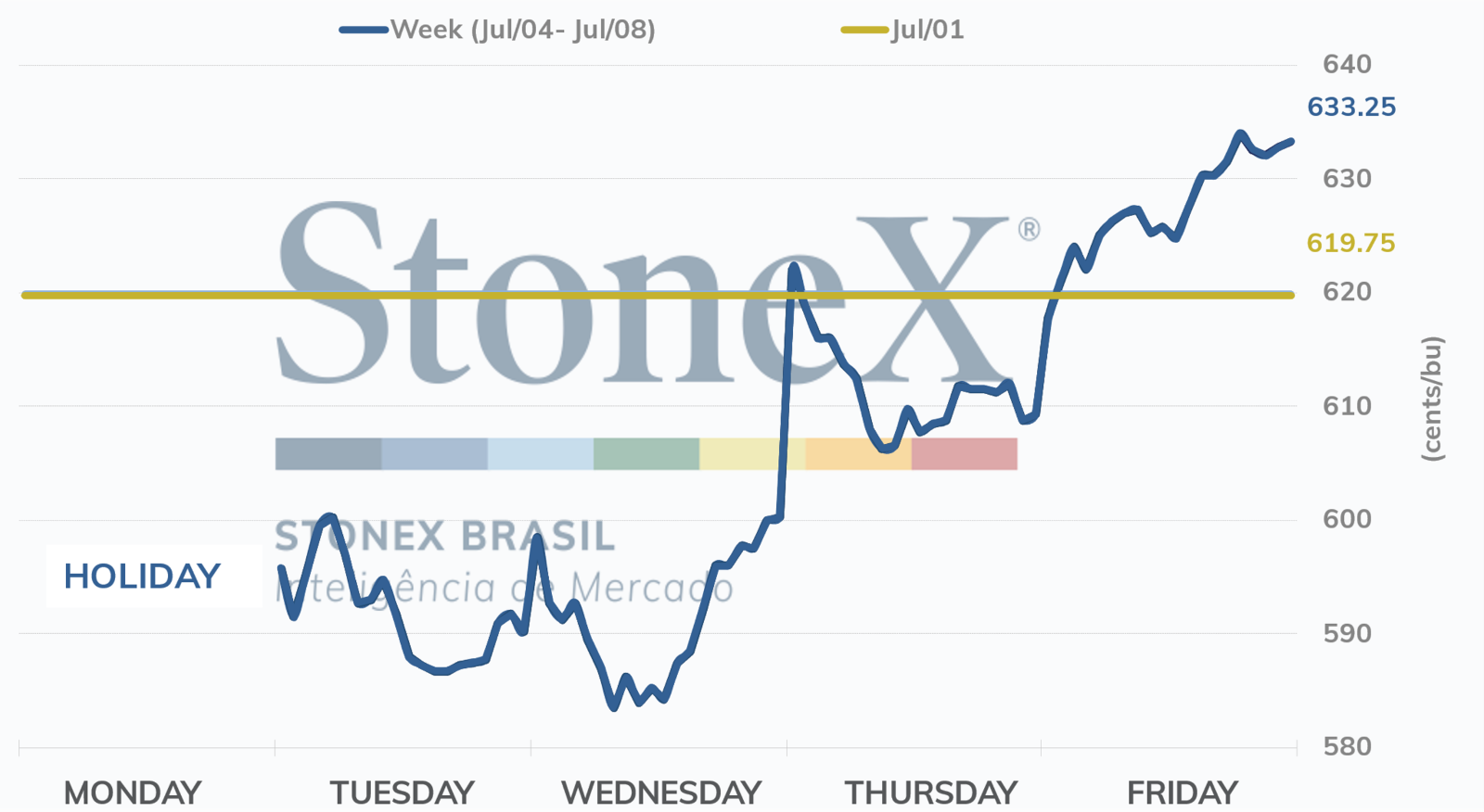
Corn futures had a bullish move in the first session of last week on the CBOT. It can be said that a large part of the appreciation seen on the day was motivated by technical purchases made by speculative funds, which took advantage of the low level of quotes after the strong drops registered last week. On Monday, the September/22 contract rose by 8 cents/bu intraday in Chicago.
As shown in the USDA's weekly export inspection report, the US shipped 1.07 million tonnes of corn in the week ended July 14, 139,400 tonnes above the volume exported a week earlier and 2,700 less than in the same period of 2021. The volume seen was within the range expected by the market, which was between 723,900 and 1.1 million tonnes. Cumulative exports totaled 50.3 million tonnes, 10.1 million less than at the same time of the previous season. The accumulated volume is 13 million tonnes below the USDA estimate for the current crop, which will be completed in August. As such, to reach the USDA's projection of 62.2 million tonnes, the US would need to export about 1.7 million tonnes of corn weekly by the end of next month, about 35% above the average for the last 10 weeks, of 1.3 million tonnes.
Also on Monday, the USDA released its weekly crop progress report. By July 17, 64% of corn crops were in good or excellent condition, the same rate as July 10 and 1 point below last year. Agents had expected a decline of 1 point in good/excellent conditions.
Intraday (15 min) - September/22 (CBOT)
Source: CME. Design: StoneX.
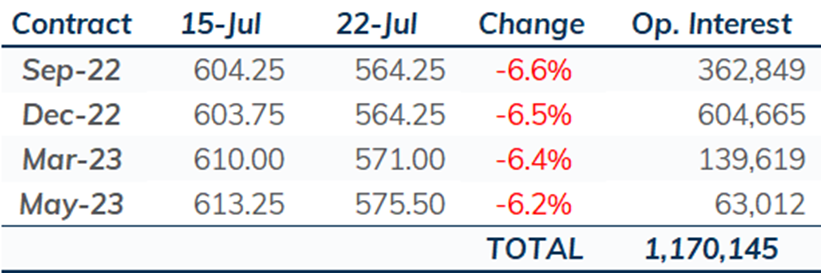
Corn Prices - CBOT (cents/bushel)
Source: CME. Design: StoneX.
On Tuesday, corn futures retreated again in Chicago, a trend that sustained until the end of the week. The most recent corn contract ended the session with a daily contraction of 15.5 cents/bu.
The weather in the US, as in recent weeks, was an important driver of prices. However, if in the previous week it limited the devaluation of prices, last week it contributed to the fall in corn prices, as weather models no longer point to a hot and dry pattern in the US Midwest and began to show milder and more favorable conditions for development, especially in the eastern region of the belt.
Another bearish factor was again the apprehension about global recession, which has raised questions about demand for grains and pressured prices, not only of corn, but several commodities.
On Wednesday, driven by the US weather, fears related to recession and a drop in US gasoline consumption, corn futures retreated again in Chicago. September/22 lost 4.5 cents/bu on the day.
The Energy Information Administration (EIA) reported that US ethanol production rose to 1,034,000 barrels per day (mbpd) in the week ended July 15, 29 mbpd higher than a week earlier. Stocks retreated to 23.55 million barrels, against 22.61 million the previous week.
On Thursday, corn futures had another significant downward movement, with September/22 accumulating a loss of 16.5 cents/bu compared to the previous close.
Weekly US export sales - 2021/22
Source: USDA. Design: StoneX.
In the last trading session of the week, contracts once again experienced a significant downward trend on the CBOT. September/22 dropped 11.5 cents/bu intraday. As a result, the nearby corn contract ended Friday (22) at 564.25 cents/bu, accumulating a devaluation of 40 cents/bu, or 6.6%.
In addition to the US weather and global recession, another issue that moved the corn market last Friday was the agreement involving the creation of a Ukrainian export corridor through the Black Sea. If kept, the agreement will contribute to the export of Ukrainian grains, including corn, via seaports, which would contribute to greater global supply.
However, even with the indication, there is still great uncertainty as to whether Russia will abide by the agreement. Less than 24 hours after signing it, the Kremlin authorized an attack on the port city of Odessa, last Saturday. Despite the attacks, Ukrainian infrastructure minister Oleksandr Kubrakov said preparations for exports continued. Still, even with the minister's comments, it can be said that the agreement is in jeopardy and there is great insecurity related to the fulfillment of the agreement by the Russian government.
As such, throughout this week, it will be essential to follow the development of this situation, which will define the matter of Ukrainian shipments. In addition, it will be important to continue watching weather conditions in the US, the pace of US shipments and issues related to a possible global recession.
In Brazil, this week features the release of the IPCA-15 for July tomorrow (26) and the IGP-M on Thursday (28). In the US, the FOMC will release a monetary policy statement on Wednesday, and on Thursday the GDP for the 2nd quarter will be released.
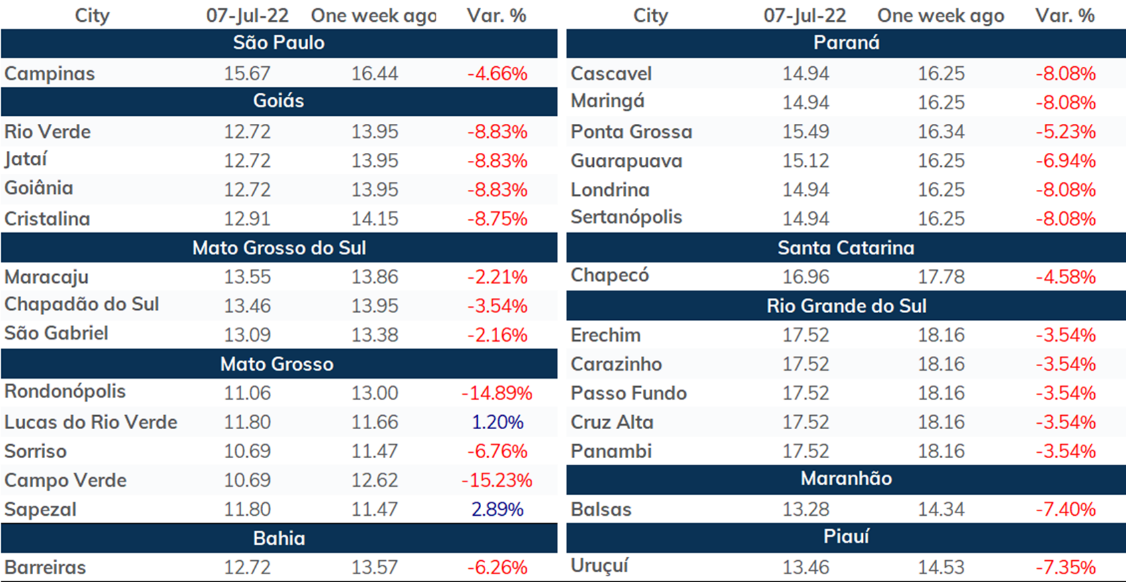
SPOT PRICES (USD/60kg-bag)