BEARISH DRIVERS
- Concern about possible recession;
New hike in US interest rates and signs that contractionary policy should continue;
- Concern with the level of Chinese economic activity and a possible reduction in demand for grains;;
- Progress of corn harvest in the US;
- US export shipments and sales weaker than usual for this time of year.
Bullish DRIVERS
- Questions raised by Russia about the Ukrainian grain export corridor;
- Summon of Russian reservists to support the war against Ukraine and threatened use of nuclear weapons;
- Expectation of lower production in the EU due to the drought;
- Quarterly position of US stocks below market expectations;
- Concern about the impacts of La Niña on the South American crop.
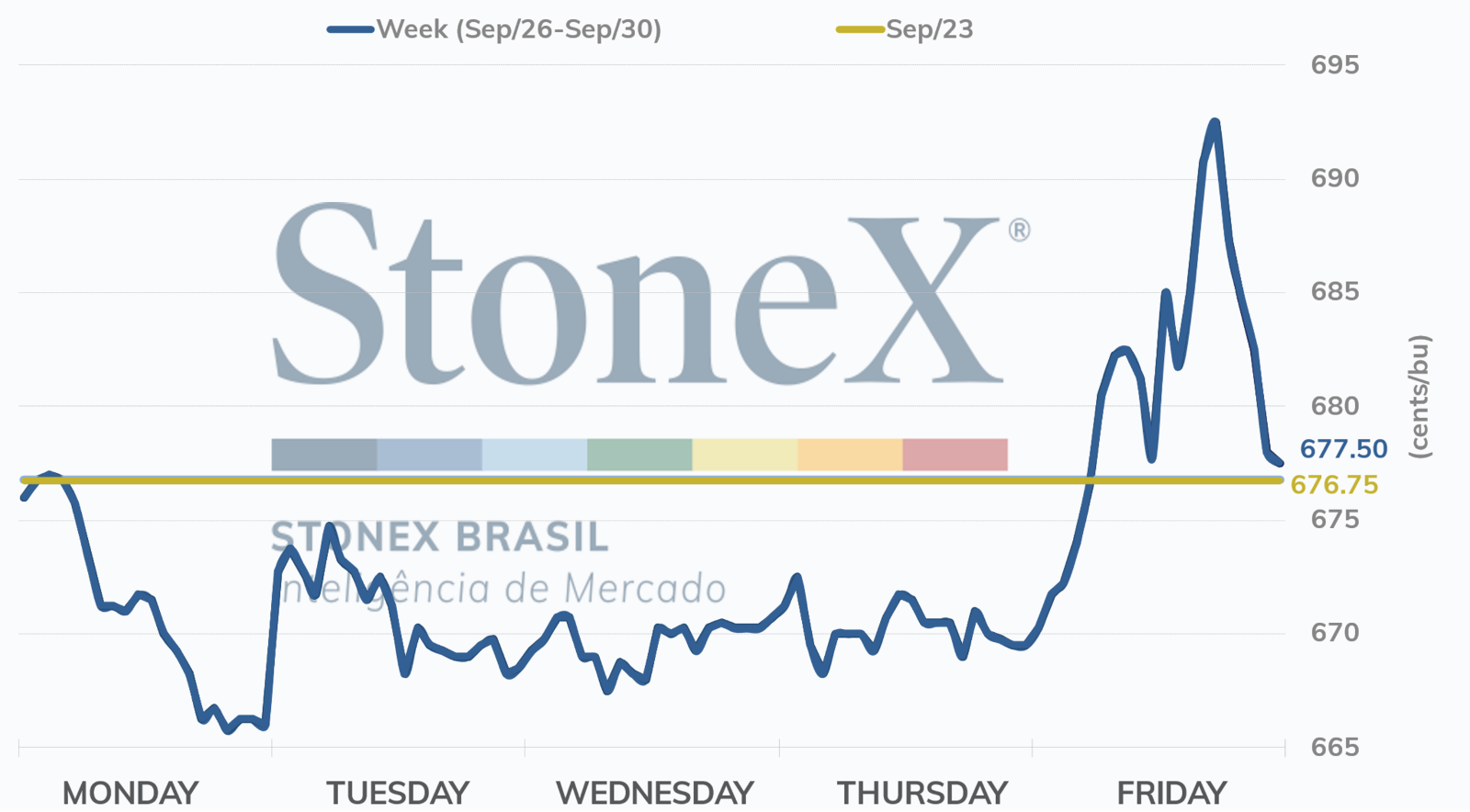
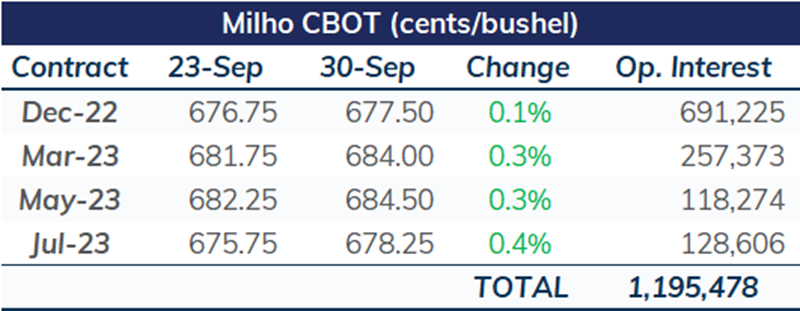
Last week, corn futures did not have a clear direction, with the clash between bullish and bearish fundamentals being marked by a certain balance. On the bearish side, we can highlight the advance of the US harvest, even if slightly delayed compared to the five-year average, and, once again, the concern about a possible recession. On the bullish side, it is worth noting the escalation of tensions between Ukraine and Russia and the release of the quarterly report on US stocks. The contract due in December 2022 ended Friday (30) at 677.5 cents/bu, accumulating a slight weekly appreciation of 0.75 cent/bu, or 0.1%.
Intraday (15 min) - December/22 (CBOT)
Tension in the Black Sea is a major source of support for corn prices for another week. Last week, another chapter was written in the conflict between Ukraine and Russia. Four Ukrainian regions were annexed to Russia, an action that was not recognized by Ukraine and Western countries. With this new escalation of tensions, fears also increase that the agreement for export of Ukrainian grains through the country's seaports will be affected, which could reduce the international supply of food, already greatly affected by the conflict and the weather adversities faced by several countries. In addition, another controversial issue in recent days was a leak in the Nordstream gas pipeline, with accusations of sabotage by both Putin and Western European leaders. In the coming weeks it will be extremely important to continue monitoring the conflict in the Black Sea, as it will have consequences not only for the supply of Ukrainian grain, but for the production chain of various products.
Lower-than-expected stocks give Chicago corn futures strength. Last Friday (30), the USDA released its quarterly US grain stocks report. On September 1, corn stocks were positioned at 34.98 million tonnes, a volume around 3.6 million tonnes higher than last year, but below average market estimates of 38.41 million tonnes.
Stable crop conditions and harvest progressing at a good pace. According to the USDA, up to September 25, 52% of US corn crops were in good or excellent condition, in line with what was expected by agents. The harvest reached 12%, 1 point below expectations and 2 points less than the five-year average for the period. The outlook is for favorable weather for fieldwork, which tends to ensure a good pace for the harvest and exert a downward influence on prices.
Possible recession remains a matter of concern among agents. In a scenario still marked by high levels of inflation in the United States, the expectation is that the Federal Reserve will continue with a policy of monetary tightening, which may stimulate the outflow of investments in riskier assets, such as futures and stocks, towards safer assets, such as US government bonds.
Weekly ethanol production in the US hits a seven-year low for the period. The Energy Information Administration (EIA) released US ethanol production data for the week ended September 23 reporting that the volume declined for the third straight week to 855,000 barrels per day, 46,000 less than a week earlier and the lowest level for the period in seven years. Despite this drop, the average weekly production year-to-date is in line with last year. Ethanol stocks, on the other hand, rose to 22.69 million barrels, against 22.5 million a week earlier, 12% above the same period in 2021.
US export sales pick up again. The USDA reported that net sales for the 2022/23 crop totaled 512,000 tonnes in the week ended September 22, against 182,300 tonnes the week before. In the equivalent week of 2021, US net sales stood at 370,400 tonnes. The volume was within the range expected by the market, which varied between 250,000 and 800,000 tonnes. The commitments of all destinations rose to 13 million tonnes, against 25.3 million in the same period last year.
Weekly US export sales - 2021/22
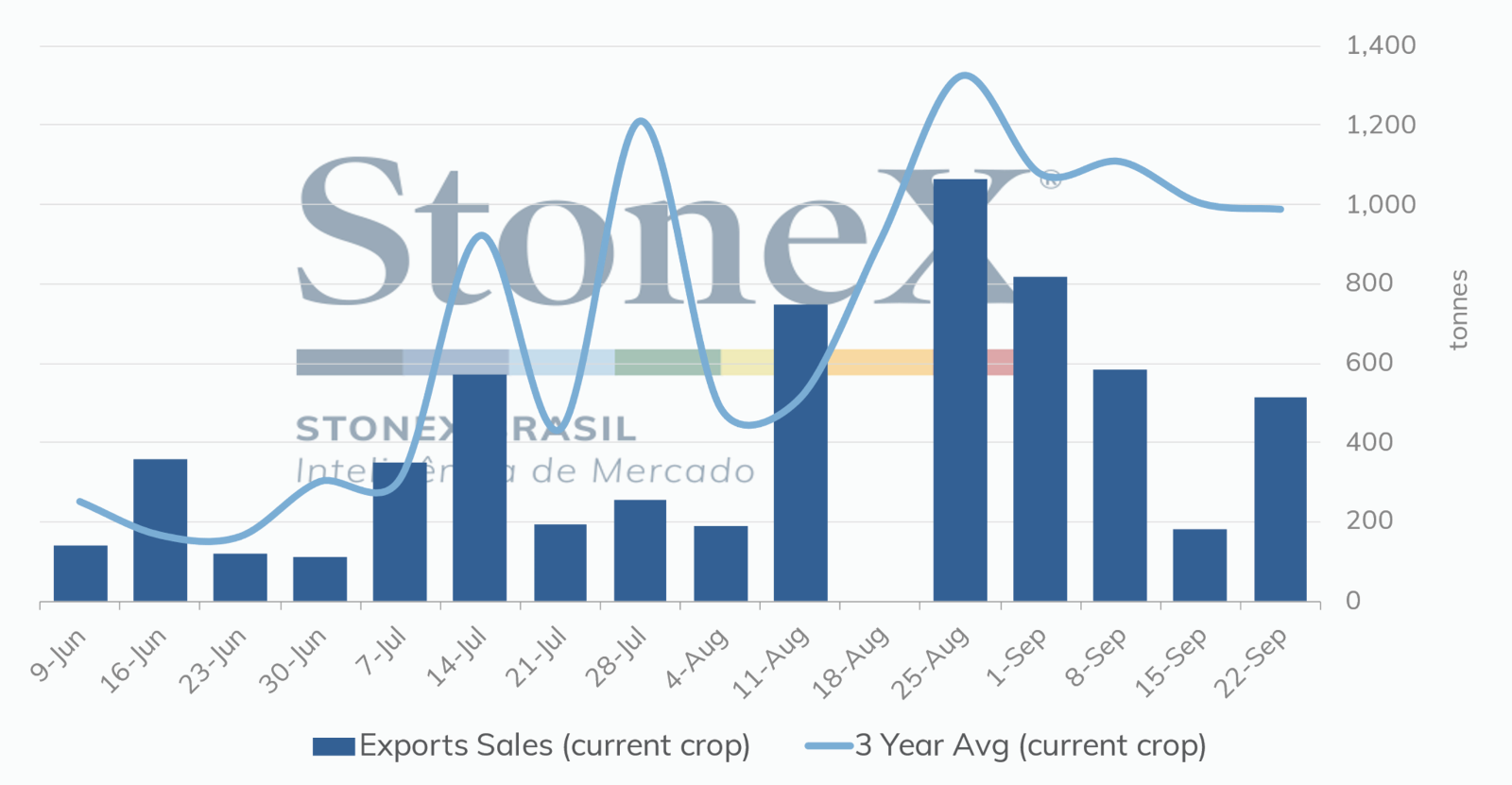
Source: USDA. Design: StoneX.