The pace of US corn shipments continues to raise questions about US corn demand. According to the USDA Export Inspection Report, the US shipped 963,400 tonnes in the week ended May 4, 555,200 tonnes less than a week earlier, 513,900 tonnes less than the same period last year and also below the lower limit of market expectations, which varied between 1 million and 1.55 million tonnes. As a result, the country increased the deficit of accumulated shipments in relation to the 2021/22 season, to 13.2 million tonnes. A week earlier the gap was 12.7 million tonnes. As of May 4, the US exported 24.9 million tonnes of corn.
Corn planting in the US reaches an above-average pace. On Monday (8), the USDA released its crop progress report. The Department reported that corn planting in the US reached 49% through May 7, a weekly advance of 23 percentage points. The number was 1 point above market expectations and also above the five-year average for the same period (42%). The models indicate that the country will see a dry month in June in the Midwest, with low temperatures in the east of the belt and hot in the west, but for now the US crop is not a concern.
Ethanol production retreats again in the US but remains above average for the period. According to data released by the Energy Information Administration (EIA), US ethanol production dropped to 965,000 barrels per day in the week between April 29 and May 5, a contraction of 11,000 in the weekly comparison, but 36,200 above the five-year average for the same period. Ethanol stocks dropped slightly to 23.29 million barrels, 72,000 barrels less than a week earlier.
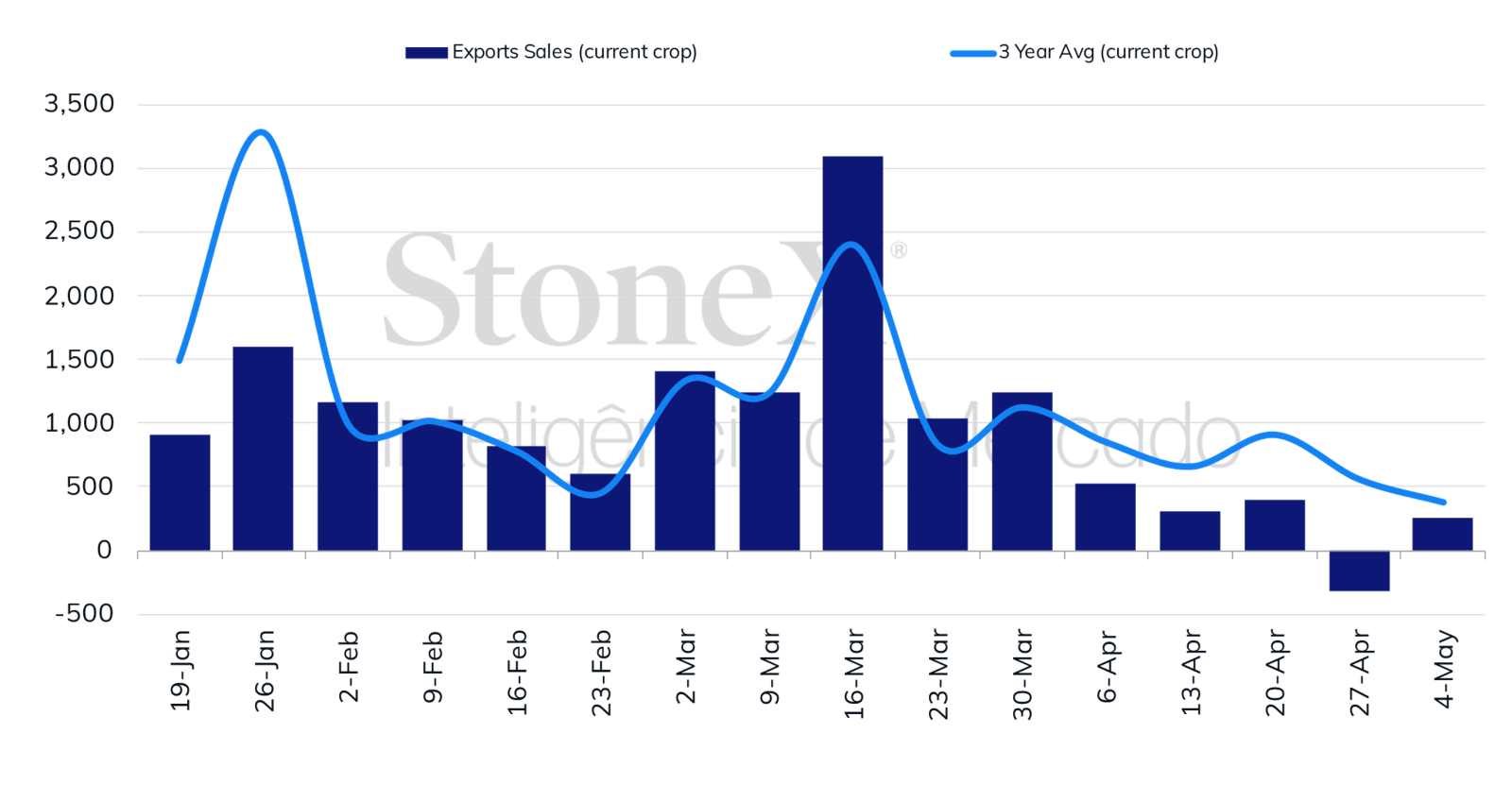
US export sales greater than a year earlier, but agents continue to question whether the country will reach USDA estimates. In its Export Sales Report, the USDA said US net sales totaled 257,300 tonnes for the week ended May 4. In the previous week, US export sales had totaled 572,900 tonnes, while in the same period of 2022 the volume reached 192,700 tonnes. With that, accumulated sales rose to 38.4 million tonnes, reducing its deficit, which had already gone from 20.2 million tonnes to 20.1 million.
Weekly US export sales (000 tonnes)
Source: USDA. Design: StoneX.
Argentine crop conditions worsen again. The Buenos Aires exchange reported that 2% of Argentine cereal crops were in good/excellent condition on May 11, a decrease of 2 points in the weekly comparison and 15 points below that recorded in the same week of 2022. The harvest in the country reached 21.2%, 4.6 points below a year earlier and 10.5 points below the five-year average. The BCBA continues to estimate the Argentine crop at 36 million tonnes, 16 million less than in the 2021/22 cycle. However, amid the significantly adverse situation of crops, this number may be reduced again.
Renewal of the Black Sea grain export agreement remains uncertain. May 18 is the deadline for extending the Black Sea grain export agreement. Officials from Russia, Ukraine, Turkey, and the UN met last week, however, as much as the Turks have shown some optimism in relation to the renewal, it has not yet occurred. Last week, Russia made several attacks on Ukrainian territories and again stated that it would not accept the extension unless barriers to the export of its grains and fertilizers were removed. Concerns about a further disruption of Ukrainian supply supported the market, preventing further losses during the week.
CONAB raises production estimate for the 2022/23 crop in Brazil. Last week, Conab revised its estimates for the 2022/23 crop in Brazil. Production for the 2nd crop was increased to 96.1 million tonnes, against 95.3 in its last report. This increase offset the drop of approximately 200,000 tonnes in the estimate for the 1st crop and, as a result, total production was increased to 125.5 million tonnes, around 6 million less than estimated by StoneX.
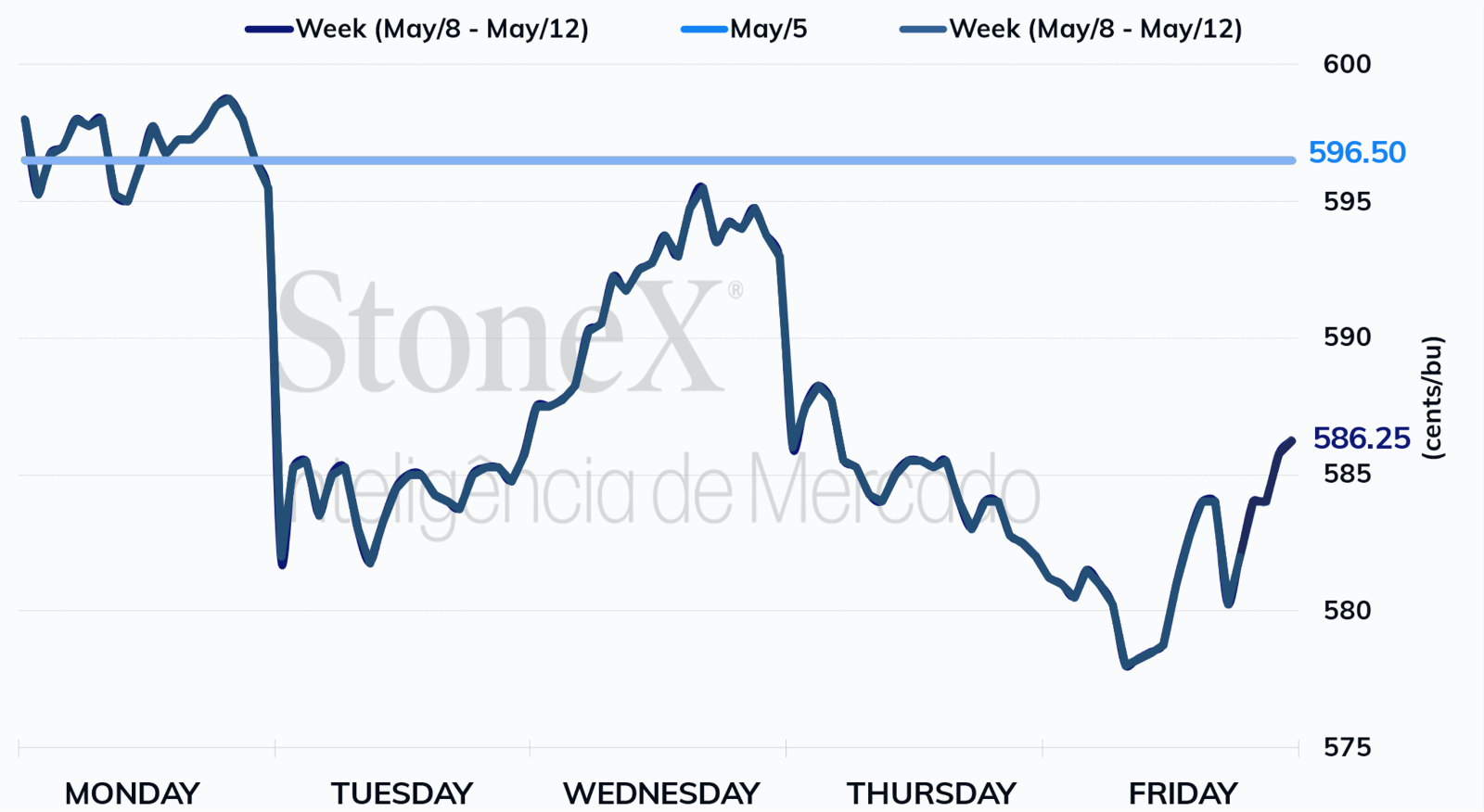
USDA releases first official estimates for 2023/24 season. On May 12, the USDA released its first numbers for the 2023/24 season, but the revisions for 2022/23 also moved the market. It is worth highlighting the reduction in US shipments in 2022/23, from 47 to 45.1 million tonnes, which resulted in an increase of the country's ending stocks, to 36 million tonnes. It is also worth noting the increase of 5 million tonnes in Brazilian production, now estimated at 130 million tonnes, which was followed by positive revisions in the country's exports, to 53 million tons (+1 million), and in its domestic consumption (+3 million). Even with the worsening conditions of Argentine crops, the Department maintained its estimate at 37 million tonnes, above the BCBA estimate.
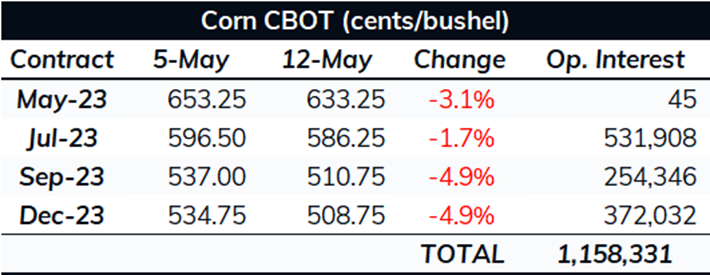
Regarding the next crop, the USDA, as expected, maintained the area brought in the Prospective Plantings and the yield of the Agricultural Forum, resulting in a production of 387.75 million tonnes. Even with an increase in domestic consumption to 314.6 million tonnes and exports to 53.4 million, ending stocks rose to 56.4 million tonnes, resulting in a stocks/use ratio of 15.3%, 5 points above the estimate for 2022/23. The prospect of a more comfortable balance for this and next season was one of the main factors behind the decline seen in corn futures.
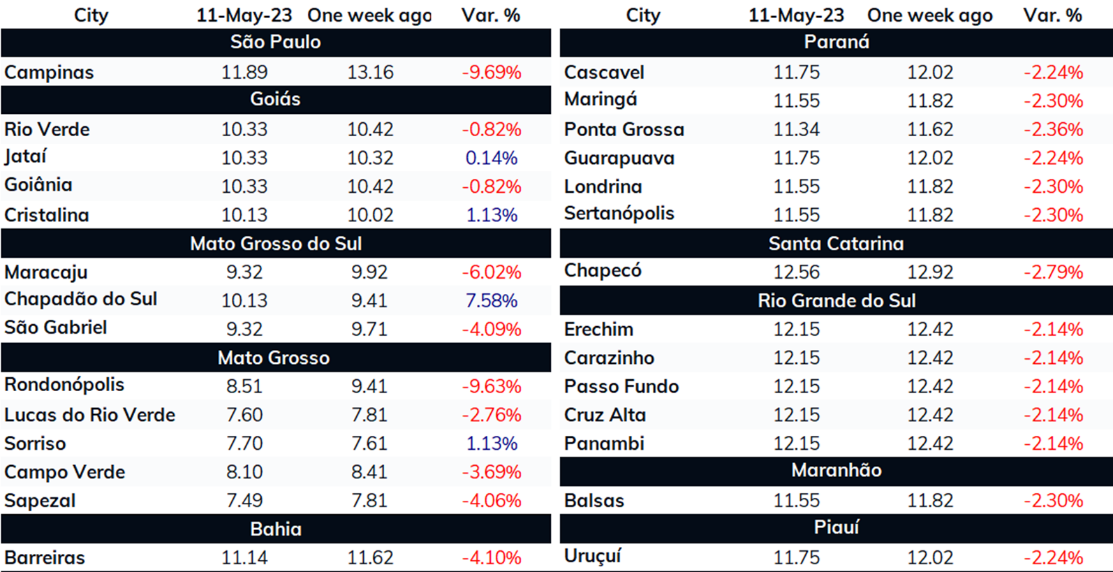
SPOT PRICES (USD/60kg-bag)