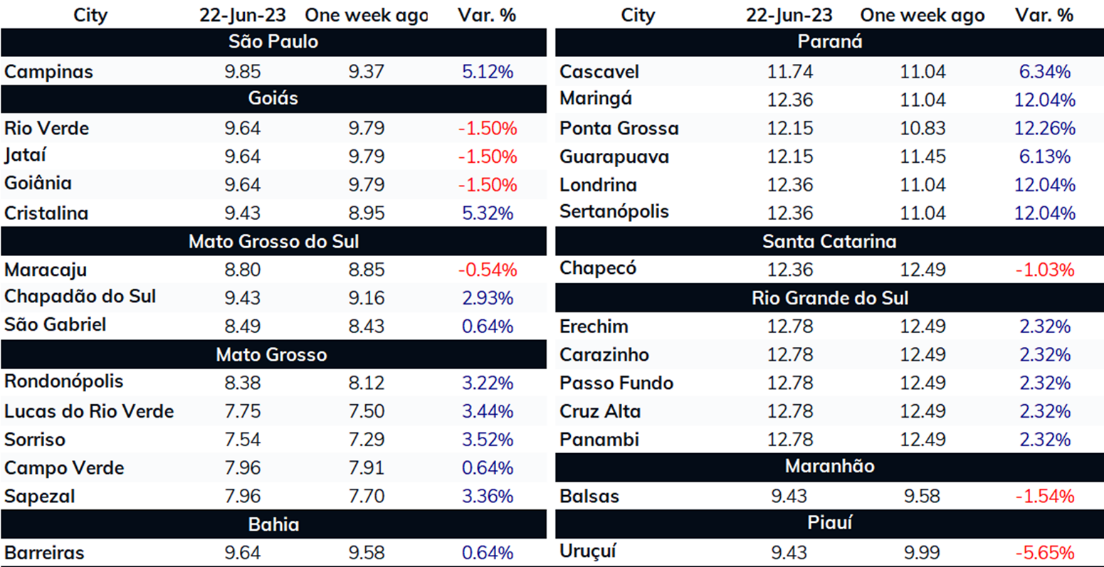
- Favorable prospects for Brazilian supply;
- Weakened pace of US sales and shipments;
- Weather models at the end of the week began to indicate the occurrence of more voluminous rains in the corn belt.
- Statements that Russia will withdraw from the Grain Agreement upon its expiration;
- Concern about the development of a drier pattern in parts of the US Midwest;
- Fears that the development of a drier pattern in China could impact local production.
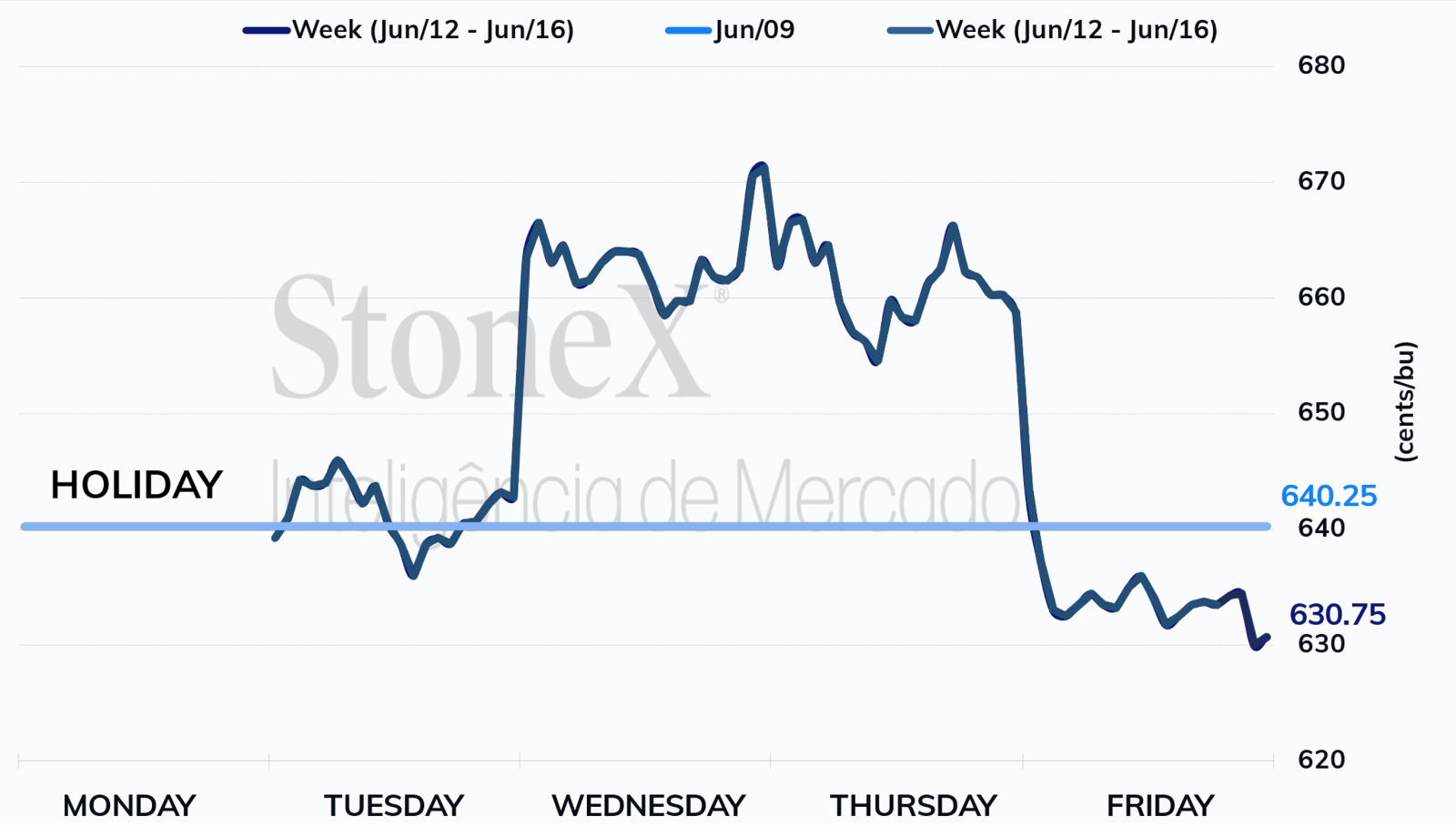
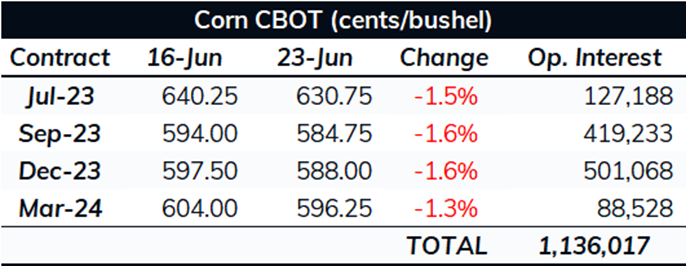
Corn futures rose earlier in the week, reacting to the weather forecast and crop condition in the US. At the beginning of the previous week, corn futures rose significantly in Chicago, reflecting the forecast of suboptimal rains in the US corn belt, especially in Illinois and Iowa, main producing states, and the sharp drop in the condition of US corn crops. The good/excellent index dropped 6 percentage points in the weekly comparison, reaching 55% on June 18, a sharper drop than the 3 points expected by the market. The current level is 15 points below the one seen in the same week last year and is the lowest for this period since 1992. The NOAA Drought Monitor showed that on June 20, the drought covered 64% of the corn crops, against 57% in the previous week and 19% a year earlier. All these indicators led the market to question US productivity. It can be said that, given the current conditions, it will be very difficult for the US to register the average productivity of 11.39 t/ha currently estimated by the USDA, but comparisons are already being made with the scenario seen in 2012. As mentioned last week, it is still too early to say anything about US production, but we should continue to observe significant oscillations in the coming weeks, given that the weather in July will be crucial to define the US crop. At the beginning of last week, as reported, weather forecasts pointed to a low volume of rainfall, with the 15-day model indicating a less than ideal volume. However, throughout the week, the models underwent changes, starting to show a greater volume of rainfall, with emphasis on Iowa and Illinois, which contributed to the drop in prices observed on Thursday and Friday.
Ethanol production in the US rises in the week. According to data released by the Energy Information Administration (EIA), US ethanol production rose to 1.052 million barrels per day in the week between June 10 and 16, an increase of 34,000 in the weekly comparison. Production was 34,200 higher than the five-year average for the same period, but 3,000 lower than a year earlier. Ethanol stocks also rose to 22.8 million barrels, 578,000 barrels more than a week earlier.
Pace of US shipments is lower in the weekly comparison. According to the USDA Export Inspection Report, the US shipped 877,300 tons in the week ended June 15, 292,800 tonnes less than a week earlier and 315,300 tonnes less than in the same period of the previous year. As a result, accumulated shipments in the 2022/23 season totaled 32 million tonnes, which is 14.2 million less than in the same period of the previous cycle.
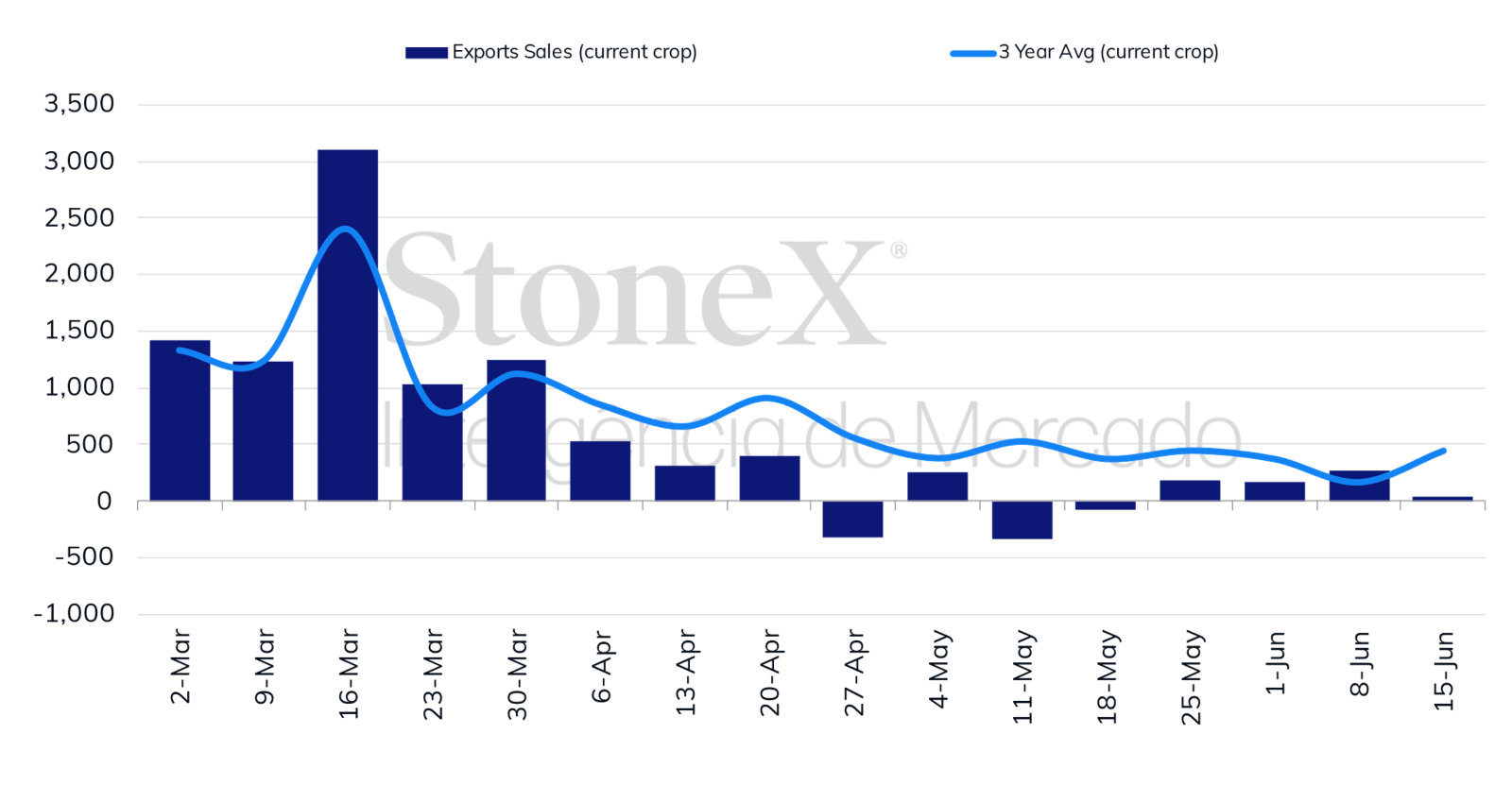
US net sales fall and delay in relation to previous crop widens. In its Export Sales Report, the USDA reported that US net sales totaled 36,000 tonnes for the week ended June 15, 237,300 less than a week earlier, 635,900 less than in the same period of 2022 and 274,800 below the FIVE-year average. With that, cumulative sales ROSE to 38.6 million tonnes, but the deficit compared to the 2021/22 season rose to 21.7 million tonnes, against 21.1 million a week earlier.
BCBA reduces Argentine crop to 34 million tonnes. The Buenos Aires exchange reported that 7% of Argentine corn crops were in good/excellent condition on June 22, unchanged week-on-week, but 10 points below the same week of 2022. The corn harvest in the country reached 43.6%, which is 1.3 points above a year earlier, but 10.4 points below the five-year average. The BCBA reduced its estimate for the 2022/23 crop in Argentina, from 36 million to 34 million tonnes, 18 million less than in the 2021/22 cycle.
Tensions in the Black Sea continue to receive attention from agents. Last week, Russia declared that it will withdraw from the Grain Agreement, which would end the initiative after July 18, the date of its expiration. One of Russia's wishes is to have access to the SWIFT system, but the UN says it is unable to guarantee that the country has access. With that, a restriction in Ukraine's grain supply looks ever closer. A solution for the continuity of shipments has not yet been ruled out, but if exports really are interrupted, the global S&D balance should be impacted.