- Slow pace of US shipments and sales;
- Good rainfall in the first two weeks of August in the Corn Belt;
- Expectation of a more comfortable balance sheet in the US in 2023/24.
- Forecast of hot and dry weather at the end of August;
- Worsening tensions between Russia and Ukraine;
- Concern about weather impacts on China's corn crop.
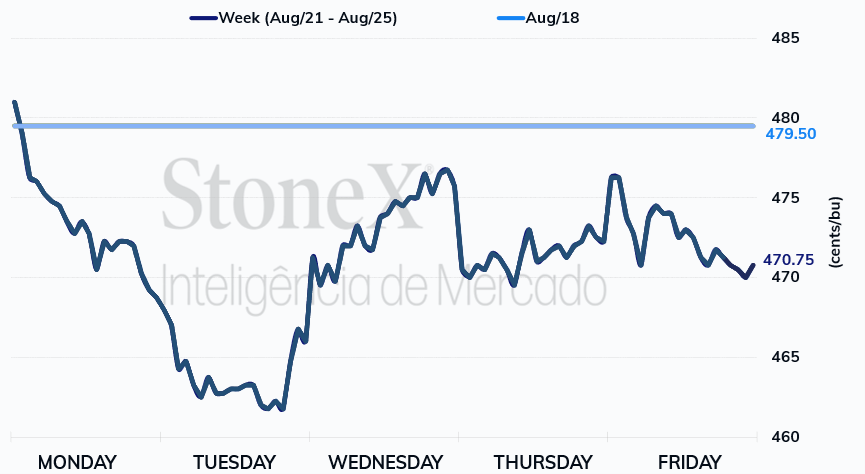
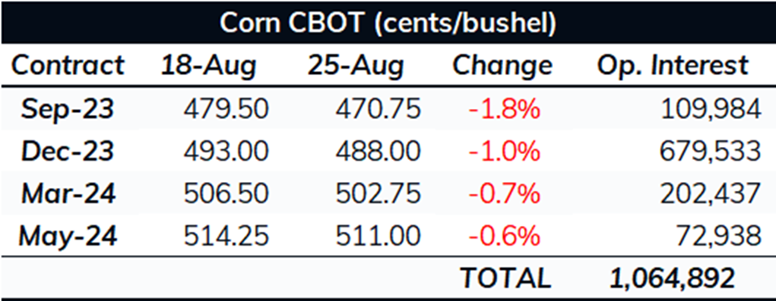
Last week, corn futures dropped in Chicago. The September/23 ended last Friday (August 25) with a devaluation of 1.8% in the weekly comparison, quoted at 470.75 cents/bu.
Last week, the Pro Farmer held its crop tour through the US Midwest's main corn and soybean areas, which is closely watched by the market. The final result of the crop tour, which reflects factors other than the information collected, such as the stage of the crops, area adjustments, historical differences in the tour data about the final USDA yields, etc., indicated a national average productivity in 2023/24 of 10.8 tonnes/hectare, with production reaching 380 million tonnes, about 3.8 million tonnes lower than estimated by the USDA in August. Considering Pro Farmer's production number and maintaining the USDA's supply and demand fundamentals, US ending stocks for the 2023/24 season would stand at 52.1 million tonnes, a much more comfortable scenario than in recent years.
Even with expectations still favorable for the US corn balance, the market continues to monitor the weather and crop conditions in the US. On August 21, the USDA reduced crops in good/excellent condition to 58%, 1 point less than a week earlier, 3 points higher than in the same period last year, but 4 points below the 5-year average. Due to the hot and dry weather observed in the last week, the Department is expected to bring a further reduction of crops classified as good/excellent in today's report.
Even without major news, tensions in the Black Sea continue to move the market. Last week, Russia carried out a new drone attack on Danube River ports, damaging some Ukrainian grain warehouses. However, the fire from the attack was quickly contained, limiting further damage. As much as the agents are already "used" to the scenario, it is still a delicate subject, as an escalation in tensions can have more severe effects on the market.
Weekly ethanol production declines in the US but remains high. According to data released by the Energy Information Administration (EIA), US ethanol production fell by 21,000 barrels per day (tbpd) in the weekly comparison, standing at 1,048 tbpd between August 12 and 18. Despite the retreat, the production level was above that observed a year earlier (987 tbpd) and the 5-year average (988.4 tbpd). Stocks also retreated, from 23.44 million barrels to 22.79 million.
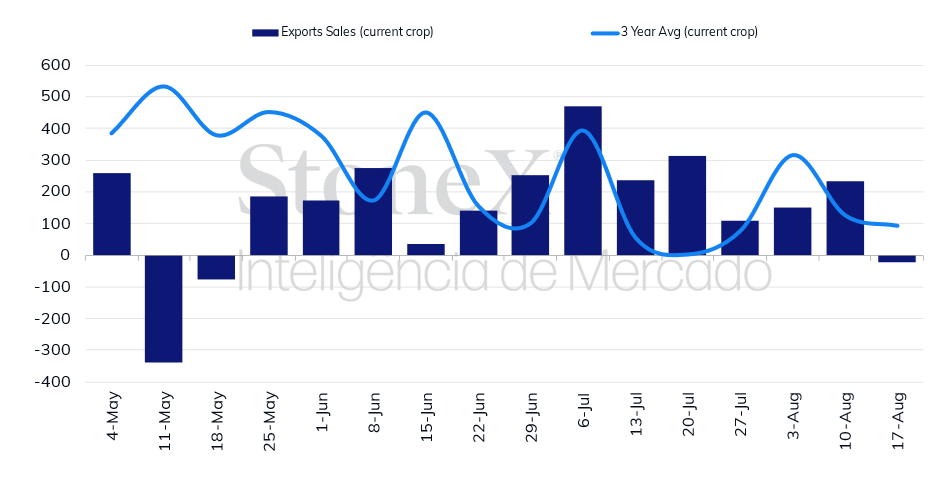
Weekly export sales - USA (thousand tonnes)
Export inspections continue to show a weak pace in the US. According to the Export Inspection Report, the U.S. shipped 482,600 tonnes of corn in the week ended Aug. 17, up from 459,000 tonnes the week before but down from 821,500 tonnes a year earlier. As a result, cumulative exports in the 2022/23 North American crop reached 36.2 million tonnes, against 53.9 million in the same period of 2021/22, a difference of 17.75 million tonnes.
US net sales are also at a slow pace. In its Export Sales Report, the USDA reported that US net sales totaled 22,700 tonnes in the week ended Aug. 17, meaning there were net cancellations. A week earlier, the country had traded 233,500 tonnes. With this, cumulative sales are 40.5 million tonnes, a deficit compared to last season.
Corn harvest in Argentina is in its final stretch. The Buenos Aires Grain Exchange reported that 96.9% of the cereal's crops had been harvested by August 23. As a result, 33 million tonnes of corn have already been removed from the field. In the same period last year, 100% of the crop had already been harvested, while the 5-year average for the same period is 99.3%.
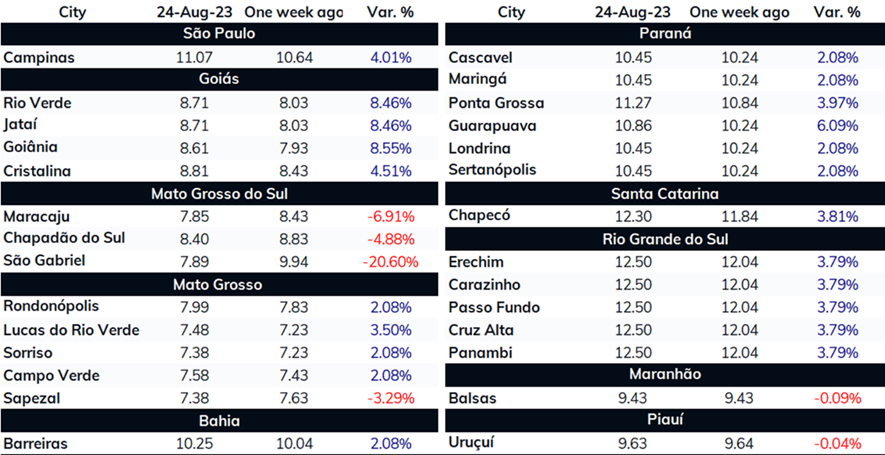
Safrinha harvest reaches 83.3% in Brazil. Last Friday (Aug. 25), StoneX released its weekly crop follow-up report. By the end of last week, 83.3% of the crop had been harvested, up from 94.1% in the same period last year. Despite the delay, expectations are very good for the crops as favorable conditions for the cereal were registered in most areas during development. The 2023/24 crop planting is beginning, reaching 4.4% by the end of last week. For more details, click here and access the full report.