- Slow pace of US shipments and sales;
- Expectation of a more comfortable balance sheet in the US in 2023/24.
- Worsening tensions between Russia and Ukraine;
- Concern about the weather impacts on China's corn crop.
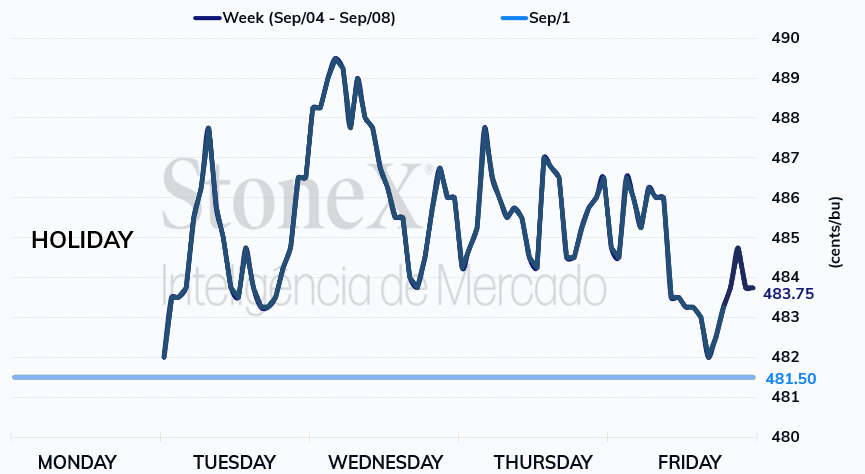
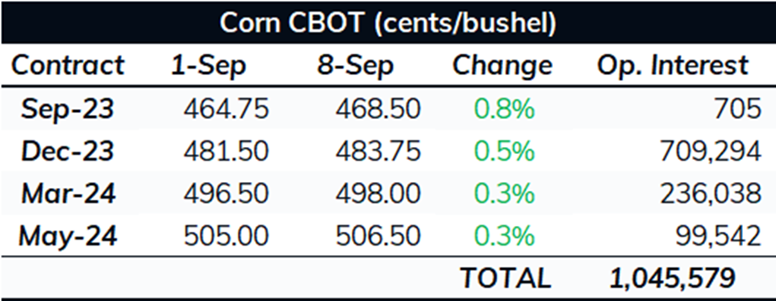
After two straight weeks lower, corn futures have moved back up in Chicago. The December/23 ended last Friday, September 8, quoted at 483.75 cents/bu, an appreciation of 0.5% in the weekly comparison.
American crop condition: According to the USDA crop follow-up report, 53% of corn crops were rated good/excellent (B/E) on Sept. 3, down three percentage points from a week earlier, down 1 point from the same period last year, and 7 points below the 5-year average. A drop in crops classified as good/excellent was expected, but the drop was 1 point higher than the agents' expectation. The US crop is advancing as expected. About 18% of the crop is mature, two percentage points above the 5-year average, and 67% has reached the denting stage, also 2 points above average. The market is preparing to shift its focus to harvesting, and soon, dry days will be considered bearish, as they would allow a rapid advance of fieldwork.
CONAB raises Brazil's production estimate: Last Wednesday (Sep 6), Conab released its new 2022/23 corn crop estimates. Total production in 2022/23 rose to 131.87 million tonnes, driven by an adjustment in the second crop, which advanced to 102.16 million tonnes. Click here to see the full report.
StoneX has released its new estimate for the US 2023/24 crop based on productivity surveys and considers the official USDA area. The national average productivity was estimated at 10.98 t/ha, a decrease of 0.13 t/ha from the previous number and slightly below the last USDA estimate (10.99 t/ha). With this, StoneX projects a production slightly lower than the Department's figure (383.83 million tonnes) at 383.61 million tonnes. Click here to view the full report.
US ethanol production: According to data released by the Energy Information Administration (EIA), US ethanol production totaled 1,012 thousand barrels per day (tbpd) in the week ended September 1, a slight advance of 5 tbpd in the weekly comparison. The volume recorded surpassed that observed in the same week last year by 23 tbpd and the 5-year average by 25 tbpd. On September 1, ethanol stocks had reached 21.62 million barrels, virtually unchanged in the weekly comparison but 560,000 barrels less than the 5-year average for the same period.
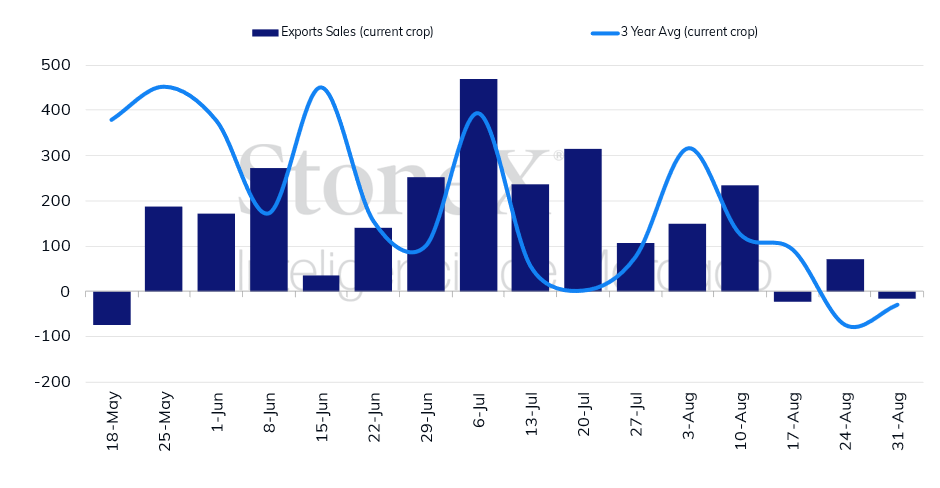
Weekly export sales - US (thousand tonnes)
US export inspections: According to the USDA's Export Inspection Report, the US shipped 481,300 tonnes of corn in the week ended Aug. 31, 118,600 tonnes less than a week earlier and 61,600 tonnes lower than at the same time in 2022. Cumulative exports in the 2022/23 season totaled 37.3 million tonnes, 17.8 million tonnes lower than in 2021/22.
US export sales: 2022/23 net sales were -15,200 tonnes in the week ended August 31, i.e., net cancellations. In the same week last year, net cancellations of 131,600 tonnes had been recorded. Commitments to all destinations came in at 40.6 million tonnes, 20.2 million tonnes less than in 2021/22.
Concerns about US river levels: Concern about the pace of US sales and shipments is not new, and with the dire outlook for river levels in the country, fears are growing. The river level in Memphis is forecast to reach -2.1 meters by Sept. 14. The current reading is -0.85 meters, and if the forecast is realized, 2023 will enter the group of the ten years of lowest readings in the place.
Russia shows interest in the resumption of the Black Sea grain export agreement. In recent weeks, there have been active talks between Russia's leaders and Turkey about a resumption of the agreement. As long as the parties do not agree, Ukraine will continue to carry out successful transports through the special maritime corridor. The ships did not carry grain, but they signaled that Ukraine could succeed by this alternative route.
The long-awaited monthly supply and demand report from the USDA. The expectation is very high regarding possible adjustments for the US crop, both in productivity and area, since the Department has already signaled that revisions in the planted area may occur.