- Lagging pace of shipments and exports in the US;
- US harvest progress;
- More positive USDA estimates for US production and global stocks.
- Tensions between Russia and Ukraine;
- Logistical problems at ports in Northern Brazil;
- Concern about weather conditions in South America.
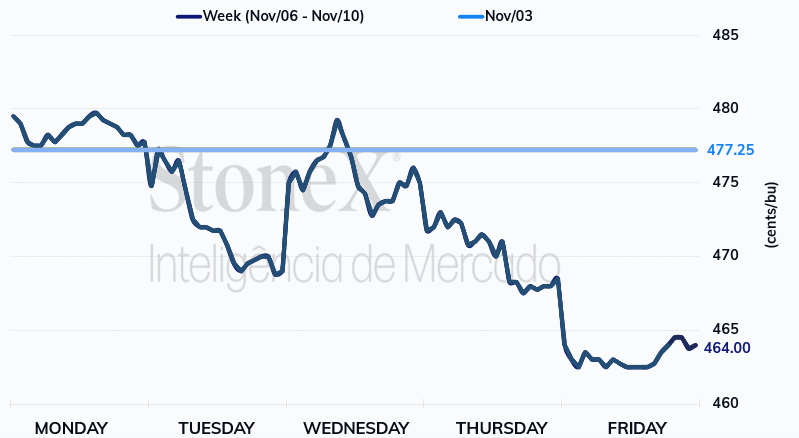
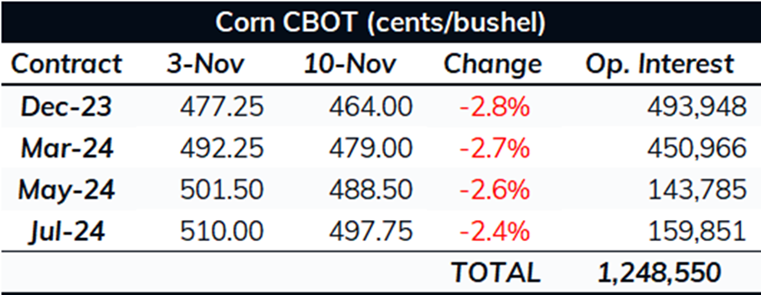
A bearish trend marked the corn futures market in Chicago throughout the last week. The December 2023 contract ended last Friday (November 10), quoted at 464 cents/bu, accumulating a depreciation of 2.8% weekly. Despite news related to the conflict in the Black Sea providing some support in recent days, the good progress of the American harvest and the USDA supply and demand report pressured corn quotes on the CBOT.
US crop progress: As disclosed in the USDA's Weekly Crop Follow-up Report, corn harvest in the US reached 81% on November 5, a ten percentage point (p.p.) increase compared to the previous week. Thus, the pace of the current crop is four p.p. above the 5-year average for the same period. The weather models do not show large volumes of rain in the corn belt, which should allow for the continuation of a good pace of fieldwork over the next few days. Click here to access the full report.
Mississippi River Level: The trade continues to monitor river conditions in the US. According to NOAA data, after showing an improvement in its conditions and reaching the mark of -1.48 m in Memphis on November 6, marginally above the necessary level to exit the low-grade classification, a setback in this progress was observed, with the level in Memphis returning to -7.3 on the morning of this Monday (November 13th). Agents should continue to be aware of river conditions as NOAA forecasts indicate a reduction in river levels, which are expected to reach -3 m in Memphis by the end of this month, potentially affecting American logistics.
Weekly export sales - USA (tmt)
US exports inspection: According to the USDA Weekly Export Inspection Report, the US shipped 535.2 tmt of corn in the week ended November 2, in line with the previous week's volume (540.8 tmt) and well above the amount observed in the same week last year (254.3 tmt). Nonetheless, despite a better performance on an annual basis, the pace remains below the necessary level to reach USDA's export projection for the 2023/24 season, which was raised by 2.5% on Thursday (November 9) to 52.7 million tonnes, 10.5 million more than in 2022/23. The accumulated shipments reached 5.49 million tonnes in the current season, compared to 4.48 million in the same period of the previous cycle.
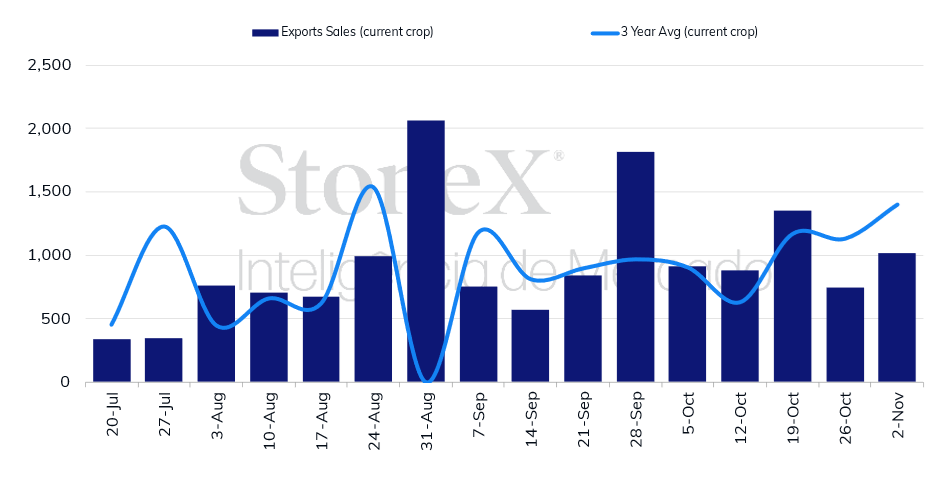
US export sales: On the export sales side, according to USDA data, the pace of business advanced in the week ended November 2, totaling 1 million tonnes during the period, 267,000 tonnes above the previous week's record. The volume was also above the one recorded in the same period last year (265.3 tmt) and the 5-year average for the same week (700 tmt). The country traded 19.3 million tonnes in 2023/24, 4.6 million tonnes above the same period of the previous season but below the pace needed to reach USDA's projection.
South American crop progress: With the American harvest approaching the final stretch, the weight of crop conditions in South America is expected to magnify even more among market drivers. According to BCBA data, corn planting in Argentina totaled 24.7% until November 8, 1.3 p.p. above the previous year's record but 8.1 points below the 5-year average. Although this condition does not bring great optimism, it is better than a few weeks ago. Recently, a good volume of rain has been observed in the country, which allowed crops to advance in good/excellent conditions by 4 points in the weekly comparison, reaching 24%. Nonetheless, the forecast for the next two weeks is for a low volume of rainfall, which may impact cultivation conditions.
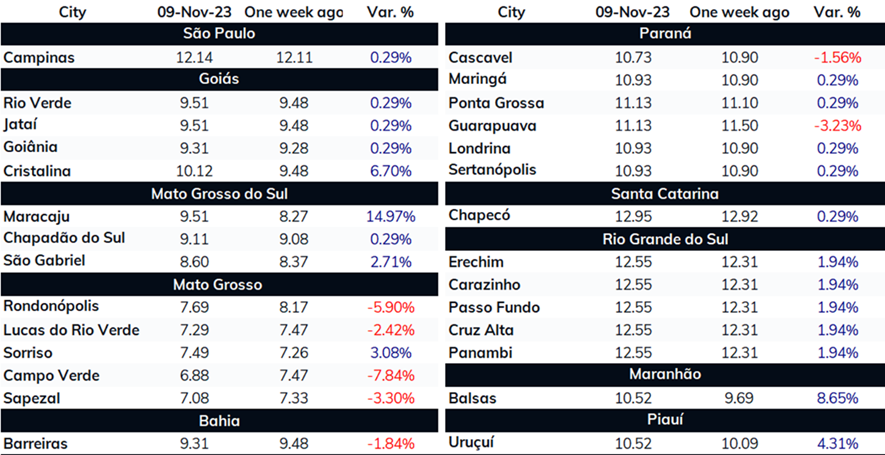
In Brazil, the first corn crop planting continues to be behind schedule, reaching 54.6% at the end of last week, compared to 65.9% in the same period last year. As mentioned in the last weekly report, despite the slower pace, the big banter is about the soybean planting pace, as its delay could ratchet down the window for second corn crop planting. The planting of the oilseed reached 59.3%, compared to 70.7% in the same period last year. The weather models indicate good volumes of rain in Mato Grosso do Sul, which should foster progress there, but they point to a low volume in several portions of Goiás and Mato Grosso, raising doubts about the crop progress in these states. Therefore, it will be important to closely monitor the weather pattern in the country over the next few weeks, as forecasts are always subject to changes. Click here to access the Weekly Crop Progress Report - Brazil.
Black Sea conflict: In the last week, it was reported that a missile hit a ship with a Liberian flag that was carrying iron ore to China at the entrance of a Ukrainian port, leaving one person dead and some injured. The incident, which occurred on Wednesday (November 8), supported the trade, resulting in significant gains for corn. Nonetheless, the event did not have enough strength to support the highs after the bearish USDA report.
USDA supply and demand report: On November 9, the USDA released its long-awaited WASDE report. One of the report's highlights was the increase in US corn production in 2023/24, from 382.6 million to 387 million tonnes, a volume about 4 million above the average of market estimates. With the increased supply from the US, the Department also expanded domestic consumption and exports to 314.72 million (+0.6%) and 52.7 million (+2.5%), respectively. Nonetheless, even with the hike in consumption variables, the estimate for the country's ending stocks increased by 2.1% to 54.76 million long tonnes, against the market's average estimate of 54.1 million tonnes. In addition, it is also worth noting the increase in global stocks by 0.8% monthly, to 315 million tonnes, about 3 million more than the average of market estimates. Click here to access the full report.