- Lower-than-expected international demand for US corn;
- Despite recent adverse weather, prospects for Argentine production remain positive;
- WASDE shows a slight increase in US 23/24 ending stocks.
- Conab and USDA reduce production estimates for Brazil's 23/24 crop;
- USDA reduces estimate for global production and ending stocks in 23/24;
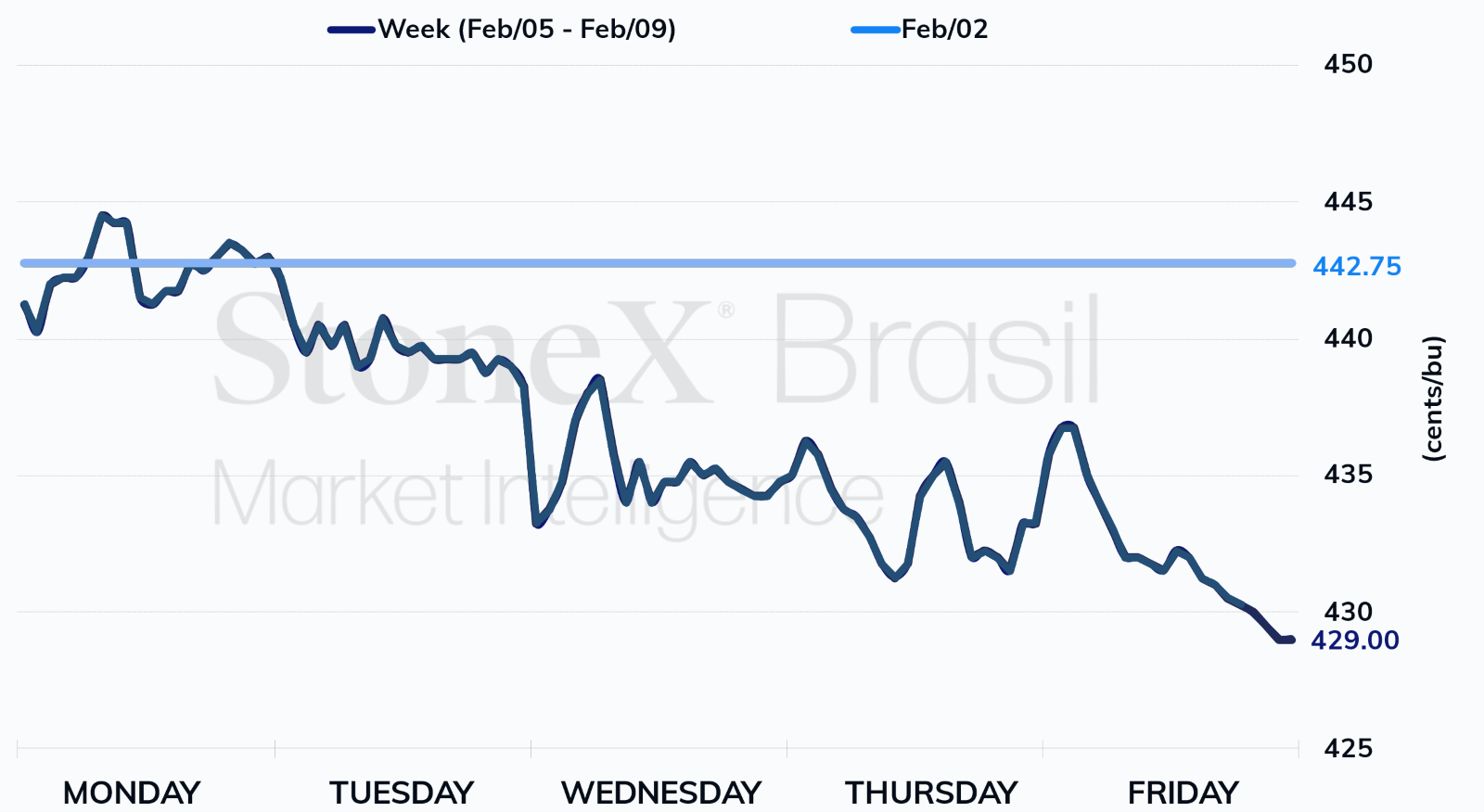
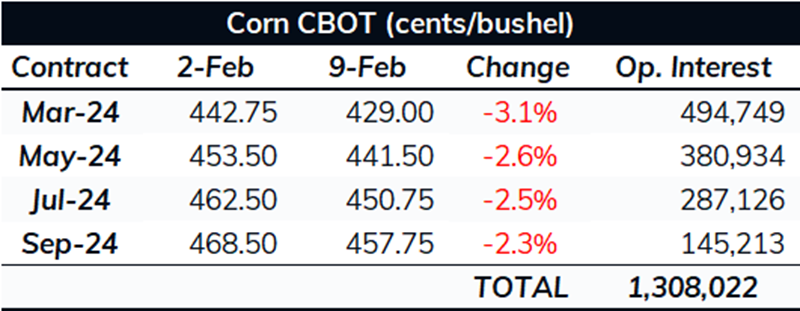
Corn futures ended another week on the downside in Chicago. The contract expiring in March 2024 ended last Friday (9) at 429 cents/bu, down 3.1% on the weekly comparison.
US corn ethanol production: The report released by the Energy Information Administration (EIA) showed that US ethanol production continued to recover from the negative impact caused by the recent extreme cold snap that hit ethanol plants in the US Midwest. In the week ending February 2, 1,033 thousand barrels per day (tbpd) were produced, up from 919 tbpd a week earlier and closer to pre-cold wave levels. Stocks rose by 509,000 barrels to 24.78 million.
US export inspections: The US export inspection report indicated a drop in international demand for the US grain. According to USDA data, 624,300 tonnes were shipped in the week ending February 1 and, although they were 130,300 tonnes higher than in the same week last year, this was 302,000 tonnes lower than a week earlier. Accumulated shipments for the 23/24 US crop reached 16.29 million tonnes, 3.74 million more than in the same period of 22/23.
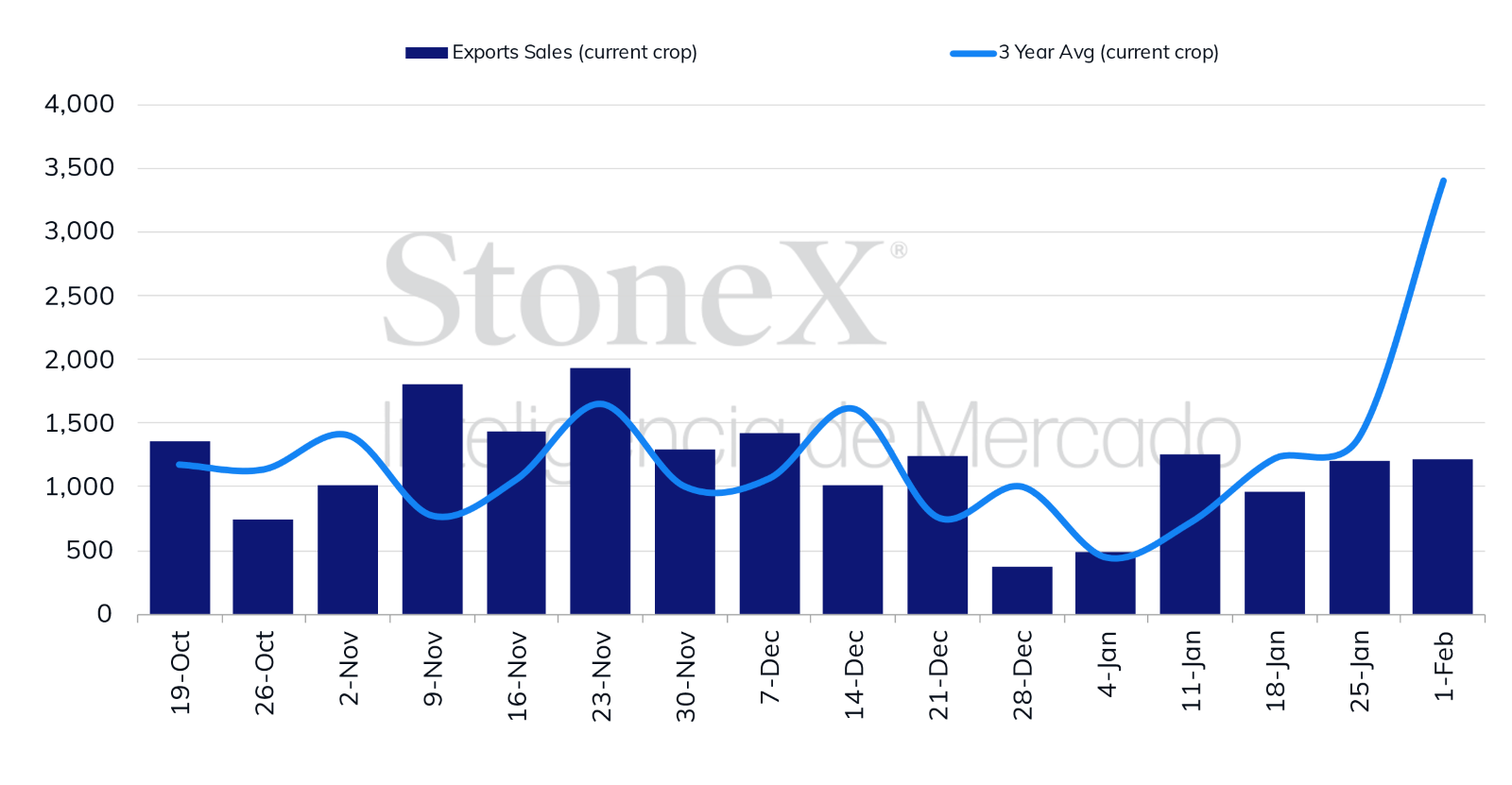
US export sales: According to data from the USDA's export sales report, the US recorded 1.22 million tonnes of net sales in the week ended on the 1st, compared to 1.21 million in the previous week and also slightly above the 1.16 million tonnes sold in the equivalent week of 2023. The figure was close to the upper end of the range of market estimates, which varied between 800,000 and 1.3 million tonnes. Accumulated sales for the 23/24 crop totaled 34.9 million tonnes, compared to 26.8 million in the same period of 22/23.
US weekly export sales ('000 tonnes)
WASDE Report: The long-awaited USDA supply and demand report, released last Thursday (8), did not bring any major surprises. The US balance was practically unchanged, with the only revisions being a marginal reduction in domestic consumption 23/24, to 316.37 million tonnes, 0.1% less than the figure released in January, and an increase in 23/24 ending stocks, to 55.17 million, around 250,000 more than in the last report and 660,000 above average market expectations.
Regarding the other players, it is worth noting the reduction of 3 million tonnes in Brazilian 23/24 production, to 124 million, a figure close to the average market estimate of 124.3 million. According to the USDA, the cut in Brazilian supply resulted from less favorable expectations for corn acreage. Normally, the first variable on the demand side to react to lower product availability is exports. Following this logic, the USDA reduced Brazilian shipments in 23/24 by 2 million tonnes, to 52 million.
Another highlight in this report was the 2-million-tonne increase in estimates for Ukrainian shipments in 23/24, to 23 million tonnes. Looking at the global balance of supply and demand, the USDA indicated a drop of just over 3 million tonnes in ending stocks for 23/24, to 322.06 million, against the average market estimate of 324 million.
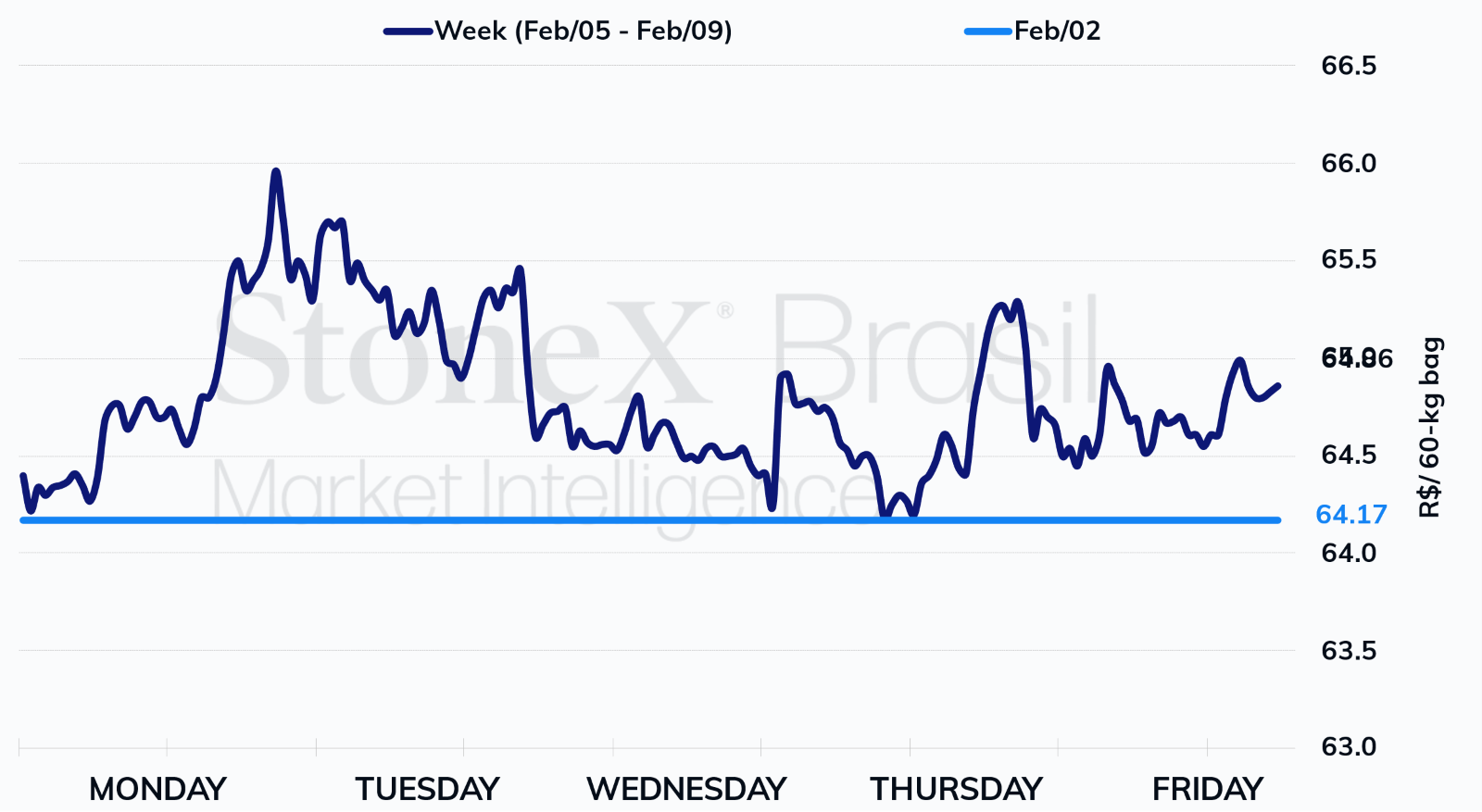
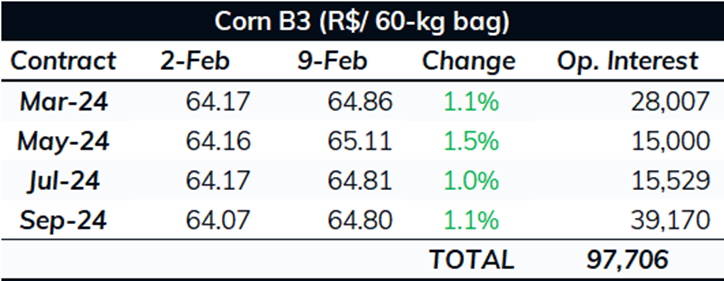
Contrary to what was observed in Chicago, an upward trend prevailed in Brazil's B3 corn market. March/24 ended last Friday at BRL 64.86/bag, an increase of 1.1% in the week. Part of this advance can be justified by a technical movement after the strong drops recorded in recent weeks. Furthermore, reductions in estimates for the Brazilian corn crop also supported the market.
Conab Estimate: Last week, Conab also released its estimates for the Brazilian grain crop. For corn, Conab reduced total 23/24 production to 113.7 million tonnes, mainly reflecting the cut of over 3 million tonnes in the second crop, to 88.1 million, which, in turn, was motivated mainly due to adjustments in planted area.
Progress of the 23/24 safrinha: During this crop, concern about the safrinha planting window was very present. The adverse weather at the end of last year and the delay in soybean planting raised doubts about how much of the 2nd corn crop could be sown within the ideal window. According to StoneX data, 32.9% of crops had been sown by the end of last week, almost 10 percentage points above what was registered in the same period last year. The faster pace of planting brings some relief to the productive potential of the next crop, but, in any case, there is a lot ahead and a favorable weather condition in the coming months is essential for obtaining a robust crop.
Argentine crop: Despite a less favorable weather pattern for Argentine crops seen in recent weeks, expectations remain favorable. In recent days, good amounts of precipitation have been recorded in the country's agricultural areas, which reduced concerns related to the Argentine crop. Furthermore, weather models point to good moisture levels in the coming weeks, which could contribute to obtaining a robust crop in the country. The USDA maintained its estimate for the 2023/24 season at 55 million tonnes, while the Bolsa de Cereales estimates Argentine production at 56.5 million.