- USDA projects hike in US ending stocks for 24/25;
- Despite recent adverse weather, prospects for Argentine production remain positive;
- WASDE reports a slight hike in US ending stocks for 23/24.
- CONAB and USDA reduce production estimates for Brazil's 23/24 crop;
- USDA reduces estimate for global production and ending stocks in 23/24;
- USDA projects a reduction in corn acreage in the US in 24/25.
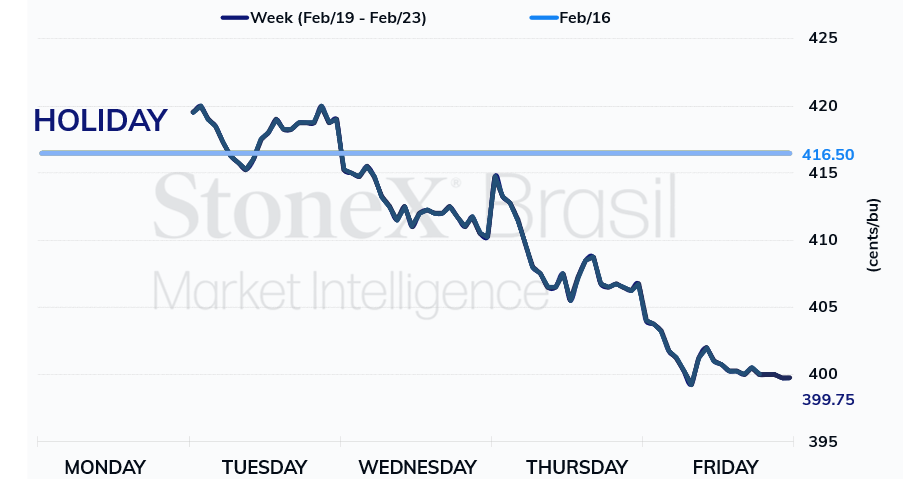
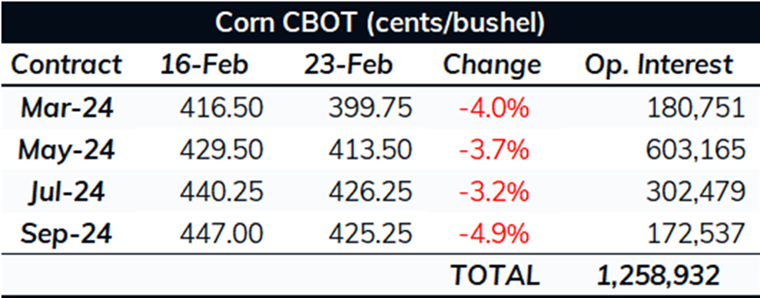
For the tenth time in the last 11 weeks, corn futures traded in Chicago ended the period in negative territory. The March 2024 contract renewed historical lows, ending last Friday (23), quoted at 399.75 cents/bu, a 4.0% decrease compared to the previous week. Among the factors responsible for the declines, there was no major news, with the rebound of the Argentine crop and uncertainties about global demand being the main determinants.
US exports inspections: The United States exports inspection report showed a significant volume of corn shipped between 02/09 and 02/15: 918.6 thousand tonnes, a hike of 2.9% weekly and 47.3% annually. In the accumulated of the crop year, the total exported in 2023/24 reached 18.1 million tonnes, against 13.7 million in the same period of 2022/23. This result helped support corn prices on the Chicago exchange on Tuesday (20/02) but was insufficient to contain losses for the rest of the week. Despite exports being more active than last year, they are still weak compared to the average of the last three years and below USDA estimates. This is one of the main factors behind the depreciation of corn.
Corn ethanol production in the US: If the foreign demand for US corn is disappointing, the same cannot be said for domestic demand. Looking at the ethanol sector, data from the Energy Information Administration (EIA) shows that 1,084 thousand barrels per day were produced in the week ending on February 16, a volume within the historical average and showing that the sector has moved past the problems of late January caused by the cold wave.
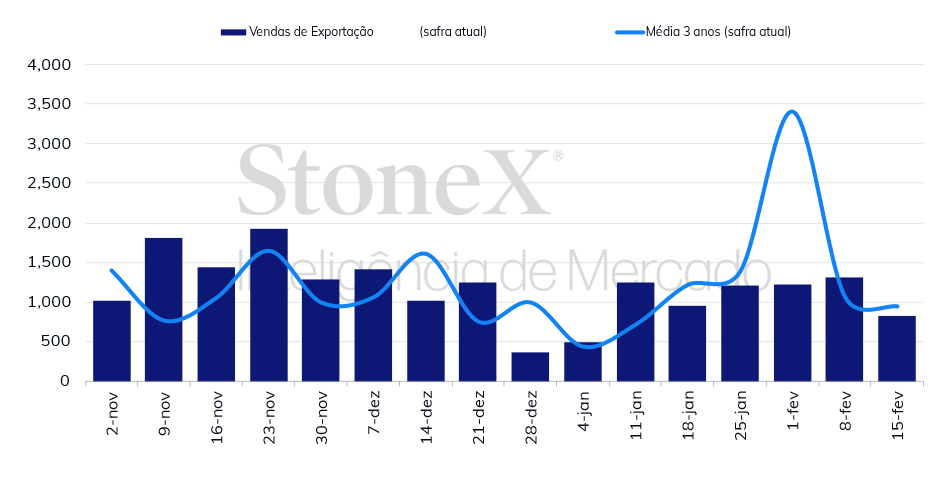
US export sales: The export sales report showed that 820 tmt of corn were sold in the week ending February 15, a volume in line with the one recorded in the same week last year (823 tmt) and above the average of the last three years (772 tmt). Even with the good weekly performance, the accumulated sales for the year continue to be weak: 37.0 million tonnes in 2023/24, against 42.3 million on average for the last three years.
Weekly export sales - USA (tmt)
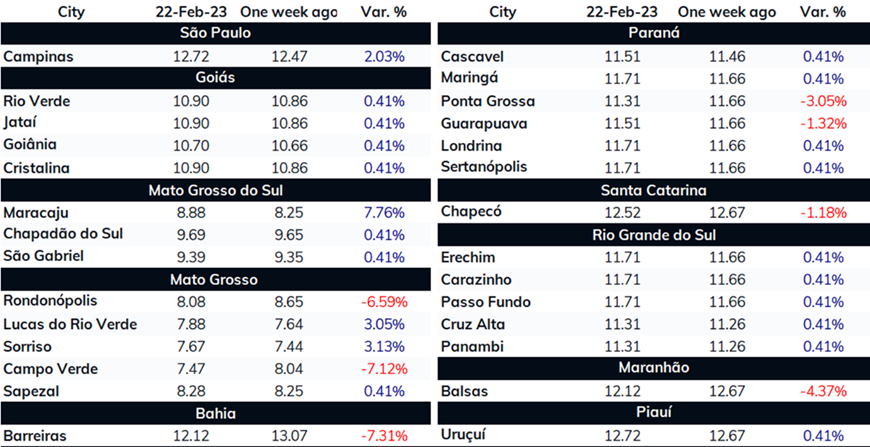
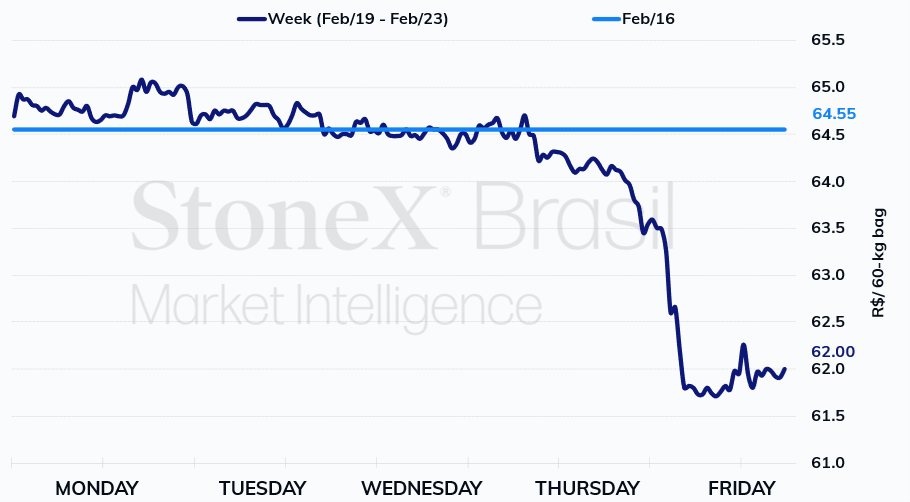
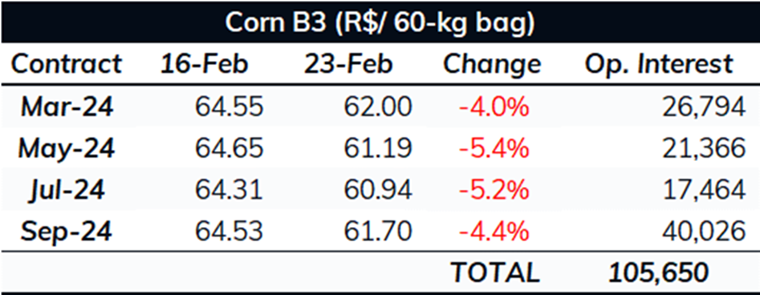
As observed in the international market, corn futures also significantly dropped in Brazil. The March 2024 contract ended last Friday (23), quoted at BRL 62/bag, a 4.0% depreciation for the week.
Progress of the summer corn harvest 2023/24: As of last Friday (02/23): 32.9% of the summer corn had already been harvested in Brazil, a percentage higher than the 20.3% recorded in the same period last year and close to the average of the last five years of 33.8%. In Rio Grande do Sul and Paraná, states whose corn cycle is ahead of the national average, the harvest has already exceeded 60%.
Progress of safrinha corn planting: As of last Friday (02/23), 65.6% of the Brazilian area destined for safrinha corn had already been sown, compared to 46.7% last year and 63.6% on average over the last five years. With planting progressing normally, fears about planting safrinha corn outside the ideal window have been reduced, contributing to the cereal's losses in the exchange.
Argentinian crop: The Rosario Exchange reduced its estimate for the 23/24 corn crop in Argentina. Due to the adverse weather conditions recorded between mid-January and early February, the institution reduced its figure from 59 million tonnes to 57 million, 500 thousand tonnes more than the Buenos Aires Grain Exchange (BCBA) estimated. Despite the contraction, this figure still significantly exceeds the Rosario Exchange estimate for the volume harvested in 22/23 (36 million tonnes). Furthermore, according to BCBA data, the situation of Argentine crops has improved due to the recent good rains. In the last week, the percentage of crops in good/excellent condition reached 28%, one p.p. more than a week before and 19 p.p. more than in the same period of 2023. Soybean crops in poor/very poor condition now represent 15% of the total, two percentage points less than a week ago and 36 percentage points below the level observed in the same week last year.
This week, the highlight is the release of the new figures from StoneX for the Brazilian crop next Friday (Mar 1).