
Corn continues to trade within narrow margins on CBOT; dollar volatility impacts prices in Brazil
- Bullish
- Strong global consumption;
- USDA estimates lower global stocks for the 2025/26 crop;
- Exports remain strong in the United States;
- Expectations of reduced planted area in the U.S. for 2026;
- Bearish
- Expansion of planted area for the 2025/26 crop in Brazil;
- Higher ending stocks in the U.S.
Note: Over the next two weeks, the Corn Weekly Report will not be published due to year-end holidays.
CBOT
Despite starting the week on a bearish note, corn futures on CBOT posted weekly gains, with March/26 contracts trading at US¢443.75/bu (+0.7%).
Intraday (15 min) March/26 contract - CBOT
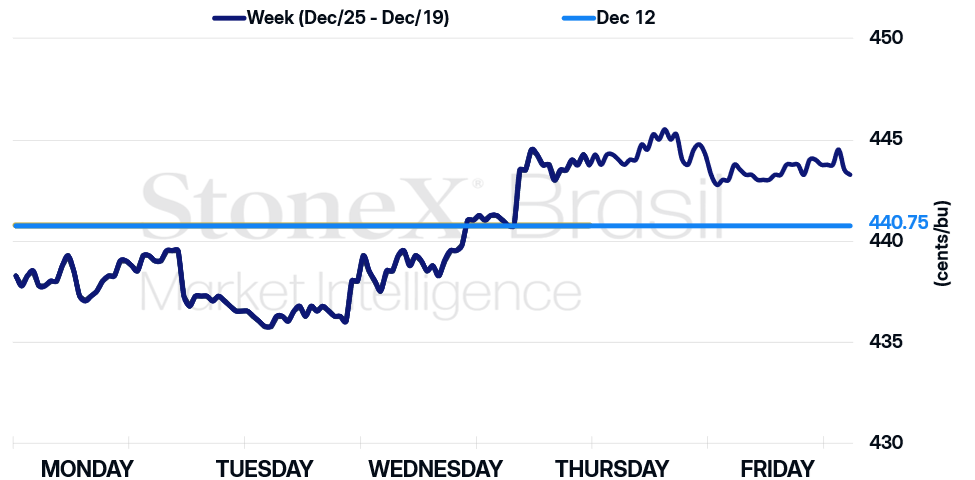
Source: CBOT. Design: StoneX.
The development of South American crops has posed some resistance to the market. In Argentina, where planting reached 70% of the area last week, 88% of the crops are in good/excellent condition. As such, the market is monitoring the possibility of substantial production in the country. Meanwhile, in Brazil, the summer crop is progressing well, although it accounts for a smaller share of the country's total supply compared to the second crop.
This favorable development in South American summer crops, combined with a sharp depreciation in wheat prices last week, resulted in significant pressure on the grain complex.
Even so, as the week went by, the market was once again confronted with positive signals in the export sector, with reported sales of 1.8 million tonnes for both weeks ending November 20 and 27 (this morning, the announcement of sales of 1.5 million tonnes in the week ending December 4 further supports this scenario of strong U.S. exports).
In addition to strong exports, the EIA released weekly ethanol production data, indicating the highest weekly corn usage in history. Consequently, corn demand continues to find solid support, boosting buying interest in the market.
It's also worth noting rumors on Friday that China allegedly bought volumes of corn from U.S. Northwest ports (PNW). In the November 3 Corn Weekly Report, we discussed the possibility of China returning to the international market due to excessive moisture during its corn harvest season. At the time, American products faced high tariffs, making the U.S. a less attractive origin, which could benefit Brazil. With tariff reductions in mid-November, the U.S. regained its appeal due to lower corn prices. Thus, today's reports of Chinese purchases of U.S. corn make sense. However, there are doubts about the sustainability of this trend, given that despite quality concerns, China still has ample domestic corn supplies.
Brazil
In Brazil, prices also rose last week, with March/26 closing at R$75.57/bag (+0.8%).
Intraday (15 min) March/26 contract - B3
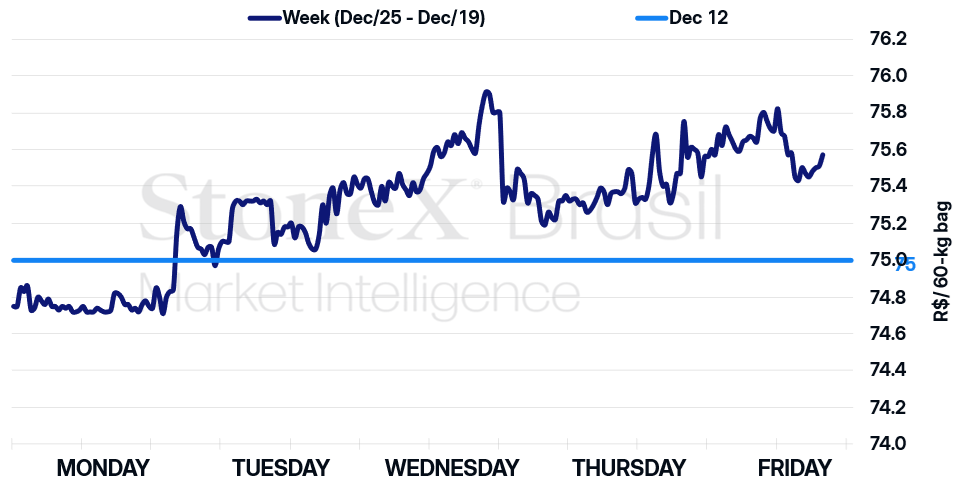
Source: B3. Design: StoneX.
Exchange rate dynamics have significantly influenced the direction of Brazilian corn prices. Even as the dollar weakens against other currencies, the Brazilian real has experienced poor performance, declining by 3.6% in December so far. Uncertainties surrounding next year's elections have weighed on the market, adding to the typical volatility of December.
The currency depreciation makes Brazilian commodities more expensive in reais, supporting corn price increases. Still, this does not necessarily translate into greater international competitiveness for Brazil, as U.S. corn remains very attractive. This means domestic balances are unlikely to experience significant shifts due to currency movements.
Inpasa announced the construction of a new corn ethanol plant in Rondonópolis, MT, and the expansion of its facility in Nova Mutum, MT. This further demonstrates the sector's strong appeal. Even in a year marked by periods of higher domestic corn prices, production margins in Mato Grosso remained robust. Nonetheless, cereal consumption continues to grow, and production will need to keep pace. Monitoring the development of the second crop, set to begin planting in a few weeks, will be critical to assessing the domestic balance for next year.
Futures contracts traded on CBOT (US¢/bu)
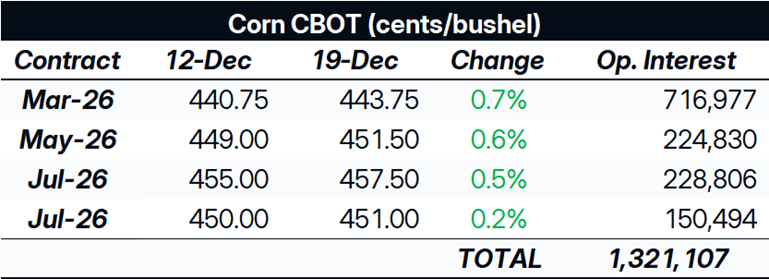
Source: CME. Design: StoneX.
Futures contracts traded on B3 (R$/bag)
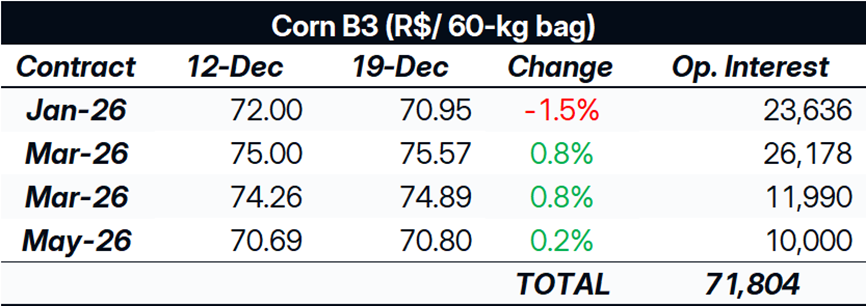

Source: B3. Design: StoneX.
Spot prices in Brazil (USD/60 kg bag)
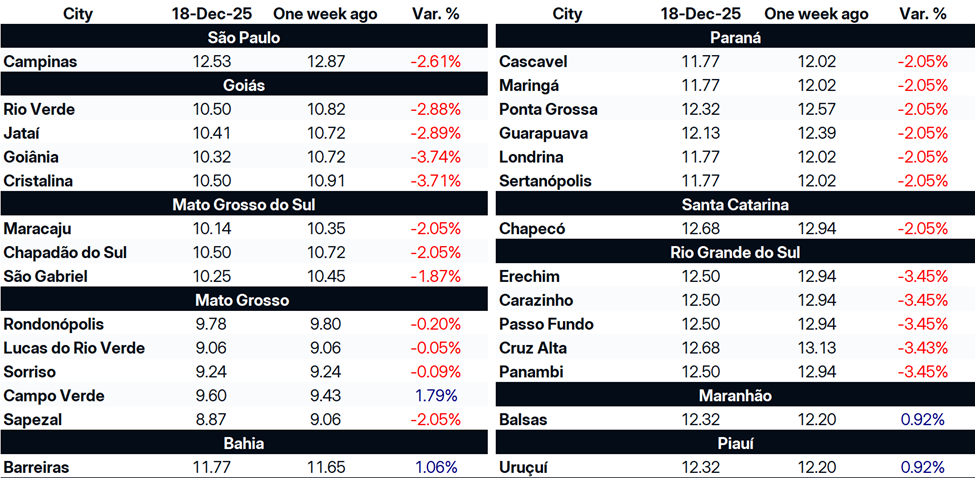

Source: StoneX.




