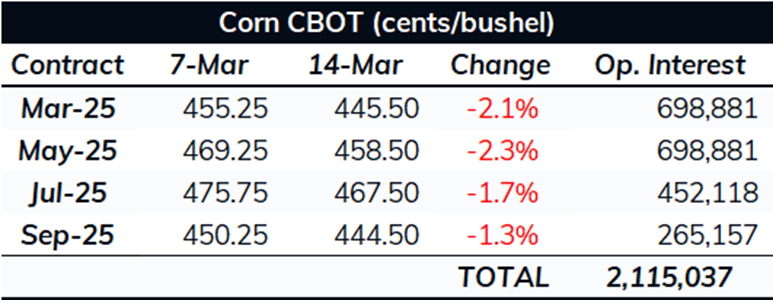
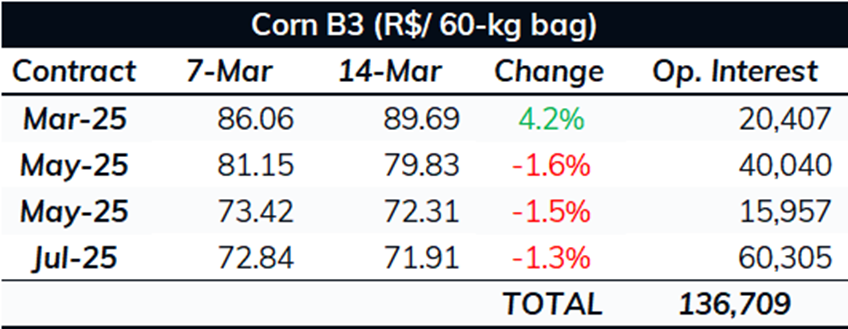
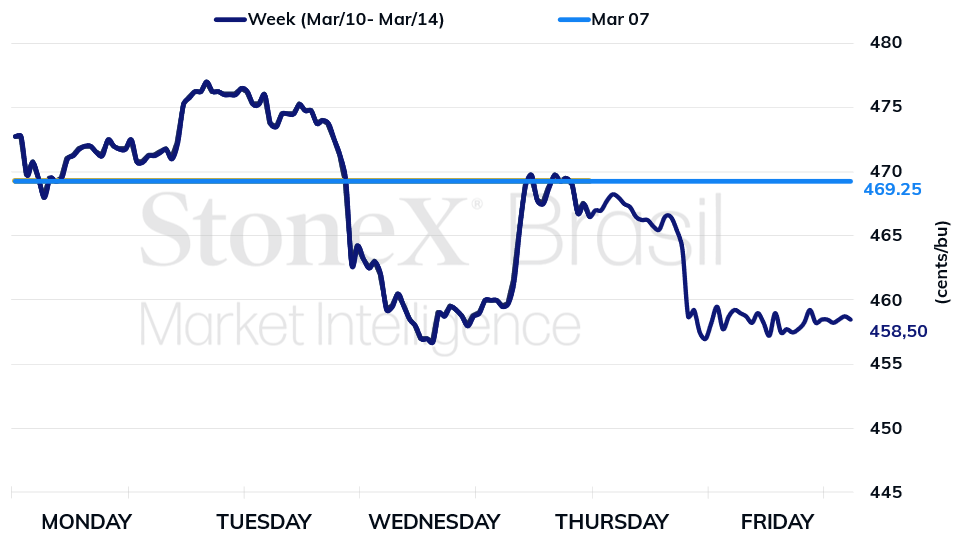
Weekly Summary | Corn contracts traded lower in Chicago last week, with the May/25 contract falling 2.3% to close at US¢458.50/bu. In addition to the inherent fundamentals of the corn market, which will be further explored throughout this report, the market has also been facing an adverse macroeconomic scenario, with stock indices trading sharply lower, erasing gains achieved since November 2024. The threat of a recession in the U.S. looms amid concerns that tariffs and a downsizing of the American government could slow down the world’s largest economy. This has also fostered a risk-off environment, further pressuring the markets.
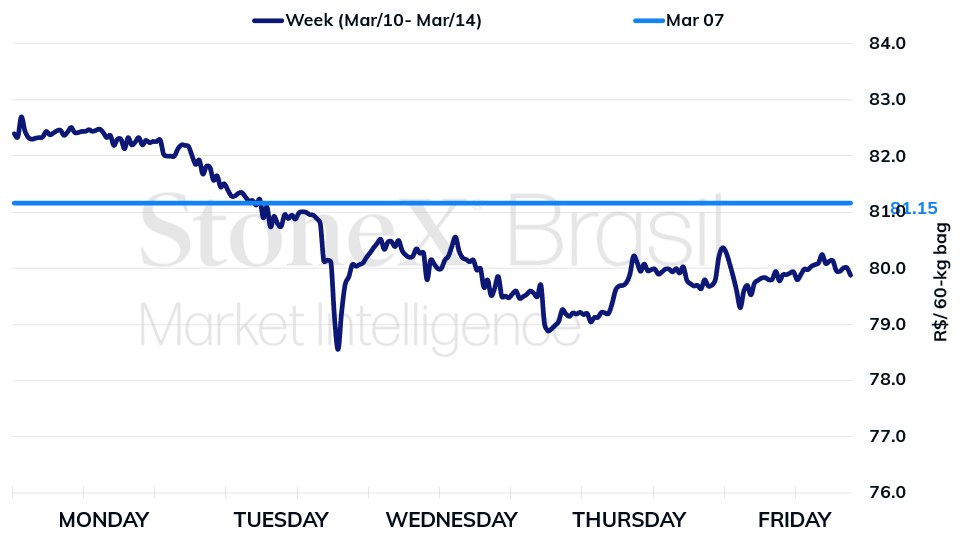
Intraday (15 min) May/25 Contract - CBOT
Source: CBOT. Preparation: StoneX.
WASDE | Last Tuesday, the USDA revised its estimates for the 2024/25 global grains crop. In the case of corn, we saw small adjustments on a global level. Global ending stocks were revised downward, largely aided by revisions in the 2023/24 crop production, especially in Brazil, where a reduction of 3 million tonnes in corn production estimates was observed. The new figure pointed to a harvest of 119 million tonnes of the cereal in last year’s Brazilian crop, coming closer to Conab’s estimate – which is 115.7 million tonnes – but falling below other estimates; StoneX, for example, estimated a crop of 121 million tonnes last year.
This revision, along with nearly unchanged supply and demand parameters for the 2024/25 crop, helped to pressure global carryout estimates for this crop, which stood at nearly 289 million tonnes.
Nevertheless, the market reacted negatively to last week’s report. The downward movement was largely related to the lack of revisions in the U.S. supply and demand balance. As will be discussed in the next section of this report, expected upward revisions for U.S. demand did not materialize, frustrating some market participants and driving the declines.
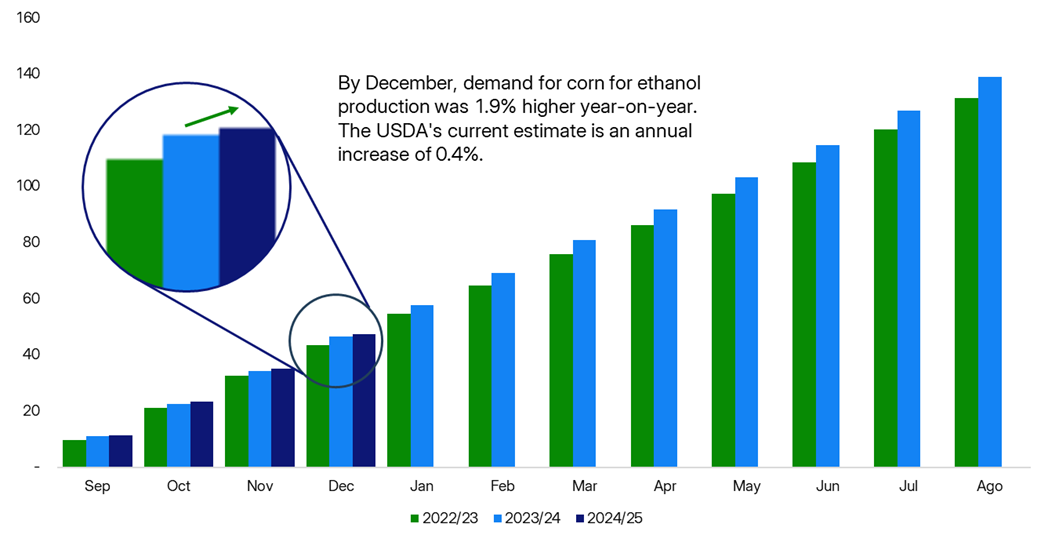
Corn Used for Ethanol Processing in the U.S. (million tonnes)
Source: EIA. Preparation: StoneX.
Weekly U.S. Ethanol Production (Thousand Barrels)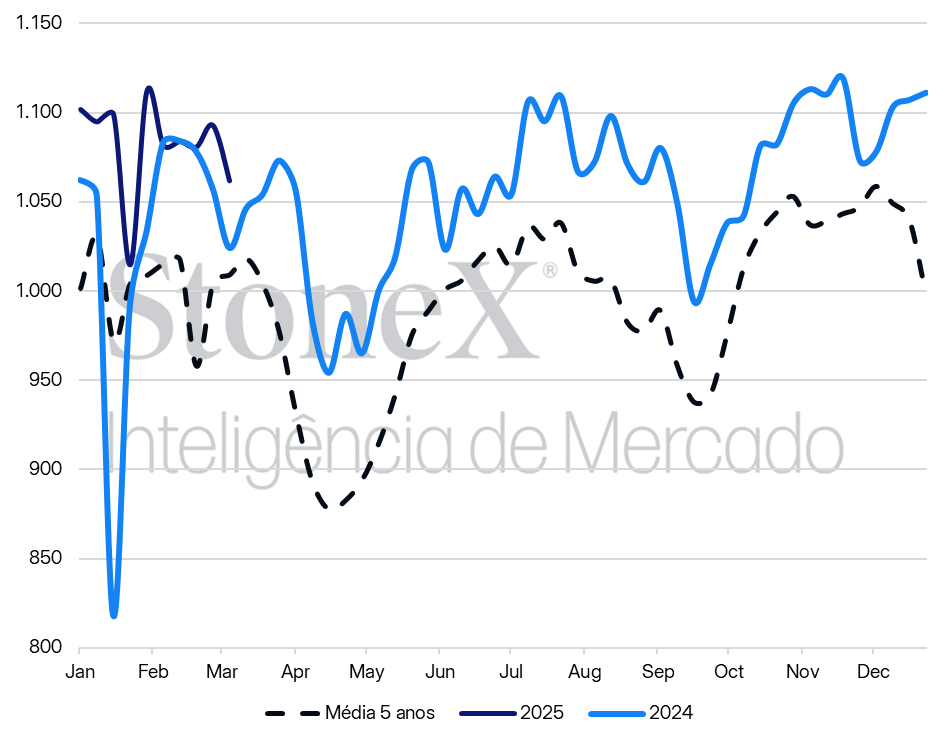
Source: EIA. Preparation: StoneX.
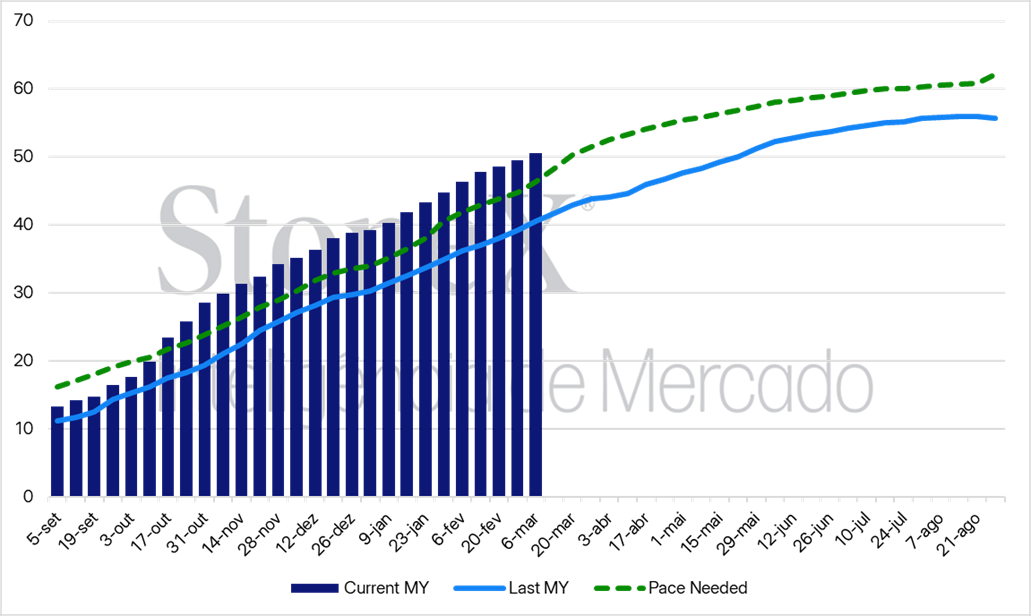
Comments on the U.S. Corn Balance | There was some expectation that the USDA would revise its U.S. demand figures. On the export side, we have observed sales that exceed the pace necessary to reach the 62.23 million tons currently estimated by the USDA (see chart below). Furthermore, corn processing for ethanol production remains strong. Currently, the USDA estimates only a 0.4% growth in U.S. corn consumption for ethanol between the 2023/24 and 2024/25 crops. However, what we have seen suggests potential for a revision of that figure. According to EIA data, the volume of corn dedicated to ethanol plants was, in December, 3.1% higher than during the same period in the previous crop. Moreover, entering 2025, the data still suggest strong plant capacity utilization, with the daily average ethanol production consistently surpassing that of last year, as can be seen in the charts below. The average ethanol production in 2025 is 5.3% higher than what was observed up to the beginning of March last year.
U.S. Corn Export Sales (million tonnes)
-
Source: USDA. Preparation: StoneX.
Tariffs | President Donald Trump announced new tariffs on steel and aluminum last week, which was followed by a response mainly from China and the European Union, raising fears that retaliation against U.S. agricultural products could impact U.S. exports. Although the EU has few pending shipments of U.S. corn, and China has been somewhat absent from the market in recent months, the imposition of tariffs still poses a greater short-term risk for U.S. exports. As for Canada and Mexico – countries that could have a more substantial impact on U.S. corn – the situation appears somewhat calmer until early April, when the 25% tariffs are expected to return. Until then, some negotiations may take place, which could provide some relief to the market.