Yesterday (08), the most active Brent contract closed down 13.3%, quoted at USD 94.8/bbl. WTI futures followed the same trajectory, ending the day at USD 94.4/bbl, down 16.4%.
The announcement of a bilateral ceasefire agreement between the U.S. and Iran resulted in a sharp drop in supply risk premiums in the Persian Gulf, with investors pricing in a gradual resumption of oil and refined products flows through the Strait of Hormuz.
This morning (09), the Brent contract for June 2026 delivery is trading up 4%, quoted at USD 98.6/bbl as of 9:00 a.m. The fragility of the current ceasefire agreement and the announcement of a new blockade of passage through the Strait of Hormuz by Iran are contributing to a recovery in oil prices at this moment.
Iran closes the Strait of Hormuz again
Iranian authorities announced late yesterday afternoon a new blockade of the Strait of Hormuz, in response to attacks carried out by Israel in Lebanese territory. At the same time, Tehran stated that it would be “irrational” to negotiate a definitive peace agreement with the U.S. while Israeli attacks against Iran’s allies continue.
Why it matters: The new blockade highlights the fragility of the bilateral ceasefire agreement negotiated last Tuesday (07), with part of the supply risk premiums in the Persian Gulf once again being incorporated into oil futures contracts.
- In parallel, confirmation of attacks in other countries – including the pipeline connecting Saudi Arabian oil fields to the Red Sea – contributes to a recovery in prices.
- In this sense, the logistical situation remains identical to what was observed prior to the ceasefire, with a significant volume of vessels stuck in the Persian Gulf and reduced flows of oil and refined products to other continents.
What to expect: At this moment, investors’ attention will remain focused on the effectiveness of the ceasefire. If the strait indeed remains closed, the coming days may be marked by a more consistent recovery in prices, with the market once again pricing in Middle East supply disruptions.
- In addition, new information regarding the meeting between Iranian and U.S. delegations in Pakistan this weekend, aimed at discussing a definitive peace resolution, should also result in oil price volatility.
SPECIAL: Brazilian oil exports
Brazilian oil exports reached their highest level since March 2023, totaling 2.5 million barrels per day (mbpd). This volume is the second highest in the historical series, with a monthly increase of 12.4%. The export growth was already expected, as the closure of the Strait of Hormuz led to intense demand from importing countries for products supplied by alternative origins, with part of the lost Middle Eastern supply being sourced from Brazil.
Brazilian oil exports – mbpd
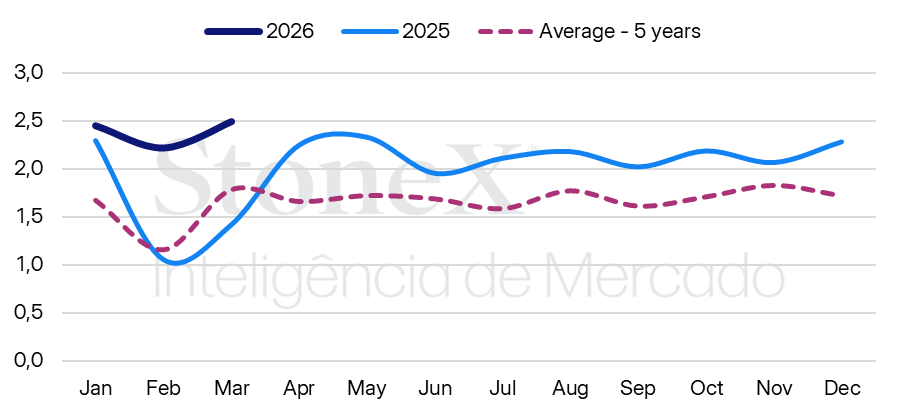
Source: MDIC. Prepared by: StoneX.
Among these consumers, China continued to stand out in purchases of Brazilian oil, demanding 1.62 mbpd in March – the highest volume in the historical series. The Asian country accounted for 67% of Brazilian exports, followed by India (7%), Spain (6.7%), and the U.S. (6.1%). This higher participation by Asia reflects the continent’s need to further diversify its suppliers, with Brazil benefiting from this scenario and shipping a larger volume of oil abroad.
As in the case of diesel imports, oil exports for April are still uncertain. The reopening of the Strait of Hormuz should ease Asian pressure, which could result in reduced demand for Brazilian oil – given the geographic proximity and logistical advantages of trade between Persian Gulf countries and the continent.
At the same time, the gradual resumption of flows through the Strait of Hormuz is a factor that should ensure the maintenance of high sales volumes from Brazil to some regional consumers, especially China and India.