FX Weekly Overview: The week's main events
- Heated inflation and retail sales data in the US should reinforce the perception of cautious behavior from the Federal Reserve in 2024, reducing bets for interest rate cuts in June and strengthening the USD.
- Increase in fiscal fears after Lula's statements may raise inflation expectations and the demand for risk premiums from investors, reducing the inflow of foreign capital and weakening the real.
- Higher inflation in Brazil in February may increase hopes of a slowdown in the pace of cuts to the basic interest rate (SELIC) by the Central Bank, which would improve the Brazilian interest rate differential with foreign countries and contribute to a greater influx of foreign capital, strengthening the BRL.
- Data on the Chinese economy may show a rebound in the country, increasing investors' appetite for risky assets such as commodities and currencies of emerging countries and strengthening the BRL.
The week in review
The week was marked by the release of mixed data on the American economy and testimonies from the Federal Reserve president, Jerome Powell, to Congress. While Powell reassured lawmakers that inflation in the US should be tempered and interest rate cuts in the US will happen soon, data for the American labor market has been inconclusive, with figures higher than expected and below.
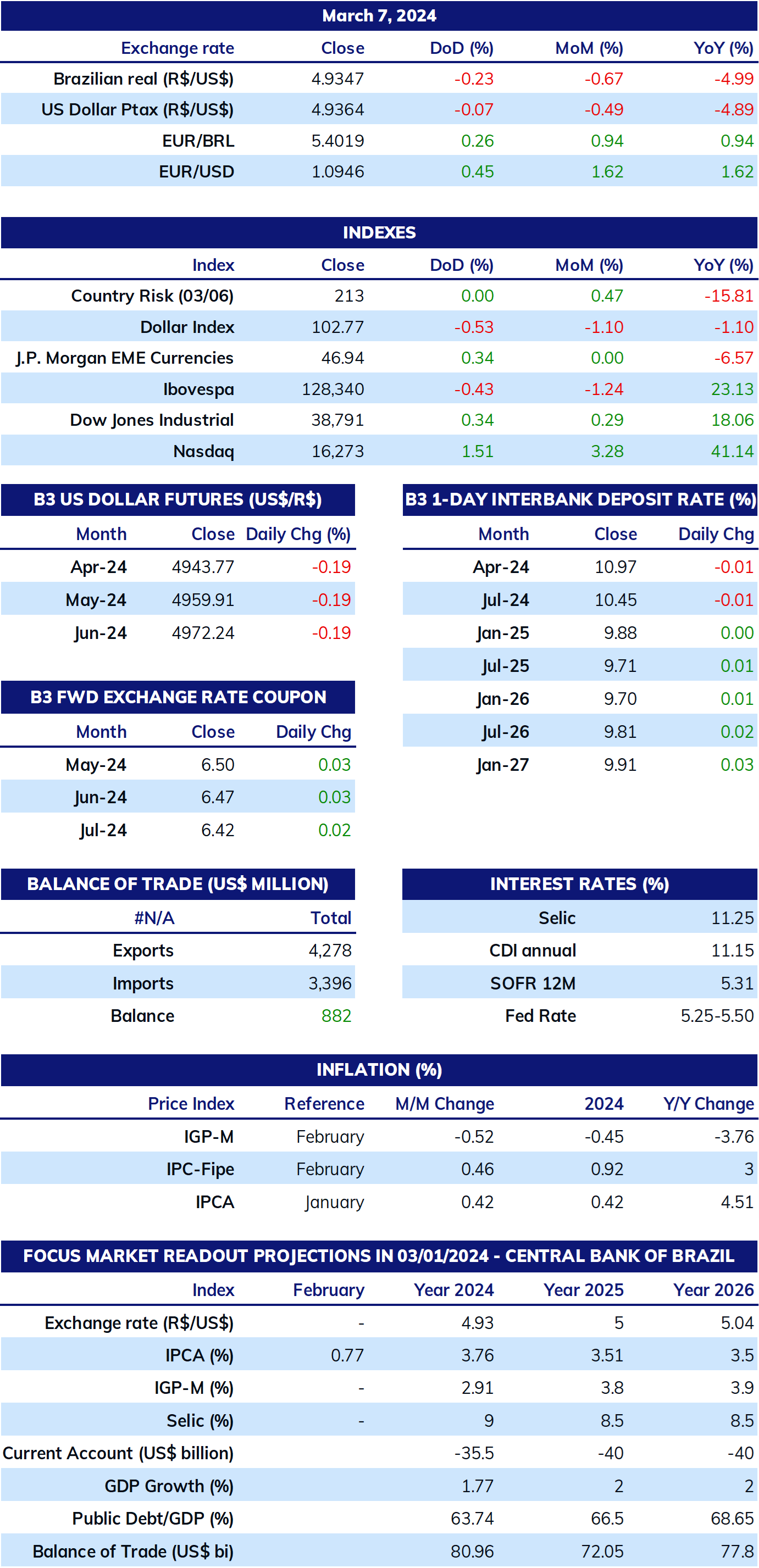
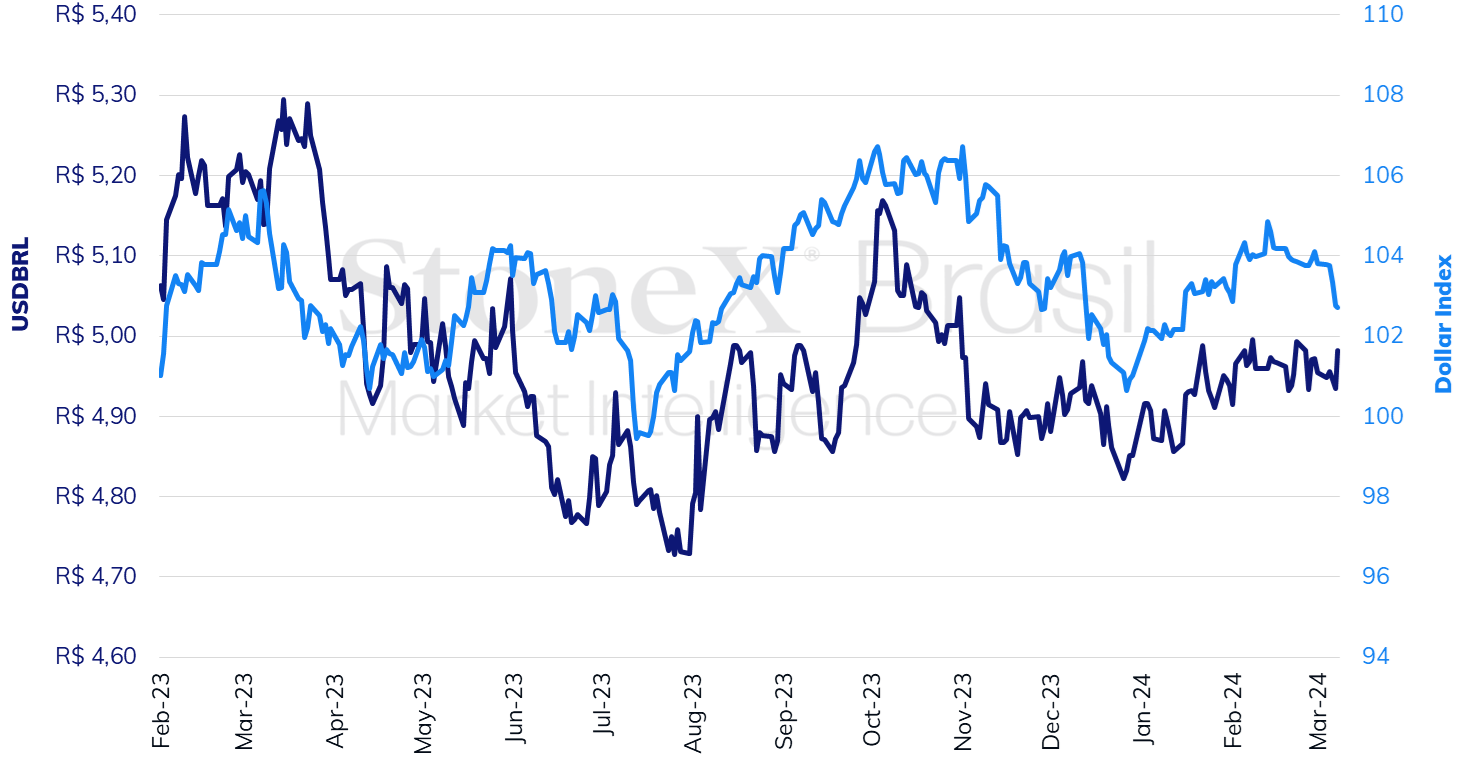
The USDBRL ended the week higher, closing this Friday's session (08) at BRL 4.982, a weekly gain of 0.5%, a monthly gain of 0.2%, and an annual gain of 2.7%. The dollar index closed Friday's session at 102.7 points, a change of -1.1% for the week, -1.3% for the month, and +1.7% for the year.
THE MOST IMPORTANT EVENT: American economy data
Expected impact on USDBRL: bullish
The median estimates for the Consumer Price Index (CPI) point to a new high reading in February. The full indicator is expected to increase from 0.3% in January to 0.4% in February, while the core indicator (which excludes the volatile categories of food and energy) is expected to decrease from 0.4% to 0.3% in the period. Despite the January data being largely attributed to seasonal factors, some categories are expected to remain on the rise, such as housing costs, personal services, and fuels (fuels do not affect the core reading). On the other hand, industrial goods are expected to remain moderate, with a projected decrease in used car prices.
Last week, investors in the interest rate futures market increased bets that the Federal Reserve will start its interest rate cuts cycle in June after mixed data for the American economy and comments from Fed President Jerome Powell. Powell told lawmakers that he believes the moment when the agency's leaders would have higher confidence in the country's disinflation process is "not far off," a prerequisite for a first cut. At the same time, the Purchasing Managers' Index (PMI) for services expanded more slowly. Employment data were inconclusive in February, when there was a job balance above estimates, with the creation of 275,000 jobs in February. Still, December (-43,000) and January (-124,000) readings were significantly revised downward. However, if the CPI estimates are confirmed, the inflation reading should reignite concerns that the American economy is overheating. The Federal Reserve may need to keep interest rates at restrictive levels for longer, possibly delaying the start of monetary easing until July.
Similarly, the disclosure of retail sales should reinforce concerns about inflation moderation in the US. The data suffered a significant contraction in January due to a sharp wave of cold and snow during the period. In February, expenses on fuel and car purchases are expected to reaccelerate the indicator from -0.8% to +0.7%. Nonetheless, after a longer period, Americans' personal expenses seem to be in a moderation trend.
February IPCA
Expected impact on USDBRL: bearish
In Brazil, after a considerable increase in the Broad National Consumer Price Index - 15 (IPCA-15), the IPCA is expected to accelerate from 0.42% in January to around 0.7% in February, driven by both food items and services. Nevertheless, the 12-month accumulated rate is expected to drop from 4.51% in January to around 4.3% in February, as the increase in February 2023 was 0.84%. Despite recognizing the resilience of service inflation as "a point of attention," the authorities of the Monetary Policy Committee (COPOM) are comfortable with the evolution of consumer prices and optimistic that the Central Bank will be able to reduce inflation to near the target center of the institution, 3% annually, so it seems unlikely the possibility of a change in the strategy of 0.50 p.p. cuts to the basic interest rate (SELIC).
Fiscal concerns in Brazil
Expected impact on USDBRL: bullish
After almost three months of relative stability in forecasts for the balance of public accounts, President Luiz Inácio Lula da Silva once again raised concerns about possibly changing the budget targets for 2024. Celebrating better-than-expected revenue figures for January, Lula told journalists last Thursday (07), "Of course, we have a spending limit, so when we have more money, we will have to discuss this spending limit with the House and the Senate, and we will see how we can use more money to provide more benefits for the people." The statement worried analysts, as according to the median reported by the Focus Bulletin, the forecast for public accounts last week was a primary deficit of -0.78% of GDP - in addition to the 0.5 p.p. margin of tolerance on the target established of a primary result of 0%. A change in budget targets would worsen market agents' public expense forecasts, resulting in higher inflation expectations and possibly a need for the central bank to adopt a more contractionary stance.
Chinese economy data
Expected impact on USDBRL: bearish
After months of weak readings, China's Consumer Price Index (CPI) for February is expected to return to positive territory. The monthly increase is estimated at 0.7%, resulting in a 12-month accumulated increase of 0.3%, compared to -0.8% in January. Higher food prices should drive the data and may raise hopes that Chinese domestic demand will increase its pace of growth after recent unenthused readings.