Dollar to reflect Copom interest rate decision and US economic data
- Bullish
- Copom is expected to cut the basic interest rate (Selic) by 0.25 percentage points, reducing the profitability of national bonds and making it harder to attract external capital, which tends to devalue the BRL.
- Strong US economic data should increase bets on a Federal Reserve interest rate hike in the short term, boosting US Treasury yields and strengthening the USD globally.
The week in review
- The Federal Open Market Committee (FOMC) kept the basic interest rate unchanged at 3.75% to 3.50% per year. However, the lack of clearer signals about a possible rate hike in the short term disappointed investors and reduced bets on a hike still in 2026.
- In Brazil, the Extended National Consumer Price Index 15 (IPCA-15) for July showed inflation at 0.06%, below expectations. With this reading, inflation accumulated over 12 months fell from 4.80% to 4.52%.
- Finally, in geopolitical news, the lack of diplomatic advances in the Middle East increased uncertainty among investors and kept oil prices elevated, raising global inflation concerns.
USDBRL and Dollar Index (points)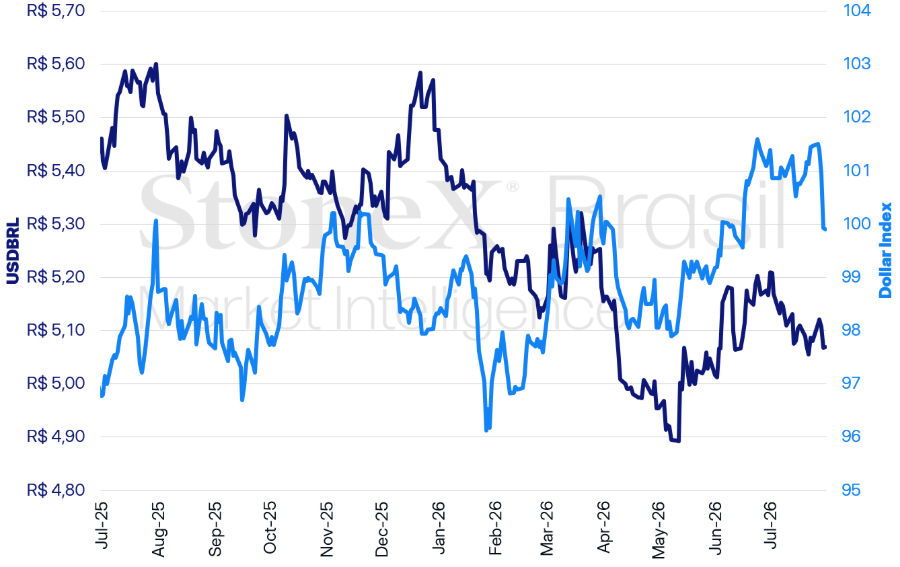
Source: StoneX cmdtyView. Design: StoneX.
USDBRLvariations | Daily: +0.02% | Weekly: -0.24% | Monthly: -1.88% | Yearly: -7.45% | Over 12 months: -9.50%
Dollar Index variations | Daily: -0.03% | Weekly: -1.55% | Monthly: -1.29% | Yearly: +1.60% | Over 12 months: -0.17%
KEY EVENT: Copom interest rate decision
Expected impact on the USDBRL: bullish
Brazil: Historical and expectations for interest rates – Focus bulletin of July 24, 2026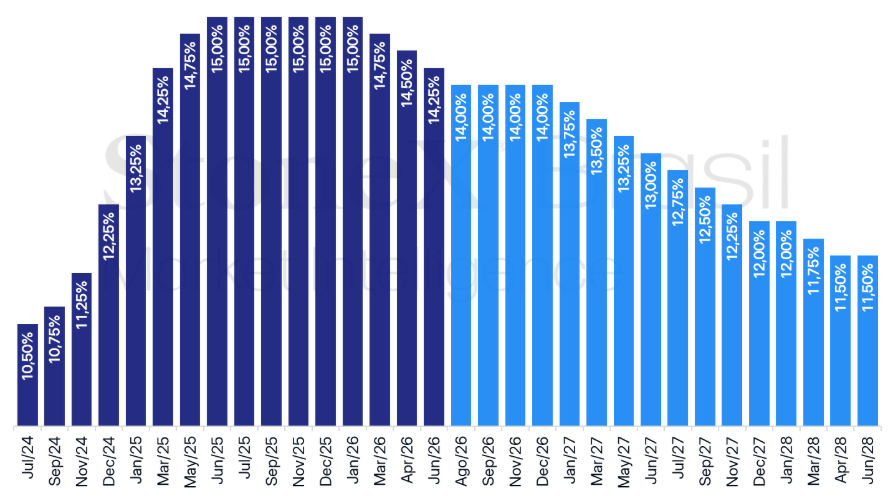
Source: Central Bank of Brazil. Design: StoneX.
The foreign exchange market is expected to respond to the Central Bank’s Monetary Policy Committee (Copom) decision on Wednesday (05), which is expected to lower the basic interest rate (Selic) by 0.25 percentage points, from 14.25% to 14.00% per year.
- The median of projections in the Focus bulletin anticipates a final interest rate cut in Wednesday’s decision, followed by maintaining the Selic at 14.00% per year until the end of the year.
- Besides the decision, investors are looking to adjust their expectations for the next steps of the monetary authority, considering the escalation of the Middle East conflict and the uncertain monetary policy scenario in the US.
Why this matters: A rate cut by the Central Bank reduces the yield of domestic public bonds and hampers the attraction of foreign capital, weakening the BRL.
Inflation data: The latest inflation data came from the July Extended National Consumer Price Index 15 (IPCA-15), which showed inflation at 0.06%, compared to expectations of 0.19%.
- With this reading, the 12-month accumulated IPCA-15 fell from 4.80% to 4.52%, slightly above the tolerance margin of 4.5%.
- The core of the indicator, which excludes the most volatile components like food and energy, slowed from a 0.37% increase in June to 0.19% in July, reinforcing the perception of benign inflation for the month.
- However, uncertainty about the duration of the Middle East conflict and international oil prices remains a risk factor that should weigh on Copom’s decision-making.
- Additionally, in the latest Focus bulletin, the median projection from financial institutions pointed to an accumulated inflation of 5.12% for the year, representing an increase from current levels and posing another area of concern.
Resilient labor market: In the labor market, the unemployment rate fell from 5.6% in May to 5.4% in June, close to the historic low of 5.1% recorded in December 2025.
- In this context, the data indicates that the labor market remains resilient, even with restrictive Selic levels, reinforcing the perception of no urgency for additional rate cuts.
External uncertainties: At the moment, the external scenario remains a significant risk factor for domestic monetary policy.
- In the Middle East, the new escalation of conflict without signs of concrete diplomatic advances keeps Brent oil prices near USD 90/barrel, raising concerns about potential inflationary pressures in the country.
- Additionally, in the US, the Federal Reserve’s lack of future guidance also brings uncertainties, creating doubts about the interest rate differential between countries.
- If this differential decreases, the attractiveness of Brazilian bonds tends to decrease, weakening the BRL and potentially raising import costs, intensifying inflationary pressures.
US economic data
Expected impact on the USDBRL: bullish
US: Historical and expectations for interest rates – updated July 31, 2026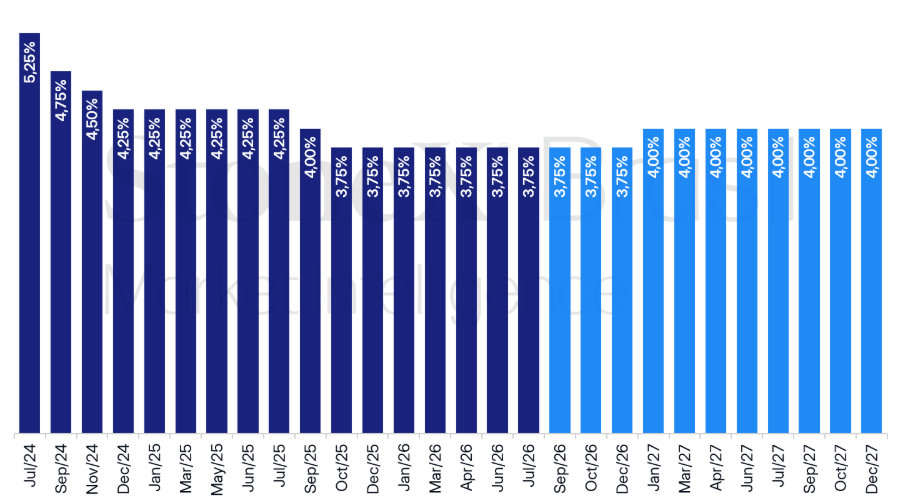
Source: CME FedWatch Tool. Design: StoneX. Refers to the market’s most probable futures interest rate bet as of the indicated date.
The foreign exchange market is expected to respond to the release of US economic indicators, particularly concerning the labor market.
Why this matters: A reacceleration in job creation in the US could increase bets for a short-term Federal Reserve rate hike, favoring capital inflows into the country and strengthening the USD globally.
Estimates: The median projections suggest net job creation should increase from 57,000 in June to 80,000 in July.
- Meanwhile, the unemployment rate is expected to return to 4.3% in July after decreasing to 4.2% in June due to an unexpected and likely temporary reduction in the labor force.
- The Purchasing Managers’ Index measured by the ISM is expected to rise from 53.3 points to 54.0 points in the industrial index and from 54.0 points to 54.2 points in the services index.
Rate hikes in doubt: June’s data surprised investors with a slowdown, suggesting the US economy might not be as overheated and reducing urgency for Federal Reserve rate hikes.
- Consumer Price Index (CPI), Producer Price Index (PPI), and Personal Consumption Expenditures (PCE) all presented readings below analysts’ expectations.
- Additionally, the Employment Situation Report showed net job creation below estimates and revised April and May figures downward.
- Conversely, the geopolitical tensions in the Middle East in July once again pushed global oil prices upward, raising fears of inflationary pressures in the second half.
Fed’s credibility questioned: Last week, rate hike bets in the short term dropped significantly after the Federal Reserve’s decision caused unease among market operators.
- The decision itself was unsurprising—the Federal Open Market Committee (FOMC) kept its interest rate stable, between 3.50% and 3.75% per year, aligning with most investors’ expectations.
- Additionally, three out of twelve Committee members voted for an immediate rate hike—regional presidents Neel Kashkari (Minneapolis), Lorie Logan (Dallas), and Beth Hammack (Cleveland).
- The unease was primarily caused by the press conference of Kevin Warsh, the Fed president, who provided vague answers and created more doubts than clarity among investors.
Overview: During the press conference, Warsh maintained his firm anti-inflation stance, well-received in June’s decision, but repeatedly refused to commit to an action plan to stabilize prices.
- For example, Warsh declined to explain why the FOMC opted to keep interest rates stable if there was such concern over inflation above the target.
- Additionally, refusing to offer any future guidance, Warsh did not clarify the criteria that might lead the Fed to raise rates in the future.
- Subsequently, Warsh suggested that the Federal Reserve might not need to raise rates since financial markets had already increased their futures interest rates—a movement reversed during the press conference.
- Finally, further complicating matters, Warsh stated he observes “a broader set of inflation data beyond the PCE,” without detailing what they might be, and hinted the index might cease being the primary reference for inflation targets starting in January.
Potential dissent: Besides being the Federal Reserve president, Kevin Warsh is the FOMC president, comprising 19 members (only 12 vote annually in a rotation system).
- It is reasonable to question whether Warsh adequately represented the Committee’s opinion during the press conference, as likely many members might disagree with much of the new president’s responses.
- Three dissenting votes in one policy direction, as occurred in the latest decision, is quite rare in the FOMC’s current format, established in 1936; four dissenting votes would be unprecedented.
- It is possible Warsh’s enigmatic style might lead to more dissent in the September 16 rate decision.
- It is worth noting that in July’s economic projections, the number of Committee members anticipating rate hikes this year caused surprise.
- As such, it is very plausible that more members advocate for a rate hike in September if inflation expectations worsen by then.

INDICATORS
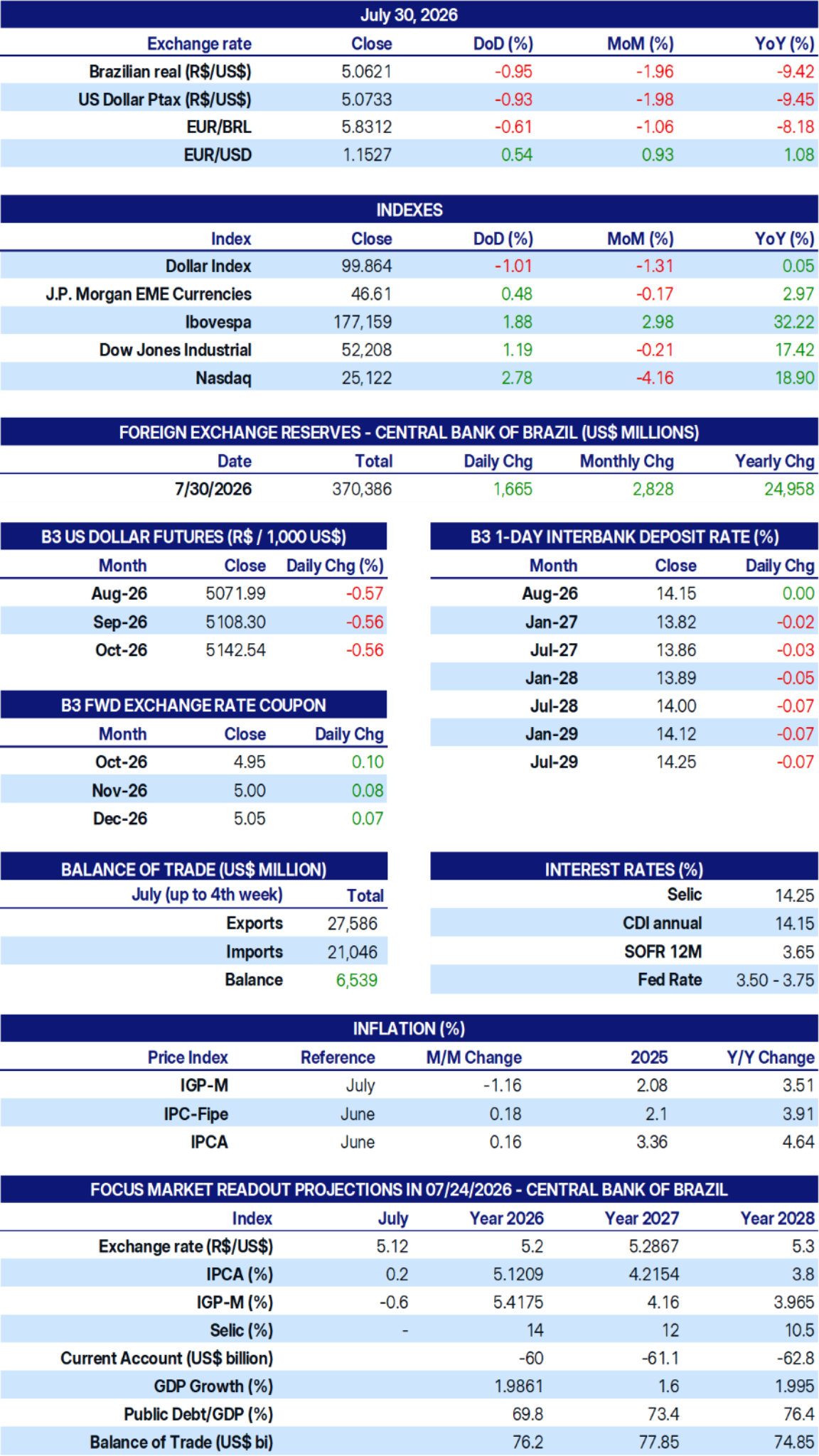
Sources: Central Bank of Brazil; B3; IBGE; Fipe; FGV; MDIC; IPEA and StoneX cmdtyView.