- The February US PCE inflation index may strengthen the bets that the Fed will have less room for interest rate cuts this year, which may favor the American interest rate differential and strengthen the USD.
- Brazilian March IPCA-15 is expected to temper and increase the perception that Copom will maintain its pace of 0.50 p.p. interest rate cuts to Selic beyond May, harming the Brazilian interest rate differential and weakening the BRL.
- Copom minutes may bring more information about changes in the Copom statement and raise expectations of a slower pace of cuts to the basic interest rate (Selic), which would benefit the Brazilian interest rate differential and contribute to strengthening the BRL.
The week in review
The week was marked by the fluctuation in bets on the trajectory of American interest rates after the Federal Reserve disappointed investors' expectations that it would adopt a stricter stance following warmer data in recent months. The Central Bank of Brazil also surprised the market by changing its statement to a more cautious stance.
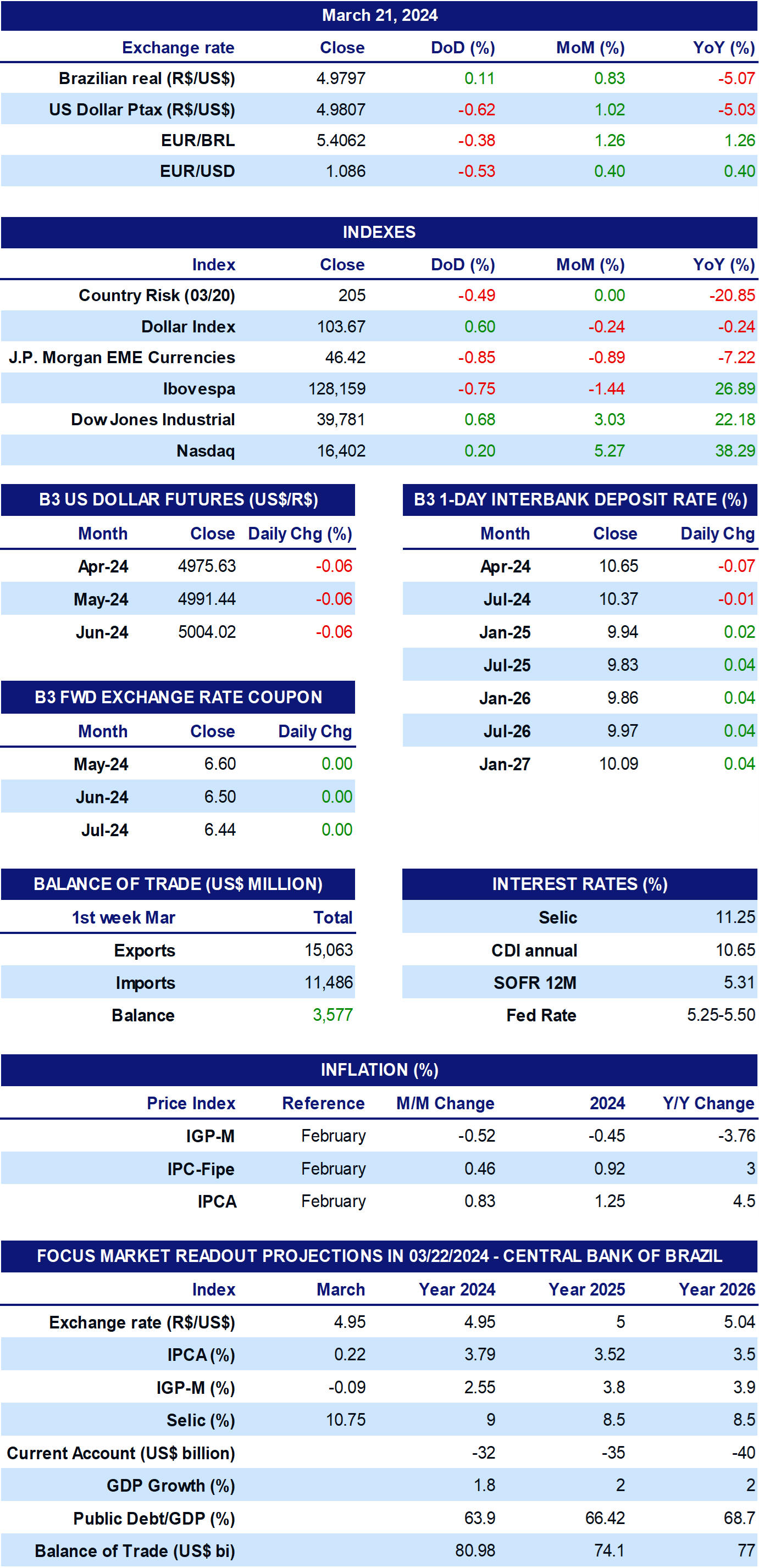
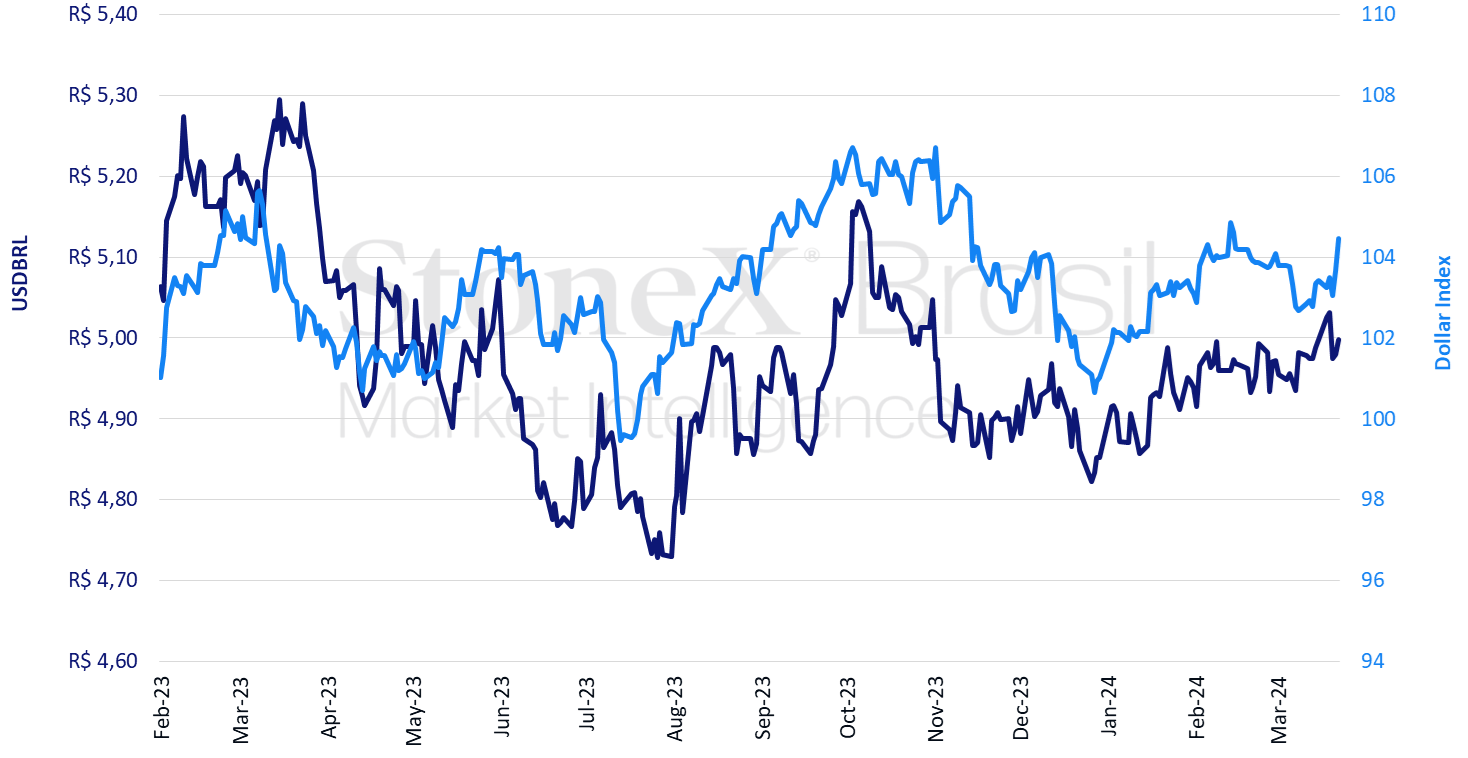
The USDBRL ended the week stable, closing this Friday's session (22) at BRL 4.999, with a weekly gain of 0.0%, a monthly gain of 0.5%, and an annual gain of 3.0%. The dollar index closed Friday's session at 104.4 points, a change of +1.0% for the week, +0.3% for the month, and +3.4% for the year.
THE MOST IMPORTANT EVENT: US PCE
Expected impact on USDBRL: bullish
The monetary policy decision of the Federal Open Market Committee (FOMC) surprised investors by adopting a more flexible stance than anticipated, maintaining the median projection of three interest rate cuts in 2024 while forecasting higher growth and inflation and lower unemployment for the year. Similarly, comments from Federal Reserve (Fed) Chairman Jerome Powell that the Committee still believes that price stabilization should maintain its trajectory and that the warmer readings in January and February may have been a bump in the road raised bets that the Fed's interest rate cutting cycle should include three reductions in 2024, starting in June.
However, this does not mean that the FOMC's optimistic projections will come true, and there is a reasonable doubt that the next heated economic data will repeat for March. This week, the Personal Consumption Expenditures (PCE) Price Index for February is expected to grow by 0.4% from January, while the core of the indicator, which excludes the volatile components of food and energy, is expected to increase by 0.3% in the period, driven by prices of used cars and airfare sales. The January data could also be revised upward, disappointing those expecting a faster easing of US monetary policy. If experts' estimates prove correct, this data will be another "outlier" for the Fed and should raise concerns about the final stretch of inflation moderation in the US.
Copom minutes and Quarterly Inflation Report (RTI)
Expected impact on USDBRL: bearish
The Monetary Policy Committee (Copom) statement took a backseat on a day when the Federal Reserve dominated global financial markets' attention. Still, analysts did not completely anticipate the changes in the statement towards a more cautious position, and the meeting minutes, which will be released next Tuesday (26), may provide more information about the adjustments in the Committee's positioning. In the document, Copom started indicating a cut of the same magnitude of 0.50 p.p. in the basic interest rate (Selic) "at the next meeting" instead of "in the next meetings," as it had been pointing out since the decision in August of last year, and signaling that the underlying inflation cores, particularly service prices, "were above the target for inflation" instead of "are approaching the target." The changes suggest to investors that the room for interest rate cuts in Brazil is shrinking, which could lead to a slower pace of Selic cuts and/or a higher interest rate at the end of the cutting cycle. Both options, in turn, would imply a smaller decrease in the Brazilian interest rate differential compared to other economies, which can increase the flow of financial investments to the country and strengthen the BRL.
It is also worth noting that the Quarterly Inflation Report (RTI) will be released on Thursday (28). This extremely detailed report analyzes internal and external economic conjuncture and is followed by the Central Bank's economic projections for the main macroeconomic variables. The president of the monetary authority, Roberto Campos Neto, and his director of economic policy, Diogo Guillen, held a press conference.
Brazilian IPCA-15
Expected impact on USDBRL: bullish
In addition to the release of the Copom minutes next Tuesday (26), asset markets are expected to react to the release of the National Consumer Price Index 15 (IPCA-15) for March, which should show a slowdown in inflation compared to February, both in the headline index and its core. The result may raise the stakes that consumer prices in Brazil have returned to temper, which would consequently allow Copom to maintain its trajectory of 0.50 p.p. cuts to the Selic rate beyond May. This, in turn, would imply a greater fall in the Brazilian interest rate differential compared to other economies, which could reduce the flow of financial investments to the country and weaken the BRL.
End-of-month Ptax rate
Expected impact on USDBRL: undefined
The foreign exchange market experienced another month of low volatility in March. Still, on Thursday (28), trading volume and volatility are expected to increase within the time windows the Central Bank uses to calculate the end-of-month Ptax rate. The PTAX rate is a reference published daily by the Central Bank, and its end-of-month value is widely used in foreign exchange and derivatives contracts. As a result, traders intensify their operations during these intervals, vying for its determination.