FX Weekly Overview: The week's main events
- Bearish factors
- FOMC minutes may show a more balanced assessment of American inflation risks, contributing to the institution's expectations of interest rate cuts, which tends to weaken the USD.
- Bullish factors
- Revenue and expense data from the public sector can worsen investors' perception of fiscal risks for Brazilian assets, particularly regarding doubts about emergency expenses in Rio Grande do Sul.
- Congress must vote on bills that establish the gradual re-taxation of payroll for selected sectors and municipalities, which is expected to increase public expenses and may worsen investors' perception of fiscal risks for Brazilian assets.
The week in review
The week was marked by the release of softer data for the United States, slightly reversing the bets on the Federal Reserve's interest rate cuts. It was also marked by the unexpected change in Petrobras' leadership, which increased the perception of risks for Brazilian assets and limited the gains of the BRL.
The USDBRL ended the week lower, closing Friday's session (17) at BRL 5.103, a weekly decline of 1.1%, a monthly decline of 1.7%, and an annual gain of 5.2%. The dollar index closed Friday's session at 104.4 points, a change of -0.8% for the week, -1.6% for the month, and +3.1% for the year.
USDBRL and Dollar Index (points)
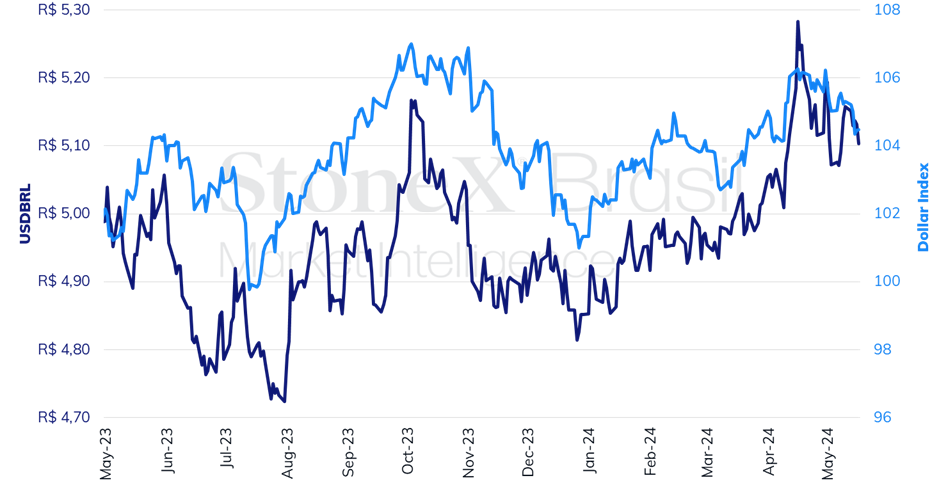
Source: StoneX cmdtyView. Design: StoneX
THE MOST IMPORTANT EVENT: FOMC decision minutes
Expected impact on USDBRL: bearish
In a week of a few indicators, the Federal Reserve's FOMC monetary policy decision minutes should draw investors' attention. The minutes, released three weeks after the meeting, may be particularly outdated, as the meeting took place before the release of softer indicators for April, such as job creation, retail sales, and consumer inflation. Still, the document can bring important information to investors regarding discussions on what economic conditions are necessary to justify a cut in the federal interest rate. Additionally, the evaluation of inflationary risks balance should be more balanced, just like Fed Chairman Jerome Powell's stance during the press conference after the decision. Finally, analysts will also observe the discussions about the decrease in the Fed's balance of payments, as the Committee decided to soften the reduction of monetary stimuli and allow a higher volume of debt repurchase to ensure a suitable level of liquidity to the financial system.
Brazilian tax data
Expected impact on USDBRL: bullish
Investors follow the release of the bimonthly revenue and expenses report to adjust expectations for the evolution of public finances and the sustainability of the Brazilian debt. The perception of fiscal risks increased after the federal government relaxed, in April, the budget targets for the years between 2025 and 2027, harming the performance of Brazilian assets. Additionally, there are many doubts about the total impact of the emergency measures necessary to mitigate the floods in Rio Grande do Sul, even though Congress has authorized the exclusion of these expenses from the calculation of the fiscal target.
Payroll tax relief
Expected impact on USDBRL: bullish
The Brazilian Congress is expected to vote on two bills this week regarding the exemption of payroll taxes after reaching an agreement with the Administration and suspending suspending the injunction on the subject by the Supreme Federal Court (STF). One measure proposes gradually re-taxing the payrolls of 17 sectors of the economy until 2028, fully maintaining the benefit in 2024. The other proposal deals with the benefit of social security contributions for public salaries in small municipalities with up to 156,000 inhabitants. The lawmakers intend to vote on the text in the Plenary of both houses this week since the STF injunction prevents municipalities and productive sectors from paying 20% of taxes on the payroll loses effect on July 16th. Estimates from the Ministry of Finance indicate that the bills are expected to cause an increase of BRL 15.8 billion in federal expenses in the 2024 Budget.

INDICATORS