FX Weekly Overview: The week's main events
- Bearish factors
- The forecast of a slight drop for the May IBC-Br may help stabilize inflation expectations for the country and contribute to the rebound of Brazilian assets.
- Milder data for American retail may slightly increase investors' bets on Federal Reserve interest rate cuts, contributing to weakening the dollar.
- The ECB's cautious interest stance in its decision may contribute to preserving a more stable outlook for the continent's interest rate differential and help strengthen the euro, indirectly weakening the dollar.
- Bearish factors
- Weaker data for the Chinese economy may reinforce the perception of a slowdown in domestic demand in the country and harm the performance of risky assets, such as commodities and currencies of countries that export primary products, like the real.
The week in review
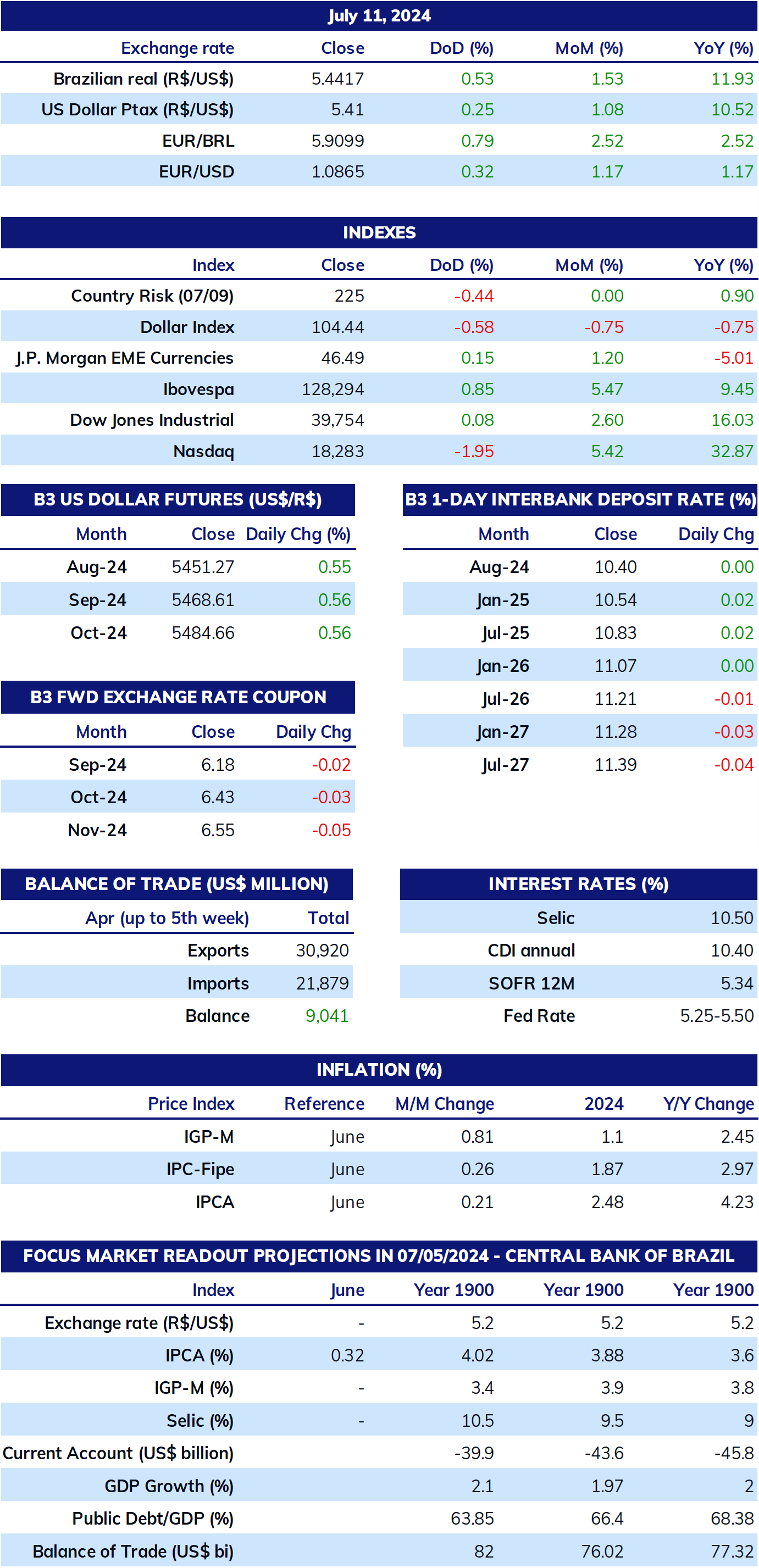
The week was marked by a global weakening of the American currency after lower-than-expected data for consumer inflation in the country boosted bets on interest rate cuts by the Federal Reserve. In Brazil, despite a very favorable IPCA, profits and an unexpected interference from the yen limited the BRL gains.
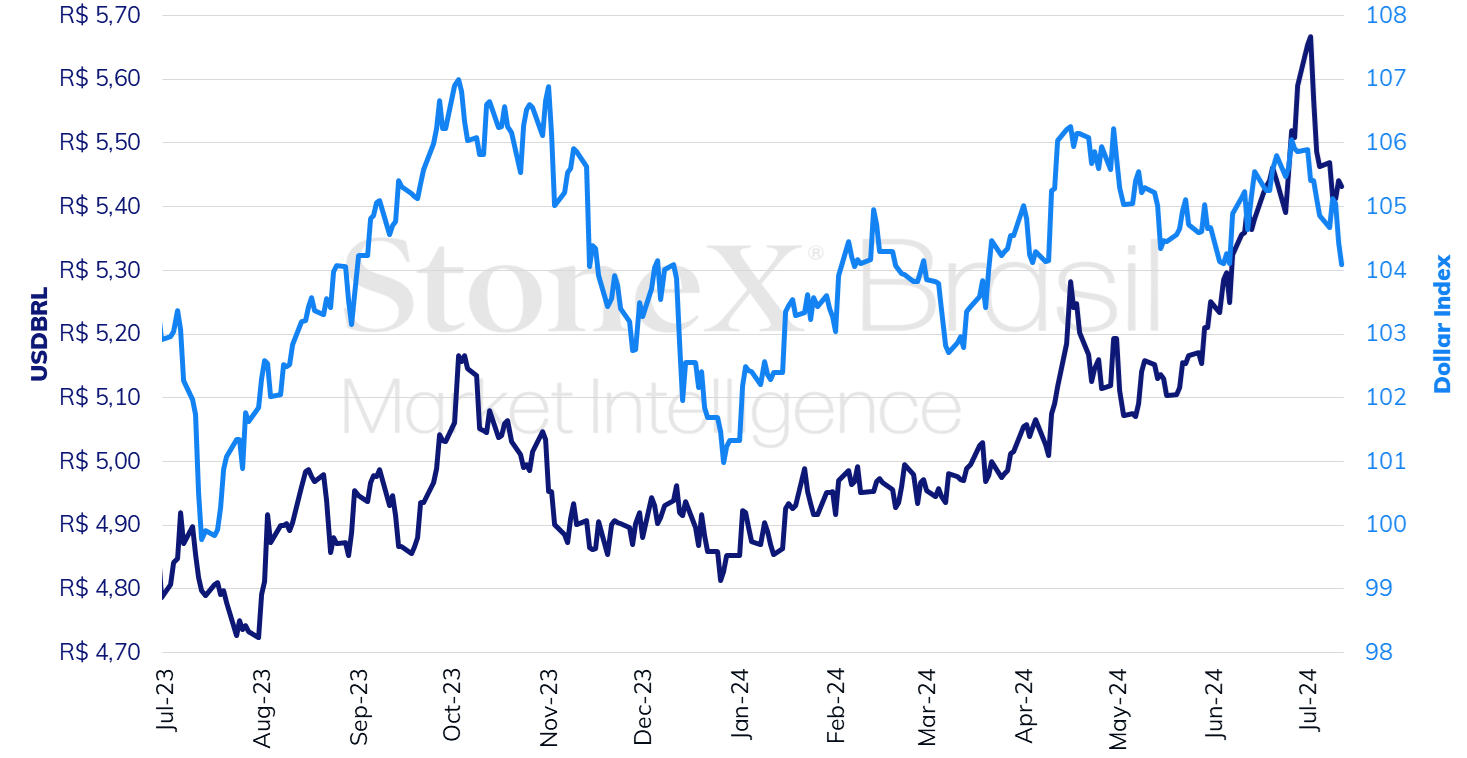
The USDBRL ended the week lower, closing Friday's session (12) at BRL 5.431, a weekly decrease of 0.6% and a monthly decrease of 2.9%, but an annual increase of 11.9%. The dollar index closed Friday's session at 104.1 points, a change of -0.7% for the week, -1.7% for the month, and +2.7% for the year.
USDBRL and Dollar Index (points)
Source: StoneX cmdtyView. Design: StoneX.
KEY EVENT: May IBC-Br
Expected impact on USDBRL: bearish
Amid a partial reprieve in perceptions of fiscal risks in Brazil, investors must react to the release of the May Central Bank Economic Activity Index (IBC-Br), seen as a preview of the Gross Domestic Product. Last week, the better-than-expected performance for services and retail sales in May put pressure on the Brazilian interest curve by giving new life to concerns that inflation in the country may be more persistent than anticipated. Still, the median of the projections for the IBC-Br is a 0.1% decline, which, if confirmed, should alleviate such concerns and help in the rebound of Brazilian assets.
American retail sales
Expected impact on USDBRL: bearish
After softer data for the labor market and consumer inflation in June, analysts' median expectations for US retail sales in June are for stability (0.0%), due to a decline in sales of some volatile components, such as automobiles and fuels. Additionally, some high-frequency data suggest that the finances of some American consumers are facing difficulties, which may limit their spending capacity and harm retail.
Economic data for China
Expected impact on USDBRL: bullish
In recent months, economic indicators have reinforced analysts' perception that domestic demand in the country continues to weaken and that it will be a challenge to achieve the growth target of 5% this year without the government's adoption of new economic stimuli. Not even the sharper-than-anticipated performance of Chinese exports, driven by industrial segments tied to electric vehicles and artificial intelligence technologies, such as batteries and processors (chips), is expected to be enough to sustain the country's economic growth. Therefore, the median of estimates for China's GDP points to a slowdown of 1.6% in the first quarter to 1.1% in the second. Likewise, it is projected that retail sales in the country should decrease from 3.7% annually in May to 3.4% in June and that manufacturing will fall from 5.6% annually to 5.0% in the same period.
It is also worth noting that the meeting of the Central Committee of the Chinese Communist Party is taking place this week, between July 15 and 18, where the major economic guidelines for the country's development for the next five years will be presented. Despite the perception that more stimuli are needed in the short term, the measures that are usually announced at this meeting, which occurs every five years, typically refer to large long-term plans, rather than addressing immediate challenges.
ECB monetary policy decision
Expected impact on USDBRL: bearish
After reducing it by 0.25 p.p. in its last decision, there is a high consensus that the European Central Bank (ECB) should keep its basic interest rate unchanged at 3.75% p.a. while most analysts anticipate another cut of the same magnitude for the next decision in September. Therefore, investors' attention will be focused on any signaling for future ECB meetings, whether in the statement or in the press conference after the decision which should indicate patient and cautious conduct and reinforce the perception that cuts should occur every two meetings.

INDICATORS