FX Weekly Overview: The week’s main events
- Bearish factors
- A firmer statement from the Brazilian Central Bank (Copom) could help slightly reduce the perceived risk of Brazilian assets and raise projections for the country's interest rate differential, contributing to strengthening the BRL.
- Expectations of a dovish tone from the FOMC and softer US labor market data may reinforce expectations of interest rate cuts by the Fed, contributing to a global weakening of the dollar.
- Bullish factors
- Rapid appreciation of the yen and the possibility of an interest rate hike by the Bank of Japan may penalize currencies used for carry trade, contributing to weakening the BRL.
The week in review
The week was marked by an international environment of pessimism and aversion to risky assets, due to investor disappointment with the first quarterly results released by publicly traded companies in the US, generating fears of a slowdown in the US economy, a decline in international prices of key commodities like oil and iron ore, and a consistent appreciation of the Japanese yen, which negatively impacts currencies used in "carry trade" operations.
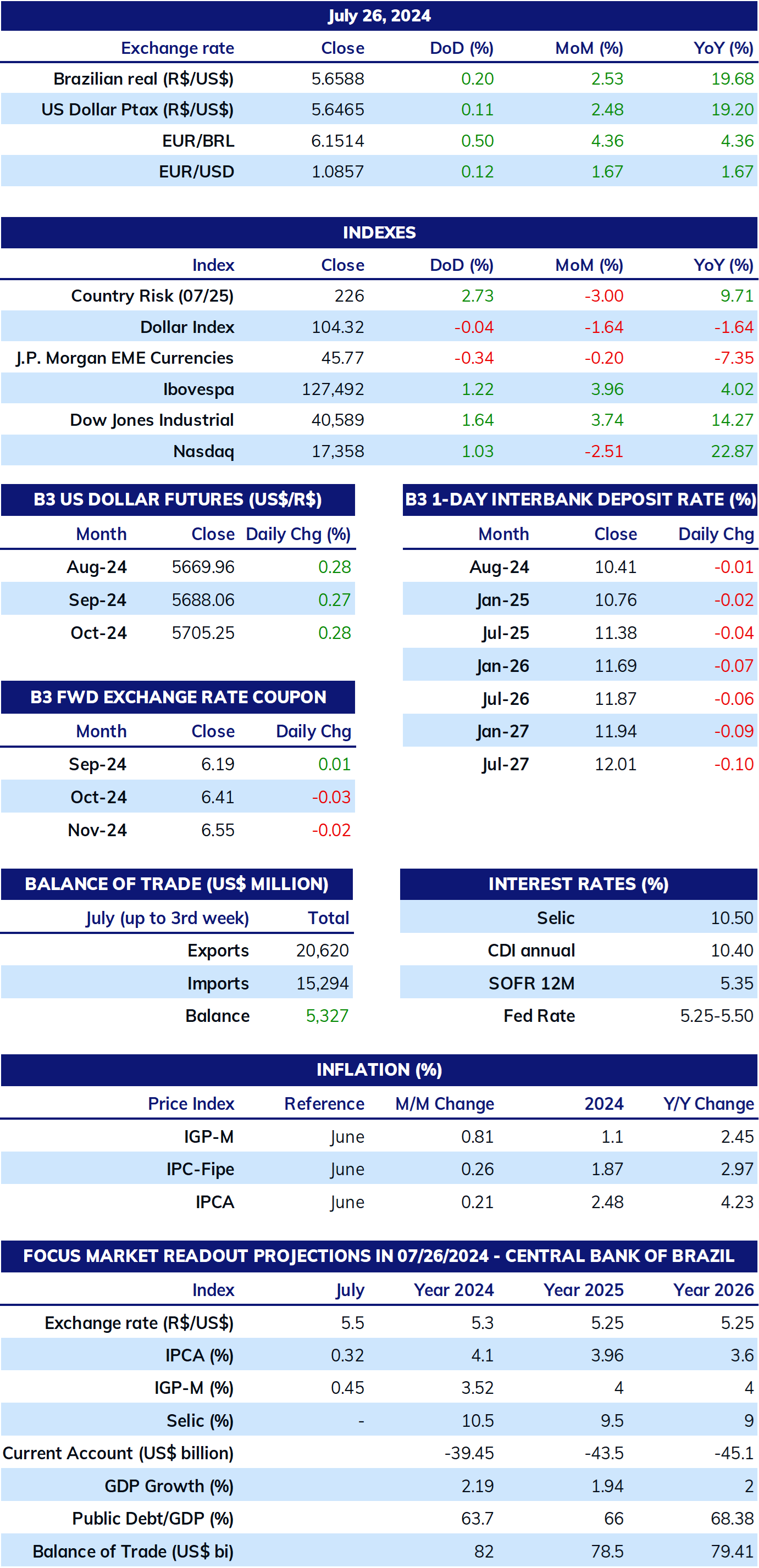
The USDBRL ended the week higher, closing Friday's session at BRL 5.658, a weekly gain of 0.9%, a monthly gain of 1.2%, and an annual gain of 16.6%. Meanwhile, the dollar index closed Friday's session at 104.3 points, a weekly variation of -0.1%, a monthly variation of -1.5%, and an annual variation of +3.0%.
USDBRL and Dollar Index (points
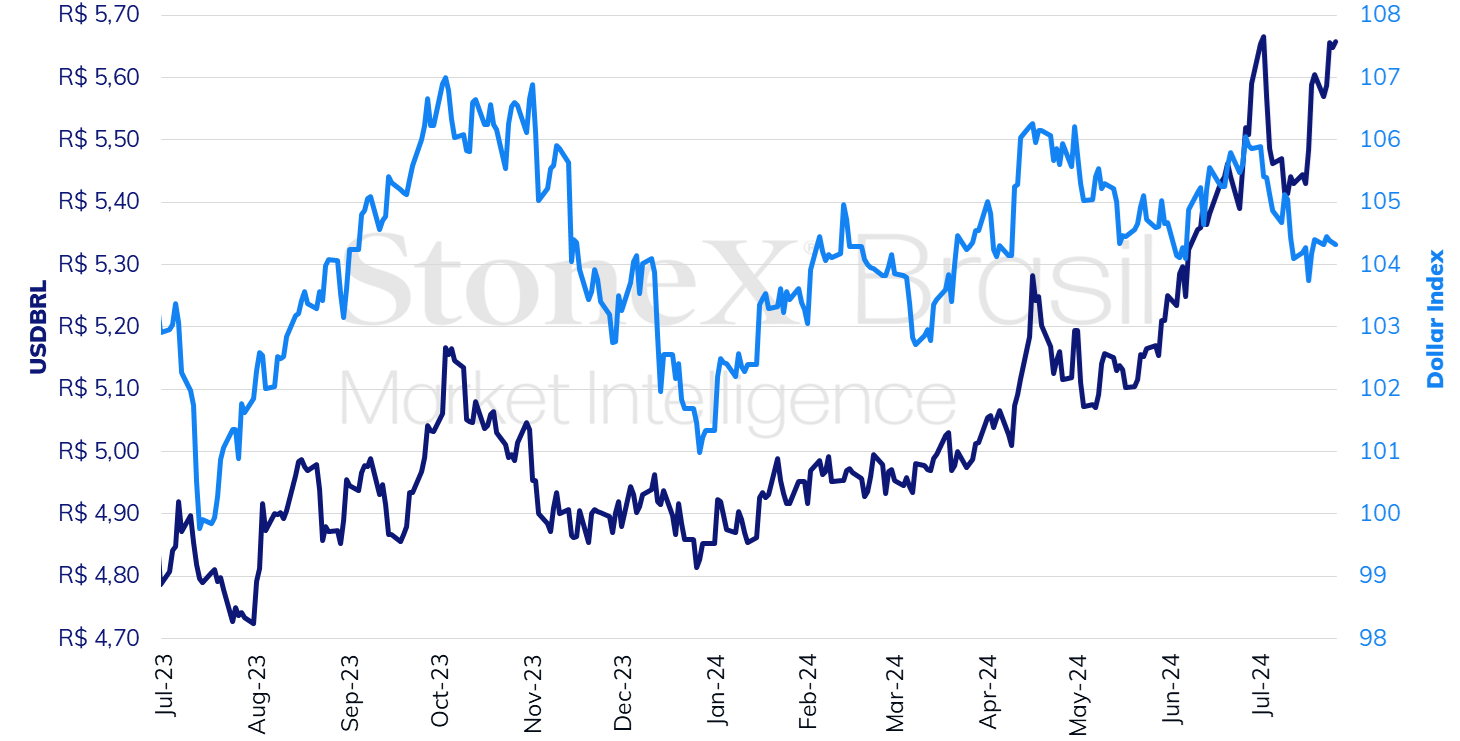
Source: StoneX cmdtyView. Design: StoneX.
KEY EVENT: Copom Decision
Expected Impact on USDBRL: Bearish
In an already stressed business environment due to communication noise from the federal government, skepticism and pessimism about the evolution of fiscal and monetary policies, and higher perceived risks for Brazilian assets, the higher-than-expected IPCA-15 inflation rate for July, and especially its composition, worsened investors' inflation expectations. The price index rose by 0.30% compared to June, above the median estimate of 0.23%, while the core indicator, which excludes volatile food and energy components, increased by 0.39%, monitored items rose by 0.54%, and service prices increased by 0.71%. This unfavorable reading reignited a debate among financial market participants about the need for a more stringent stance by the Central Bank of Brazil in its upcoming decisions, resulting in a rise in the future DI interest curve. Although it prices the Copom to keep the Selic rate stable at 10.50% per annum in this Wednesday's decision, it points to a 0.25 percentage point hike by the end of this year (10.75% per annum) and another 1.00 percentage point by January 2026 (11.75% per annum). Thus, in this scenario of greater caution and apprehension, investors will closely analyze Copom's decision statement for clues about the Committee's future conduct and any mentions of the possible trajectory of the base interest rates. If the BC indeed shows a willingness to maintain a more contractionary monetary policy, it may help slightly reduce the perceived risk of Brazilian assets and signal a higher interest rate differential compared to other economies, contributing to strengthening the Brazilian real.
FOMC Decision
Expected Impact on USDBRL: Bearish
There is a high consensus among analysts that the Federal Open Market Committee (FOMC) of the Federal Reserve (Fed) will keep US interest rates unchanged in the range of 5.25% to 5.50% per annum. After a heated first quarter, inflation data in the second quarter moderated substantially, raising investor optimism about the possibility of rate cuts soon. This optimism was reinforced by the higher-than-expected release of the first estimate of the Gross Domestic Product for the second quarter. Additionally, the recent softening in labor market numbers and a disappointing start to the earnings season for publicly traded companies in the US led some analysts to argue that the US economy is slowing down more quickly and that the Fed should not risk maintaining a more stringent monetary tightening for too long, as it could weaken economic activity beyond what is necessary to bring price indices back to the 2% annual target.
However, given the statements of Federal Reserve members who continue to advocate a cautious stance and the need for a longer sequence of favorable inflation numbers before initiating a monetary easing cycle, a cut in this Wednesday's decision seems quite unlikely.
On the other hand, the FOMC decision statement and the remarks of its chairman, Jerome Powell, in the subsequent press conference may have a dovish tone and signal the possibility of rate cuts for the September decision, although this is not a consensus among analysts. Some believe that the Committee will maintain its cautious stance as in previous meetings and that a signal for a shift to a more flexible stance may be reserved for the annual Jackson Hole Economic Symposium at the end of August.
US Labor Market Data
Expected Impact on USDBRL: Bearish
Although more readings of economic indicators are needed to confirm the trend, second-quarter numbers seem to point to a slowdown in the US economy, which is moving from the above trend to closer to the trend. In this context, the median estimates for the US job balance point to a net creation of 185,000 jobs in July compared to 206,000 in June, mainly due to the recent increase in unemployment benefit claims and the impact of Hurricane Beryl on the Gulf Coast earlier this month.
BoJ Interest Rate Decision
Expected Impact on USDBRL: Bullish
After hitting its weakest levels against the dollar since 1986 at the beginning of July, the Japanese yen appreciated by almost 5% between July 11 and 26, likely due to government interventions, which are not usually confirmed in the currency market, and investor bets that the Bank of Japan (BoJ) might raise interest rates in its decision this week – the country's interest rate futures market prices a 50% chance of a 15 basis point increase. Although BoJ members recognize the need to raise rates in the short term, there is no consensus on when this might occur. While core consumer inflation, excluding volatile food and energy components, has been above the 2% annual target pursued by the monetary authority since April 2022, weaker domestic consumption and wage gains reduce the urgency for a rate hike and make the scenario more complex and uncertain. Nonetheless, this week's decision is likely to have a significant impact on the value of the Japanese currency, which could extend its strengthening trend if the central bank raises rates or weaken again as in the first half of the year if it keeps them stable.
The rapid strengthening of the yen has significantly penalized the performance of currencies used in carry trade, such as the Brazilian real and the Mexican peso. Since the yen is often used by financial market operators as a "funding" currency for these operations, an appreciation of the yen reduces the returns on these transactions and encourages agents to unwind their positions. In other words, it is common for investors to borrow resources in the Japanese financial system, with low interest rates, and convert them into BRL for investment in the Brazilian financial system, with higher interest rates. With the unwinding of positions, there is a high sale of reais to settle the original Japanese loans, weakening the Brazilian currency.
End-of-Month Ptax Rate
Expected Impact on USDBRL: Undefined
After depreciating by 4.2% in just two weeks, the USDBRL is expected to remain volatile and under stress. On Wednesday (31), trading volume and volatility are likely to be higher within the time windows used by the Central Bank of Brazil to calculate the end-of-month Ptax rate, i.e., between 10:00 am and 1:10 pm (BRT). The Ptax is a reference rate published daily by the Central Bank, and its end-of-month value is widely used in foreign exchange and derivative contracts. As a result, traders intensify their activities during these intervals, competing for its definition.

INDICATORS