FX Weekly Overview: The week's main events
- Bearish factors
- Copom decision minutes may clarify the Committee's assessment of the current risk balance and possible trajectories for the basic interest rate (Selic), helping BRL alleviate frustration with last week's statement and also strengthening the real.
- Warmer reading for IPCA may worsen investors' inflation expectations and increase bets on Brazilian interest rates, which in turn contributes to strengthening the BRL.
- Bullish factors
- Global risk aversion environment and concerns about the American economy favor the performance of safe-haven assets and harm risky assets, such as stocks, commodities, and currencies from emerging countries.
The week in review
The week was once again marked by an international environment of pessimism and “risk off” mode, due to weaker economic data for the US and a frustrating season of quarterly results released by publicly traded companies in the country.
The USDBRL ended the week higher, closing Friday's session (02) at BRL 5.711, a weekly gain of 0.9%, a monthly gain of 1.0%, and an annual gain of 17.7%. The dollar index closed Friday's session at 103.2 points, a change of -1.1% for the week, -0.9% for the month, and +1.2% for the year.
USDBRL and Dollar Index (points)
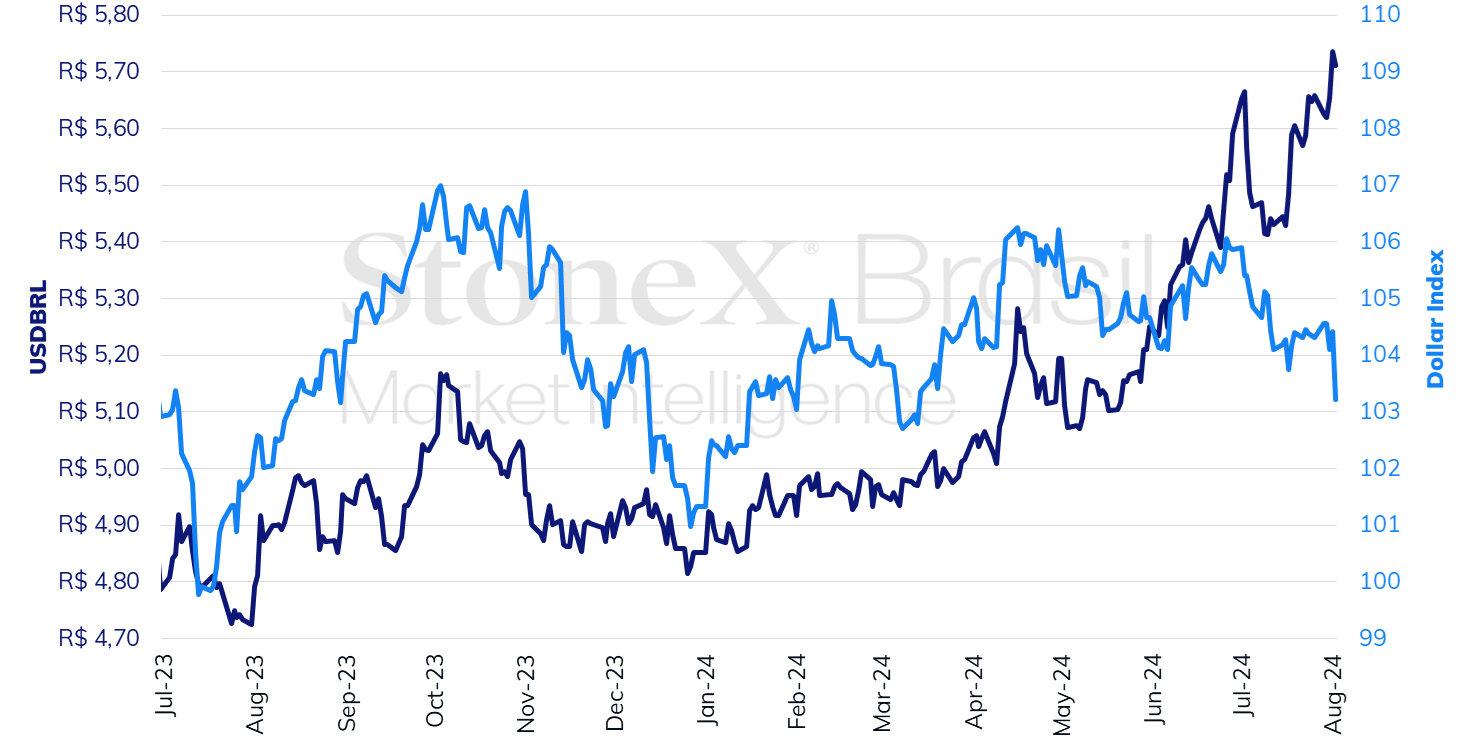
Source: StoneX cmdtyView. Design: StoneX.
KEY EVENT: Global risk aversion
Expected impact on USDBRL: bullish
The global business environment last week was marked by sharp volatility and intense risk aversion, with investors seeking safe-haven assets as a defensive strategy to protect investments. The main driver of the reduced appetite for risk was weaker-than-expected figures for American economic indicators, leading to renewed fears of a slowdown in activity in the country or even a recession—a so-called "growth scare." Weekly jobless claims exceeded the median estimates and reached their highest value since August of last year. Meanwhile, the Purchasing Managers' Index (PMI) for July fell more than expected, with its employment subcomponent showing the lowest reading since July 2020. Additionally, the balance for new jobs in July recorded 114,000 new positions, below the median estimate, and the unemployment rate unexpectedly rose to 4.3%, accumulating an increase of 0.6 percentage points since January. These fears of a sudden slowdown were further reinforced by the release of quarterly results below expectations for several publicly traded companies in the US, suggesting that the economic scenario in the country may be worse than what is perceived in official indicators and that this is affecting the performance of these companies.
Change in total urban employment (in thousand people) and unemployment rate (%) in the United States
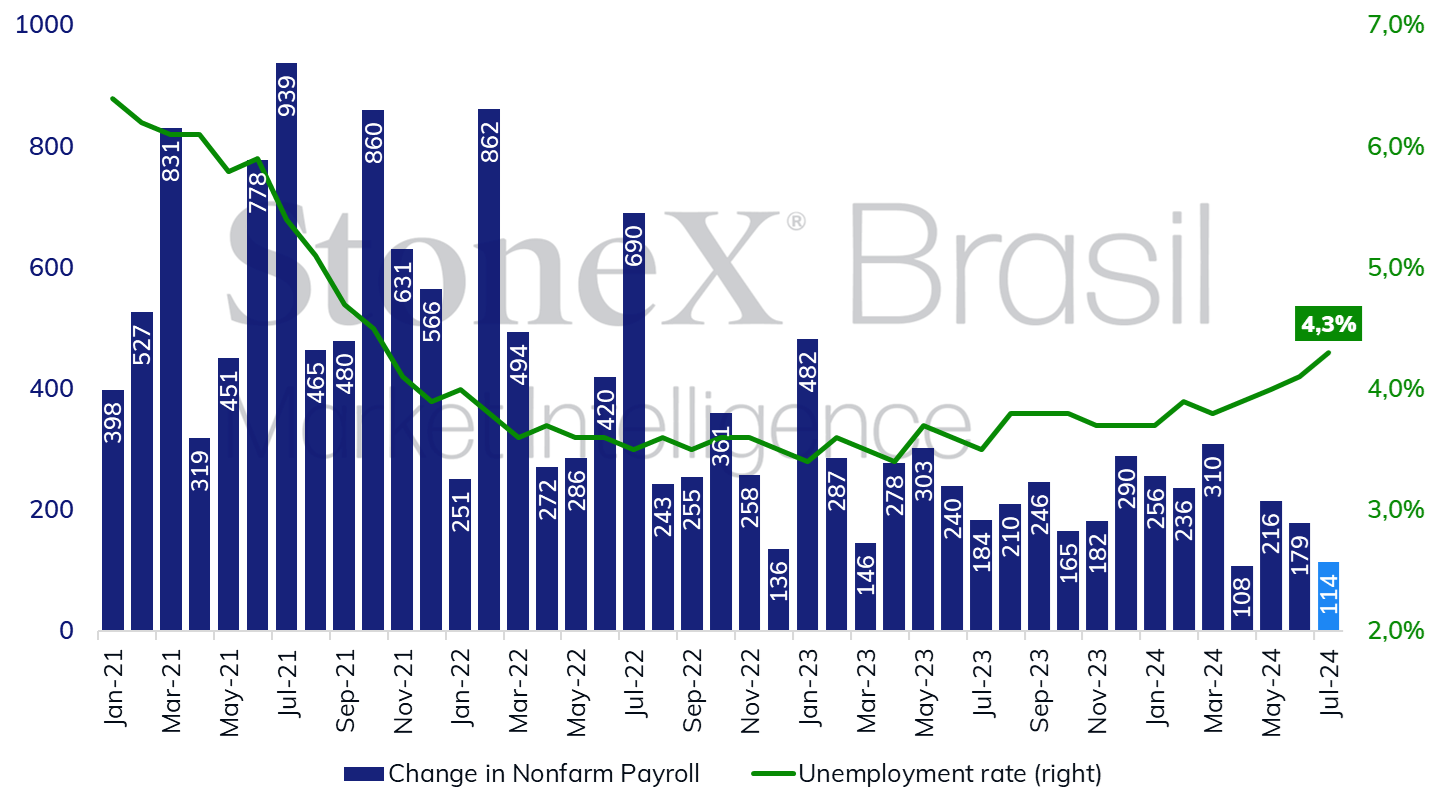
Source: Federal Reserve Bank of St. Louis. Design: StoneX.
US: History and expectation for the interest rate - August 2, 2024
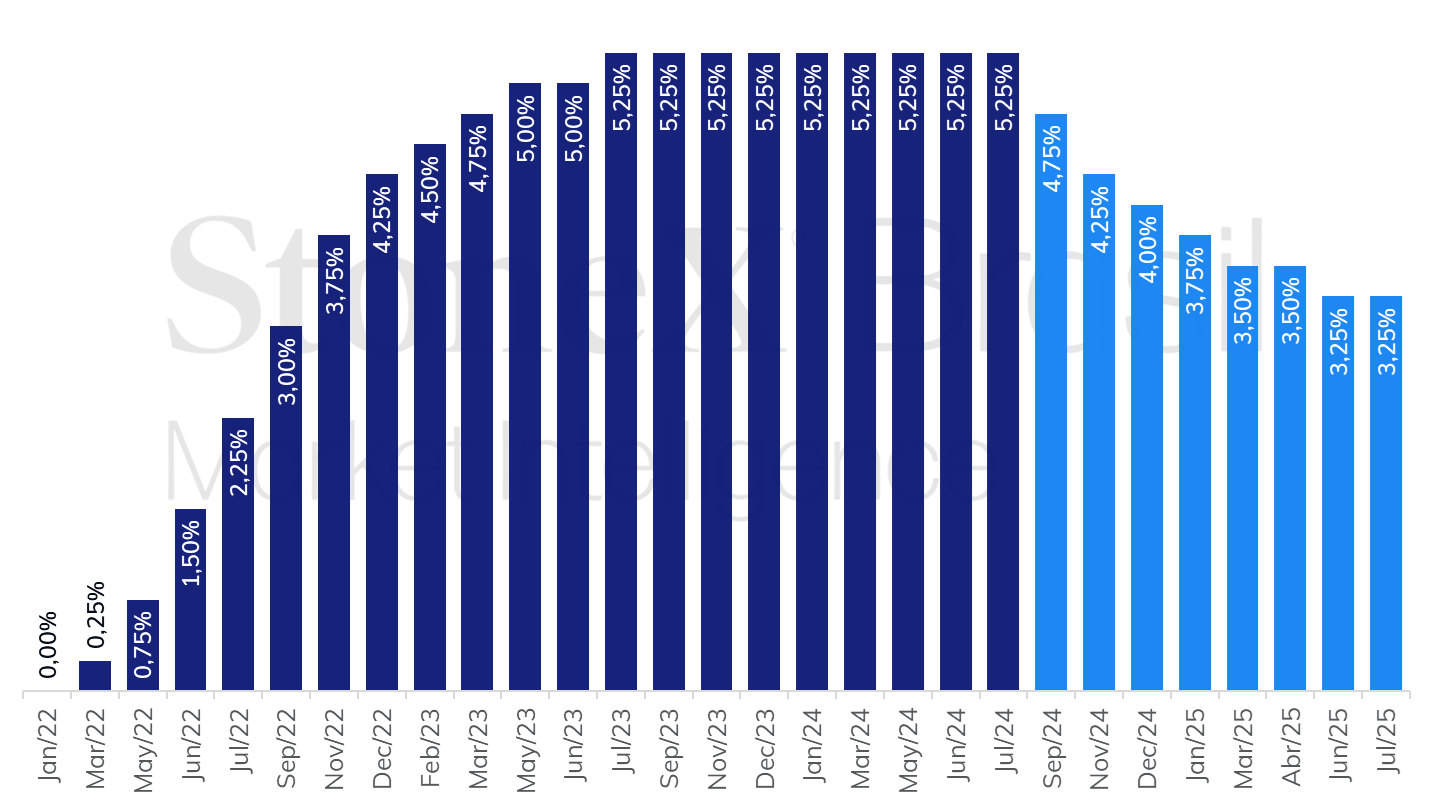
Source: CME FedWatch Tool. Design: StoneX. Refers to the bet with the highest probability in the future interest rate market on the indicated date.
Underlying these fears of a weakening American economy is the perception that the Federal Reserve should have made an interest rate cut in last Wednesday's decision (31), and by choosing not to do so, is consequently maintaining an excessive level of monetary tightening on the country's activity. However, such fears could be alleviated, at least temporarily, with the release of the American Services Purchasing Managers' Index (PMI) on Monday (05). After the indicator surprised in June by posting 48.8 points, the lowest value since June 2020, the median expectation for July is a return to expansion with 51.0 points.
The picture of global risk aversion was also reinforced by the perception of worsening geopolitical tensions, driven by the Israeli assassinations of the military leader of Hezbollah in Beirut, Lebanon, and the political leader of Hamas in Tehran, Iran. These attacks on the leaders of opposing groups in foreign territories have raised fears among investors about an escalation of the conflict in the region, such as the possibility of war clashes between Israel and Iran.
Finally, it is worth noting the asynchrony and divergence of the scenarios faced by major central banks, which result in differences in monetary policy cycles between countries. On one hand, the Bank of Japan, which has faced the challenge of very low (or negative) inflation for decades, has opted for a second increase in the basic interest rate, which was not a consensus among analysts, in addition to a long-term plan to reduce purchases of Japanese public debt securities. In Brazil, the Monetary Policy Committee kept the basic interest rate (Selic) flat but adopted a firmer tone against the risks of inflation expectations becoming unanchored. Even though it did not mention the possibility of an interest rate increase, the Committee seemed closer to a hike than to a reduction in the Selic. In the USA, the Federal Reserve signaled the possibility of a first interest rate cut in the September decision but preferred to wait for more information on price stabilization in the country. In England, the first interest rate cut by the Bank of England was observed, in a decision divided with 5 votes to 4.
Copom minutes
Expected impact on USDBRL: bearish
During an unfavorable external scenario for emerging market currencies, investor frustration with the statement from the Monetary Policy Committee (COPOM) reinforced the negative performance of the BRL last week. Although the statement adopted a firmer tone by making the risk balance asymmetric with a bias towards higher interest rates and explicitly warning about the risks of a more prolonged disanchoring of expectations and the effects of the devalued exchange rate on macroeconomic variables, some analysts expressed disappointment over the absence of a clear signal regarding a possible increase in the basic interest rate (Selic) in the future due to this context. In this regard, the minutes of the Committee's decision, which will be released this Tuesday (06), could help alleviate this frustration by clarifying the members' assessment of the economic situation and risk balance, more clearly signaling possible paths for the country's interest rates, and describing criteria that may lead to a future rate hike.
July IPCA
Expected impact on USDBRL: bearish
After the higher-than-expected increase in the IPCA-15 for July and its underlying measures, such as service prices and its core, which excludes volatile components like food and energy, the median expectation for the IPCA suggests an increase from 0.23% in June to 0.35% in July. This reading is expected to be driven by fuel price adjustments and softened by a decrease in food prices. Such a reading could impact traders' inflation expectations, which have been steadily rising in recent months amid a climate of skepticism and pessimism about the conduct of economic policies in the country and the more robust performance of the Brazilian labor market.

INDICATORS