FX Weekly Overview: The week's main events
- Bearish factors
- Expectation of wording from Federal Reserve officials signaling an interest rate cut in the September decision
- Bullish Factors
- Inflation data from Japan
The week in review
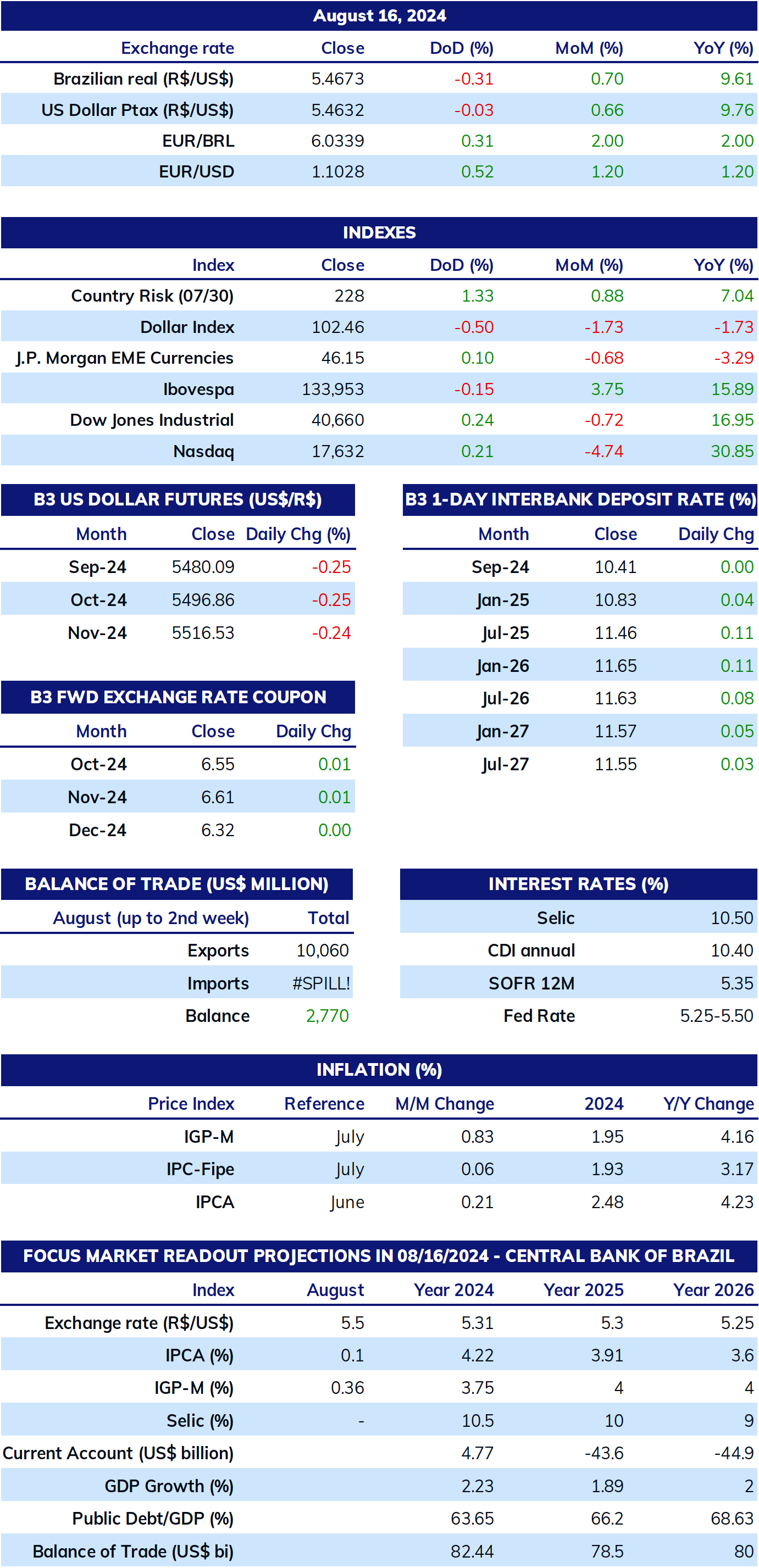
During the week, the foreign exchange market reflected the increased risk appetite of global investors, driven primarily by the release of stronger economic indicators from the American economy. Notably, the consumer inflation data (CPI) released on Wednesday (14th) adjusted expectations for the upcoming Federal Reserve monetary policy decision, scheduled for September 18th. Throughout the week, consensus among traders has solidified around a 0.25 percentage point rate cut, which is expected to bring greater calm to investors in the coming days, favoring gains in risk assets and emerging market currencies.
The USDBRL ended the week lower, closing Friday's session (16th) at BRL 5.46, representing a weekly decline of 0.9% and a monthly decline of 3.3%, but an annual increase of 12.7%. The dollar index closed Friday's session at 102.41 points, marking a weekly decrease of 0.7%, a monthly decrease of 1.6%, but an annual increase of 1.1%.
USDBRL and Dollar Index (points)
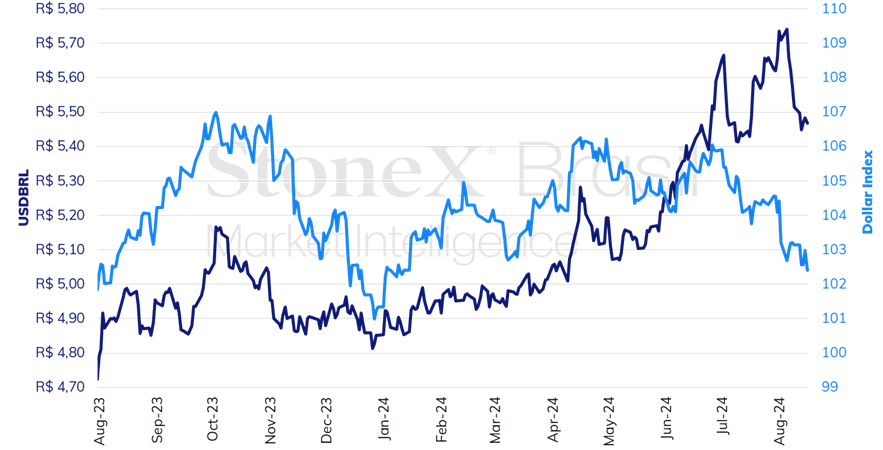
Source: StoneX cmdtyView. Design: StoneX.
KEY EVENT: FOMC Monetary Policy Decision Minutes
Expected impact on USDBRL: bearish
In a week with few significant economic indicators in the US, investors are likely to seek signals that reinforce expectations for the Federal Reserve's interest rate decision in September (09/18). Last week, data on producer price inflation (PPI) and consumer price inflation (CPI) showed milder figures, aligning with the anticipated normalization of prices toward the Federal Reserve's 2% annual inflation target. However, these figures, along with other statistics suggesting the resilience of the American economy, have significantly reduced the likelihood of a monetary easing larger than the anticipated 25 basis points in September. Throughout the week, the market briefly priced in a 52.5% probability of a 0.50% rate cut, but this expectation has since receded to just 25.5%.
The main inflation indicators that will underpin the Fed's decision have already been released—except for the PCE, which will only be published on August 30. Therefore, market movements next week are expected to be influenced mainly by signals from Federal Reserve officials. Of particular interest will be the release of the minutes from the July 31 monetary policy meeting on Wednesday (21), where investors will be looking for clues about the anticipated start of monetary easing in the US Additionally, the annual Jackson Hole symposium begins on Thursday (22) and runs until Saturday (24). This event, hosted annually by the Kansas City Federal Reserve, will feature a speech by current Fed Chair Jerome Powell, who is expected to address the US economic outlook. Expectations surrounding his speech could increase volatility in currency markets, especially if Powell's comments are more conservative than expected regarding interest rates, potentially influencing global currency movements.
US: History and expectation for the interest rate - August 09, 2024
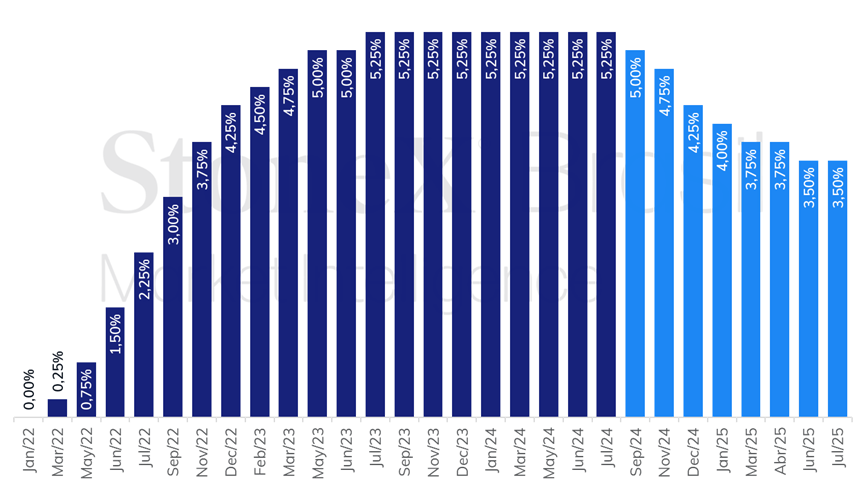
Source: CME FedWatch Tool. Design: StoneX. Refers to the bet with the highest probability in the future interest rate market on the indicated date.
Consumer inflation (CPI) in Japan
Expected impact on USDBRL: bullish
The release of consumer inflation data (CPI) in Japan is expected to impact the foreign exchange market. According to a survey released by Reuters this morning, the core CPI, which excludes fresh food but includes energy items, is projected to show a 2.7% increase in July compared to the previous year, slightly above the 2.6% growth observed in the previous month. If confirmed, this would mark the 28th consecutive month of inflation remaining above the Bank of Japan's 2% target, reinforcing the recent decision to raise the interest rate to around 0.25% per year—the highest level in the country since 2008.
Earlier this month, the prospect of continued monetary tightening in Japan led to sharp volatility in global markets, driven by the possibility of yen appreciation. During that period, stock markets in Japan and other countries experienced significant devaluations, while currencies considered safe, such as the yen and the Swiss franc, absorbed a significant portion of the gains. Although this movement was exacerbated by the ongoing confidence crisis in the US, Japanese exchange rate policy has a particularly relevant impact on global markets, primarily due to the yen carry trade. Since the yen is widely used as a funding currency in these operations, its appreciation reduces the yields of such transactions, prompting investors to unwind their positions. In this scenario, it is common for investors to borrow funds in the Japanese financial system at low interest rates and convert them into reais for investment in Brazil, where interest rates are higher. As these positions are unwound, there is a significant sale of reais to settle Japanese financings, exerting downward pressure on the Brazilian currency.

INDICATORS