FX Weekly Overview: Key Events of the Week
-
Notice: This report will not be published on December 20 and 27, resuming on January 3, 2024. Happy Holidays!
- Bearish Factors
- The Copom meeting minutes are expected to reinforce the outlook for higher interest rates for a longer period in Brazil, which could attract foreign investment and strengthen the real.
- Expectations of announcements regarding Chinese fiscal stimuli may improve economic growth projections for the country, benefiting risky assets such as stocks, commodities, and emerging market currencies like the real.
- Bullish Factors
- The FOMC interest rate decision and new projections are expected to underline a cautious approach by the Federal Reserve in its rate-cutting cycle, supporting the yield of dollar-denominated bonds and strengthening the global value of the dollar.
The week in review
The week was marked by pessimism and skepticism among investors regarding Brazil’s fiscal policy management, which offset potential gains driven by expectations for a stronger sequence of increases in the basic interest rate (Selic). In the US, stronger-than-expected inflation data reinforced bets that the Federal Reserve might cut interest rates less and at a slower pace.
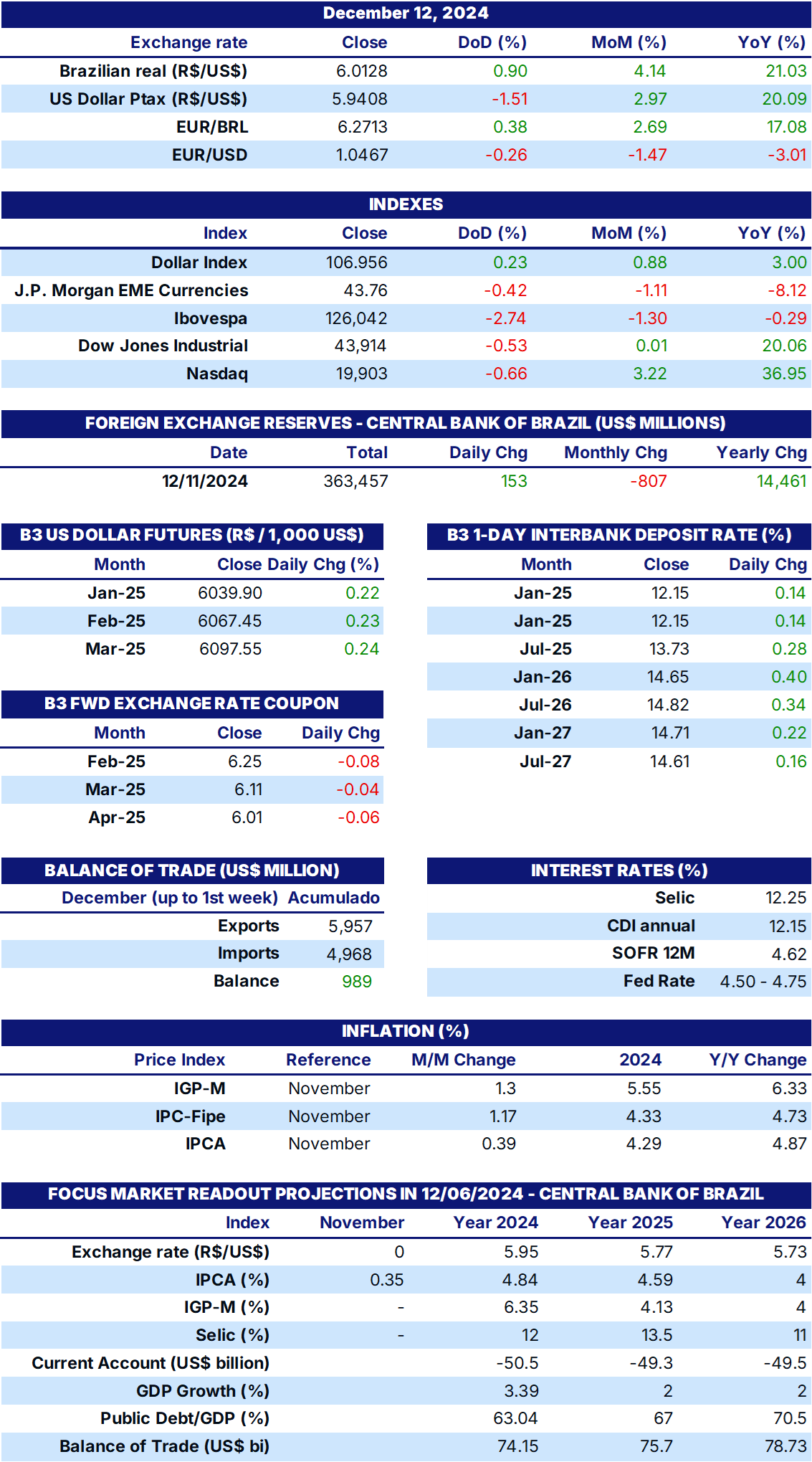
The dollar traded in the interbank market ended Friday's session (13th) at BRL 6.023, with a weekly variation of -0.8%, a monthly increase of +0.5%, and a yearly increase of +24.3%. Meanwhile, the Dollar Index closed Friday's session at 107.0 points, with weekly, monthly, and yearly gains of 1.0%, 1.2%, and 5.6%, respectively.
USDBRL and Dollar Index (Points)
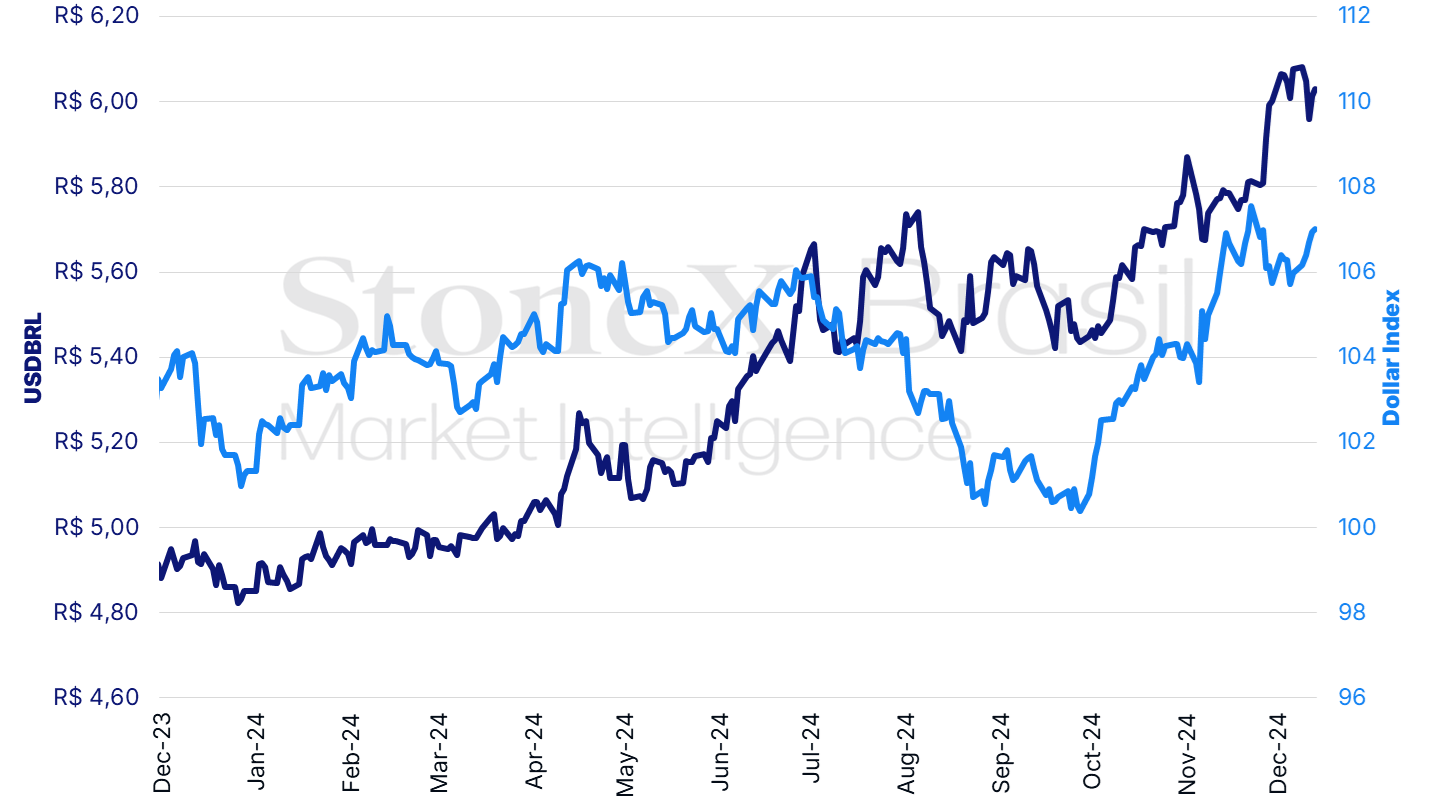
Source: StoneX cmdtyView. Prepared by: StoneX.
Key Focus: FOMC Monetary Policy Decision
Expected Impact on USDBRL: Bullish
There is strong consensus that the Federal Open Market Committee (FOMC) of the Federal Reserve (Fed) will cut the US basic interest rate by 0.25 percentage points, from a range of 4.50%-4.75% p.a. to 4.25%-4.50% p.a. This expectation appears more based on perceptions that committee members lean toward a rate cut in this decision rather than on recent data. Since the Federal Reserve began its rate-cutting cycle in September, US indicators have generally pointed to a stronger economy, higher inflation risks, and lower-than-expected risks of labor market weakening. Additionally, most analysts believe policy changes anticipated during Donald Trump's new administration may exert inflationary pressures, compelling the Fed to reduce rates less to counteract these pressures.
Given this context, the statement accompanying the decision and the press conference by FOMC Chair Jerome Powell are expected to adopt a cautious tone, emphasizing that the Federal Reserve is in no hurry to implement further cuts and will closely monitor economic data to decide the appropriate monetary policy trajectory. Moreover, likely more important than the decision itself, the Committee will update its Summary of Economic Projections, expected to indicate a slower pace of US interest rate cuts in 2025, improved economic growth and unemployment rate forecasts, and higher inflation estimates. Thus, even if the FOMC cuts rates in this decision, it is likely to reinforce investor perceptions that the US central bank will cut rates less and more gradually, potentially boosting US Treasury yields and strengthening the dollar.
Federal Reserve Rate Decision Bets – December 18
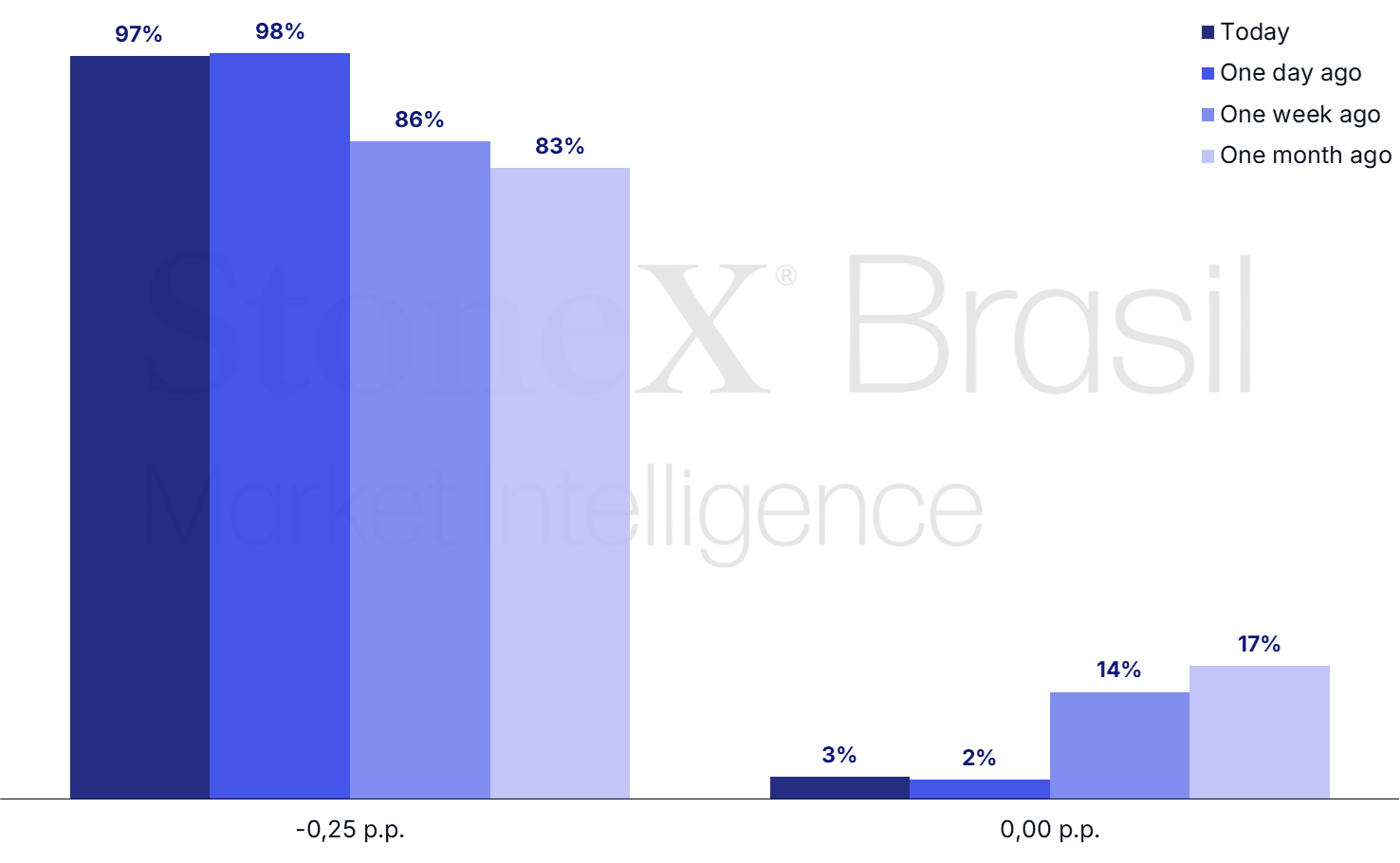
Source: CME FedWatch Tool. Prepared by: StoneX. Probabilities in the futures interest rate market as of December 13, 2024.
US: Historical and Expected Interest Rate – December 13, 2024
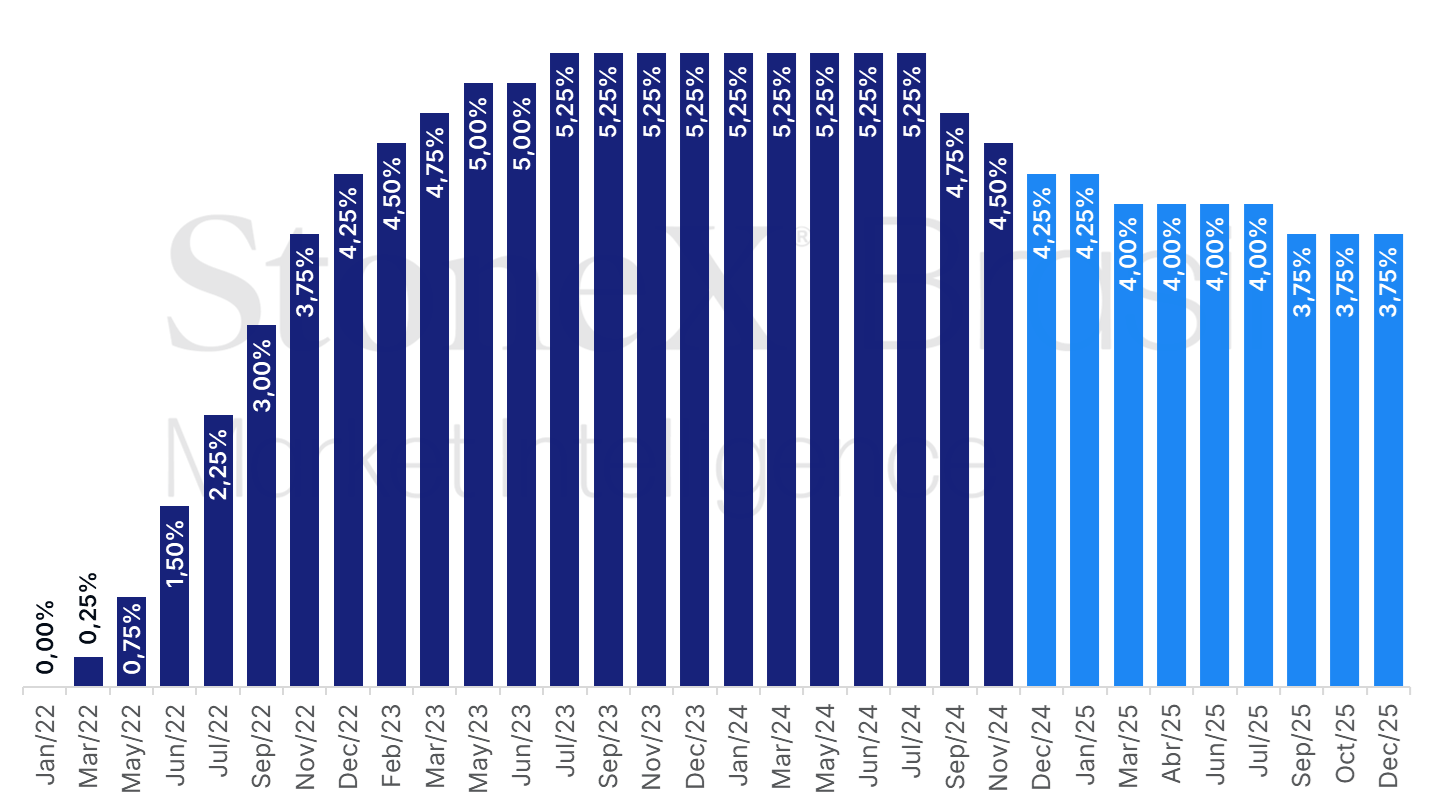
Source: CME FedWatch Tool. Prepared by: StoneX. Refers to the highest-probability futures market bet on the indicated date.
Copom Monetary Policy Decision Minutes
Expected Impact on USDBRL: Bearish
Last week, the Central Bank of Brazil's Monetary Policy Committee (Copom) surprised analysts with a firmer stance than expected, unanimously increasing the basic interest rate (Selic) by 1.00 percentage points and signaling two similar hikes in upcoming meetings (January 29 and March 19). Some analysts dubbed this decision a "rate shock," as although a significant portion of investors anticipated a possible 1.00 percentage-point Selic hike, the forward guidance for two additional adjustments of the same magnitude was unexpected.
The Copom’s statement highlighted that the sequential and more intense rate hikes were justified by a worsening future inflation outlook, described as "less uncertain and more adverse" with "upward asymmetry" following the "materialization of inflationary risks." This scenario includes: (i) stronger-than-expected economic activity and labor market performance, which poses inflationary pressure risks due to heated demand; (ii) significant and persistent currency depreciation, potentially driving up import costs and price levels; (iii) a serious credibility crisis in Brazilian fiscal policy management among investors, who anticipate greater public spending stimulus on domestic demand, thereby risking inflation acceleration and deteriorating the country’s debt trajectory.
The minutes of this decision, to be published on Tuesday (17), are expected to emphasize the Committee's firmer stance and reiterate its commitment to "re-anchoring expectations" — ensuring the Central Bank does whatever it takes to stabilize inflation around its 3.0% annual target and convincing financial market participants of this stabilization. Additionally, the minutes are expected to provide clearer forecasting horizons for investors, reducing uncertainties surrounding monetary policy. This outlook for higher basic interest rates for a longer period could help reduce risk premiums and boost domestic bond yield expectations, attracting foreign investments and contributing to the appreciation of the real.
Expectations for Chinese Stimuli
Expected Impact on USDBRL: Bearish
Last week, expectations for new stimuli to boost Chinese economic growth increased after a Politburo statement announced plans to accelerate measures to stimulate domestic demand and maintain "appropriately loose" monetary policy in 2025 — a term previously used only during major international crises like 2008. However, it is worth noting that recent Chinese indicators have generally shown weaker-than-expected dynamism, raising investor concerns about a deeper slowdown in the world’s second-largest economy, which faces growing challenges such as weakening domestic demand, stagnation in price indices, and threats of tariff barriers from key trading partners like the United States and the European Union. Nevertheless, although the documents lack detailed information, investors are awaiting new incentive announcements soon, boosting prospects for increased commodity demand from China and favoring currencies of primary-exporting countries such as the real.
Progress of the Economic Measures Package
Expected Impact on USDBRL: Undefined
In Brazil, investors are likely to stay attentive to news related to the progress of the government’s economic measures package in Congress during the final legislative week before the parliamentary recess from December 23 to February 2. Last week, the Speaker of the House, Arthur Lira (PP-AL), stated that he would "activate turbo mode" in this final week to ensure the approval of strategic topics such as the 2025 Budget, tax reform regulations, and the fiscal package. Additionally, the Presidential Office released approximately BRL 1.8 billion in parliamentary amendments to facilitate the approval of these measures. However, media reports highlight dissatisfaction and resistance among deputies due to decisions by Supreme Court Justice Flávio Dino, unanimously upheld by other justices, concerning the release of funds for parliamentary amendments. Dino blocked the release of funds for these amendments in August, only releasing them with restrictions in early December. Lawmakers attribute these judicial decisions to an Executive initiative, complicating government project approvals in the Legislature.

ECONOMIC INDICATORS TABLE