FX Weekly Overview: Main Events of the Week
- Bearish Factors
- US production and labor market data may reinforce the perception of a soft landing for the American economy, increasing expectations for Fed rate cuts and weakening the dollar.
- Chinese economic data and the possibility of new stimulus measures by the country's authorities may improve growth expectations for 2025, favoring the performance of currencies from countries exporting primary products, such as the real.
- Bullish Factors
- Increased geopolitical and trade tensions by the US are expected to result in greater global risk aversion, which tends to strengthen the dollar worldwide.
- Heightened perceptions of fiscal risks for Brazilian assets tend to elevate investors’ risk premium demands, weakening the real.
- An ECB interest rate cut harms the interest rate differential between the bloc and the US, indirectly strengthening the dollar.
The week in review
The week was marked by a consistent increase in the real/dollar pair due to renewed investor concerns over the Brazilian fiscal scenario and a more risk-averse external environment after the confirmation of new US import tariffs on China, Mexico, and Canada.
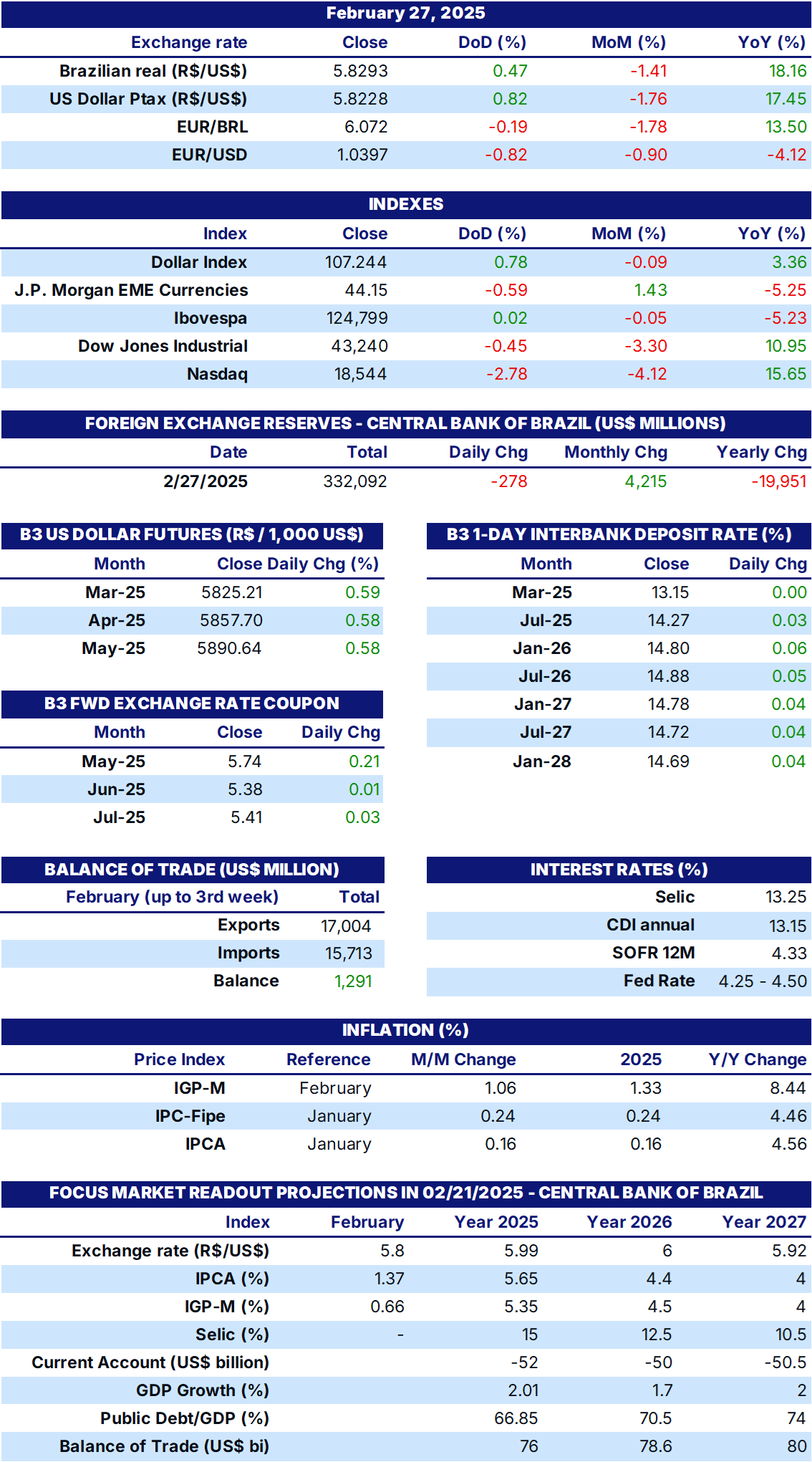
The USDBRL ended Friday’s session (28) quoted at BRL5.9160, a weekly gain of 3.2% and a monthly gain of 1.4%, but an annual decline of 4.2%. Meanwhile, the dollar index closed Friday at 107.6 points, with a weekly change of +0.9%, a monthly change of -0.7%, and an annual change of -0.5%.
USDBRL and Dollar Index (points)
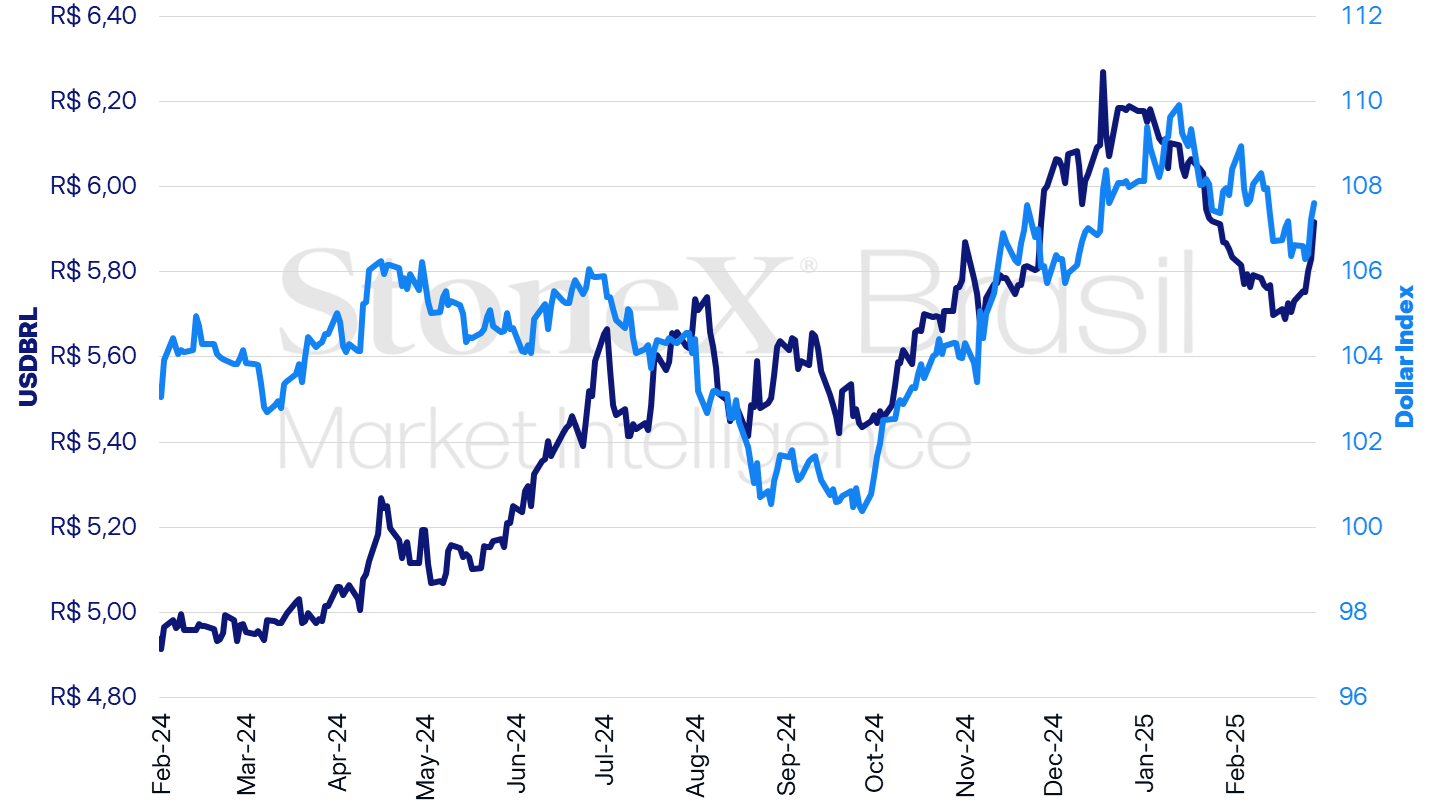
Source: StoneX cmdtyView. Preparation: StoneX.
KEY EVENT: US Geopolitical and Trade Tensions
Expected Impact on USDBRL: Bullish
Since Donald Trump’s inauguration as President of the United States on January 20, financial markets have experienced significant volatility and uncertainty due to the low predictability of the country’s economic policies and diplomacy. Last week, investors expressed concerns that economic growth and inflation in the US might worsen after Trump confirmed that 25% import tariffs would be applied to products from Mexico and Canada starting on March 4, while surcharges on Chinese products would increase from 10% to 20%. Additionally, the president promised to impose 25% tariffs on all imports of steel and aluminum starting on March 12 and on all imports of copper, automobiles, semiconductors, pharmaceuticals, wood, and forest products starting on April 2, the same date when “reciprocity tariffs” would be adopted to match the import taxes imposed by the US on those of its trading partners. The implementation of higher trade barriers by the US is expected to result in increased global risk aversion, which tends to strengthen the dollar, a currency considered a “safe haven” during periods of stress.
Furthermore, the US government continues to amplify perceptions of geopolitical risks due to tensions and disputes with former allies, such as the European Union and Ukraine, as well as a perceived differential treatment toward Russia, a historical adversary. These perceptions were significantly aggravated last Friday following a disastrous meeting in the White House’s Oval Office between Trump and Ukrainian President Volodymyr Zelensky. Zelensky visited the White House to sign a trade agreement on critical mineral exports to the US in exchange for American support for Ukrainian defense. However, during a press conference before the agreement signing, the Ukrainian leader upset US Vice President J.D. Vance by stating that he did not believe a US-brokered peace agreement with Russia would halt Russian aggression or bring lasting peace to the region. Vance, in turn, accused him of not being grateful for American military aid and blamed Ukrainian diplomacy for instigating the Russian invasion, while Trump told Zelensky that he was not in a “good position to negotiate,” that “he is playing with the Third World War,” and that “either you make a deal [for peace] or we’re out, and if we’re out, you fight alone. I don’t think that’s going to be pretty.” Heightened US tensions with Ukraine are expected to increase investor concerns about Europe’s geopolitical stability and further boost global risk aversion, which, in turn, tends to strengthen the dollar.
US Activity and Employment Data
Expected Impact on USDBRL: Bearish
In a week filled with indicators for US production and the labor market, special attention is given to the February Employment Situation Report, which is expected to show a slight decline in job creation, with median estimates anticipating a positive balance of 133,000 new jobs in February compared to 143,000 in January. If this forecast is confirmed, it would increase investor concerns regarding the dynamism of the US labor market, following several high-frequency indicators suggesting a weakening in February. Additionally, recent hiring freezes and mass layoffs promoted by the US federal government are expected to reinforce this downturn in the coming months. However, it is important to note that this weakening trend has been moderate, consistent with a “soft landing” of the economy, with no abrupt deterioration in labor conditions anticipated.
Median projections for the Services Purchasing Managers’ Index (PMI) indicate that it will remain stable in February at 52.8 points (a reading above 50 indicates expansion), following a weaker-than-expected reading in January. This stability is expected to result from a decline in business confidence levels, which returned to pre-election boost levels after November’s electoral results. Thus, this week’s indicators for activity and the labor market are expected to signal greater room for Fed rate cuts, which tends to reduce the yield on dollar-denominated bonds and, thereby, weaken the US dollar globally.
USA: Historical and Expected Interest Rate – February 28, 2025
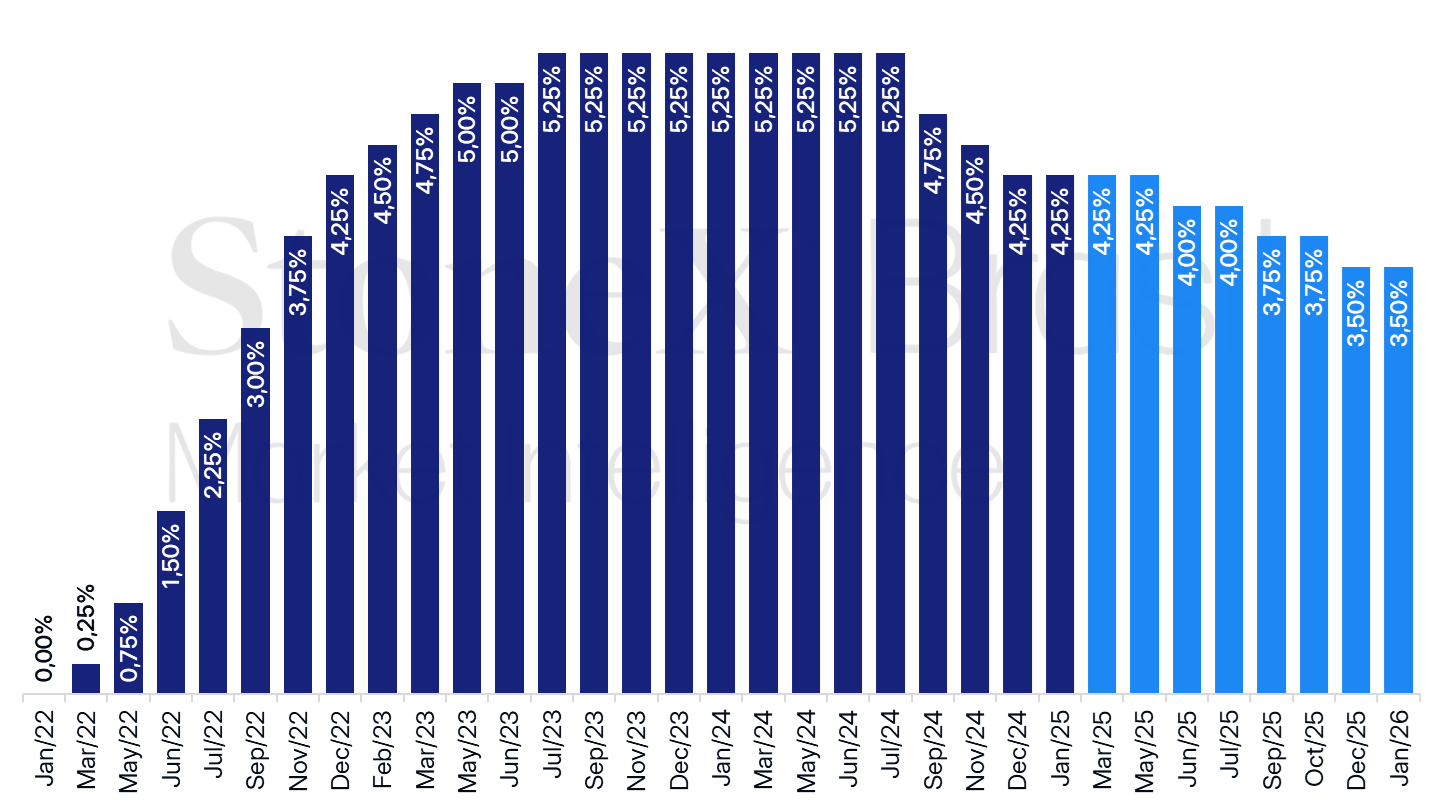
Source: CME FedWatch Tool. Preparation: StoneX. Refers to the most likely bet in the futures interest rate market for the indicated date.
GDP and Fiscal Concerns in Brazil
Expected Impact on USDBRL: Bullish
In a week shortened by the extended Carnival holiday, investors await the release of Brazil’s fourth-quarter Gross Domestic Product (GDP), with median estimates pointing to a 3.5% expansion in 2024. However, growth is expected to have slowed in the last quarter even with a more vigorous boost from public spending. In this context, the data may reinforce investor pessimism regarding the trajectory of the country’s public accounts, as last week market participants largely expected the federal government to increase spending in an attempt to recover its popularity ratings and become more competitive for the 2026 elections. This pessimism deepened last Friday when President Luiz Inácio Lula da Silva indicated that Congresswoman Gleisi Hoffmann (PT-SP) would be appointed to the Secretariat of Institutional Relations, the body responsible for political liaison with Congress. Gleisi, a vocal critic of Finance Minister Fernando Haddad and former Central Bank President Roberto Campos Neto, will likely oppose further government spending cuts. An increase in perceived fiscal risks by investors may, in turn, lead to higher demanded risk premiums, thereby weakening the real.
ECB Interest Rate Decision
Expected Impact on USDBRL: Bullish
Analysts largely agree that the European Central Bank (ECB) is expected to lower its key interest rate from 2.75% per annum to 2.50% per annum due to improved inflation projections and, primarily, stagnating production activity within the 20-country bloc. Following this decision, however, it is likely that the ECB will adopt a more cautious stance, evaluating the evolution of economic conditions and trade relations with the US before deciding on further cuts. Currently, most investor bets are that the monetary authority will implement two additional 0.25 percentage point cuts in 2025, in an effort to revive economic growth. ECB rate cuts, in turn, tend to weaken the euro, which indirectly contributes to strengthening the US dollar.
Indicators and Congress in China
Expected Impact on USDBRL: Bearish
In a week filled with significant events in China, investors are expected to react to the release of the trade balance for January and February, which is anticipated to show an acceleration in export growth as companies in the country strive to get ahead of the imposition of US import tariffs. Additionally, Chinese authorities are expected to announce a comprehensive set of economic targets at the end of the important Chinese People’s Political Consultative Conference on Wednesday, and new, albeit smaller-scale, fiscal and monetary stimulus measures may be unveiled to complement those implemented last year. In any case, the expectation is that these indicators and announcements will improve growth prospects for China in 2025, potentially favoring risk assets such as stocks, commodities, and the currencies of emerging markets like the real.

INDICATORS