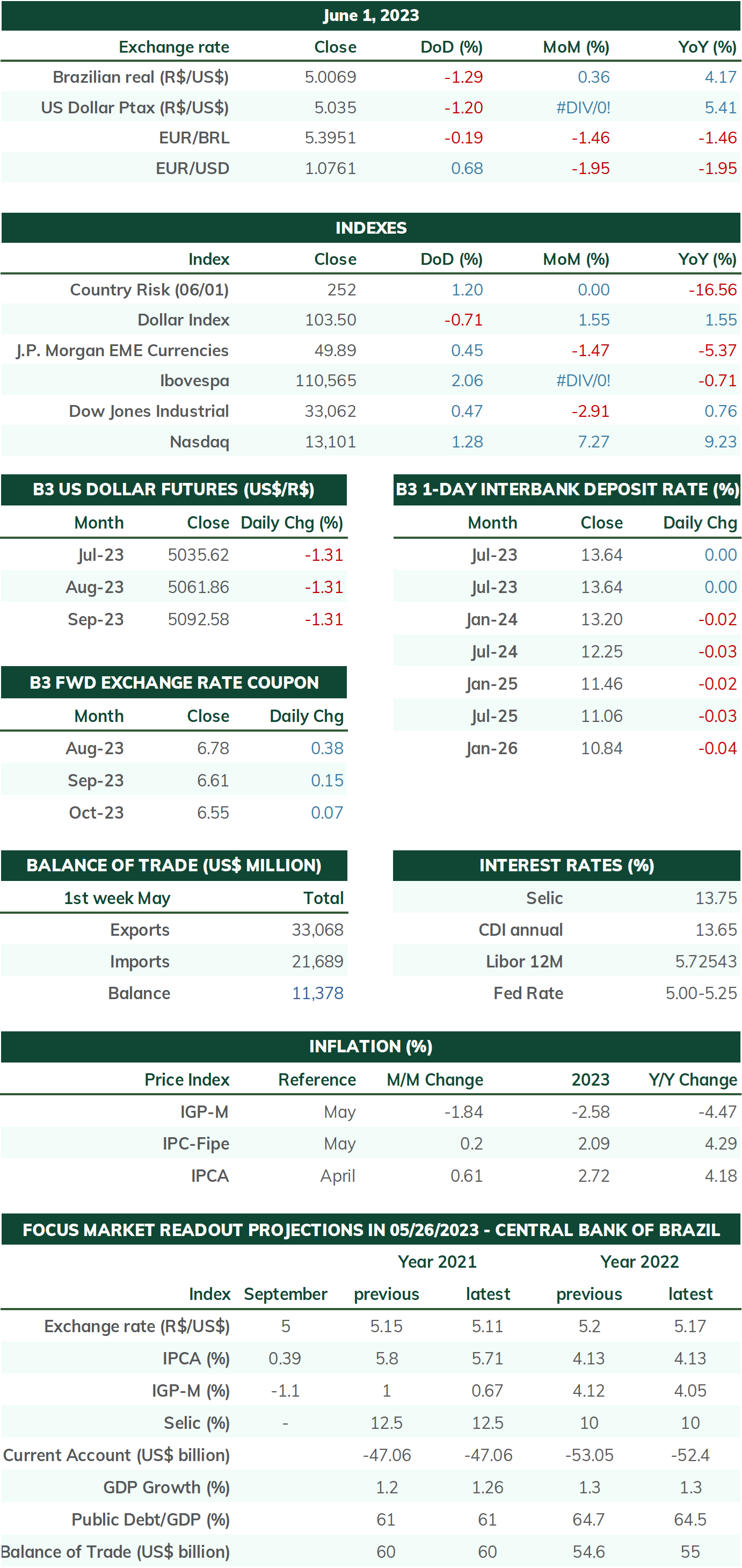
- Warm economic data in the United States should suggest that the country is still expanding and that the Federal Reserve will need to keep its interest rates higher for longer, contributing to strengthening the dollar.
- Weak economic data for China should suggest that demand in the country is recovering slower than anticipated and could hurt the performance of risky assets such as commodities and currencies of emerging countries, weakening the real.
- The expectation of a slight moderation in the IPCA in May may reinforce bets that the Central Bank will start cutting the benchmark interest rate (Selic) soon, which may contribute to attracting investments to the country and strengthen the real.
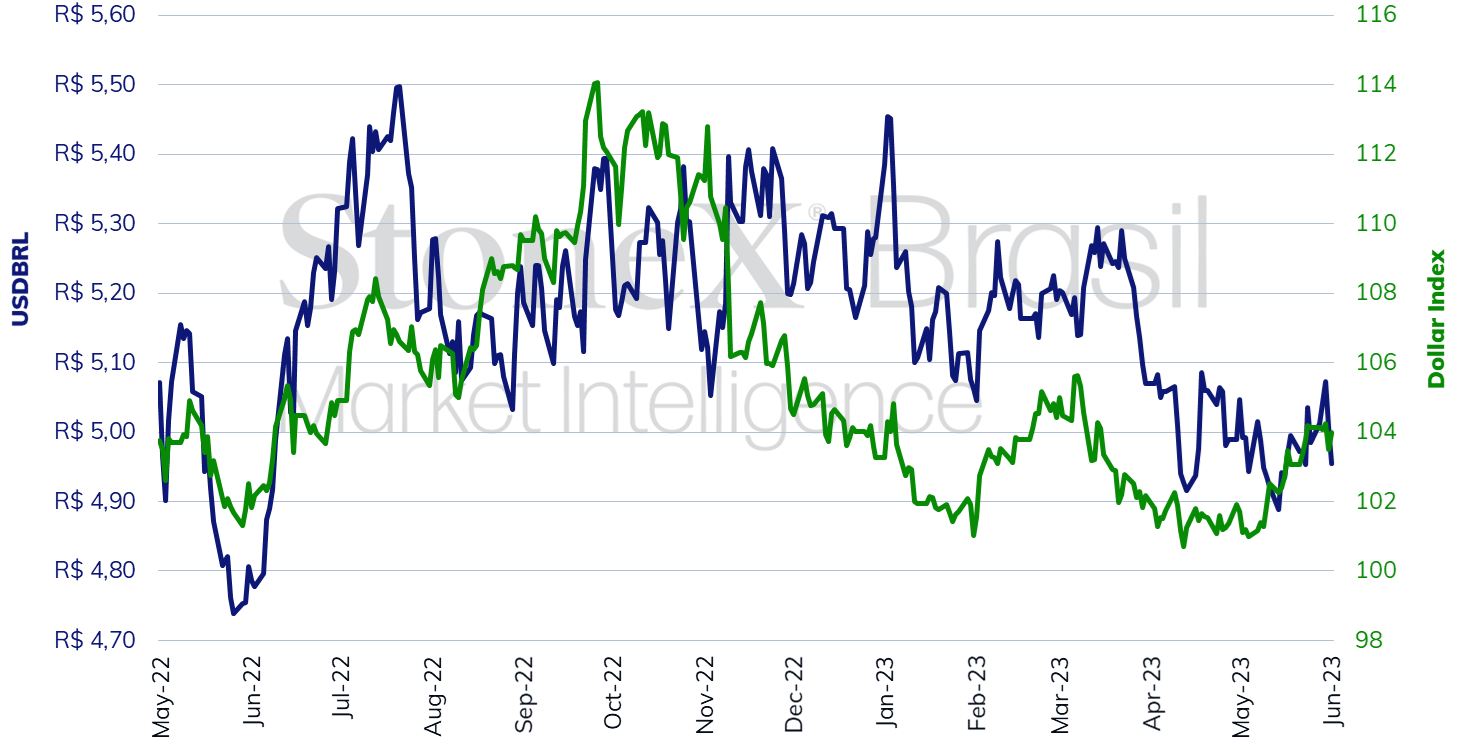
The USDBRL ended Friday's session (02) at BRL 4.955, a weekly decline of 0.6%, monthly of 2.3% and annual of 6.2%. The dollar index closed the session quoted at 104,0 points, a variation of -0.2% in the week, -0.3% in the month and +0.7% in the year. The foreign exchange market reflected the approval of the agreement between Democrats and Republicans that suspended the US public debt limit until January 01, 2025, heated economic data in the United States and growth of the Brazilian Gross Domestic Product (GDP) above expectations for the first quarter of 2023.
Expected impact on USDBRL: bullish
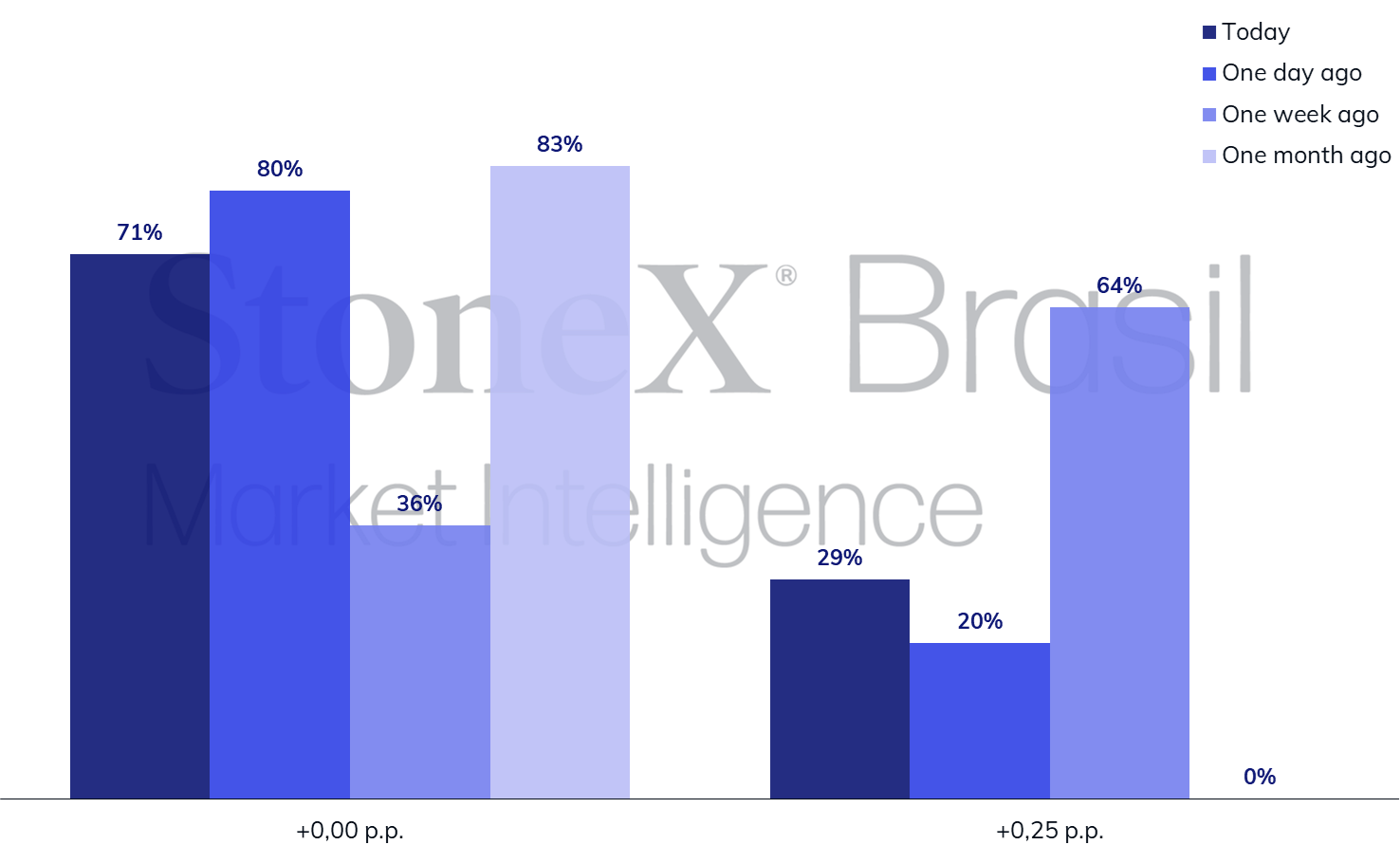
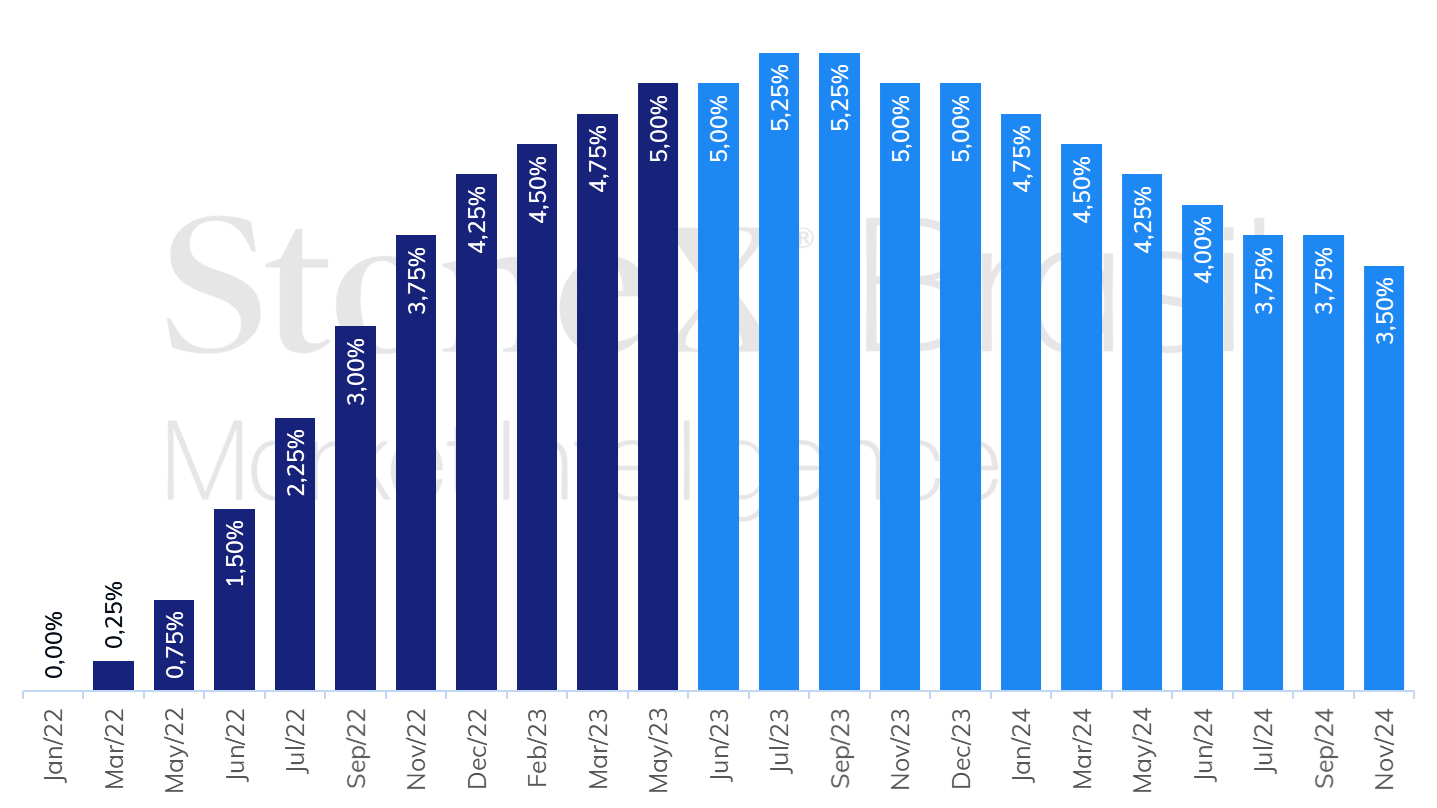
After weeks of tension in the financial markets due to the possibility of an unprecedented default on the US debt – avoided in the last moments by the country's Congress –the week will be relatively tranquil due to an emptied agenda. The agents will focus on the monetary policy decision of the Fed's Federal Open Market Committee (FOMC), which will take place on June 14 and reveal a complex balance of risks. On the one hand, at the May meeting, “many” members of the committee had already advocated stopping the interest rate hike cycle due to fears that recent instabilities in the banking sector could lead to a significant reduction in the level of credit in the economy and deepen an economic slowdown in the United States. In addition, some Fed members want to collect more information about the economic situation, afraid of the delayed effects of monetary tightening on manufacturing. On the other hand, however, recent economic data such as consumer inflation and the labor market suggest a warming economy, with high worker demand and continued pressure on prices, particularly for services.
In this scenario, some members of the Federal Reserve began to defend an intermediate stance, that of a “pause” in a cycle of intermittent increases. That is, it would be more prudent not to readjust interest rates at the next meeting and to be inclined to a further increase at the July meeting. In this way, the FOMC would still signal to policymakers that it has not ended its inflation-fighting strategy and could assess information over a longer time horizon in its next decision. The interest futures market reflects this intermediate stance.
Expected impact on USDBRL: bearish
This week, the Brazilian Institute of Geography and Statistics (IBGE) releases the National Broad Consumer Price Index (IPCA) for May, the last inflation reading before the decision of the Monetary Policy Committee on June 21. The median of expectations expects a further moderate monthly increase of 0.54%, which would discreetly reduce the accumulated high in 12 months from 4.18% to 4.10%. The recent fall in inflation has been caused by the reduction in fuel prices, especially gasoline, so it will be more relevant for the monetary policy decision to follow the behavior of the price core – this one is much higher and resistant. Similarly, the above-expectations Brazilian GDP growth in the first quarter of this year should not result in revisions to inflation projections, given that the result came from the strong performance of agriculture, while industry and services showed results that suggest a slowdown in productive activity.
Expected impact on USDBRL: bullish
In recent weeks, prices of major commodities such as oil, minerals, grains and meat have fallen due to lower-than-expected data for China, which show that the country's economy is recovering at a slower pace than anticipated and more focused on the services sector, which, by its characteristics, moves less the foreign trade. Thus, the data for the Chinese trade balance, which will be announced on Wednesday (07), is expected to maintain its deceleration trend in annual comparison, with the accumulated increase in exports reducing from 8.5% in April to 8.0% in May, and the accumulated drop in imports remaining steady at 7.9% in the same period. The prospect of lower Chinese demand has hurt the performance of these commodities and currencies of countries that export primary products, such as the real.