- Postponement of the fiscal framework in the Brazilian Congress due to disagreements between the Chamber of Deputies and Senate may increase the perception of the political risks of Brazilian assets and drive investments out of the country, weakening the BRL.
- Copom minutes may clarify whether officials discussed interest rate cuts and adopted a lighter tone than the statement, strengthening the BRL.
- Expectations of accelerated processing of the tax reform in the Chamber of Deputies may reinforce the optimism about the Brazilian macroeconomic scenario, attracting investments to the country and strengthening the real.
- The Personal Consumption Expenditures (PCE) price index should reinforce the perception that inflation is slowly tapering off in the United States and that the Federal Reserve's cycle of interest rate hikes is nearing an end, potentially weakening the USD.
The week in review
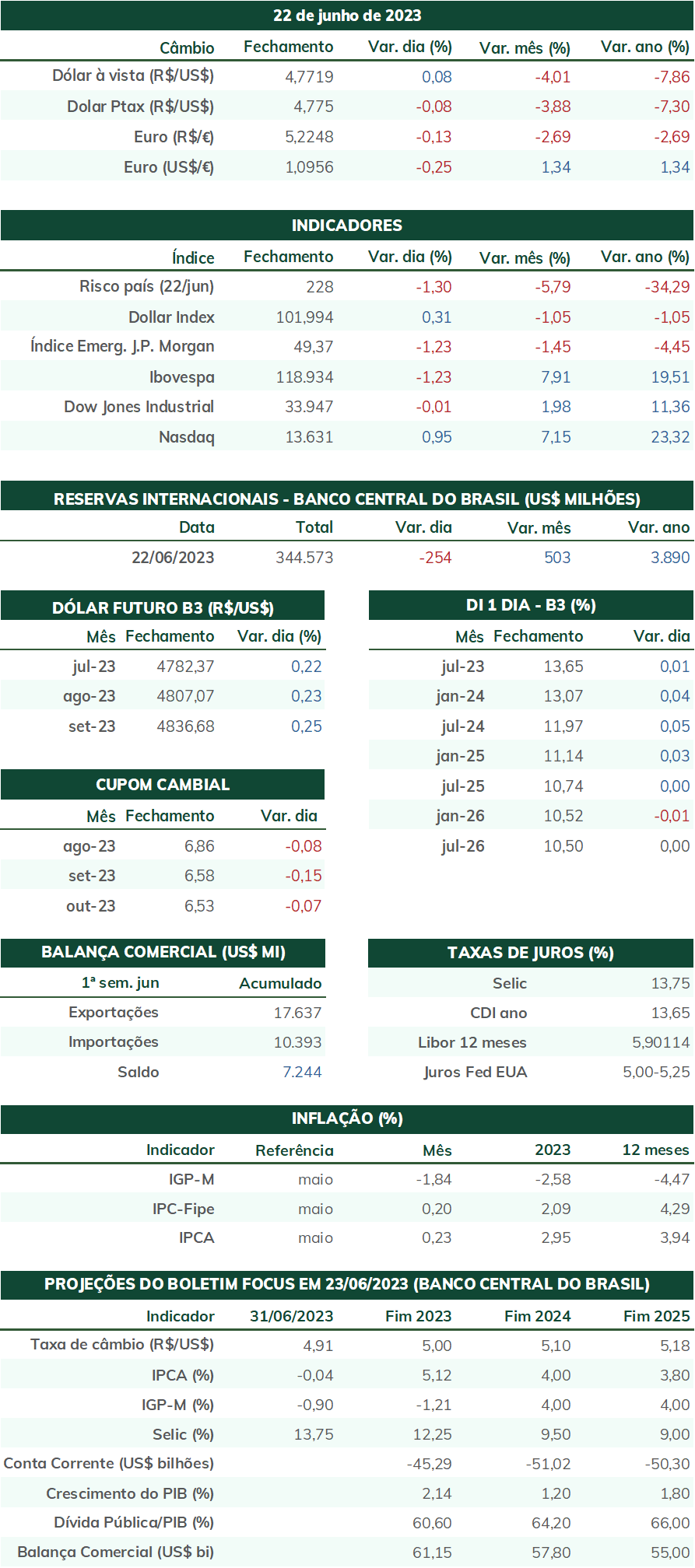
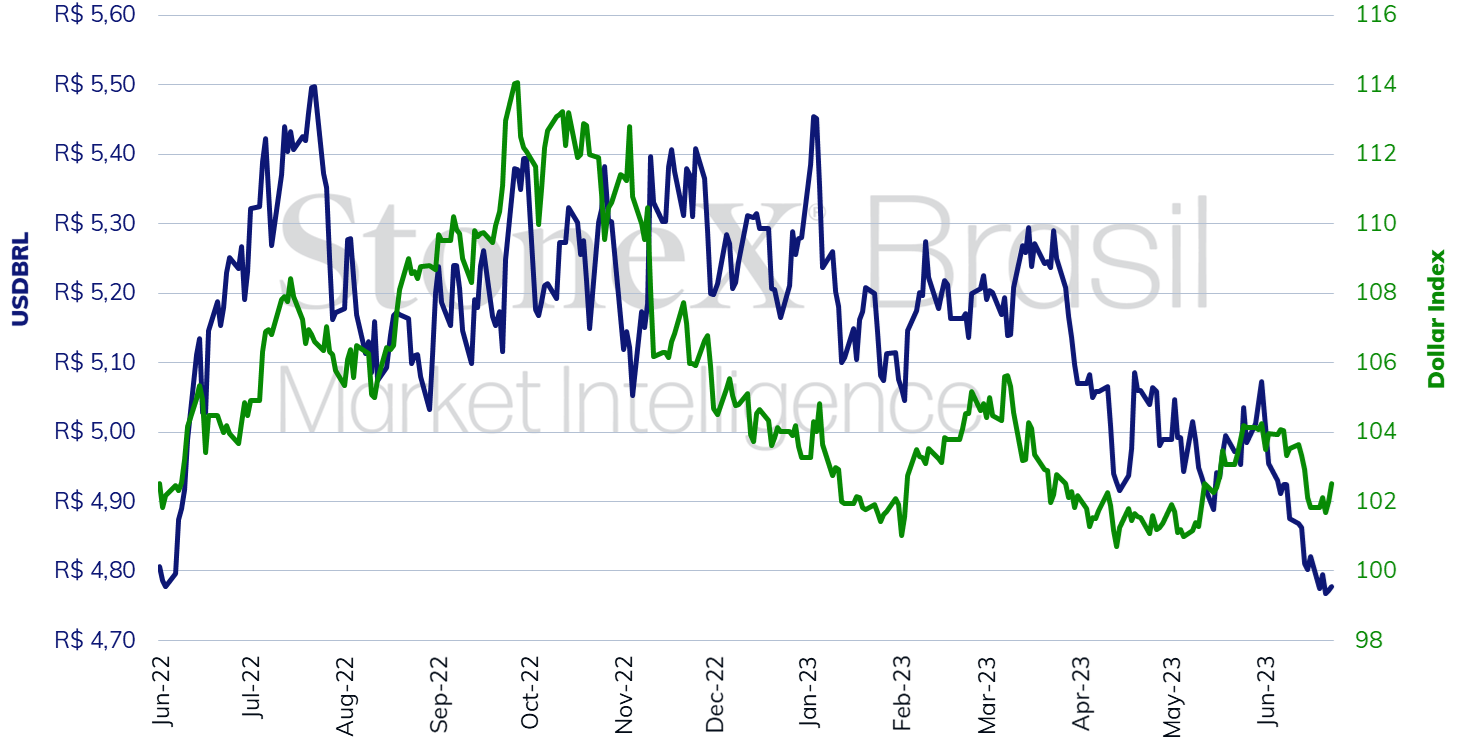
The USDBRL retreated for the fifth week in a row as it closed this Friday's session (23), quoted at BRL 4.777, a weekly retreat of 0.9%, a monthly one of 5.8%, and an annual one of 9.5%. The dollar index closed Friday's session quoted at 102.5 points, a variation of +0.7% in the week, -1.6% in the month, and -0.7% in the year. The foreign exchange market reflected the harsh tone of the Monetary Policy Committee (Copom) statement, which ruled out the possibility of cuts to the benchmark interest rate (Selic) in the short term and the approval of the fiscal framework bill in the Federal Senate, which returns for a last consideration in the Chamber of Deputies. Abroad, the American currency strengthened as China's stimulus measures were considered timid and worse-than-estimated economic data for the euro area promoted an environment of risk aversion.
Expected impact on USDBRL: Bearish
Last week, the Central Bank of Brazil's Monetary Policy Committee (Copom) released a harsh statement on its interest rate decision. On the one hand, the maintenance of the basic interest rate (Selic) at 13.75% p.a. and the removal of the passage that the Committee "will not hesitate to resume the adjustment cycle if the disinflation process does not go as expected" were widely anticipated by economists. However, Copom did little to change its balance of risks between May and June, while most analysts believe there was a significant improvement in the macroeconomic environment. Additionally, the document mentioned a "residual uncertainty about the final design of the fiscal framework," putting pressure on inflationary expectations, contradicting recent statements by Central Bank officials that attributed the bill's design to stabilizing longer-run inflationary expectations. Finally, Copom frustrated investors' expectations by not signaling the possibility of reductions in the Selic rate, mentioning that "the strategy of maintaining the basic interest rate for an extended period has proven adequate to ensure inflation convergence.”
The statement was criticized by leaders of the Executive branch, especially the Brazilian President Luiz Inácio Lula da Silva and the Minister of Finance Fernando Haddad, who classified it as "very bad, as usual." The release of the Copom minutes can at least clarify whether its members discussed the possibility of an interest rate cut and why they chose to keep the only mention of maintaining the Selic rate in the communiqué. The minutes may provide more detailed context about the participants' view of the current macroeconomic framework and perhaps recognize qualitative advances between May and June. They may sound more moderate than last week's communiqué.
Finally, on Thursday (29), there will be a meeting of the National Monetary Council (CMN), which brings together the Minister of Finance, the Minister of Planning and Budget, and the president of the Central Bank. Traditionally, the CMN June meetings are dedicated to discussing inflation targets, a subject of criticism from the Administration at the beginning of the Lula administration. Most analysts do not believe in a change to the long-term target of 3.0% or a tolerance interval of 1.50 percentage points. However, a change in the format of the targets, which would no longer follow the calendar year but would be defined as a longer-term continuous target, is considered likely. The subject has been approached on several occasions and in a good way by the Minister of Finance, Fernando Haddad, and the president of the Central Bank, Roberto Campos Neto.
Expected impact on USDBRL: Bullish
Last week, as expected, the bill for the new fiscal framework was approved in the Federal Senate by 57 votes to 17. The project returns to the lower house for final analysis because it contains changes compared to the initial text approved by the Chamber of Deputies. Although the previous week, the president of the House of Representatives, Congressman Arthur Lira, had stated that he intended to consider the matter the day after it was approved in the Senate, members of Congress and senators have disagreed on what is the best format for the country's new fiscal rules.
The text appreciated in the Senate was authored by Senator Omar Aziz (PSD-AM) and caused surprise in political analysts by including topics not being reported in the specialized media. Aziz acknowledged that his project was done autonomously and without prior agreement with the Chamber. The bills' rapporteur in the Chamber, Congressman Cláudio Cajado (PP-BA), declared that "he doesn't agree with anything that the Senate changed" and that "everything goes back to the Chamber text." With the disagreement between the houses, Lira should promote a meeting between party leaders before proceeding with the consideration of the project, which should be extended to the second week of July.
Expected impact on USDBRL: Bearish
Last Thursday (22), the preliminary opinion of the Proposal of Amendment to the Constitution that deals with the consolidation and reorganization of the consumption tax system in Brazil (PEC 45/19) was presented to the Chamber of Deputies by its rapporteur, Congressman Aguinaldo Ribeiro (PP-PB). Among the main measures of the reform are the extinction of some taxes - IPI, PIS and Cofins (federal), ICMS (state) and ISS (municipal) - and their replacement by two new Value Added Taxes (VAT): the Tax on Goods and Services (IBS), unifying ICMS and ISS, and the Contribution on Goods and Services (CBS), in place of IPI, PIS and Cofins.
In addition to the simplification obtained with the reduction in the number of taxes, the change aims to neutralize the collection of taxes by avoiding their cascading throughout the production chain, which ends up placing too heavy a burden on more complex industrial activities. In the proposal, tax collection would no longer occur at the origin of the operation (production or sale), as it is currently, but at the destination, where the consumption of the good or service in question occurs. Some economic activities would have a reduced tax rate, such as the basic food basket, education services, and agricultural products, while others would be fully exempt, such as medicines, Prouni, and rural activities performed by individuals up to a billing limit of BRL 2 million per year. Additionally, the special regimes of the Manaus Free Trade Zone and Simples Nacional (simplified taxation system) would be maintained, and specific regimes would be established for fuels and lubricants, financial services, real estate, health plans and betting, and government purchases.
According to the rapporteur, the text is still in the preliminary stage and should be considered by the parliamentarians as of July 03. The president of the Chamber of Deputies, Arthur Lira (PP-AL), believes that the matter can be approved in the House Plenary in two rounds, on July 05 (Wednesday) and July 07 (Friday). If approved, the PEC provides for the transition to the new taxes over eight years between 2026 and 2033, with the gradual entry of the CBS starting in 2027 and the IBS starting in 2029. The change of charging from origin to destination would occur over 50 years, defined by the governors, between 2029 and 2078.
Expected impact on USDBRL: Bearish
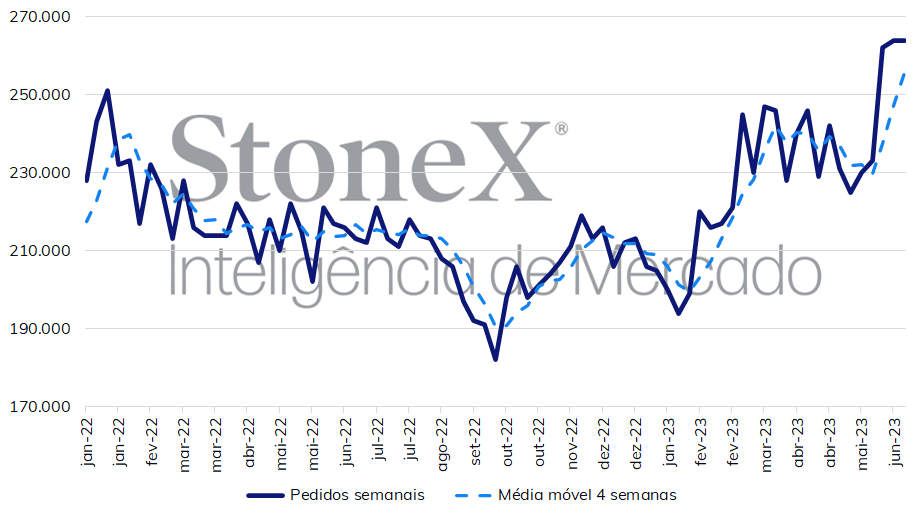
The Personal Consumption Expenditures (PCE) price index for May should show similar behavior to the Consumer Price Index (CPI), i.e., a small increase in the full index but a more moderate rise in its core, which excludes the volatile food and energy components. The average expectation is that the 12-month accumulated growth of the core PCE will remain unchanged between April and May at 4.7%. In recent weeks it has seemed clear that there is a process of economic deceleration and cooling of inflationary pressures occurring more intensely in industrial chains than in services, as well as in the prices of food, metal and energy commodities. At a time when the possibility of the end of the cycle of interest rate hikes by the Federal Reserve is being discussed, it seems fundamental to observe the resilience of prices in the service sectors and the strength of the American labor market. In this regard, the relative increase in weekly unemployment claims in the United States over the past three weeks is worth noting, which may be the first sign of weakening employment in the country.