FX Outlook: Key Events of the Week
- Bearish factors
- Diversification and risk dilution by investors may stimulate demand for risky assets and favor a strengthening of the real.
- An increase in the IPCA may worsen inflation expectations for Brazil and reinforce the prospect of further hikes in the basic interest rate (Selic), which helps attract foreign investments and tends to strengthen the real.
- Bullish factors
- The announcement of import tariffs by the Trump administration deepened fears of a global economic recession, which should stimulate demand for "safe haven" assets and hurt the performance of the real.
- A slowdown in the Central Bank's Economic Activity Index (IBC-Br) in February may reduce bets on increases in the basic interest rate (Selic), which could harm foreign investments and weaken the real.
The week in review
Last week was marked by significant volatility and deep risk aversion after the announcement of US import tariffs deepened fears of a global recession and a "tariff war" among countries, leading financial markets to experience their worst week since the Covid-19 pandemic.
The USDBRL ended Friday’s session (04) quoted at 5.8382, a change of +1.3% for the week, 2.3% for the month and -5.5% for the year. Meanwhile, the dollar index closed Friday’s session at 103.0 points, down 1.0% on a weekly basis, 1.2% on a monthly basis and 4.7% on an annual basis.
USDBRL and Dollar Index (points)
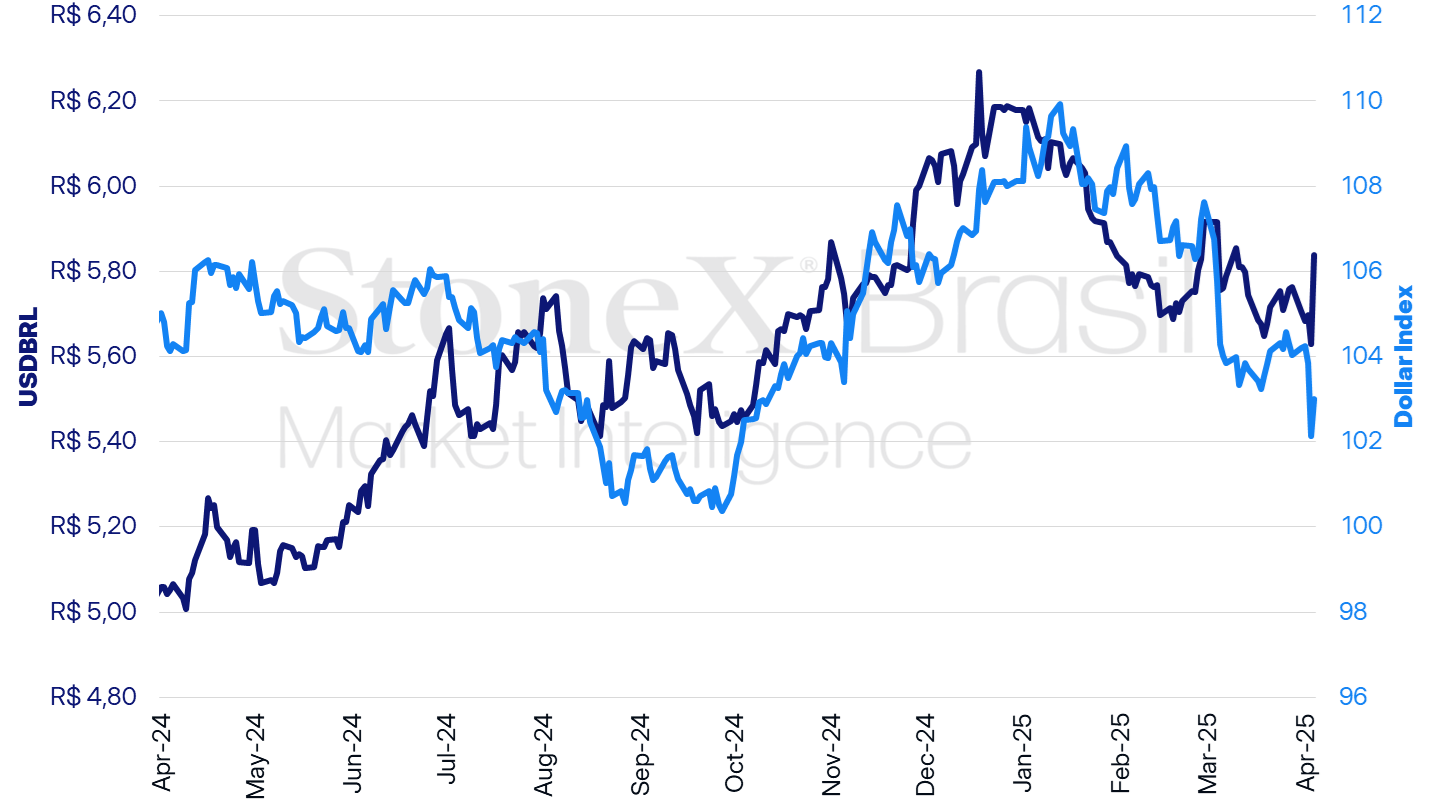
Source: StoneX cmdtyView. Preparation: StoneX.
KEY EVENT: Repercussions of US Tariffs – Risk Aversion
Expected Impact on USDBRL: Bullish
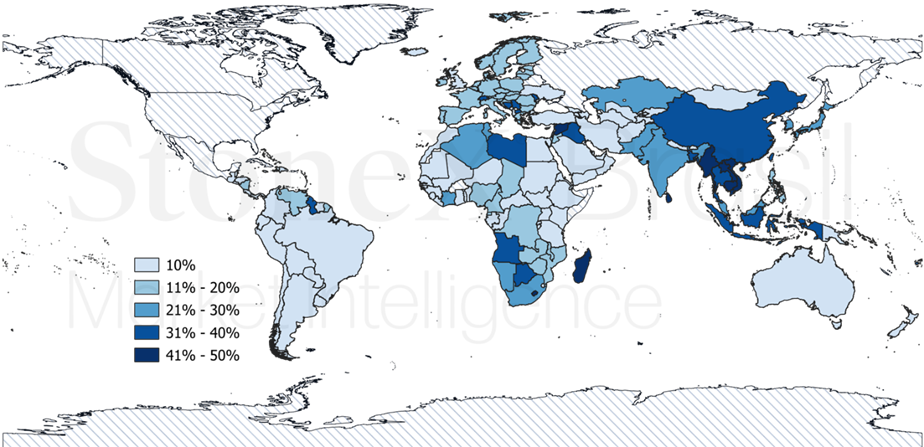
After weeks of uncertainty regarding the conduct of US trade policies, US President Donald Trump surprised investors by declaring a State of Economic Emergency and announcing the imposition of heavy import tariffs on virtually every country in the world. A minimum import surcharge of 10% will be applied to almost every economy starting on Saturday (05), but higher rates will apply to a list of 57 countries beginning on April 09.
Countries affected by the import tariffs announced on April 02, 2025, by the White House.
Source: The White House. Design: StoneX.
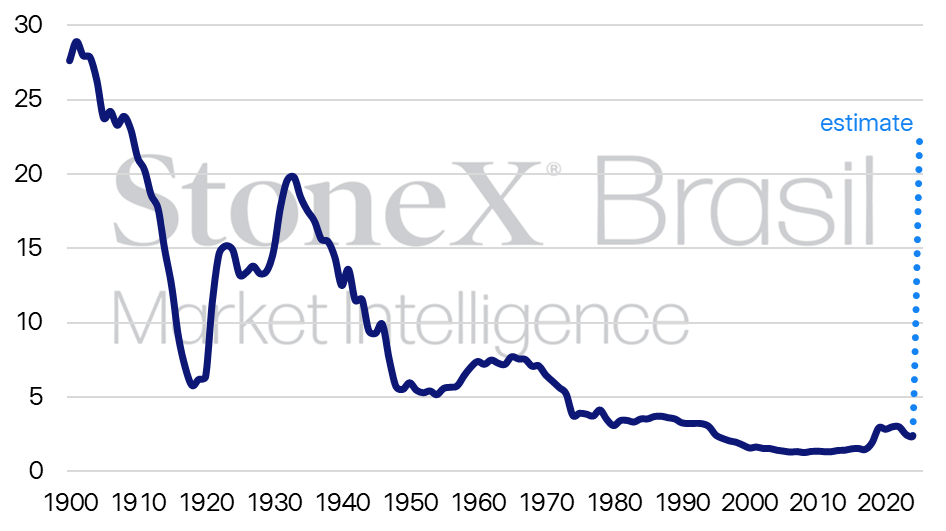
There are few exceptions to these tariffs, such as imports from Canada and Mexico, imports of energy and mineral products, imports of segments already affected by other tariffs (such as steel, aluminum, and automotive products), and imports from some countries under US sanctions and embargoes, such as Russia, Cuba, North Korea, and Libya. Apart from these cases, the surcharges are added to any other fees and tariffs already charged on the country's imports. As a result, the effective average tariff charged by the US is expected to rise from 2.5% to about 22.5%, the highest level since 1910.
US Effective Average Import Tariff (%)
Source: Yale Data Lab. Preparation: StoneX.
An increase in tariffs of this magnitude in such a short time will have important repercussions for the global economy, reducing global trade volume and harming the growth pace of both the US and its trading partners. Asian countries are expected to be more penalized, precisely because they are more embedded in a global, diversified, and interdependent production chain, specializing in exporting goods and inputs to other nations. Additionally, multinational companies that rely on this globalized production chain, many of them American, will also be more affected.
The declared objective of this intensification of trade barriers is to force these companies to start producing within the United States and to buy inputs produced domestically. Otherwise, the idea is to vertically integrate production within the country and reduce interdependence with other nations. Even if it is assumed that these goals will be achieved in the future—something that is uncertain at the moment—the fact remains that not all companies currently have the capacity to produce in the US the products made elsewhere. Building new factories is usually costly and time-consuming, and finding local suppliers that meet specifications is not always quick and may be more expensive than the previously imported product. As a result, investors have deepened fears of "stagflation" in the US—that is, rising inflation combined with economic stagnation.
In theory, the countries affected by these tariffs have three options for reacting to the American measures: retaliate with surcharges on U.S. products—like China did last Friday (04)—which could potentially trigger a global “tariff war”; negotiate with the Trump administration to try to reduce or cancel these tariffs through concessions; or remain on hold to assess the impacts and await developments. However, the way the American government chose to announce this intensification of trade barriers makes it difficult to negotiate with these countries. It was a sudden change, planned for weeks, and full of insults toward other nations, accused of “raping and pillaging” the U.S. on purpose. Moreover, when announcing the tariffs, Donald Trump falsely claimed they were calculated for “reciprocity,” taking into account how much other countries charged, making American imports more expensive through “tariffs, non-tariff barriers, and currency manipulation.” Later, it was discovered that the calculation for these tariffs was simply half of each country’s trade surplus with the U.S. divided by the volume of exports to the U.S., with a minimum of 10%. In other words, this so-called “reciprocity” did not account for any tax or fee charged by those countries on American imports; rather, it aimed to punish the countries with the largest surpluses with the U.S. The imposition of significant barriers on almost all global economies using an arbitrary formula shows little seriousness on the part of the American government and makes negotiations with these countries—seeking middle ground and de-escalation—much more difficult.
Thus, the main effect of the U.S. tariff announcement is to increase fears of American stagflation and a global economic recession, provoking a strong risk aversion and boosting the performance of assets considered “safe havens” during times of stress and uncertainty, such as the euro, the Japanese yen, and the Swiss franc. Likewise, this scenario tends to damage the performance of riskier assets, such as stocks, commodities, and currencies of emerging economies, including the real.
Repercussions of US Tariffs – Rotation Away from the US
Expected Impact on USDBRL: Bearish
A second effect of the US tariff announcement should be a reduction in the global flow of investments into US financial markets. First, due to a movement of diversification and risk dilution by investors seeking to reduce their exposure to US assets. Moreover, since the US runs a trade deficit with most countries but holds surpluses in its services and, mainly, its financial account, a large portion of the commercial surplus accumulated by foreign countries used to return to the US in the form of financial investments and service contracts (such as software and technology licensing) will also be diminished. Thus, a decrease in trade surpluses also reduces the potential for capital inflows into the US, especially in an environment of hostility from the American government. These combined effects—asset diversification and the restriction on surplus accumulation—should hurt the performance of US assets and the dollar. Although a significant portion of these flows is expected to be channeled to the safe-haven assets mentioned earlier, some may be directed to risky assets, such as stocks, commodities, and the currencies of emerging economies like the real, boosting their performance.
Finally, it is worth noting that this new global business scenario may benefit Brazilian assets and the real, not only due to the trend of a weakening US dollar but also because Brazil now faces an import tariff (10%) lower than that applied to East Asian countries, generating a kind of "comparative advantage" that may favor its exports in the future and increase foreign currency inflows into the country. However, this effect depends on a recovery in global risk appetite, which may not occur in the short term.
CPI and FOMC Minutes
Expected Impact on USDBRL: Bearish
This week, investors will be watching the release of the March Consumer Price Index (CPI), whose median forecast points to an increase of 0.1% in March. However, the core of the indicator, which excludes the volatile food and energy components, is expected to rise by 0.3% for the month due to signs of higher demand for industrial goods in anticipation of the impact of import tariffs. Additionally, investors should also analyze the release of the FOMC meeting minutes from the Federal Reserve's decision on March 17, looking for clues on how the US central bank may act following Trump's tariff announcement. In comments last Friday (04), Fed Chair Jerome Powell stated that economic uncertainty has increased and warned of greater risks of both more persistent inflation and weaker growth in the US. These risks challenge US monetary policy, since they require opposite measures to address them—a central bank typically raises interest rates to curb inflationary pressures, while lowering rates to stimulate a slowing economy. In practice, in its upcoming decisions, the Federal Reserve will need to assess which risk is greater or more urgent in order to decide how to proceed. On one hand, the US labor market continues to show resilience and dynamism, with an unemployment rate low by historical standards, while the country has a recent history of persistent and widespread inflation without fully regaining price stability. On the other hand, investors are very pessimistic and concerned about the possibility of a US recession, increasing their bets on four rate cuts in 2025 after Trump's tariff announcement. This, in turn, reduces the expected returns on US bonds and tends to weaken the dollar globally relative to other currencies, such as the real.
US: Historical and Expected Interest Rate – updated on April 04, 2025
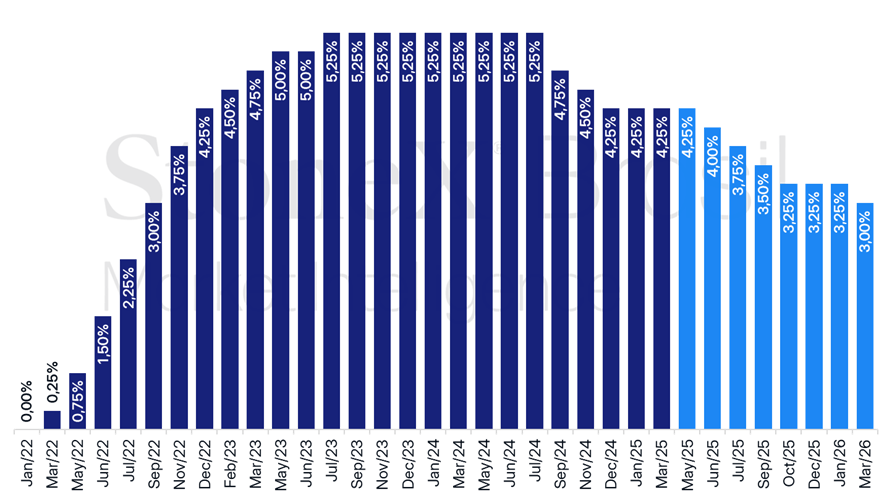
Source: CME FedWatch Tool. Preparation: StoneX. Refers to the most likely bet in the interest rate futures market on the indicated date.
Inflation in Brazil
Expected Impact on USDBRL: Bearish
Domestically, attention is focused on the release of the National Consumer Price Index (IPCA) for March, whose median projection points to an increase of 0.56%. If confirmed, this change would represent a slowdown compared to the 1.31% advance observed in February, when the index reached its highest rate since May 2022 (1.62%), but would result in a 12‑month cumulative rate above 5%, thus exceeding the inflation target ceiling of 4.5% set by the Central Bank. This scenario tends to worsen inflation expectations over the course of the year, reinforcing the likelihood of further increases in the basic interest rate (Selic), which in turn tends to make Brazilian bonds more attractive, stimulating foreign capital inflows and strengthening the real.
Economic Activity in Brazil
Expected Impact on USDBRL: Bullish
Also in Brazil, the Central Bank's Economic Activity Index (IBC-Br) for February is expected to slow its monthly growth from 0.9% in February to around 0.4% in March. Considered a monthly preview of GDP, the March IBC-Br should provide a relevant indication of the economic activity level during the first quarter of the year. This assessment gains additional importance following the announcement from the Central Bank's latest monetary policy decision, which once again noted "incipient signs" of an economic slowdown in the country. In this context, the IBC-Br may influence the Central Bank’s upcoming decisions, as the cooling trend indicated by recent indicators could reinforce the perception that monetary authorities might be more cautious in their rate-hiking cycle, which would weaken the real.

INDICATORS