FX Outlook: Key Events of the Week
- Bearish Factors
- Expectation of eased trade tensions by the United States may stimulate demand for risk assets and support a stronger real.
- Bullish Factors
- Brazil’s bi-monthly primary revenue and expenditure report may raise perceptions of fiscal risk for domestic assets and weigh on the real.
- Expectation of slowing Chinese economic indicators may worsen the country’s growth outlook, which could hurt risk assets such as equities, commodities, and emerging market currencies like the real.
- Expectation that the US will extend tax cuts in its new Budget may support US corporate profitability and help attract investments to the country, which tends to strengthen the dollar globally.
The week in review
The week was marked by the extended relief in trade tensions after the United States and China agreed to cut their import tariffs for 90 days, as well as by weaker-than-expected data in the US.
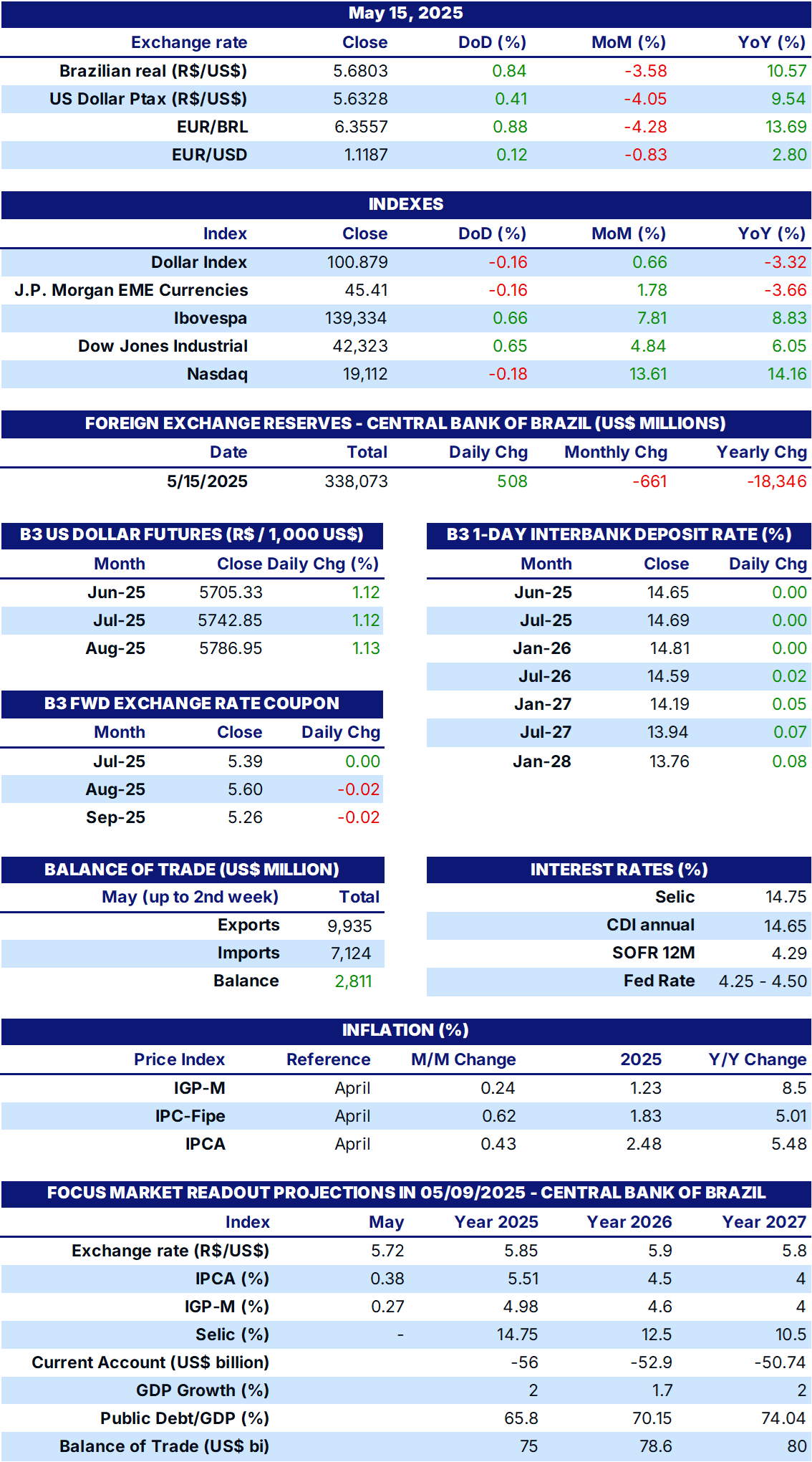
The USDBRLclosed this Friday (16) at BRL 5.6690, a weekly change of +0.3%, -0.1% for the month, and -8.2% for the year. Meanwhile, the Dollar Index (DXY) closed the week at 101.1 points, with a weekly gain of 0.7%, a monthly gain of 1.6%, but a yearly decline of 6.5%.
USDBRL and Dollar Index (points)
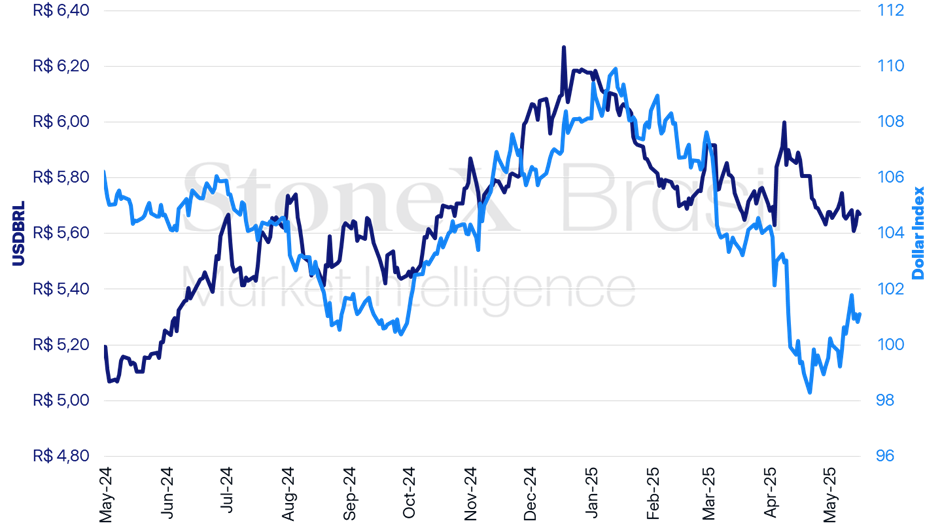
Source: StoneX cmdtyView. Prepared by StoneX.
THE MOST IMPORTANT: Trend of Easing US Tariff Tensions
Expected Impact on USD/BRL: Bearish
In a week with a light agenda, investors will continue to monitor news from Washington for greater clarity on the trajectory of US trade policy and its effects on the US economy. It seems more likely that trade tensions will continue to ease and that this will support the performance of risk assets such as equities, commodities, and emerging market currencies; however, the outlook remains complex, and the foundations of the recovery in risk appetite appear fragile and subject to reversal.
Since Donald Trump took office as US President, global financial markets have experienced significant volatility due to uncertainty, unpredictability, and inconsistency in US economic policy. In particular, his contradictory approach to import tariffs has caused abrupt fluctuations, first with a deep global risk aversion following the “tariff shock” in the first half of April, followed by an intense risk appetite rebound as several of these measures were reversed or eased. In this regard, the temporary truce between the United States and China reinforced this trend by unexpectedly reducing import rates by 90 days, while both sides continue negotiating a broader deal, cutting US rates from 145% to 30% and Chinese rates from 125% to 10%.
However, uncertainty, unpredictability, and inconsistency in US trade policy persist, since the White House’s recent retreats were announced as temporary, no formal trade agreements have been signed, and, most importantly, there is no clarity about the government’s objectives or how tariffs will evolve over time. This results in insecurity among economic agents and dampens important decision-making, such as investments.
While the recent measures by the White House reduce fears that US import tariffs could reach perceived excessive levels, the majority view is that tariffs will still be relatively high, likely averaging above 10%, which could harm the US economy and put upward pressure on inflation. Additionally, a significant majority of the changes enacted by the US government have been through executive orders, under eight declarations of State of Emergency and without accompanying legislation, which increases insecurity about sudden policy shifts. Therefore, investors were concerned by President Trump’s remarks last Friday (16), stating that it is not possible to negotiate with all countries simultaneously and that, for this reason, the United States will unilaterally set import tariffs for various countries within the next “two or three weeks.” It is worth recalling that this had already occurred on April 2, when the government used an arbitrary formula to set rates for practically all US trading partners, although it reversed course a week later.
US Effective Import Tariff Rate (%)
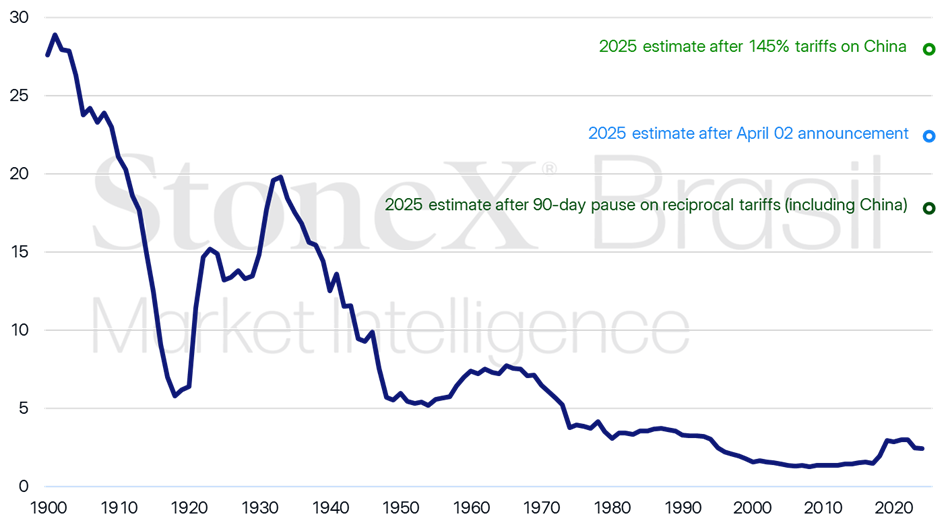
Source: Yale Data Lab. Prepared by StoneX.
Fiscal Policy in Brazil
Expected Impact on USD/BRL: Bullish
In Brazil, investors will focus on the release of the National Treasury’s report on primary revenues and expenditures for the second bi-monthly period of 2025, which has attracted heightened attention after press reports last week claimed that the Brazilian government is preparing a set of fiscal measures to boost its popularity. Among the measures reportedly under consideration are a new gas voucher program, credit lines for gig economy workers, and home renovation financing. In response, on Thursday (15), Finance Minister Fernando Haddad denied the existence of such measures, stating that any executive initiative will be within the Budget and that the government is studying certain measures for 2025; however, they would be “targeted” and aimed at both limiting federal expenditure levels and broadening the revenue base. Nonetheless, despite Haddad’s statements, the news prompted pessimism among investors and raised perceptions of fiscal risk for Brazilian assets, causing the real to be the worst performer of the day among the most liquid currencies in the FX market session. Accordingly, if the report’s release or potential new developments reinforce fiscal pessimism in Brazil, the real will likely weaken against the dollar.
China Data
Expected Impact on USD/BRL: Bullish
Next week will additionally feature the release of key Chinese economic activity indicators, notably April retail sales and industrial production. These readings should capture the effects of the recent intensification of trade tensions with the United States, which culminated at the beginning of the month in the US imposing 145% import tariffs on Chinese products, followed by Chinese retaliatory tariffs of up to 125%. Although China has recently intensified efforts to diversify its export markets to reduce reliance on the United States, the US remains central to its trade agenda, meaning tariff shocks tend to impact consumer confidence and domestic Chinese activity. On the other hand, since the most recent progress in talks between the two countries, which resulted in the 90-day tariff pause, there has been a reactivation of halted production lines and an increase in demand for Chinese freight shipments. For now, however, if next week’s data reinforce the perception that the economy contracted more than expected during the period, the indicators may strengthen fears of a more rapid slowdown in the world’s second-largest economy, which could hurt currencies of commodity-exporting countries like Brazil.
US Budget Discussions
Expected Impact on USD/BRL: Bullish
Finally, it is worth mentioning that the US Congress is actively debating a new federal budget bill. After the White House prioritized import tariff implementation in the first months of the year and, in April, negotiated trade agreements with other countries, the Trump administration’s current focus is advancing new fiscal legislation. The proposal submitted by the executive branch to Congress proposes, among other items, extending the tax cuts enacted during Donald Trump’s first term, exempting certain income from income tax (such as tips and overtime), increasing the state and local tax deduction cap, cutting non-military expenditures by USD 163 billion (-22.6%), and increasing military spending by USD 120 billion (+16.4%). In total, the proposal would reduce federal spending by USD 140 billion (-7.6%). Although Trump has vowed to pass this Budget by July 4, budget discussions are complex and typically take months for approval. Currently, the House of Representatives is debating the issue, facing internal resistance within the Republican Party. After passing the House, the proposal will move to the Senate for review, and then to the Executive for ratification. Therefore, although this topic has received significant focus in recent debates, there is still a long way to go before its conclusion. In general, it is expected that approving a new Budget extending tax cuts will support US corporate profitability and help attract investment to the country, which tends to strengthen the dollar globally.

INDICATORS