Dollar should reflect economic data in Brazil and the US, the threat of Brazilian reciprocity and attacks by the White House on the Fed
- Bullish
- The threat of reciprocity from Brazil against the US and a slowdown in national GDP could deter the inflow of foreign capital into Brazil and contribute to weakening the real.
- Bearish
- The U.S. Employment Situation Report and Purchasing Managers’ Index (PMI) are expected to suggest that the American economy continues to slow down, reinforcing bets on interest rate cuts by the Federal Reserve and weakening the dollar globally.
- White House attacks against the Federal Reserve can undermine the credibility of American economic institutions and result in a greater perception of risk for the country's assets, which tends to devalue the dollar globally.
The week in review
- Donald Trump announced the resignation of Federal Reserve Board of Governors member Lisa Cook for alleged mortgage fraud. Cook, in turn, appealed to the Judiciary to nullify the dismissal.
- US GDP for the second half is revised upward, while inflation and consumption in July grew in line with expectations.
- IPCA-15 showed less deflation than estimated and maintained a significant acceleration in its core, which excludes food and energy items.
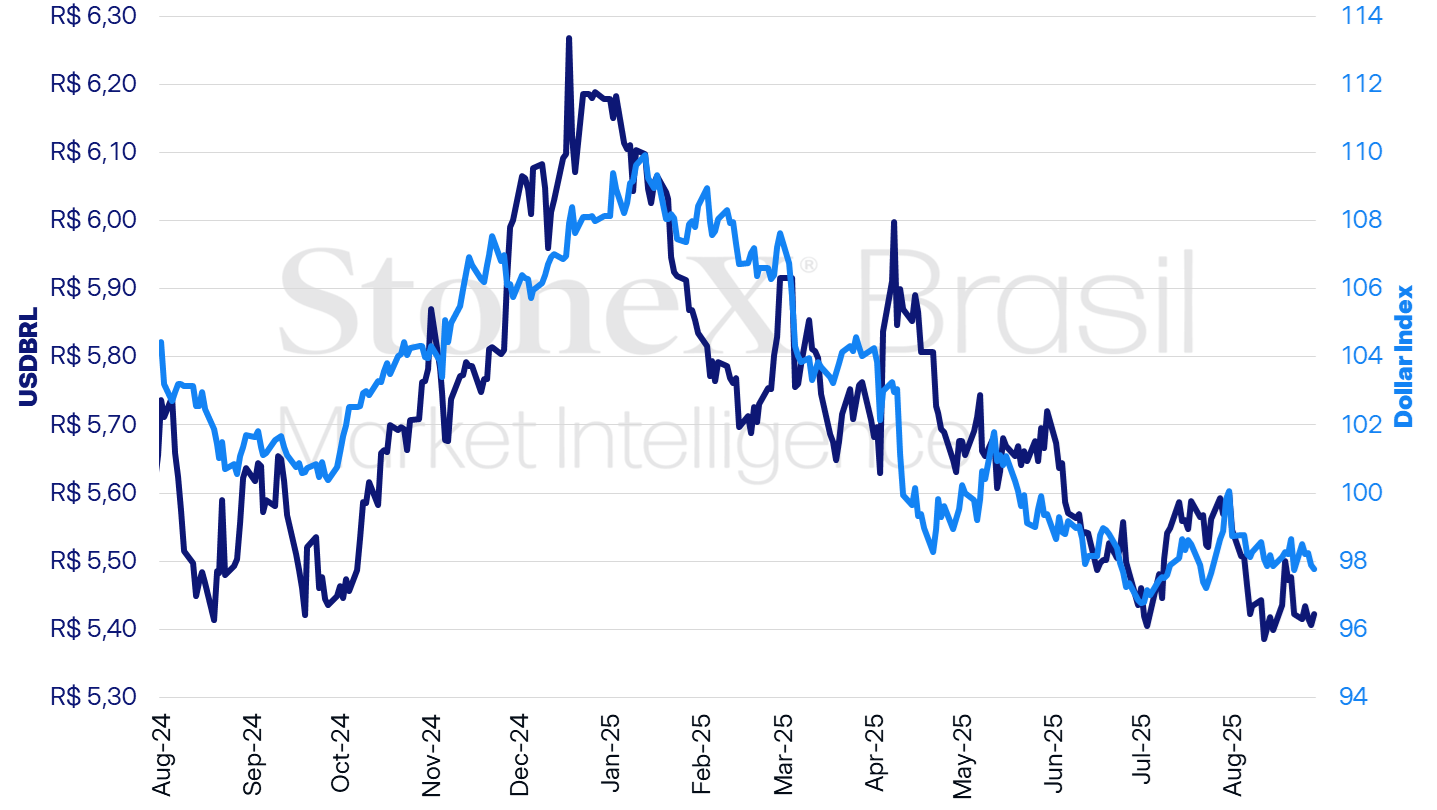
USDBRL and Dollar Index (points)
Source: StoneX cmdtyView. Design: StoneX.
Variations of the USDBRL | Daily: +0.29% | Weekly: -0.01% | Monthly: -3.19% | YTD: -12.23% | In 12 months: -3.57% |
Dollar index variations | Daily: -0.12% | Weekly: +0.03% | Monthly: -2.30% | YTD: -9.58% | In 12 months: -3.53% |
KEY EVENT: American economic data
Expected impact on USDBRL: bearish
USA: History and expectation for the interest rate – updated on August 29, 2025
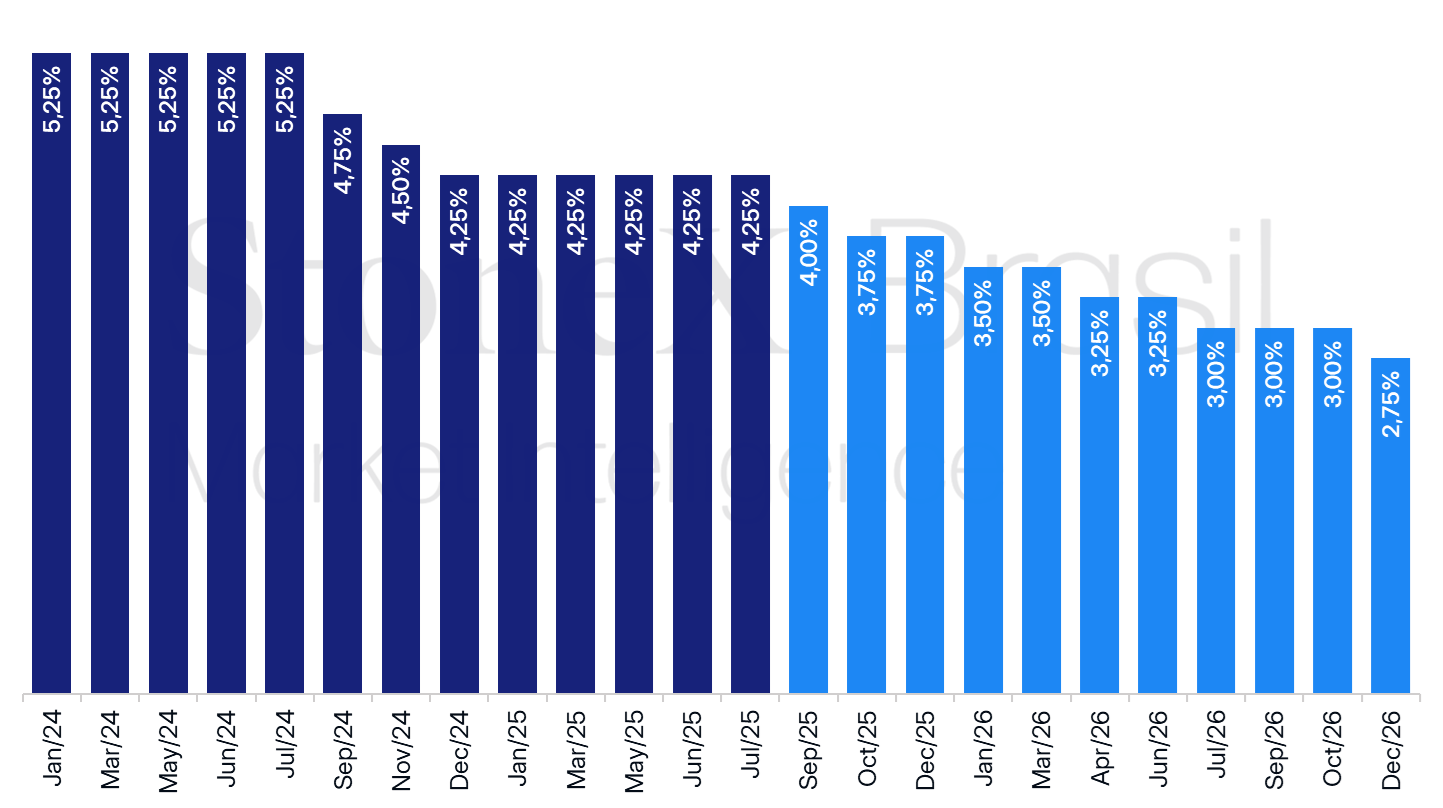
Source: CME FedWatch Tool. Design: StoneX. Refers to the bet with the highest probability in the future interest rate market on the indicated date.
The week brings several important economic indicators that should help investors adjust their expectations for the United States economy in the second half of the year.
Why this is important: Developments in productive activity, the labor market, and inflation significantly influence the Federal Reserve's monetary policy decisions.
- Currently, investors are betting on a cycle of interest rate cuts starting in September because they believe the U.S. labor market is weakening more quickly than anticipated, which reduces the outlook for U.S. Treasury yield and tends to weaken the dollar globally.
Overview: Since the “tariff shock” imposed by the White House in April, investors have feared that the American economy could go through a process of “stagflation,” that is, stagnating growth with a pick up in inflation.
- These concerns deepened after the release of the July Employment Situation Report, which significantly lowered the number of jobs created in May and June following a revision.
- However, so far, most indicators have shown a more stable performance and better than anticipated, with a gentle slowdown in the labor market and subtle increases in inflation.
Curious kind of balance: In a recent speech, Jerome Powell, chairman of the Federal Reserve, noted that the labor market is in “a curious kind of balance” due to both a smaller number of available workers and a slowdown in the pace of hiring.
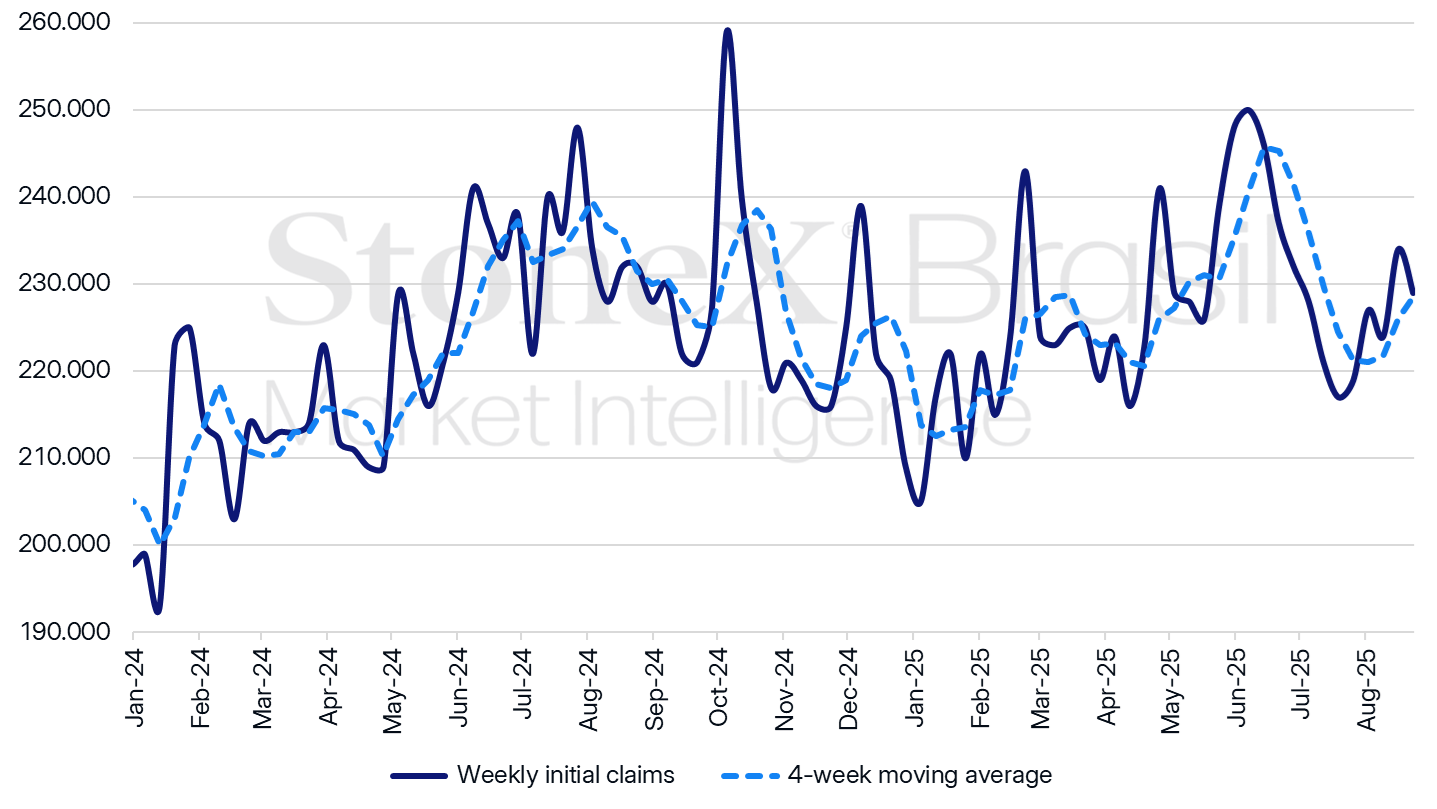
- For example, the weekly unemployment assistance data imply that there is no pick up in the number of new claims, which imply that the pace of layoffs is approximately stable.
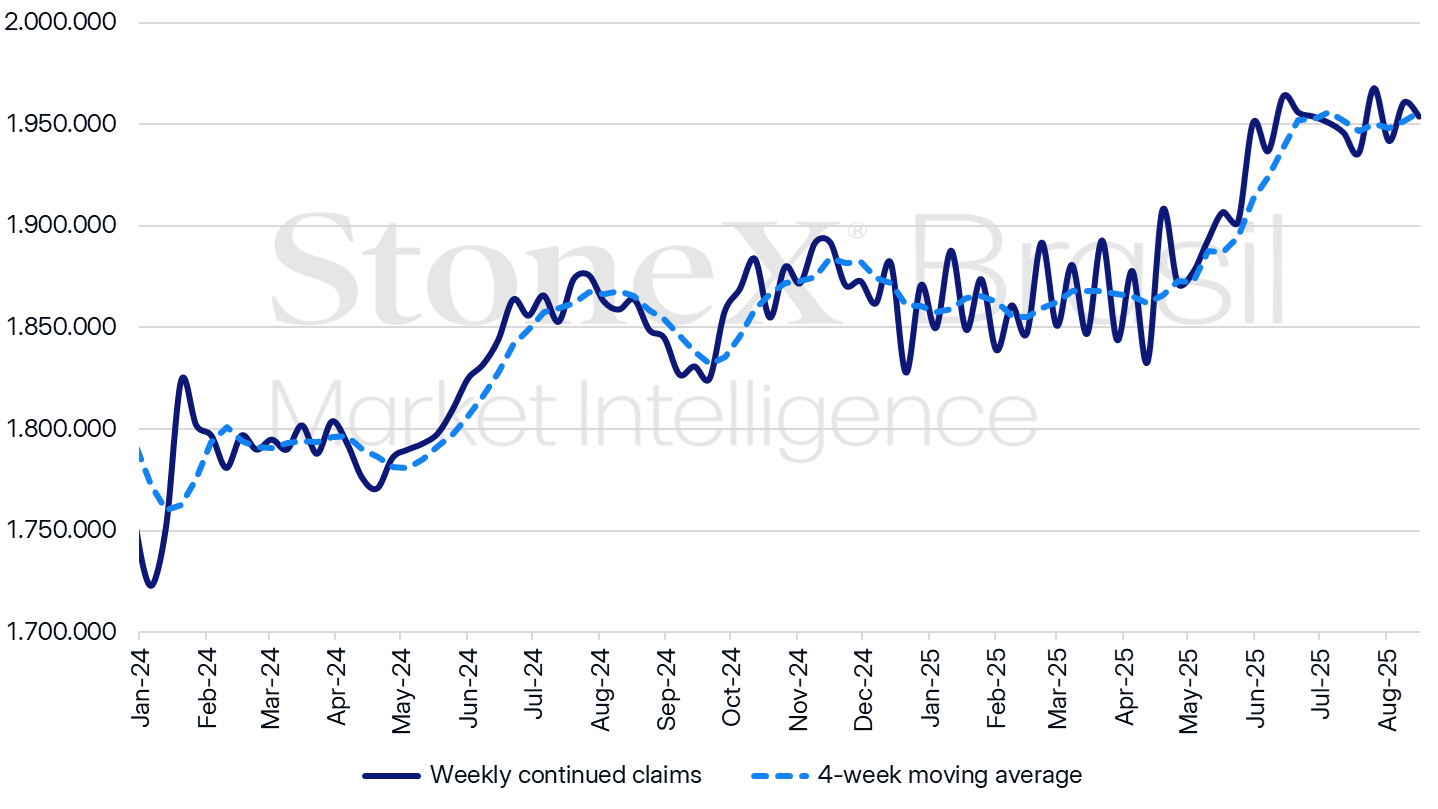
- Meanwhile, continued jobless claims, that is, the number of people who keep receiving the benefit after the first week, show a rapid pick up and imply that the pace of hiring has decreased significantly.
- This scenario can be called "no hire, no fire", that is, no hiring or firing, an indication that the labor market is weakening, but it is not in crisis.
- In this context, the release of the August Employment Situation report becomes important as it updates the conditions of the labor market.
- The median of the estimates indicates that net job creation should remain modest, rising from 73 thousand in July to 78 thousand in August, which would probably keep investors’ bets on an interest rate cut in September.
New weekly claims (left) and weekly continuing claims (right) for unemployment benefits in the United States
Source: U.S. Department of Labor (DOL), Federal Reserve Bank of St. Louis. Design: StoneX.
Source: U.S. Department of Labor (DOL), Federal Reserve Bank of St. Louis. Design: StoneX.
Managers' view: On the other hand, the Purchasing Managers’ Index (PMI) has indicated higher risks of “stagflation,” signaling a rapid increase in prices and a decrease in productive activity and demand for workers, a trend that is expected to repeat in this week’s releases.
PMI for the United States industry (left) and services (right) and selected subcomponents
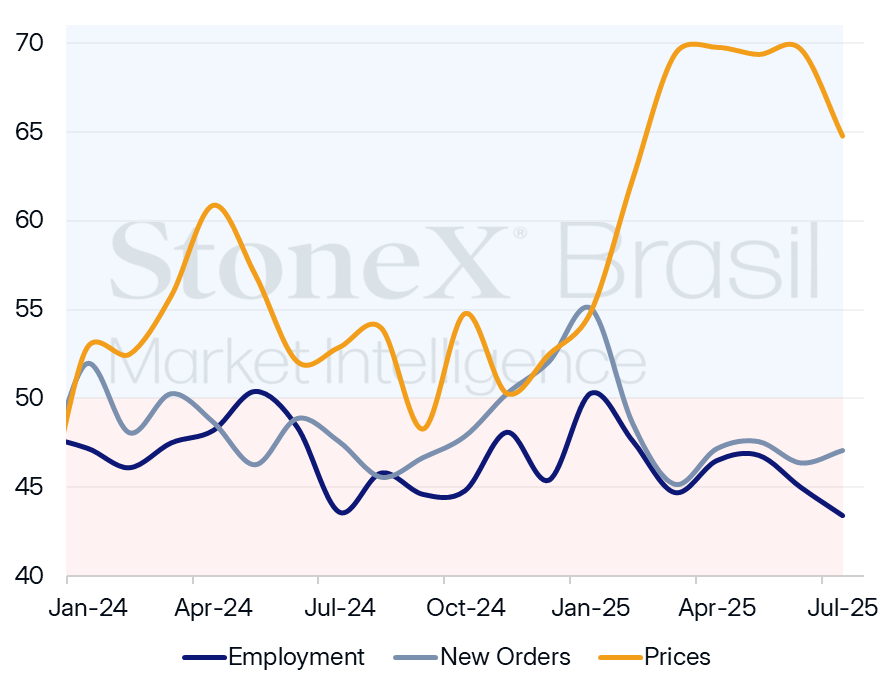
Source: Institute for Supply Management (ISM). Design: StoneX.
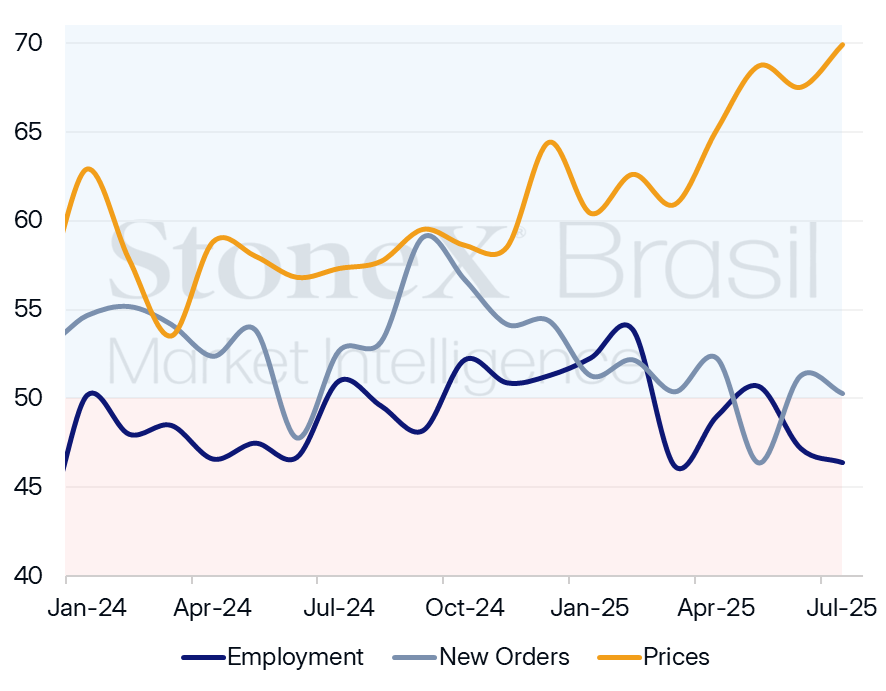
Source: Institute for Supply Management (ISM). Design: StoneX.
Political pressures on the Federal Reserve
Expected impact on USDBRL: bearish
Letter from Donald Trump announcing the resignation of Lisa Cook
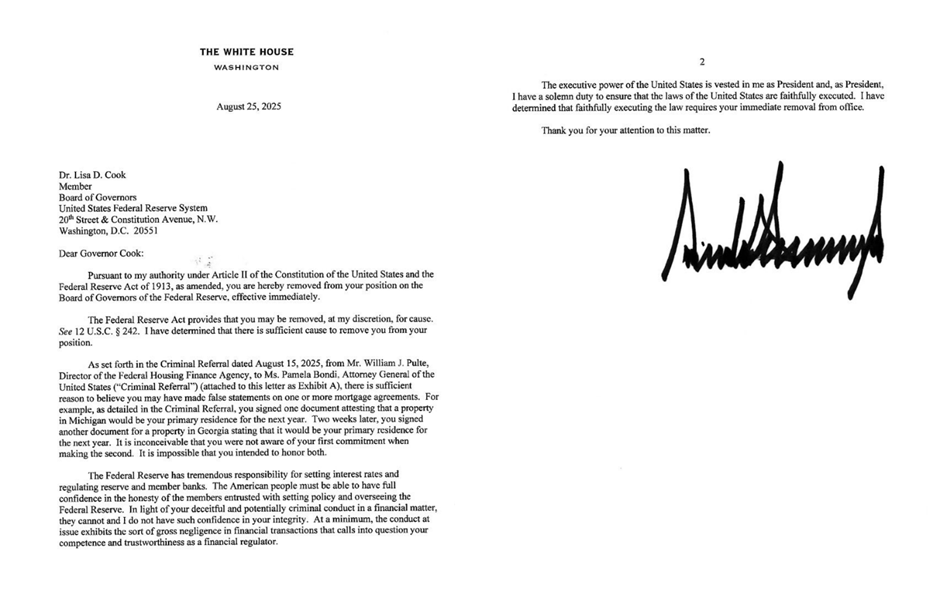
Source: White House.
Last week, US President Donald Trump announced the resignation of Federal Reserve Board of Governors member Lisa Cook for alleged mortgage fraud.
- Cook, in turn, filed a lawsuit to thwart his dismissal temporarily while the merits of his dismissal are not analyzed by the Judiciary.
Why this is important: Political pressure to influence the Federal Reserve and the conduct of American monetary policy can undermine the credibility of economic institutions and result in a higher perception of risk for the country’s assets, which tends to depreciate the dollar globally.
Market complacency: Despite the significant risks, financial markets as a whole have had very subtle reactions to friction between the White House and the Fed, surprising most analysts.
- There is no clarity about the reasons that justify this absence of more intense reactions.
- One possibility would be that investors believe Trump will not succeed in firing Cook, something that is uncertain at this point.
- Another possibility would be that investors want a Federal Reserve more aligned with the interests of the White House, but the history of central banks subservient to political interests should cause concern.
Attacks on Powell: For months the President of the United States has criticized the Federal Reserve and its chairman, Jerome Powell, frustrated by the decisions of the Federal Open Market Committee (FOMC) not to lower U.S. interest rates.
- In April, Trump said on social media that "Powell's resignation could not come faster."
- That same month, the Wall Street Journal reported that White House lawyers explored legal options to try to remove Powell from the Federal Reserve, including whether they could do so under "cause."
- In May, Trump confirmed news reports that he was considering announcing Powell's successor early in order to influence expectations for American monetary policy.
- In June, Trump again stated on social media that he could fire Powell.
- At the end of June, Trump sent a letter to Powell criticizing the level of American interest rates and stating that it cost "a fortune" to the US.
- In July, the White House ramped up pressure on Powell, alleging that he lied or was grossly negligent in his testimony to Congress regarding the renovations of the Fed's headquarters, seeking a legal alternative to his dismissal.
- Also in July, Trump confirmed news reports that he had discussed Powell's dismissal with Republican Party lawmakers the night before, but that it was "highly unlikely" he would do so.
- And at the end of that same month, Trump made an official visit to the Fed's renovation works, criticizing the costs of the work and the level of American interest rates before Powell.
Attacks on Cook: On August 20, the White House stepped up its pressure on the Fed, with the director of the Federal Housing Finance Agency, Bill Pulte, accusing Lisa Cook of committing mortgage fraud.
- The accusation is that Cook used preferential rates by mortgaging two different properties, declaring that both were his main residence.
- Pulte is one of the main advocates for Powell's dismissal because of the costs of the Fed's renovation works, and has already accused other Trump political opponents, such as Democratic Senator Adam Schiff and New York Attorney General Letitia James, of mortgage fraud.
- Although a US Department of Justice official has signaled that he intends to investigate the charges against Cook, so far there is no news that this investigation is ongoing.
Questionable legality: There are important legal challenges to the dismissal of a member of the Federal Reserve. The U.S. Supreme Court ruled in 1935 that members of independent agencies, such as the Fed, cannot be dismissed without just cause.
- Additionally, in a decision on May 22 of this year, the Supreme Court stated that "we disagree that [the dismissals of members of independent agencies] necessarily imply the constitutionality of removing members of the Federal Reserve without just cause."
- In his letter, Trump said that the real estate fraud accusation constitutes "just cause" for Cook's dismissal.
- However, there is a lot of banter about the legality of Trump's dismissal.
- In American jurisprudence, a dismissal for just cause of a public servant with the right to stability requires the initiation of a process, with the right to the defense of the servant before the formalization of their dismissal. This did not occur in this case.
- Additionally, in American jurisprudence, criminal referral does not constitute just cause, since it is only a notification of suspected irregularity. Most referrals do not result in a criminal investigation, although it may result in one.
- While the language of the Federal Reserve Act of 1913 is vague and broad, in most positions with tenure, just cause is defined as "inefficiency, neglect, or malfeasance" in the performance of the role. That is, just cause is necessarily linked to the activity performed by the employee, and the allegations against Cook are indeed related to events that occurred before his term at the Federal Reserve.
Conquering the Council: Trump is explicit in his statements that his goal is to pressure the Fed to lower its interest rates, but the FOMC’s monetary policy decisions are made by 12 members – the seven members of the Fed’s Board of Governors and five presidents of regional Federal Reserves.
- Trump, however, is looking for a way to reconfigure the Committee with people aligned with the goals of the White House.
- On Thursday (28), Trump told reporters that “we’ll have a majority [on the FOMC] very shortly. Once we have a majority, housing is going to swing and it is going to be great. People are paying too high an interest rate. That’s the only problem with us. We have to get the rates down a little bit."
- Two of the seven members of the Board of Governors were appointed by Trump during his first term—Christopher Waller and Michelle Bowman, who disagreed with the decision of the other FOMC members in the July 30 decision.
- Another member, Adriana Kugler, resigned from her position in early August, and Trump nominated Stephen Miran, the current head of the White House Council of Economic Advisers, as a replacement for that term, which ends on January 31.
- If the White House succeeds in firing Cook, Trump would nominate one more member to the Board of Governors and secure a majority, with four nominees out of seven advisers.
Conquering the FOMC: If Trump holds the majority of the members of the Board of Governors, he could influence the selection of the presidents of regional Federal Reserves and thus secure the majority of FOMC votes.
- Under the Federal Reserve Act of 1913, the 12 presidents of the Federal Reserves must be ratified by the Fed's Board of Governors every five years (each year, only five of these 12 may vote in FOMC decisions).
- The next ratification will take place in March 2026, and in theory, if Trump has a majority on the Council, they may refuse to approve regional presidents who are not aligned with the interests of the White House.
- Additionally, both 12 U.S. Code § 341 of the Federal Reserve Act and an opinion from the U.S. Department of Justice's Office of Legal Counsel state that the Fed's Board of Governors can dismiss regional Federal Reserve presidents without the need for just cause.
Worrying precedents: Although this scenario is quite drastic, it is worth remembering that Donald Trump is causing a series of drastic changes and challenging the limits of American institutions on several fronts.
- Trump promotes significant changes in foreign trade, immigration, fiscal policy, energy policy, business Regulation, diplomacy, and the structure of the federal administration of the United States through acts of the Executive branch, practically unaccompanied by changes in legislation and legally supported by the declaration of emergency powers on 72 occasions.
Reciprocity against the USA and second quarter GDP
Expected impact on USDBRL: bullish
This week, the Brazilian government authorized the start of a study to evaluate the possible application of the Economic Reciprocity Act against the United States.
- The measure is a direct response to the import tariffs imposed by the White House on Brazilian products.
- The analysis will allow the government to consider possible retaliations, which may include restrictions on the trade of goods and services or even measures related to equity.
Why this is important: The possibility of retaliation increases the risk of worsening trade and diplomatic relations between Brazil and the United States.
- This scenario tends to be negative for the Brazilian economy and for exporting companies, and may reduce the inflow of foreign capital into the country and, thus, harm the performance of the real.
Overview:The Ministry of Foreign Affairs, in coordination with the federal government, submitted the request for review to the Foreign Trade Chamber (Camex), which is expected to be completed within 30 days.
- CAMEX will assess whether the tariffs imposed by the USA fall under those subject to sanction according to the Economic Reciprocity Law.
- If the answer is positive, a working group will be created to define what measures Brazil can adopt. The final decision will be officially communicated to the White House.
- At the current stage, therefore, the authorization does not imply that any reciprocal measure will necessarily be implemented.
- Moreover, President Luiz Inácio Lula da Silva has reiterated caution, stating last Friday (29) that "there is no hurry to do anything regarding reciprocity against the United States."
Keeping an eye on economic data: The debate on possible retaliation occurs at a time of attention to the resilience of domestic economic activity.
- Among the indicators to be released next week, the release of the Gross Domestic Product (GDP) for the second quarter stands out.
- The median of the projections points to quarterly growth of 0.3%, below the 1.4% increase recorded in the first quarter.
- This weaker performance, in turn, should be related to restrictive credit conditions, which should have had a limiting effect on household consumption.
- On the supply side, however, the services sector is expected to have shown resilience once again, likely growing at a rate approximately twice as fast as GDP.

INDICATORS
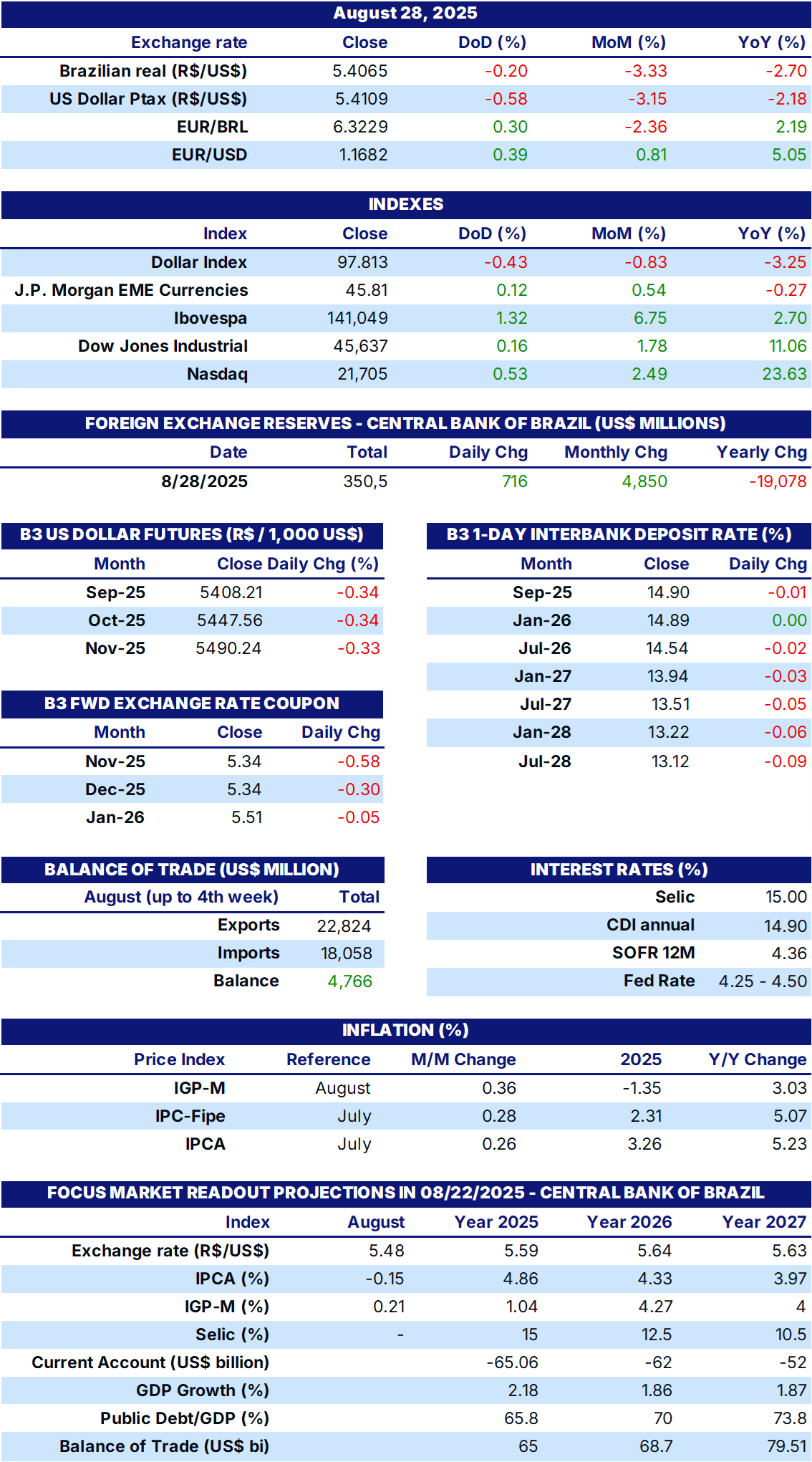
Sources: Central Bank of Brazil; B3; IBGE; Fipe; FGV; MDIC; IPEA and StoneX cmdtyView.