USDBRL is expected to reflect anticipation of slower interest rate cuts in the US, the Copom minutes, RPM, and the IPCA-15 in Brazil
- Bullish
- The release of economic data this week should reduce expectations for rapid interest rate cuts in the US, which tends to increase the outlook for yields on US bonds and to appreciate the dollar globally.
- Another moderate reading of the IPCA-15 could increase bets on a cut in the basic interest rate (Selic) this year, which tends to hinder the attraction of foreign investment and harm the performance of the real
- Bearish
- Minutes of the Monetary Policy Committee (Copom) decision and the Central Bank’s Monetary Policy Report are expected to reinforce the expectation that the basic interest rate (Selic) will remain stable for a prolonged period, which supports the outlook for Brazil’s interest rate differential and the strengthening of the real.
The week in review
- The Federal Reserve cut its interest rate for the first time this year, but sent mixed signals about the speed of cuts in the coming months.
- The Central Bank of Brazil kept the benchmark interest rate (Selic) unchanged and indicated that it should remain stable for a long period.
- American retail sales grew above expectations in August, signaling the resilience of American consumption and easing fears of a possible economic slowdown.
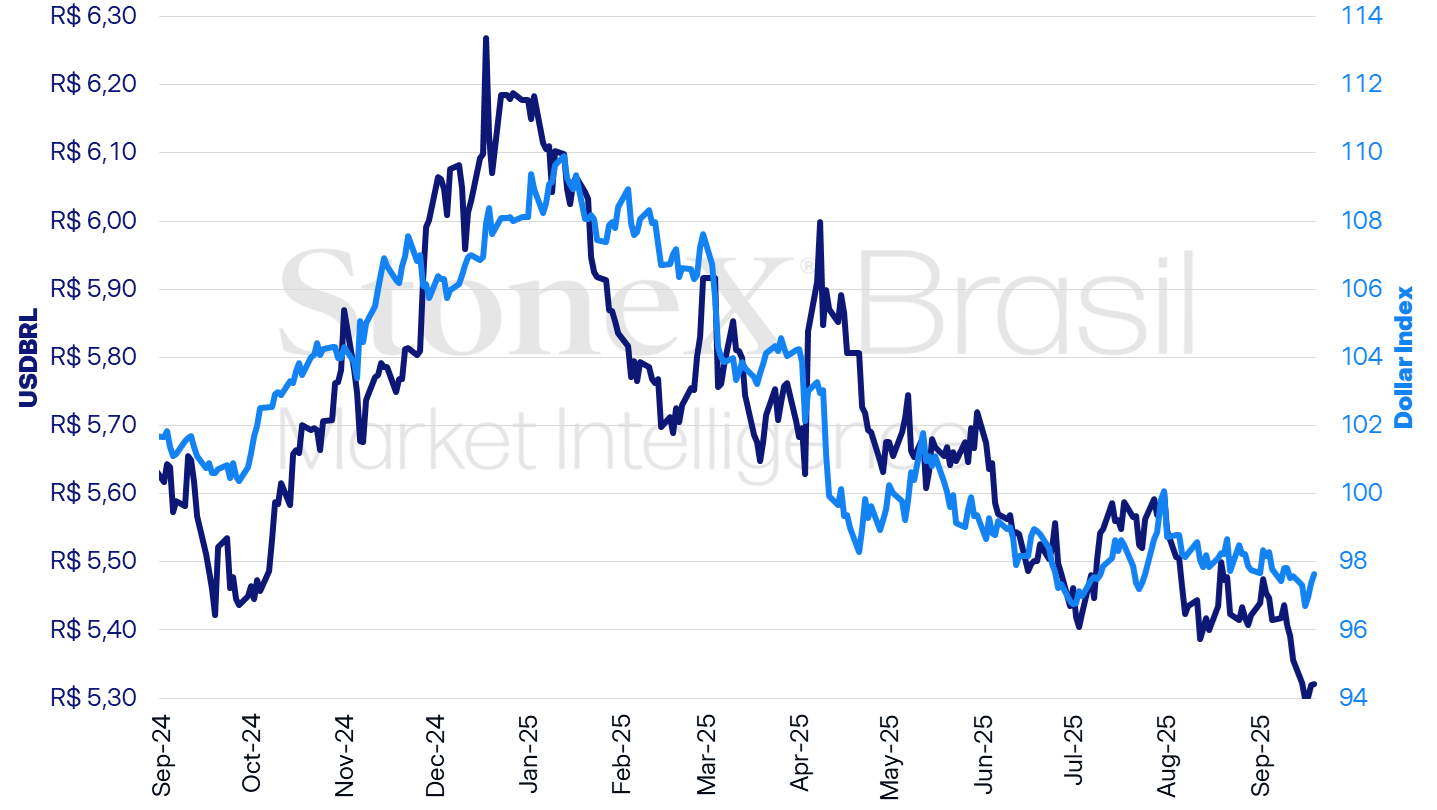
USDBRL and Dollar Index (points)
Source: StoneX cmdtyView. Design: StoneX.
USDBRL variation | Daily: +0.03% | Weekly: -0.64% | Monthly: -1.87% | YTD: -13.87% | In 12 months: -1.85% |
Dollar index variation | Daily: +0.28% | Weekly: +0.06% | Monthly: -0.12% | YTD: -9.69% | In 12 months: -2.95% |
KEY EVENT: Expectation for the trajectory of interest rates in the US
Expected impact on USDBRL: bullish
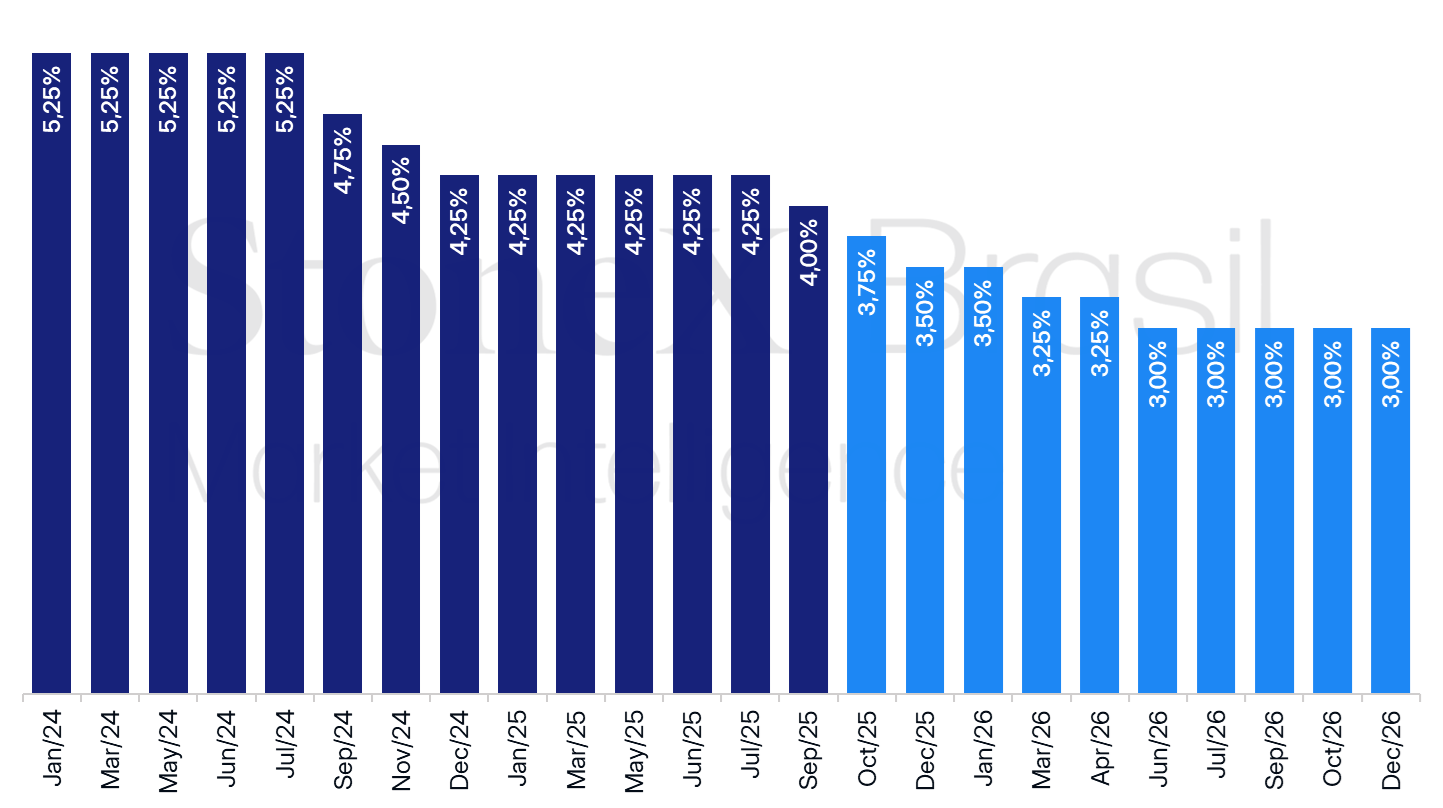
USA: History and expectation for the interest rate – updated on September 19, 2025
Source: CME FedWatch Tool. Design: StoneX. Refers to the bet with the highest probability in the future interest rate market on the indicated date.
Investors should continue to reflect doubts about the trajectory of US interest rates, after the Federal Reserve (Fed) issued contradictory signals in its interest rate decision last Wednesday (17).
Why this is important: The expectation of lagging interest rate cuts by the Federal Reserve in the coming months increases the outlook for returns on American bonds and favors the attraction of foreign investments, which tends to appreciate the dollar globally.
FOMC lowers its interest rates: Last Wednesday, the Federal Open Market Committee (FOMC) of the Federal Reserve lowered its interest rate by 0.25 p.p., from the range between 4.25% and 4.50% p.a. to the range between 4.00% and 4.25% p.a.
- Fed Chair Jerome Powell noted that the rate cut was a result of the shift in the balance of risks, which presents lower risks of higher and more persistent inflation and higher risks of worsening unemployment.
Just in case: However, Powell stressed that the scenario remains challenging and that these risks remain present and require opposite measures for their management.
- Fed Chair Jerome Powell called the Fed's decision a "risk management cut" in case the economy suddenly slows significantly.
- In addition, Powell stated that "there wasn't widespread agreement for a significant 0.50 percentage point interest rate cut at a recent FOMC meeting, signaling the central bank does not feel compelled to rush further rate reductions".
Contradictory projections: The Summary of Economic Projections released after the decision showed that 10 out of the 19 FOMC members foresee at least two more cuts in the two remaining decisions this year, while 7 did not see any further reductions.
- In addition, the 2026 projections for inflation and economic growth were revised slightly upwards, while the unemployment projection was revised slightly downwards. In theory, this scenario would suggest fewer interest rate cuts, as it indicates a warmer economy.
- Additionally, there is a high degree of dispersion in expectations for interest rates in 2026 and 2027, which imply a low level of confidence among the members regarding the evolution of the economy in the coming years.
- Powell's comments and the dispersion of economic projections resulted in a slight decrease in investor bets on rate cuts by the Fed.
Changes ahead at the Fed? Contrary to expectations, only the newest FOMC member, Stephen Miran, diverged from the other members of the committee.
- Miran was sworn in on Tuesday (16) as a member of the Federal Reserve Board of Governors, to finish a term that ends on January 31.
- He technically remains tied to the Executive, since he only took a leave from his position as head of the White House Council of Economic Advisers while he does not know if he will be nominated to continue at the Fed for the 14-year term that begins in February.
- On the one hand, the unified vote of the other members of the Committee, especially those of Christopher Waller and Michelle Bowman, members appointed by Donald Trump in his first term, eased investors' fears about possible interference by the White House in the conduct of monetary policy.
- On the other hand, Miran argued that the FOMC should carry out three consecutive interest rate cuts of 0.50 p.p., a position quite at odds with his peers and difficult to justify based on the current economic scenario and risk balance.
- This position, however, is consistent with the view of Donald Trump and other economic authorities in the White House, such as the Secretary of the Treasury and the director of the National Economic Council, who argue that American interest rates are excessively high.
- As an aftermath, investors believe that the next president of the Federal Reserve, who will replace Powell starting in May, should take a fairly lenient view versus inflationary risks and be very favorable to monetary stimulus for economic growth.
- It remains to be seen whether this chair would be able to convince the other FOMC members to vote in line with this view, under the threat of facing attacks from the White House just like those recently experienced by Powell and Lisa Cook, a member of the Board of Governors.
Indicators: Additionally, investors should follow the release of indicators to calibrate their expectations for the evolution of the American economy in the coming months.
- Personal Consumption Expenditures (PCE) Price Index: The PCE is expected to rise by 0.2% in August in both its headline index and its core, which excludes the volatile food and energy components, a slight slowdown compared to July due to smaller-than-anticipated impacts from import tariffs on prices.
- Income and Consumption: Americans' personal consumption is expected to maintain its growth pace of 0.5% in August, signaling the resilience of American consumption and easing fears of a possible economic slowdown. Personal income growth, on the other hand, is expected to slow slightly, with a 0.3% increase in the month.
- Gross Domestic Product (GDP): the third and final reading for the GDP of the second quarter should maintain its annualized quarterly growth rate of 3.3%, with a slowdown in the expansion of domestic demand being offset by the decline in imports.
Minutes of the Copom and Monetary Policy Report (RPM)
Expected impact on USDBRL: bearish
In Brazil, investors should react to the release of the minutes from last Wednesday's (17th) meeting of the Monetary Policy Committee (Copom), when the committee unanimously decided to keep the benchmark interest rate (Selic) at 15.00% per year.
- In addition, the Central Bank will be issuing the Monetary Policy Report (MPR) for the third quarter, with the release to be followed by a press conference held by the institution's president, Gabriel Galípolo, and the Economic Policy director, Diogo Guillen.
Why this is important: Both the minutes and the RPM should reinforce the Central Bank's commitment to stabilizing inflation, consolidating the perception that Brazil will maintain for longer a wide interest rate differential versus other economies.
- This scenario tends to support the flow of foreign capital and to favor the performance of the real.
Copom minutes: The document should maintain the tone observed in the statement after the decision, reiterating that “the scenario continues to be marked by unanchored expectations, elevated inflation projections, resilience in economic activity, and pressures in the labor market.”
- Investors should also seek additional details about one of the changes made in the statement, which removed the reference that the decision represented a "continuation in the interruption of the interest rate hike cycle", a phrase present in the previous text.
- The change was interpreted by analysts as an indication that the Copom considers the current rate appropriate for the moment and does not see, at least for now, a need for further increases to the Selic.
Monetary Policy Report (RPM): The RPM is the Central Bank's most comprehensive analysis of the domestic and international macroeconomic environment and includes projections for key macroeconomic indicators in the coming years.
- The market's attention should focus on possible revisions of inflation projections and the output gap, a measure of the economy's idleness.
- Galípolo and Guillen's statements will also be monitored, as they may offer signals about the next steps of monetary policy and about the monetary authority's assessment regarding the risks to the convergence of inflation to the target.
July IPCA-15
Expected impact on USDBRL: bullish
Still in the domestic scenario, investors will watch for the release of the Extended National Consumer Price Index 15 (IPCA-15) for September.
- The expectation is that the indicator should again show a milder increase in prices, after the deflation of 0.14% observed in August.
Why this is important: If confirmed, the greater moderation of the data may reinforce expectations of cuts to the benchmark interest rate (Selic) earlier than initially anticipated, amid the perception of greater price stabilization.
- This scenario tends to reduce the attractiveness of Brazilian treasuries by lowering their yield prospects and hinder the inflow of foreign capital, negatively affecting the performance of the real.
Overview: The release of more moderate inflation rates in August marginally raised bets that the start of the cutting cycle could be discussed sooner than expected.
- However, for a broader repricing of Selic cut expectations still in the second half of the year, more consistent signs of inflation stabilization will likely be needed, especially in the core services sector.
- In a recent interview, the president of the Central Bank, Gabriel Galípolo, pointed out that, although inflation projections are being revised downward, they remain above the target for the next two years and convergence is happening slowly.
- According to him, this would justify the maintenance of the restrictive monetary policy and reinforces that the "Central Bank cannot be moved by punctual data."

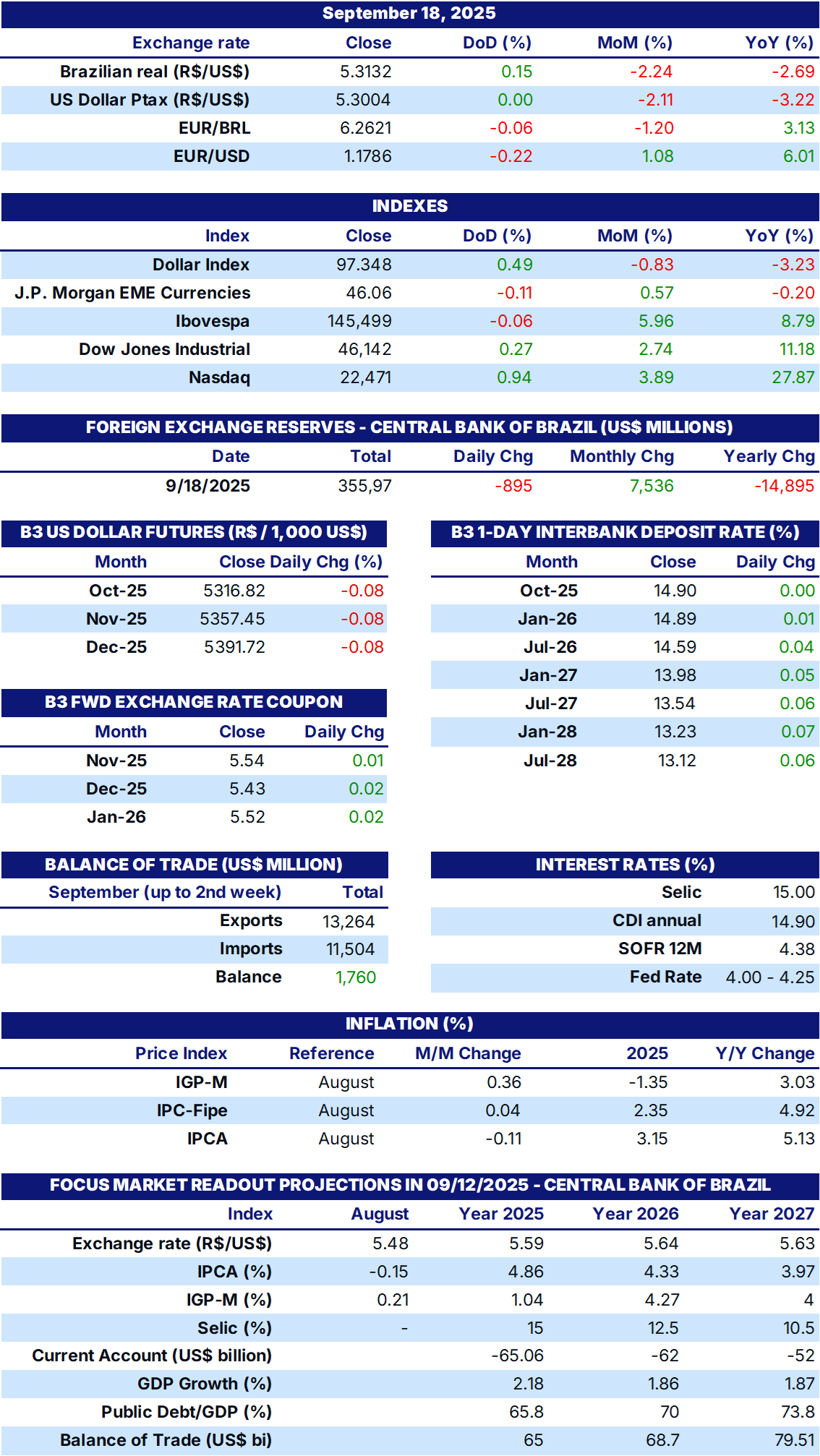
INDICATORS
Sources: Central Bank of Brazil; B3; IBGE; Fipe; FGV; MDIC; IPEA and StoneX cmdtyView.