USDBRL expected to reflect fiscal concerns in Brazil, trade tensions between the US and China, US government shutdown, and statements from Fed officials
- Bullish
- Concerns about increased Brazilian public spending in 2026 could heighten perceptions of fiscal risks for national assets, weakening the real.
- Escalation of trade tensions between the United States and China raises fears of a global economic slowdown, which may increase demand for "safe-haven" assets and harm the real's performance.
- Statements from Federal Reserve officials may suggest a more cautious stance among FOMC members, reducing bets on faster interest rate cuts in the US, which tends to attract foreign investments and strengthen the dollar globally.
- Bearish
- US government shutdown halts the release of economic indicators, complicating the understanding of the country's economic situation and potentially harming foreign investment attraction.
The week in review
- Concerns about increased Brazilian public spending in 2026 caused a sharp deterioration in the performance of domestic assets, such as the real's exchange rate and the futures interest rate markets.
- Concerns about fiscal policies in France, England, and Japan led to the depreciation of their currencies against the dollar.
- The US government shutdown persisted with no prospect of a near-term resolution.
- A conversation between Trump and Lula boosted optimism about reducing trade tensions between the two countries.
- A benign reading of September's IPCA slightly increased expectations of short-term interest rate cuts in Brazil.
USDBRL and Dollar Index (points)
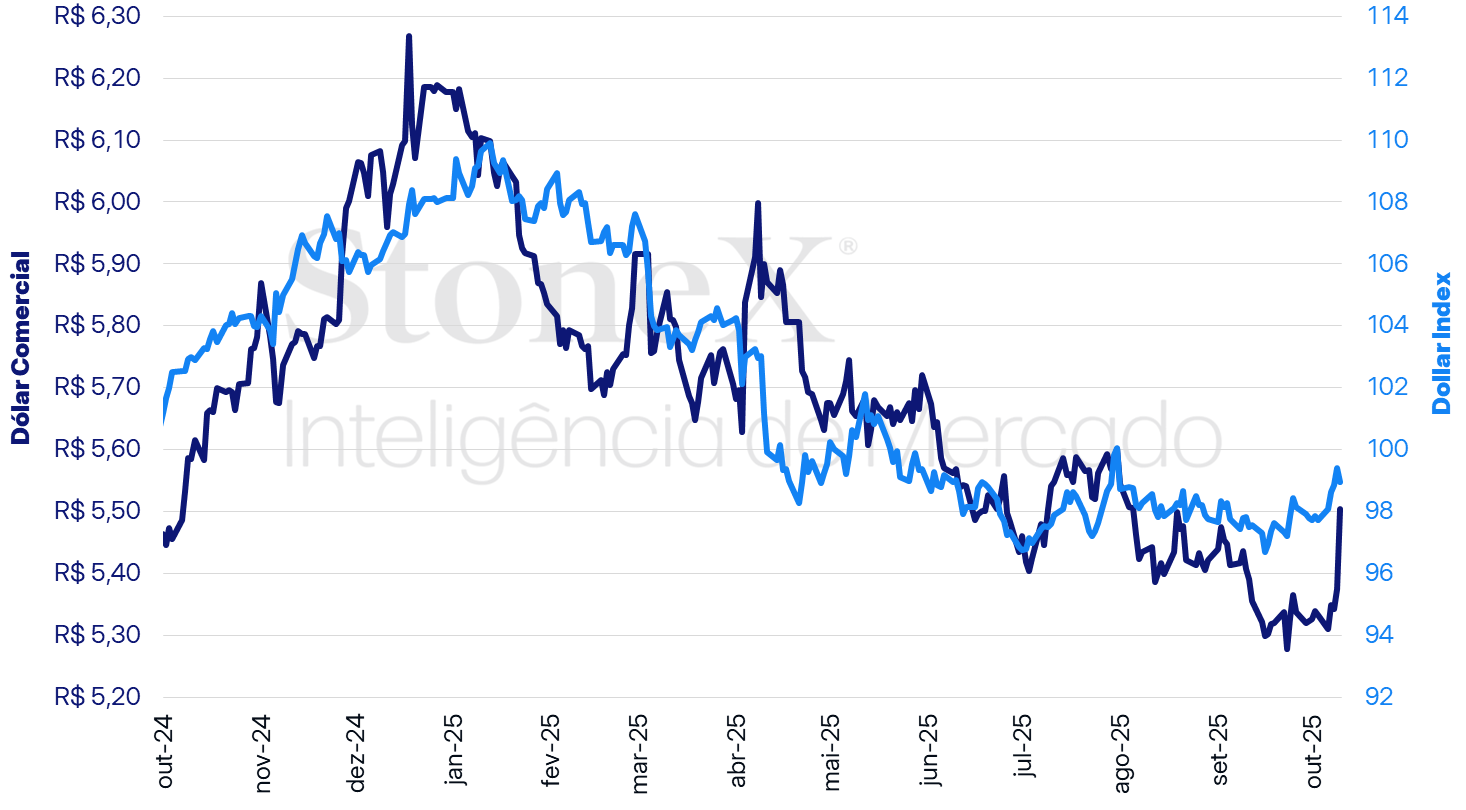
Source: StoneX cmdtyView. Compiled by StoneX.
Commercial Dollar Variations | Daily: +2.40% | Weekly: +3.19% | Monthly: +3.41% | Year-to-date: -10.91% | 12 months: -1.45% |
Dollar Index Variations | Daily: -0.48% | Weekly: +1.25% | Monthly: +1.18% | Year-to-date: -8.50% | 12 months: -3.93% |
KEY EVENT: Fiscal concerns in Brazil
Expected impact on USDBRL: Bullish
Investors should remain attentive to news from Brasília, as heightened fiscal concerns regarding Brazil last week led to significant depreciation of Brazilian assets, such as the real.
Why this matters: Emerging news that amplifies fiscal risk perceptions may increase the risk premiums demanded by investors, complicating foreign capital attraction and causing greater volatility and weakening of the real.
Zero fare for public transportation: Fiscal concerns in Brazil intensified early last week after Finance Minister Fernando Haddad stated in an interview that the zero fare proposal for public transportation is expected to be part of President Luiz Inácio Lula da Silva's re-election campaign in 2026.
- The statement introduced two novelties in the federal government's communication: a clearer signal of Lula's candidacy in 2026 and the inclusion of a new spending program in the political agenda.
- According to Haddad, a technical study on the feasibility of the measure is already underway at the president's request.
- A few weeks ago, rumors about the program's creation had already pressured local assets, especially the interest curve, due to fears of worsening fiscal conditions.
Rejection of a provisional measure in Congress: Last Wednesday (Oct. 8), the Chamber of Deputies did not vote on the Provisional Measure that replaced the increase in the Tax on Financial Transactions (IOF) with a rise in rates of other taxes, nullifying its effects.
- The measure would result in an additional revenue of BRL 10.55 billion in 2025 and BRL 20.89 billion in 2026.
- Without these resources, the economic team will need to recalculate revenue projections for the 2025 budget and reduce planned expenses.
- Government leaders stated that the executive has an "arsenal" of alternatives, such as the contingency of up to BRL 10 billion in parliamentary amendments.
Economic measures package: Fiscal tension worsened last Friday (Oct. 10) following announcements about a new mortgage credit model and news that the government is preparing a package of economic measures exceeding BRL 100 billion for 2026.
- Among the initiatives are expanding income tax exemptions for those earning up to BRL 5,000, free distribution of cooking gas, electricity bill exemptions for 17 million families, and stipends under the Pé-de-Meia program for high school students.
- Although these programs had been announced previously and are included in the budget project, market agents expressed concerns that 2026 may be marked by increased public spending on measures aimed at boosting presidential re-election, harming public debt sustainability.
Trade tensions between the US and China
Expected impact on USDBRL: Bullish
The United States and China have re-escalated trade tensions, sparking fears of a resurgence of a trade war between the world's two largest economies.
Why this matters: The rise in tensions between the two countries raises concerns about the return of significant trade barriers, potentially causing a more intense slowdown in the growth of both economies.
- The prospect of a slowdown in Chinese and American demand could increase global risk aversion among investors, harming the performance of risky assets such as the real.
Crossfire: After months of mutual trade barriers, the US and China had reached a temporary truce, reducing import tariffs until Nov. 10.
- However, last week, Chinese authorities announced a plan to restrict exports of rare-earth minerals, critical for many industrial applications.
- Under the new rules, foreign companies will require prior approval to export these minerals or any products processed through Chinese extraction, refining, or technology.
- Segments most impacted include batteries, magnets, semiconductors, and military materials.
- China accounts for approximately 70% of rare-earth extraction and 90% of global separation and processing.
- These measures expand the export restrictions applied in April and will take effect in November, coinciding with the end of the tariff truce between both nations.
- Under Trump, the US tightened its export restrictions to China, particularly in advanced chips and related technologies.
- On Friday (Oct. 10), Chinese authorities also announced surcharges on American-owned, operated, constructed, or flagged ships starting Oct. 14, mirroring identical surcharges imposed by the US on Chinese ships.
- In response, the US president threatened "massive tariffs" on Chinese imports and canceled a planned meeting with Chinese President Xi Jinping.
- Trump initially announced the meeting with Xi in Gyeongju, South Korea, for Oct. 29, but Beijing never confirmed the meeting.
US government shutdown
Expected impact on USDBRL: Bearish
The US government shutdown has lasted over ten days, with no signs of progress between Republicans and Democrats in reaching a compromise to approve a new budget or extend the previous one.
- At this moment, the expectation is for a prolonged shutdown lasting at least another week.
Why this matters: The shutdown affects most of the US public sector, including departments responsible for collecting and publishing economic statistics, which suspended all indicator releases since last Wednesday.
- This could result in greater risk perception for US assets as it complicates investor interpretation of the country's economic situation, potentially devaluing the dollar globally.
Overview: Sixty Senate votes are required to approve a new budget or extend the previous one, but the Senate is divided between 53 Republicans and 47 Democrats.
- Lawmakers from both parties have significantly different demands regarding public spending, with no progress made in negotiations so far.
- Both parties appear to believe that the prolonged impasse will benefit their electoral performance in next November's legislative elections.
- Without increased political pressure—for example, polls showing most voters blame one party more for the shutdown—reaching a consensus seems unlikely.
- Some analysts suggest this pressure might increase on Oct. 15, the date when military salaries would no longer be paid.
- Additionally, costs for public health programs would rise substantially on Nov. 1, potentially providing another source of pressure.
- Moreover, the White House continues to threaten mass layoffs and non-retroactive payment for the shutdown period for public servants, despite such payments being stipulated in a 2018 law.
Delayed data: The shutdown threatens the release of labor market, economic activity, and inflation data before the Federal Reserve's next interest rate decision on Oct. 29.
- This week, the Consumer Price Index (CPI), Producer Price Index (PPI), and retail sales data for September were all set to be released.
- The Bureau of Labor Statistics (BLS) announced last week that the CPI would be published on Oct. 24 as the data must be incorporated into retirement adjustments required by law by Nov. 1.
- The absence of official indicators increases the importance of regional and private data for financial market movements.
Statements from economic authorities
Expected impact on USDBRL: Bullish
US: Historical and forecast interest rate updates – as of Oct. 10, 2025
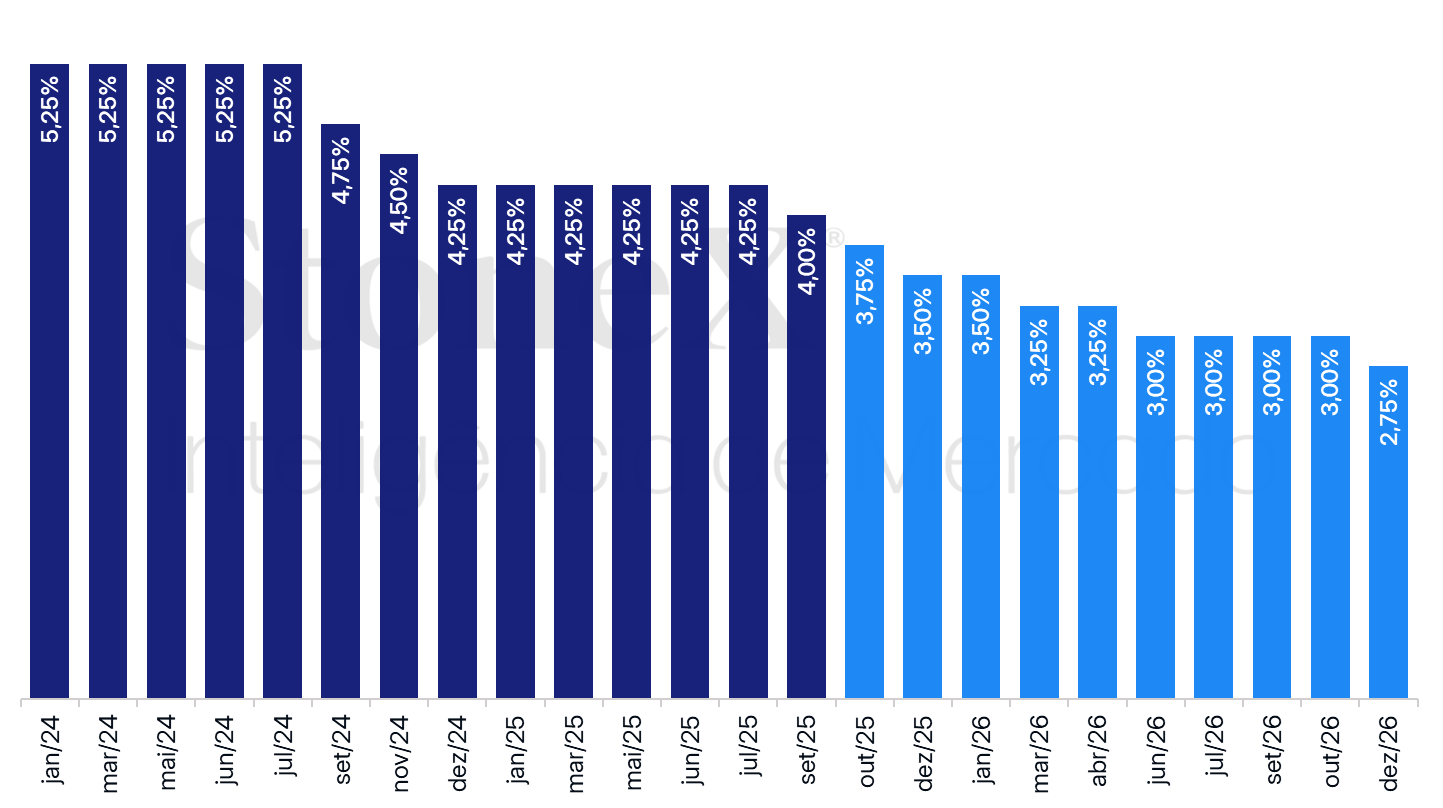
Source: CME FedWatch Tool. Compiled by StoneX. Refers to the most probable market futures interest rate bet on the indicated date.
While the government shutdown hampers the release of economic indicators in the US, investors will look for clues about American interest rate trends in speeches from Federal Reserve (Fed) members.
- This week, speeches are scheduled from Federal Reserve Chairman Jerome Powell, Vice Chair for Supervision Michelle Bowman, Board of Governors members Christopher Waller, Michael Barr, and Stephen Miran, and regional Fed presidents Susan Collins (Boston), Tom Barkin (Richmond), Raphael Bostic (Atlanta), Anna Paulson (Philadelphia), Neel Kashkari (Minneapolis), and Alberto Musalem (St. Louis).
Why this matters: Following the minutes of the last Federal Open Market Committee (FOMC) interest rate decision revealing greater dissent than anticipated, investors seek clues about the Oct. 29 interest rate decision in officials' speeches.
- If officials' comments cast doubts on the possibility of another interest rate cut in October, this would increase expectations for yields on American securities, which tends to strengthen the dollar globally.
Overview: On Sept. 17, the FOMC cut interest rates for the first time this year, with 11 votes in favor of a 0.25% reduction and one for a 0.50% reduction.
- Post-decision comments from Federal Reserve members highlighted significant divergence regarding scenario interpretation, current risks, and consequently, the most appropriate trajectory for US interest rates.
- On one hand, some members, such as Bowman, Waller, and Miran, express greater concern about labor market weakening and are likely to advocate for another cut in October.
- On the other hand, some regional Federal Reserve presidents express concern about the inflationary scenario and favor a more cautious stance, keeping rates unchanged in this decision.
- During the post-decision press conference, Powell stated that the September cut represented "risk management," as inflation accelerated less than anticipated with few signs of import tariff effects, while the labor market slowed more intensely than expected.

INDICATORS
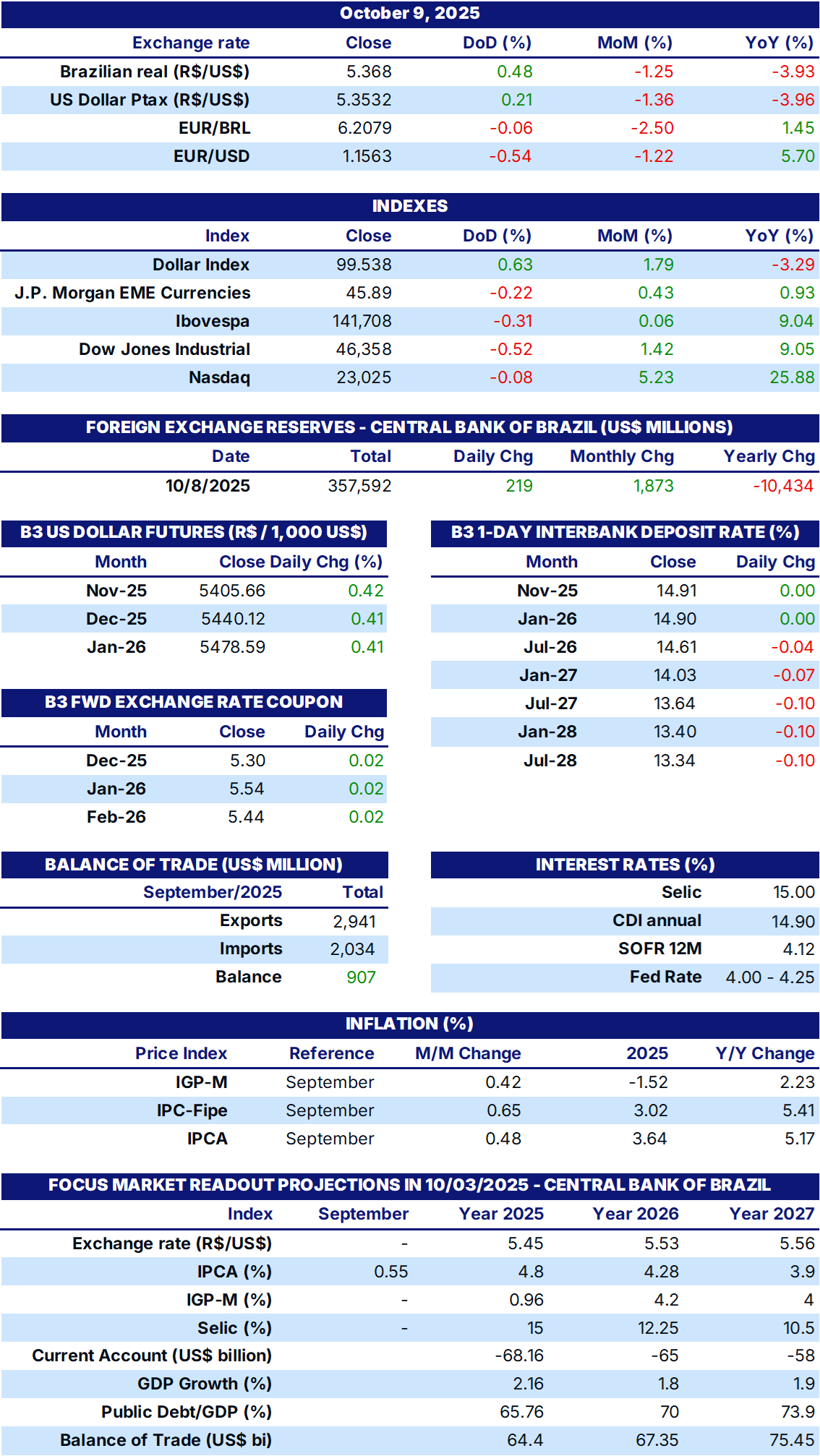
Sources: Central Bank of Brazil; B3; IBGE; Fipe; FGV; MDIC; IPEA and StoneX cmdtyView.