USDBRL Expected to Reflect the Resumption of U.S. Data Releases, FOMC Minutes, and Tariff Exemptions for Select Countries
- Bullish
- The release of the FOMC minutes is expected to highlight the Fed policymakers' concerns over inflation risks in the U.S., reducing expectations for interest rate cuts in December. This scenario could attract foreign capital and strengthen the dollar globally.
- The reduction of U.S. tariffs on agricultural products from four Latin American countries may negatively impact Brazilian export competitiveness, increasing risk perception for domestic assets and weakening the Brazilian currency.
- Bearish
- The resumption of U.S. economic data publication could encourage risk appetite among investors, supporting the performance of the Brazilian real.
The week in review
- U.S. Congress approved a budget extension until the end of January, ending the longest government shutdown in the country’s history.
- Private job market data for the U.S. suggested a slowdown in October.
- Brazil’s IPCA inflation rate slowed to 0.09% in October but showed moderate increases in service prices and the indicator’s core index, excluding volatile food and energy components.
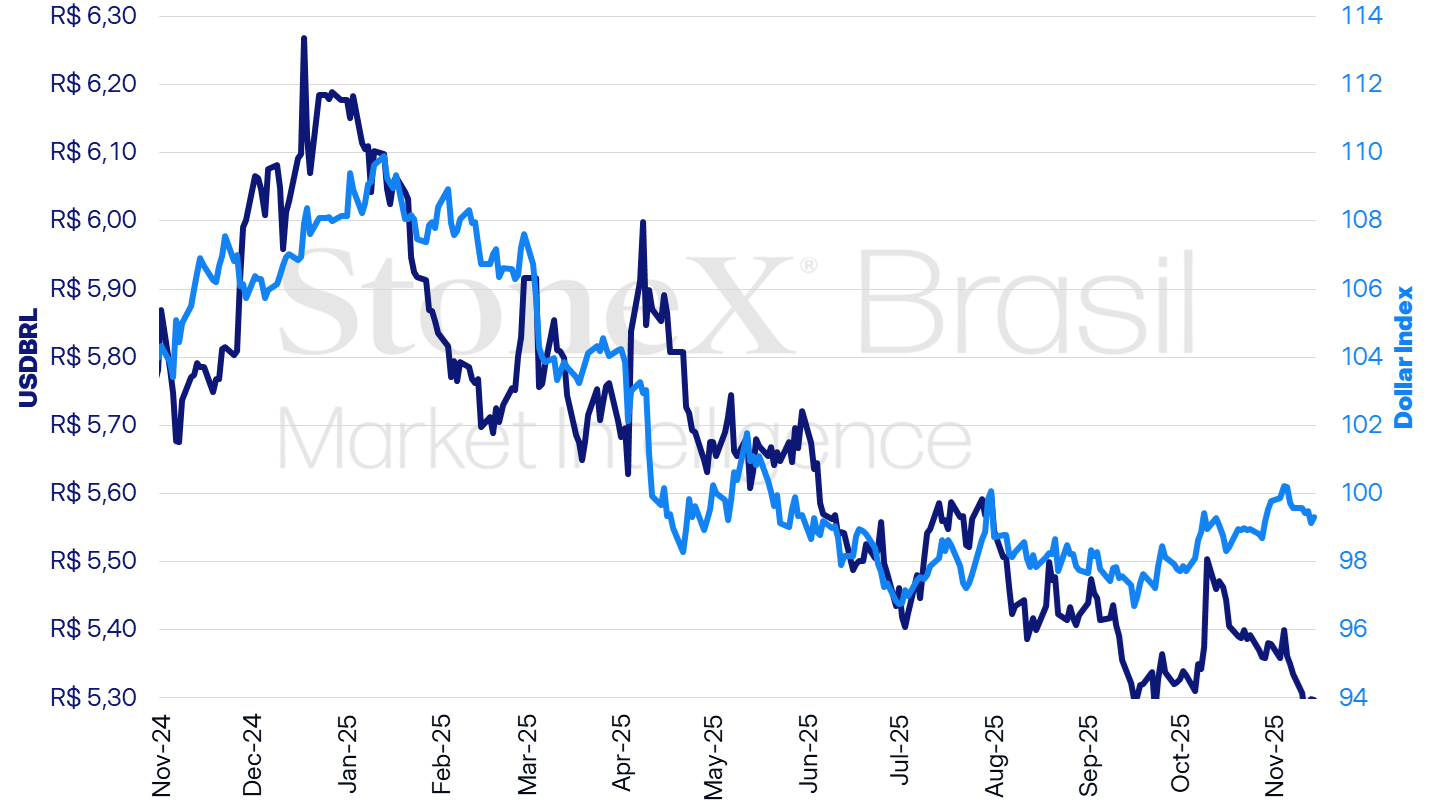
USDBRL and Dollar Index (points)
Source: StoneX cmdtyView. Prepared by StoneX.
USDBRL Variations | Daily: -0.01% | Weekly: -0.70% | Monthly: -1.53% | Year-to-Date: -14.25% | 12-Months: -8.44% |
Dollar Index Variations | Daily: +0.19% | Weekly: -0.28% | Monthly: -0.48% | Year-to-Date: -8.16% | 12-Months: -7.12% |
Key Focus: Resumption of U.S. Data Releases
Expected Impact on USDBRL: Bearish
Following the end of the U.S. government shutdown, investors are anticipating details on the resumption of economic indicator publication, which had been suspended during the shutdown and may face prolonged delays.
Why This Matters: The return of data collection and publication, halted since October 1, will gradually provide a clearer understanding of U.S. economic trends, potentially boosting risk appetite among investors and benefiting performance of riskier assets like the Brazilian real.
Context: After 43 days of the longest government shutdown in U.S. history, lawmakers approved reopening with a budget extension until January 31.
- During the shutdown, nearly all economic data collection, production, and publication were suspended.
- Indicators are expected to be released retroactively, from oldest to newest.
- As of last Friday (Nov. 14), statistical agencies had not provided an updated calendar for releasing these statistics.
- It is likely that months will be needed to normalize the publication of these indicators.
- In 2013, during a 16-day government shutdown, it took 51 days to clear the backlog of data releases.
Statistics at Risk: Some statistics are derived from electronic system data, allowing recovery of October figures without difficulty.
- However, others rely on in-person or telephone data collection, putting October data recovery at serious risk.
- Similarly, if these statistics are estimated, data quality may be compromised.
- The most vulnerable data include the Employment Situation Report (“payroll”) and the Consumer Price Index (CPI).
- The Employment Situation Report relies on approximately 60,000 phone calls per month to collect labor market information.
- The CPI involves collecting about 100,000 prices monthly, with roughly two-thirds gathered through in-store visits.
No Unemployment Rate: Last week, White House Economic Council Director Kevin Hassett stated that September’s Employment Report should be released this week, as data was collected before the shutdown.
- However, he noted that October's report will only include company survey results, such as job counts and employee compensation data.
- Household survey data, including unemployment rates and labor force statistics, were not collected and will not be published.
- Hassett also expressed confidence in recalculating and releasing other October indicators.
FOMC Minutes
Expected Impact on USDBRL: Bullish
Interest Rate Decision Expectations for the Federal Reserve’s December 10 Meeting
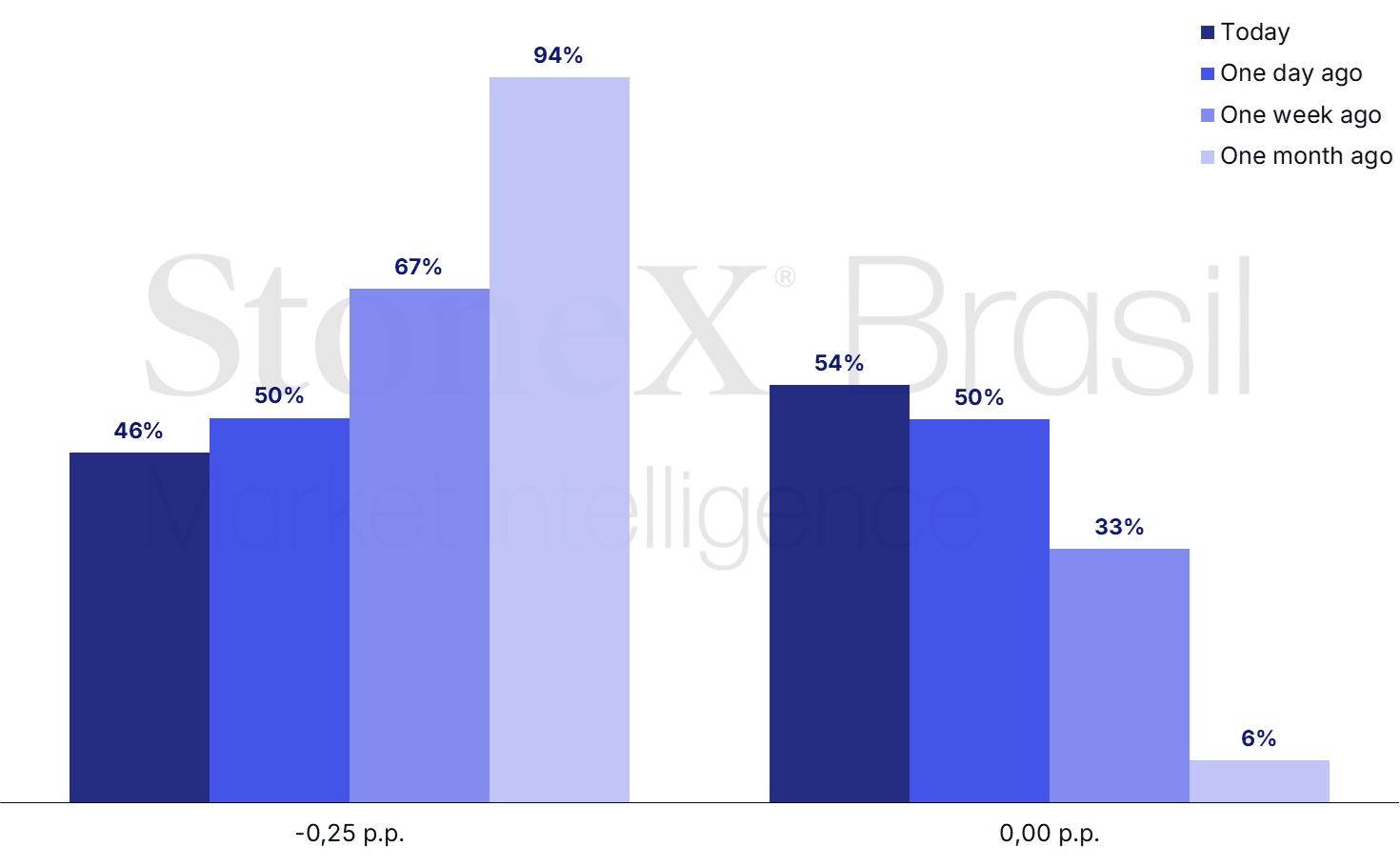
Source: CME FedWatch Tool. Prepared by StoneX. Futures market probabilities as of November 14, 2025.
Investors are closely monitoring the release of minutes from the Federal Reserve’s (Fed) October 17 meeting, seeking insights into the trajectory of U.S. interest rates.
- Although the minutes pertain to a meeting held three weeks ago, the document gains importance due to the lack of unanimity among Fed members regarding the next steps, potentially offering clues about future decisions.
Why This Matters: The perception of slower-than-expected interest rate cuts in the U.S. could boost returns on U.S. Treasury securities and attract foreign investment, strengthening the dollar globally.
Context: In October’s decision, as widely expected, the FOMC reduced its benchmark interest rate by 0.25 percentage points, from the 4.25%-4.00% range to the 4.00%-3.75% range.
- Ten of the twelve voting members supported the 0.25-point cut, while one voted to maintain the rate and another for a 0.50-point cut.
- During the press conference, Fed Chair Jerome Powell downplayed expectations for another rate cut at the December meeting, revealing greater dissent within the Committee than anticipated.
- Since then, an increasing number of Fed officials have adopted a more cautious stance on further rate cuts, especially given the lack of visibility caused by the government shutdown.
- Consequently, market bets for another December rate cut dropped from about 90% before October’s decision to around 46% last Friday (Nov. 14), according to the CME FedWatch tool.
Diverging Views: During the press conference, Powell stated: “In discussions at this meeting, there were quite differing opinions on how to proceed in December. Another rate cut in December is far from guaranteed—far from it. Monetary policy is not on a predefined path.”
- This suggests that a significant portion of FOMC members are concerned about inflation risks and may hesitate to support further cuts without clearer evidence of labor market weakening or stabilized inflation.
Shift in Risk Balance: Powell noted regional and private data indicating stable labor market conditions or a slower-than-expected slowdown, suggesting reduced risks of labor market weakening.
- He also highlighted stronger-than-anticipated U.S. production activity, which often contributes to inflationary pressures and higher labor demand.
- Powell suggested that inflation and labor market risks are more balanced, making stable rates more suitable.
- If the ongoing lack of official data due to the shutdown clouds the Committee’s economic outlook, it may favor a cautious approach and a pause in rate cuts.
Trade Agreements Between the U.S. and Latin American Countries
Expected Impact on USDBRL: Bullish
Last week, U.S. President Donald Trump announced new trade agreements with Argentina, Guatemala, El Salvador, and Ecuador, substantially reducing import tariffs on agricultural products not produced in the U.S. in exchange for preferential market access in these countries.
Why This Matters: The absence of Brazil from the initial list, despite being a major agricultural exporter, could increase risk perception for domestic assets, negatively impacting the Brazilian currency.
Details: According to Trump, agreements will be finalized within two weeks, focusing on tariff exemptions for specific foods, while maintaining tariffs on other products.
- Tariffs of 10% for goods from El Salvador, Guatemala, and Argentina, and 15% for Ecuador will remain.
- Exempted products likely include beef, bananas, and coffee beans, aiming to curb U.S. food inflation.
- The agreements align with recent negotiations with Asian countries, such as Indonesia, which secured exemptions for palm oil, cocoa, and rubber exports to the U.S.
What About Brazil? This week, U.S. Secretary of State Marco Rubio and Brazilian Foreign Minister Mauro Vieira discussed a potential framework for a Brazil-U.S. trade agreement, though concrete progress remains unclear.
- The White House aims to finalize other agreements by year-end, including talks with Switzerland and Taiwan, raising expectations for further announcements soon.
- Absent progress on tariff reductions for Brazilian goods, ongoing negotiations between the U.S. and direct competitors in agricultural exports could heighten concerns about Brazil’s competitiveness in the American market.

ECONOMIC INDICATORS TABLE
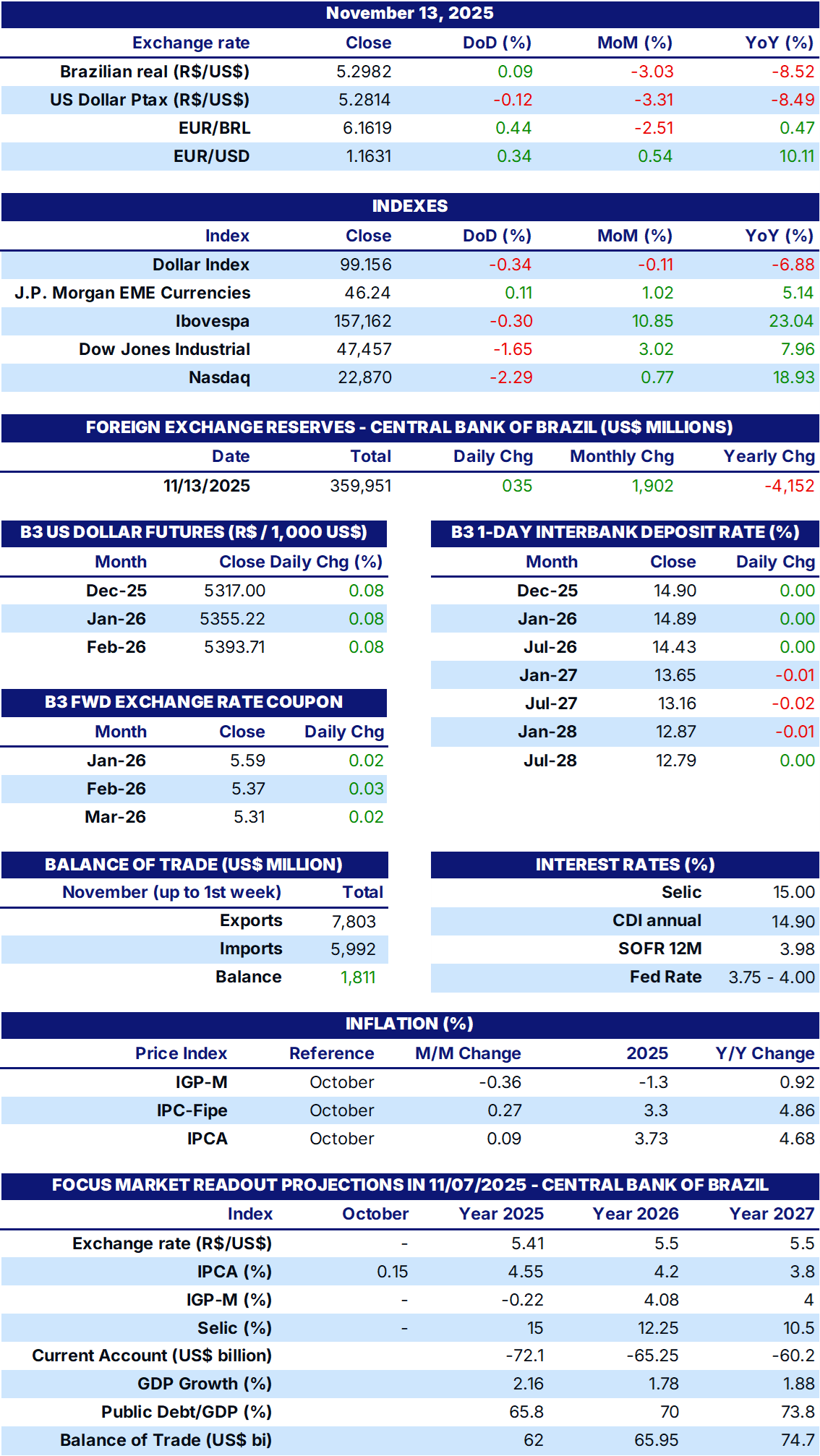
Sources: Central Bank of Brazil; B3; IBGE; Fipe; FGV; MDIC; IPEA; and StoneX cmdtyView.